By The Numbers – 24

In 1929, uniform numbers appeared on the back of baseball jerseys for the first time, thanks to the Indians and the Yankees.  By 1937, numbers finally appeared across all uniforms, both home and away, across both major leagues.  Since that time, 81 distinct numbers have been worn by members of the White Sox, while the Cubs boast 76.

Today, we continue our look at those players, picking our favorite, if not the best, player to wear each uniform number for both Chicago teams with #24.  104 different players have donned #24 while playing in Chicago, 49 for the White Sox and 55 for the Cubs.
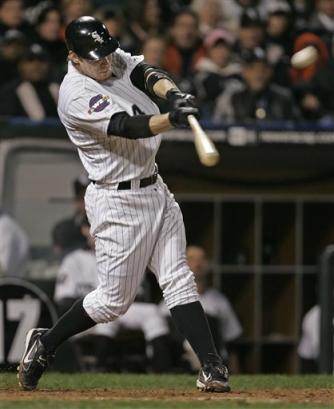
Joe Crede earned a September call-up from Double A in 2000, and, wearing #24, made his major league debut on September 12, replacing Herbert Perry and going 0-1 in the Tigers 10-3 victory at Comiskey Park.  Crede appeared in 7 games, making the most of his 14 at bats, and finished with a .357 average.  Crede got another cup of coffee with the big league club in September of 2001, earning a little more playing time, but he was less successful, finishing with a .220 average in 50 at bats over 17 games.  Crede returned to the White Sox for good in July of 2002.  On August 12, he hit his first major league home run off of former teammate James Baldwin and he finished with 12 home runs, 35 RBIs, and a .285 average.  Crede established himself as the starting third baseman in 2003.  He appeared in a career high 151 games and launched 19 home runs with 75 RBIs while posting a .261 average.  He struggled in 2004, seeing his average drop to .239 while hitting 21 home runs with 69 RBIs.

In 2005, Crede started to come in to his own.  While he improved his average to .252 and hit 22 home runs with 62 RBIs, he came alive in the second half, culminating with a game winning, and possible season saving, home run in the 10th inning against the Indians on September 20, which pushed the White Sox to a 3.5 game lead and propelled them into the playoffs.  Crede had a rough series in the ALDS against the Red Sox, getting only 1 hit in 9 at bats, but rebounded in the ALCS and World Series, hitting .368 and .294 respectively, with 2 home runs in each series.  2006 was Joe Crede’s breakout season.  He hit .283 with career highs in home runs, with 30, and RBIs, with 94, winning his first, and only, Silver Slugger award.  A back injury in 2007 limited him to 47 games and only 4 home runs.  He returned with a bang in 2008, hitting a grand slam on opening day against the Twins and parlayed a good first half into his first All Star selection, but the back injury recurred and kept him out for most of the second half of the season, including the playoffs, thus ending his White Sox career.

On the north side of town, Dexter Fowler joined Cubs via trade prior to the 2015 season.  Donning #24, he ended the year with a .250 average, 102 runs scored, 46 RBIs, 17 home runs, and 20 stolen bases as the Cubs made a surprise run for the NL Wild Card.  Fowler helped propel the Cubs to the NLDS, putting up three hits, three runs scored, a home run, and a stolen base in defeating the Pirates.  In nine postseason games, Fowler batted .396 with two home runs and three RBIs, as the Cubs made it to the NLCS against the Mets.

Fowler became a free agent after the season and was unsigned into the start of spring training.  Despite reportedly agreeing to a three-year contract with the Orioles, Fowler arrived in Cubs camp and signed a one year deal.  And what a year it was.  Fowler finished the year with a .276 average, 13 home runs, 48 RBIs, and 84 runs scored as the Cubs won the NL Central.  Fowler’s .333 average with 4 RBI helped the Cubs win the NLCS against the Dodgers, advancing to the World Series for the first time since 1945.  On October 25, 2016, Dexter Fowler became the first African-American to appear and to bat for the Cubs in a World Series game.  Fowler led off Game 7 of the World Series with a home run, becoming the first player in history to do so, and helping the Cubs win 8–7 in 10 innings, giving the team their first championship in 108 years.

Against The Astros All Time Leaders – Through 2021

astros-primaryIn the past, we’ve looked at the all time leaders in both offensive and defensive categories for all 30 teams. This offseason, we will take our first ever look at those leaders against all 30 clubs.  We continue today with the Houston Astros.

The Astros began life in 1962 as the Colt 45’s, joining the National League along with the Mets, and became the Astros 3 years later.  In 2013, they moved to the American League, becoming just the second team to switch leagues.  I’ve seen them play 47 times, including game 2 of the 2005 World Series and games 3 and 4 of the 2021 ALDS.

Home Runs

Name Total
Derrek Lee 4
Corey Patterson 3
Tim Anderson 2
Paul Konerko 2
Adam Dunn 2
Tadahito Iguchi 2
Alfonso Soriano 2

Hits

Name Total
Derrek Lee 15
Alfonso Soriano 11
Aramis Ramirez 11

Runs

Name Total
Derrek Lee 10
Alfonso Soriano 6
Aramis Ramirez 5
Paul Konerko 5
Alejandro de Aza 5

RBI

Name Total
Derrek Lee 8
Paul Konerko 7
Tadahito Iguchi 7
Adam Dunn 7

Doubles

Name Total
Derrek Lee 4
Aramis Ramirez 3
7 tied with 2

Triples Continue reading →

Against The Dodgers All Time Leaders – Through 2021

dodgersIn the past, we’ve looked at the all time leaders in both offensive and defensive categories for all 30 teams. This offseason, we will take our first ever look at those leaders against all 30 clubs. We continue today with the Los Angeles Dodgers.

The Dodgers began life in Brooklyn in 1883, moving to their current home on the west coast, along with their rival Giants, in 1957.  I’ve seen them play 27 times, including the first two games of their 2008 NLDS sweep against the Cubs and their pennant-clinching victory in the 2017 NLCS.

Home Runs

Name Total
Aramis Ramirez 3
Javy Baez 3
Paul Konerko 2
Alexei Ramirez 2
A.J. Pierzynski 2
Josh Fields 2
Willson Contreras 2

Hits

Name Total
Derrek Lee 15
Alfonso Soriano 13
Ryan Theriot 12

Runs

Name Total
Alexei Ramirez 7
A.J. Pierzynski 6
Alfonso Soriano 5
Ryan Theriot 5
Aramis Ramirez 5

RBI

Name Total
Alexei Ramirez 8
Aramis Ramirez 7
Mark DeRosa 7
Paul Konerko 7

Doubles

Name Total
Alexei Ramirez 4
Kris Bryant 4
Derrek Lee 4

Triples Continue reading →

By The Numbers – 25

In 1929, uniform numbers appeared on the back of baseball jerseys for the first time, thanks to the Indians and the Yankees.  By 1937, numbers finally appeared across all uniforms, both home and away, across both major leagues.  Since that time, 81 distinct numbers have been worn by members of the White Sox, while the Cubs boast 76.

Today, we continue our look at those players, picking our favorite, if not the best, player to wear each uniform number for both Chicago teams with #25.  87 different players have donned #25 while playing in Chicago, 51 for the White Sox and 36 for the Cubs.

Acquired by the Cubs following the 2003 season for Hee Seop Choi, Derrek Lee, wearing #25, quickly became a mainstay of the Cubs lineup.  He hit .278 with 32 home runs and 98 RBIs in his first year on the north side.  2005 was a career year for Lee, and that was just in the first half.  He led the majors with a .376 average and 72 RBIs while tying for the lead with 27 home runs.  For the full season, he hit 46 home runs and a .335 average, the highest for a Cub since Bill Madlock in 1976 and he notched the first batting title for a Cub since Bill Buckner in 1980.  When it was all said and done, he had won the Gold Glove and Silver Slugger awards and finished third in MVP voting.

A broken wrist limited Lee to 50 games in 2006, but he rebounded in 2007 to hit .317 with 22 home runs as the Cubs won their first NL Central title since 2003.  Lee went 4 for 12 as the Cubs were swept in 3 games by the Diamondbacks.  Another strong season in 2008, with a .291 average, 20 home runs, and 90 RBIs helped push the Cubs back to the post-season.  Lee did all he could, hitting .545 in the NLDS against the Dodgers, but the Cubs were once again swept.  Lee overcame a slow start in 2009 thanks to a 21 game hitting streak and finished with a .306 batting average, 35 home runs and 111 RBIs, which earned him enough votes to finish ninth in MVP voting.

2010 was a strange year for Lee and the Cubs.  On June 9th, he hit his 300th career home run.  Later that month, however, he would get in to a fight in the dugout with Carlos Zambrano, which led to a suspension for Zambrano.  In the last year of his contract and with the team going nowhere fast, Lee was traded to the Braves on August 18th, ending his Cub tenure.

Looking to reload after winning their first World Series championship in 88 years, the White Sox acquired Jim Thome from the Phillies for Aaron Rowand, Gio Gonzalez, and Daniel Haigwood.  Thome, wearing his familiar #25, made an immediate impact, setting a major league record by scoring in each of Chicago’s first 17 games and setting the team record with 10 home runs in April.  By season’s end, Thome had put up a .288 average with 42 home runs, 102 RBIs, and an OPS of 1.014.  One of the few bright spots for the 2007 White Sox came in mid-September, when Thome, on his bobblehead day, launched his 500th career home run, the first player to do so on a walk-off.  For the year, Thome hit .275, with 35 home runs and 96 RBIs.  2008 was a bit of a down year for Thome, as his average and OPS both fell, but he still managed 34 home runs and 90 RBIs.  The most important of each came in the 163rd game of the year, as he hit a solo home run to give the White Sox a 1-0 victory over the Twins and the Central Division title.  With the White Sox going nowhere in 2009, Thome was traded to the Dodgers on August 31 for a warm body.


By The Numbers – 26

In 1929, uniform numbers appeared on the back of baseball jerseys for the first time, thanks to the Indians and the Yankees.  By 1937, numbers finally appeared across all uniforms, both home and away, across both major leagues.  Since that time, 81 distinct numbers have been worn by members of the White Sox, while the Cubs boast 76.

Today, we continue our look at those players, picking our favorite, if not the best, player to wear each uniform number for both Chicago teams with #26.  71 different players have donned #26 while playing in Chicago, 58 for the White Sox and 13 for the Cubs, who have retired it for a Hall of Fame outfielder.

Sweet-Swinging Billy Williams first wore his familiar #26 in 1961, his first full season with the Cubs, where he played in 146 games, hitting 25 home runs with 86 RBIs, while earning Rookie of the Year honors.  Williams hit at least 20 home runs and drove in 84 or more runs in every season from 1961 to 1973, earning 6 All-Star team nods along the way, in 1962, 1964, 1965, 1968, 1972, and 1973.  In 1963, he started a consecutive game streak that would last into 1970, setting the National League record with 1,117.

In 1970, Williams batted .322 with 42 homers and 129 RBI and finished second in MVP voting.  He replicated that finish in 1972, winning the batting title with a .333 average, along with a .606 slugging percentage, 37 home runs, and 122 RBIs.  That gave him his 3rd top ten finish in 5 seasons.  Following the 1974 season, Williams was traded to the A’s for, amongst others, Manny Trillo.  Williams was elected to the Hall of Fame in 1987 and his number 26 was retired by the Cubs later that summer.

On the South Side of town, nobody has really made their mark wearing #26, though one of the greatest “what ifs” in team history did don the number in 1986.  Acquired in the Rule 5 draft from the Pirates in December of 1985, Bobby Bonilla made his major league debut with the White Sox on April 9, going 0-1 as a pinch hitter in the Sox loss to the Brewers.  Bonilla was putting together a pretty decent rookie campaign, especially since he was making the jump from A ball, hitting .269 with 2 home runs in 75 games when GM Ken Harrelson decided send Bonilla back to the Pirates, in exchange for pitcher Jose DeLeon.  DeLeon went 23-22 across parts of 5 seasons in 2 stints with the White Sox, while Bonilla made 6 All Star teams, earned three Silver Slugger awards, and two top ten MVP finishes over the next 10 seasons.

By The Numbers – 27

In 1929, uniform numbers appeared on the back of baseball jerseys for the first time, thanks to the Indians and the Yankees.  By 1937, numbers finally appeared across all uniforms, both home and away, across both major leagues.  Since that time, 81 distinct numbers have been worn by members of the White Sox, while the Cubs boast 76.

Today, we continue our look at those players, picking our favorite, if not the best, player to wear each uniform number for both Chicago teams with #27.  103 different players have donned #27 while playing in Chicago, 52 for the White Sox and 51 for the Cubs.

Acquired on December 19, 2016 from the Nationals, Lucas Giolito made his White Sox debut the following summer donning #27.  In 7 starts, he put up a sparkling 2.38 ERA while compiling a 3-3 record.  Things went south In 2018, as Giolito was, statistically, the worst starting pitcher in baseball with a 6.13 ERA, leading the league (the bad way) in WHIP and walks per 9 innings.  That offseason, he began rebuilding his game from the ground up, leading to a 2019 All Star appearance en route to a 14-9 record with a 3.41 ERA.  In the COVID-shortened 2020 season, he held the hapless Pirates hitless on August 25th, striking out 13 while facing one batter over the minimum of 27.  He made his post-season debut in Game 1 of the Wild Card series against the A’s, retiring the first 18 batters in order before giving up 2 hits and a walk in the 7th inning, earning the victory in the White Sox only win during the series.  In 2021, Giolito made 31 starts, finishing with a record of 11-9 and a 3.53 ERA.

During his second go-around with the North Siders, Joe Girardi wore #27 for the 2001 and 2002 seasons.  On June 22, 2002, Girardi addressed a sold-out Wrigley Field to announce the day’s game was cancelled following the death of Cardinal pitcher Darryl Kile.  Following that season, he became a free agent and left the team for the second, and final, time.

Against The Mariners All Time Leaders – Through 2021

marinersIn the past, we’ve looked at the all time leaders in both offensive and defensive categories for all 30 teams. This offseason, we will take our first ever look at those leaders against all 30 clubs.  We continue today with the Seattle Mariners.

The Mariners began life in 1977, joining the American League along with the Toronto Blue Jays. I’ve seen them play 39 times, including the final night game at the original Comiskey Park, the first 2 games of their sweep of the White Sox in the 2000 ALDS, and the first series back with 100% capacity last June.

Home Runs

Name Total
Paul Konerko 10
Alex Rios 4
Avisail Garcia 3
Jose Abreu 3
Dayan Viciedo 3

Hits

Name Total
Paul Konerko 17
Alexei Ramirez 17
Tim Anderson 15

Runs

Name Total
Paul Konerko 14
Tim Anderson 10
Alex Rios 9

RBI

Name Total
Paul Konerko 17
Alex Rios 9
Alexei Ramirez 8

Doubles

Name Total
Alexei Ramirez 5
A.J. Pierzynski 5
Melky Cabrera 3

Triples Continue reading →

Book 51 (of 52) – Yogi

Yogi: A Life Behind The Mask – Jon Pessah

Lawrence Peter Berra was born on May 12, 1925 in St. Louis, the third child of Italian immigrants who wanted to try and make a living playing baseball.  When the hometown Cardinals passed on him, Berra started playing in the local American Legion league, where he picked up a nickname: Yogi.  After serving with the Navy in World War II, Yogi Berra made his mark with the New York Yankees.  Over his career, he won 3 MVP awards, appeared in a record 14 World Series. and won 10 championships.  After his playing career, he managed and coached for both the Yankees and the Mets.  When he was fired by George Steinbrenner 16 games into the 1985 season, Berra vowed to never enter Yankee Stadium again as long as Steinbrenner owned the team.  14 years later, Steinbrenner apologized and mended fences, bringing Berra back in to the fold, where he would remain until his 2015 death.

I feel like for baseball fans of my era, Yogi Berra’s accomplishments on the baseball field were blunted by his reputation off of it, that of the bumbling goofball who says funny things.  In fact, until fairly recently, I didn’t even know that he had coached with the Astros for 5 seasons following his fallout with the Yankees in 1985.  Reading through this biography, I learned that Berra was not just along for the ride for Joe DiMaggio and Mickey Mantle’s championship teams, but was instead the driving force that bridged those two eras and kept the Yankees the champions of the American League for all but 3 seasons of his career.  I have a newfound respect for Berra and his place in baseball history.


By The Numbers – 28

In 1929, uniform numbers appeared on the back of baseball jerseys for the first time, thanks to the Indians and the Yankees.  By 1937, numbers finally appeared across all uniforms, both home and away, across both major leagues.  Since that time, 81 distinct numbers have been worn by members of the White Sox, while the Cubs boast 76.

Today, we continue our look at those players, picking our favorite, if not the best, player to wear each uniform number for both Chicago teams with #28.  86 different players have donned #28 while playing in Chicago, 46 for the White Sox and 40 for the Cubs.

Acquired by the Cubs prior to the 1989 season, Mitch Williams, wearing #28, quickly became a beloved cult figure on the north side.  He made an immediate impression, giving up 3 hits to load the bases in the ninth inning on Opening Day before striking out the next three batters, starting with future Hall of Famer Mike Schmidt, to close out a one-run victory.  That kickstarted an amazing season for Williams, and the Cubs, as they made a surprise run towards an NL East title.  On April 28th, Williams became the only pitcher in major league history to earn a save without throwing a pitch, entering the game with two outs and picking off runner Carmelo Martinez to end the game.  Williams made the All Star team for the only time in his career and hit his lone career home run, en route to a 4-4 record with 36 saves.  He appeared in two games of the NLCS against the Giants, giving up the game-winning hit to Will Clark in Game 5.

1990 was not quite as good for Williams.  His record dropped to 1-8 while his ERA rose to 3.93.  He earned only 16 saves, a drop of 20 from the previous season, as a knee injury bothered him throughout the year.  The next spring, with the Cubs having acquired Dave Smith to replace him as closer, Williams was traded to the Phillies just prior to Opening Day.

On the other side of town, Joey Cora switched to #28 after the 1991 season, his first with the White Sox.  Cora spent the 1992 season on the bench following the acquisition of Steve Sax, starting only 21 games at second base.  With Sax faltering, Cora became the everyday second baseman in 1993.  He set a career high with 153 games played and hit .268 with a career high 20 stolen bases as the White Sox won their final AL West crown.  Cora struggled in the ALCS, hitting an anemic .136 as the White Sox fell in 6 games to the Blue Jays.

Cora continued to improve in 1994, raising his average again to .276 and had 2 home runs and 30 RBIs when the season came to a premature end due to the player’s strike.  When baseball resumed in 1995, Cora became a free agent and his White Sox playing career came to an end.  He rejoined the organization and once again wore #28 as third base coach for the 2004 season, when Ozzie Guillen was hired as manager.  He moved to became the bench coach after the 2006 season, where he would remain until the end of the 2011 season, when he was fired with 2 games left in the season as part of Guillen’s exit from the team.

Against The Padres All Time Leaders – Through 2021

In the past, we’ve looked at the all time leaders in both offensive and defensive categories for all 30 teams. This offseason, we will take our first ever look at those leaders against all 30 clubs.  We continue today with the San Diego Padres.

The Padres began life in 1969, joining the National League along with the Montreal Expos.  I’ve seen them play 21 times (would have been 24 if my trip to San Diego in May of 2020 hadn’t been wiped out by the corona virus) at 5 different ballparks, first in 1985 at Wrigley Field and, most recently, this past June.

Home Runs

Name Total
Corey Patterson 3
Sammy Sosa 3
Patrick Wisdom 3

Hits

Name Total
Alfonso Soriano 10
Moises Alou 9
Corey Patterson 8
Derrek Lee 8
Jose Macias 8
Aramis Ramirez 8

Runs

Name Total
Derrek Lee 6
Moises Alou 5
Corey Patterson 5
Michael Barrett 5
Sammy Sosa 5

RBI

Name Total
Corey Patterson 6
Michael Barrett 6
Aramis Ramirez 6
Alfonso Soriano 6

Doubles

Name Total
Michael Barrett 3
Kosuke Fukudome 3
Aramis Ramirez 2
Alfonso Soriano 2
Jacque Jones 2
Reed Johnson 2
Sergio Alcantara 2

Triples Continue reading →