Interleague Pitching Leaders

Yesterday, we looked at the offensive leaders in interleague games I’ve attended since 1997.  Today, let’s take a look at the defensive side of the ball and the active pitching leaders in the 199 games I’ve attended featuring teams from opposite leagues.

Wins

Name Total
Mark Buehrle 6
Carlos Zambrano 5
Chris Sale 5
Jon Lester 5
Jake Peavy 5

Losses

Name Total
Kyle Hendricks 6
Jon Garland 5
Jose Contreras 4
10 tied with 3

ERA (> 10 IP)

Name Total
Reynaldo Lopez 0.55
Scott Linebrink 0.87
Matt Thornton 0.90
Kip Wells 1.13
Travis Wood 1.20

ERA (> 30 IP)

Name Total
Chris Sale 1.24
Jake Peavy 1.56
Jon Lieber 2.70
James Shields 2.80
Jon Lester 2.82

Strikeouts

Name Total
Carlos Zambrano 62
Chris Sale 59
Mark Buehrle 54
Continue reading →

Interleague Batting Leaders

First introduced in 1997, games between teams in the American and National leagues started occurring in the regular season.  In 2002, it expanded between the corresponding division in the opposite league to a rotation between all of the divisions.  In 2023, it expanded again with each team playing every other team regardless of league.  With the Cardinals coming to town to battle the White Sox this week, let’s take a look at the offensive leaders for the 199 interleague games I have attended since the start of interleague play in 1997, including the World Series in both 2005 and 2016:

Home Runs

Name Total
Paul Konerko 23
Jermaine Dye 12
Jose Abreu 12
Alexei Ramrez 10
Aramis Ramirez 9
Luis Robert 9
Carlos Lee 9

Hits

Name Total
Paul Konerko 89
Alexei Ramirez 67
Jose Abreu 65
A.J. Pierzynski 49
Derrek Lee 49

Runs

Name Total
Paul Konerko 44
Alexei Ramirez 42
Continue reading →

Moving On… Slowly

The White Sox announced on Thursday that chairman Jerry Reinsdorf and minority shareholder Justin Ishbia have reached a “long-term investment agreement that establishes a framework” for Ishbia to obtain a controlling interest in the franchise within the next ten years.  As part of the agreement, Ishbia will make “capital infusions” into the White Sox in 2025 and 2026 that will be used to pay down existing debt and support ongoing team operations.  Following that, Reinsdorf will have the option to sell controlling interest to Ishbia between 2029 and 2033 and, following the 2034 season, Ishbia will have the option to acquire the controlling interest.

Reinsdorf, who has had controlling interest in the White Sox since purchasing the team for $19 million from Bill Veeck in 1981, will be 93 at the start of the initial transition period in 2029.  He has long claimed that he has no interest in selling while he remains in good health but would be 97 by the time Ishiba controls the option to buy.  Ishiba, a billionaire private equity investor, increased his stake in the Whtie Sox this spring to a reported 35%.  In a statement, Ishbia said, “I love Chicago, have always loved baseball, and am thrilled to marry two of my passions.”

Overall, this should be a good thing for the White Sox and their fans.  While Reinsdorf has had one of, if not the winningest ownership tenure in franchise history, he has also managed to successfully alienate most of the fan base, starting with his threats to move the team to Florida in the 1980s, followed by his appearance as one of the largest contributors to the work stoppages that wiped out the end of the 1994 season and the start of the 1995 season and, most recently, overseeing the team’s fall to setting the MLB record for most losses last year.  It is time to turn the page, and waiting for 2029, 2034, and/or Reinsdorf’s death is the price we have to pay for being White Sox fans.

Chicago White Sox Baseball Is On The Air

Over a year ago, the White Sox, Bulls, and Blackhawks announced that they were partnering with Standard Media Group to create the new television broadcast home for all three teams, which eventually became Chicago Sports Network (CHSN for short).  Starting in October, the network went live missing one small little thing: a carriage agreement with Comcast, the largest cable provider in Chicago.

Ratings for the Blackhawks this past season, their first on the new network, were down 78% from the previous year on NBC Sports Chicago.  The Bulls were looking at a 63% decrease as of February.  The White Sox, coming off a season where they set the MLB record for losses in a year, were not exactly worth the $29.99 the network was charging for streaming.

Well, that all changes today.  Word broke yesterday that the fledgling network had finally reached agreement with Comcast to be added to their channel line-up.  They are expected to be placed on the Ultimate tier plan, which will add $20 to your cable bill if you are not already subscribed.  The Cubs’ Marquee Sports Network is expected to be moved to the same tier following this season.  With live sports seemingly one of the few reasons to keep cable, it seems that providers are looking to soak their customers for as much as they can before everything moves to streaming.


Eligible For The Hall

Last week, MLB Commissioner Rob Manfred announced that anyone on the league’s permanently ineligible list that was now deceased would be removed, making them eligible for Hall of Fame consideration.  In a statement, Manfred said, “In my view, once an individual has passed away, the purposes of Rule 21 have been served.  Obviously, a person no longer with us cannot represent a threat to the integrity of the game.”  Later in the statement, he said, “I have concluded that permanent ineligibility ends upon the passing of the disciplined individual.”

The driving force behind this change was, of course, Pete Rose.  Rose, who died last September, agreed to be banned by then-Commissioner Bart Giamatti in 1989 after a report by investigator John Dowd confirmed that he had bet on Reds games while he was the manager.  That agreement prohibited Dowd from further investigation which likely would have uncovered that Rose had bet on his team to lose.  Complicating matters, Giamatti died of a heart attack eight days later, making his successors hesitant to remove Rose from the ineligible list during his lifetime.

Along with Rose, this decision applies to 16 other deceased individuals, including members of the 1919 White Sox like Shoeless Joe Jackson and Buck Weaver, among others.  2028 would be the earliest any of the newly eligible players could be inducted into the Hall of Fame, as the Classic Baseball Era Committee will next meet and vote in December 2027.  The two most likely to get any consideration are Rose and Jackson, and neither is the shoe-in their supporters may think.

Not Getting Better

37 games into the 2025 season, the White Sox hold a 10-27 record, good for a birthday but not for a record.  This is one game ahead of last year, when the White Sox started their longest winning streak of the year by defeating the Rays 4-1 to go to 9-28 on the year.  The White Sox, of course, finished last year with the most losses in modern MLB history.

Position Players Pitching

In the mid-2010s, putting in a position player to pitch in an effort to save overworked bullpens became more popular than ever before in the history of Major League Baseball.  Starting in 2023, rules changes restricted position players from pitching unless their team is leading by ten or more runs in the 9th inning, their team is losing by eight or more runs at any time, or the game is in extra innings.  This weekend, i saw my tenth eighth position player pitch, so it seemed like a good time to review.

5/6/2017
With a depleted bullpen and down by five against the Yankees, Joe Maddon turned to catcher Miguel Montero to pitch the final inning.  Montero’s inning could generously be called effectively wild, as he walked two and sailed one pitch over Chris Carter’s head but managed to escape without giving up a run.  Maddon’s notion to avoid going back to his bullpen proved prescient, as the following night the two teams went 18 innings, with the Cubs losing by one.

7/6/2017
Exactly two months later, Maddon again turned to his bench rather than his bullpen as the Brewers held a nine-run lead heading into the 9th inning.  This time he turned to veteran outfielder Jon Jay, who gave up just one hit while retiring the Brewers on just 16 pitches.

6/22/2019
Wrigley Field was again the stage for our next installment of position players pitching, as catcher Victor Caratini took the mound for the 9th inning with the Cubs down 10-1 to the Mets.  He did his part, throwing a 1-2-3 inning and giving the Cubs a chance to mount a comeback in the bottom of the 9th.  The rally fell short, however, as the Cubs lost 10-2.

8/17/2021
We move to the South Side for our next occurrence, this time for an opponent.  With the White Sox leading the A’s 9-0, first baseman Mitch Moreland came out to face the White Sox in the bottom of the 8th.  Facing the bottom of the batting order, Moreland gave up a single to Danny Mendick en route to a scoreless outing.

9/16/2021
Nearly a month later, the shoe was on the other foot as the White Sox were losing 9-3 to the Angels at Guaranteed Rate Field.  With two outs in the top of the 9th, Rick Renteria picks Romy Gonzalez to nail down the final out.  With Shohei Ohtani on first base, Gonzalez strikes out Max Stassi on four pitches to end the inning.

7/9/2022
With pitching in his genes, Kody Clemens took the mound for the bottom of the 8th with his Tigers trailing the White Sox 8-0.  Clemens did what none of his fellow Tigers could accomplish that day, giving up no hits and retiring the side on only fourteen pitches.

4/3/2023
The Giants had a big 7-3 lead against the White Sox heading into the 9th inning when Jose Ruiz took the mound looking to hold the line.  Instead, he faced six batters, giving up five runs on two home runs while only getting a single out.  Down by nine, rookie manager Pedro Grifol brought in infielder Hanser Alberto to mop up.  He gave up two hits but wrapped up the inning without giving up a run.

5/1/2025
With the White Sox holding a surprising 8-0 lead over the Brewers, Jake Bauers, who started the game in left field, came in to pitch the bottom of the 8th.  He quickly put down the White Sox, getting a 1-2-3 inning on just ten pitches.

Connecting The City 2.0

Back in 2021, Nike announced they would be introducing City Connect uniforms to Major League Baseball, reimagining each team’s look to “celebrate[s] the bond between each team and its city.”  The White Sox were one of the first to get a City Connect, the infamous Southside set that was widely recognized as one of, if not the best rendition of the initial go-arounds.  Each City Connect uniform combination was intended to last for three years.

Four years later, the second wave of City Connects are being released and the White Sox will likely find themselves on the bottom of most rankings.  Announced yesterday, the new uniform set is the first collaboration between the MLB and NBA, as the jerseys basically adopt the Chicago Bulls look, with red jerseys with black pinstripes, black sleeves, and Chicago across the chest in a very Bulls-like wordmark.

First, the good: I like the black hat with the winged sock logo and the red brim.  And that’s about it.  The jersey looks like a cheap generic that you would pick up at Walgreens or Osco, not something a major league team would wear.  The black pants have red stripes down the sides with “SOUTHSIDE” repeated in black within the stripe.  Overall, this seems like a lazy, bottom of the barrel idea and I can’t see how this City Connect program will last long-term if they are already down to ideas like this.

Ballpark Tour: White Sox

With Opening Day in the books, it is time to wrap up our tour of all of the baseball stadiums I’ve been to over the years with the ones I’ve been to the most: the homes of the Chicago White Sox.  Between the two stadiums that have been located at the corners of 35th and Shields, I’ve seen at least 668 games, all but one of which have involved the White Sox.  So, without further ado, let’s take a deeper look at my history with Comiskey Park and the facility currently known as Rate Field.
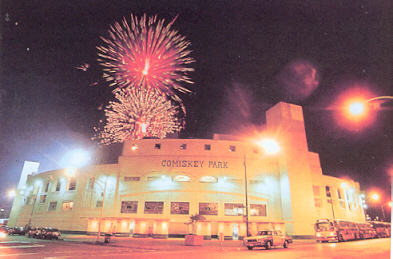
Stadium Name: Comiskey Park

Years in Service: 1910 – 1990

Visits: 13 (that I’m aware of)

Comiskey Park, the so-called Baseball Palace of the World, was the home of the White Sox from 1910 through the 1990 season.  Built on a former city dump at the corner of 35th Street and Shields Avenue, the stadium opened on July 1, 1910, as the White Sox lost to the St. Louis Browns 2-0.  The final game for the old ballyard occurred on September 30, 1990, a 2-1 victory over the Mariners.

Comiskey Park was the host for four World Series, including three in a row from 1917-1919.  The White Sox won the World Series in 1917 against the New York Giants.  The Cubs, looking for a larger seating capacity, moved their home games in the 1918 series against the Red Sox to Comiskey Park.  The 1919 World Series, of course, was the Black Sox scandal, where the White Sox threw the series against the Reds.  The White Sox returned to the World Series 40 years later in 1959 but fell to the Dodgers.  The final post-season games to be played in Comiskey Park were games 3 and 4 of the 1983 ALCS, which the White Sox lost to the Baltimore Orioles.

Comiskey Park was also the host to three All-Star games.  The first All-Star game, in 1933, was held in conjunction with Century of Progress Exposition being held on Chicago’s lakefront.  The event returned to Chicago’s south side in 1950 and the final All-Star game at Comiskey Park was in 1983, the 50th anniversary of the first game.  Comiskey Park was also the frequent home of the Negro League East-West All-Star Game from 1933 to 1960.

Looking back, I’ve now been able to piece together evidence of 13 games that I attended at Comiskey Park, either from pictures, stadium giveaways, or specific memories.  I know there are more, but I have not been able to pinpoint exact games as of yet.  The most memorable game I can remember would be the final night game, on September 29, 1990, where, after the game, the lights were symbolically turned off for the final time.

Stadium Name: Comiskey Park II/US Cellular Field/Guaranteed Rate Field/Rate Field

Years in Service: 1991 – Present

Visits: 655

On the evening of June 30, 1988, with the clock literally stopped, the Illinois legislature passed a bill that provided the financing for a new stadium for the White Sox, stopping them from moving to St. Petersburg, Florida.  Two and a half years later, on April 18, 1991, Comiskey Park II opened, the first new major facility built in Chicago since the erection of the Chicago Stadium in 1929.  Sadly, the White Sox were embarrassed by the Tigers, losing 16-0 in the opening of their new park.

Unfortunately for the White Sox, the new Comiskey Park was the last stadium to be built prior to the wave of retro ballparks that started with the opening of Camden Yards the following year.  Because of this, there have been numerous renovations to the park, starting in 2001 with the addition of nearly 2000 seats and the relocation of the bullpens.  More extensive renovations began in 2003 in preparation for that season’s All-Star Game and using the money generated from selling the naming rights to US Cellular, and continued through 2007, when the replacement of the blue seats with green seats was completed.  Less extensive renovations have occurred since, replacing the different video boards and creating premium seating areas.

The post-season came to the new Comiskey Park for the first time in 1993, as the White Sox battled the Blue Jays in the ALCS.  The stadium hosted its first World Series games in 2005, the first to be played in the city of Chicago since 1959, as the White Sox went on to sweep the Houston Astros and win their first World Series since 1917.

I attended my first game at the new Comiskey Park on April 20, 1991, the second game in the stadium’s history.  Since then, I’ve been to 654 other games at the stadium, the majority coming from 2005 on, when I became a season ticket holder.  I went to both games of the 2000 ALDS, which the White Sox lost to the Mariners, both games of the 2005 ALDS, which the White Sox won against the Red Sox, both games of the 2005 ALCS, which the White Sox split against the Angels, and game 2 of the 2005 World Series.  I attended game 163 of the 2008 season to break the tie between the White Sox and the Twins. and then the two ALDS games against the Rays, the first time I saw the White Sox actually end a post-season series, either in victory or defeat.

Notable regular season games I’ve seen at what is now known as Guaranteed Rate Field include the September 18, 2001 game against the Yankees as baseball returned following the attacks of 9/11, the April 16, 2005 game where Mark Buehrle defeated the Mariners in 1 hour and 39 minutes, the April 2, 2006 season opener against the Indians when the World Series championship banner was raised, the April 4, 2006 game where the players received their World Series rings, and the September 16, 2007 game where Jim Thome hit his 500th career home run against the Angels.  Not to mention a streak of 24 consecutive home openers.

All Time Team Records

After a long winter, the North American portion of the 2025 baseball season is set to get underway tomorrow.  To celebrate, it is time once again to look at the all-time team records for games that I have identified as having attended dating back to 1984.  Last year, I posted my lowest total since 2001, a decrease of 16 games from the year before, and managed to see 20 out of the 30 teams, so there should be some nice changes.

The White Sox are coming off the most losses in modern major league history and may be hard-pressed to avoid breaking that record again this year.  On the other side of town, the Cubs made some big moves to get back into playoff contention.  The 2025 season may look completely different on each side of town.

All-Time Team Records

Team Name Won Loss Winning Pctg
California Angels 2 0 1.000
Arizona Diamondbacks 16 4 0.800
Cleveland Guardians 4 2 0.667
Florida Marlins 15 8 0.652
New York Yankees 19 12 0.613
Toronto Blue Jays 18 12 0.600
Philadelphia Phillies 13 9 0.591
Colorado Rockies 11 8 0.579
Boston Red Sox 21 16 0.568
Los Angeles Angels 20 16 0.556
Washington Nationals 7 6 0.538
Detroit Tigers 35 30 0.538
Cleveland Indians 31 27 0.534
Chicago Cubs 238 215 0.525
Houston Astros 26 25 0.510
Chicago White Sox 372 360 0.508
Continue reading →