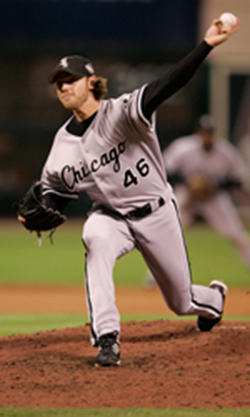
#86 – Omar Vizquel

vizquel

Name: Omar Vizquel

Rank: 86

Position: 3B/2B

Years With White Sox: 2010-2011

Signing as a free agent, Omar Vizquel joined the White Sox prior to the 2010 season.  With his usual #13 taken by manager Ozzie Guillen, Vizquel was allowed to wear jersey #11, retired in 1984 for Luis Aparicio.  He ended up getting the most playing time he had seen since 2007, appearing mostly at third base.  On May 25, he landed in second place for hits all-time by a shortstop, behind Derek Jeter.  One month later, he hit his first home run of the year, becoming the 4th player to homer in four different decades.

Vizquel returned to the White Sox in 2011, but his playing time fell off as he appeared in a career low 58 games.  On April 3, he got the 2800th hit of his career.  Following the season, he left as a free agent.

Vizquel’s numbers in a White Sox uniform, both for games I attended and overall, were:

Continue reading →

Oops, I DFA’d It Again

For the second time in as many days, and the third time this season, the White Sox said goodbye to an underachieving veteran, designating Jimmy Rollins for assignment.  The move allowed the team to recall Tim Anderson, the crown jewel of their farm system and expected to be the shortstop of the future.  Rollins, the 37 year old former National League MVP, hit just .221 with 2 home runs and 8 RBIs in 41 games this year.  Anderson, meanwhile, was hitting .304 in Triple A, with 4 home runs and 20 RBIs.

The move follows yesterday’s release of Mat Latos and the dumping of John Danks in early May.

See You Latos

latosFor the second time this season, the White Sox, in the midst of losing 20 out of their past 26 games, have cut ties with a pitcher that was part of their opening day starting rotation, designating Mat Latos for assignment yesterday.  Latos won his first 4 starts of the season with a sterling 0.74 ERA, but, like the rest of the White Sox, quickly fell apart.  In his last 7 starts, his ERA was 7.25, the same as John Danks when he was set loose earlier this year.

In another move, the White Sox signed former Twins star Justin Morneau, who is recovering from off-season elbow surgery.  Morneau is expected to be ready to play in July.

#87 – Carl Everett

everett-wsName: Carl Everett

Rank: 87

Position: DH/CF

Years With White Sox: 2003, 2004-2005

Carl Everett was acquired by the White Sox on July 1, 2003 from the Rangers for Frank Francisco, Josh Rupe, and Anthony Webster.  Two weeks later, he appeared in the All Star Game at his new home stadium, going 0-1 as one of 3 White Sox representatives.  Everett continued his all star ways in the second half, hitting .301 with 10 home runs after the trade, but the White Sox faded down the stretch and finished the year in second place.

After signing with the Expos as a free agent for the 2004 season, Everett was reacquired by the White Sox on July 18, two weeks after Frank Thomas went down with a broken left foot, for Gary Majewski and Jon Rauch.  In more limited playing time, Everett hit .266 with only 5 home runs and the White Sox again finished in second place.

With Thomas still recovering from his foot injury, Everett went into 2005 as the primary designated hitter.  He appeared in 135 games, hitting .251 with 23 home runs and 87 RBI.  Everett added 12 hits during the post-season as the White Sox won their first World Series title since 1917.  Following the season, Everett again left as a free agent.

Everett’s numbers in a White Sox uniform, both for games I attended and overall, were:

Continue reading →

#88 – Steve Lyons

stevelyons

Name: Steve Lyons

Rank: 88

Position: 3B/OF

Years With White Sox: 1986-1990

Steve Lyons was acquired by the White Sox at the end of June in 1986 in the deal that sent Tom Seaver to the Red Sox.  “I’ve liked him since he came into professional baseball,” GM Ken Harrelson said.  “The only reason we were able to get him is that Boston is in a divisional race.”  Lyons appeared in 42 games for the White Sox following the trade, starting 35 of them, and hit a disappointing .203 while finding his way into manager Jim Fregosi’s doghouse.

Lyons saw his average improve in 1987, though it didn’t necessarily add up to additional playing time.  Splitting time between Hawaii and Chicago, he appeared in only 76 games and saw a mere 193 at bats.

With an improved relationship with Fregosi in 1988, Lyons stepped in to become the regular third baseman after the Kenny Williams experiment came to an end in May.  While his offense was serviceable enough, he struggled defensively, finishing the year with 25 errors.  “It’s a huge embarrassment,” Lyons conceded.  “I’m just not doing the job. I hate to think that our pitchers are scared of me playing third base, but that would be a natural thought.”

1989 saw Lyons move primarily to second base.  The biggest moment of his season came at Yankee Stadium in June when a woman ran onto the field and accosted Lyons in the on-deck circle, giving him a big kiss.  He finished the year hitting .264 with a career high 50 RBI.

With the White Sox returning to contention in 1990, Lyons saw himself out of a starting job.  He clashed with new manager Jeff Torborg over his diminished playing time, due to the arrival of Robin Ventura at third base and the commitment to Scott Fletcher at second base.  He managed some late-inning duty at first base, until Frank Thomas joined the big league club in August.  In his new role, his average dropped to .192.  The most famous, or infamous, moment of his career came on July 16 against the Tigers, when, after sliding into first base for a bunt single, he lost track of where he was and dropped his pants to remove the dirt from his slide.  He quickly raised them back up, but the damage was done and a legend was born.

Despite his clashes with Torborg, Lyons managed to break camp with the White Sox in 1991, but lasted 4 games into the season, without getting in to any of them, before being released to make room for Charlie Hough, who was coming off the disabled list.  “I started seeing there wasn’t an opportunity for me to get on the field anywhere,” said Lyons.  “They had other guys to do the same kind of things that I was going to do.”

Lyons’ numbers in a White Sox uniform, both for games I attended and overall, were:

Continue reading →

#89 – Darrin Jackson

djName: Darrin Jackson

Rank: 89

Position: RF

Years With White Sox: 1994, 1999

Darrin Jackson signed with the White Sox as a free agent prior to the 1994 season.  He set career highs with a .312 batting average and a .817 OPS during the strike-shortened season, thanks in part to two separate 8 game hitting streaks.  With uncertainty about the state of MLB heading in to the 1995 season, Jackson moved on to the Japanese leagues.

He returned to the White Sox in January, 1999, again signing as a free agent.  He appeared in 73 games, getting only 149 at bats and ended the year hitting .275.  He retired following the year and joined the White Sox broadcast booth, replacing Tom Paciorek as the color analyst on television along side Hawk Harrelson.  In 2009, he moved over to the radio side, where he remains to this day.

Jackson’s numbers in a White Sox uniform were:

Continue reading →

#90 – Neal Cotts

neal-cotts-whitesoxName: Neal Cotts

Rank: 90

Position: P

Years With White Sox: 2003-2006

Neal Cotts was acquired by the White Sox, along with Billy Koch and Daylan Holt, from the A’s in exchange for Keith Foulke, Mark Johnson, and Joe Valentine in December of 2002.  He made his major league debut on August 12, 2003, lasting only 2 1/3 innings in a start against the Angels, walking 6 and giving up 2 hits and 2 runs.  He made 3 additional starts, finishing the year with an 8.10 ERA in only 13 1/3 innings pitched.

Under new manager Ozzie Guillen, Cotts moved to the bullpen in 2004.  Appearing in 56 games, he managed to lower his ERA somewhat, to a still-horrid 5.65.  He did manage to pick up his first major league hit, against the Expos on June 18.

Things clicked in 2005, both for Cotts and the White Sox.  He appeared in 69 regular season games and posted a sparkling 1.94 ERA as the White Sox took the AL Central crown.  He faced one batter in the ALDS, getting Trot Nixon to flyout in Game 1 of the sweep against the Red Sox.  He was the only White Sox reliever to appear in the ALCS, getting the final 2 outs in the Game 1 loss to the Angels.  As the White Sox moved on to their first World Series since 1959, Cotts appeared in all 4 games, winning Game 2 and giving up only 1 hit in an inning and a third.

Cotts reverted back to his previous form in 2006, appearing in 70 games and seeing his ERA balloon back up to 5.17, though he did earn his first career save.  Following the season, he was traded across town to the Cubs for fellow relief pitcher David Aardsma.

Cotts’ numbers in a White Sox uniform, both for games I attended and overall, were:

Continue reading →

#91 – Dave Martinez

dave_martinez

Name: Dave Martinez

Rank: 91

Position: OF/1B

Years With White Sox: 1995-1997

Following the resolution of the strike that prematurely ended the 1994 season and delayed the start of the 1995 season, Dave Martinez signed with the White Sox as a free agent.  Martinez saw little playing time early in the season, until manager Gene Lamont was fired and replaced by Terry Bevington.  He split time between the outfield and first base, finishing the year with a .307 average and setting a career high with an .806 OPS.

Martinez returned to the White Sox in 1996, serving as the fourth outfielder and again backing up at first base.  He set a career high with 146 games played, a .318 batting average, an .861 OPS and 53 RBIs.  1997 was another good year for Martinez, where he set career highs in home runs and RBIs.  Following the season, Martinez became a free agent and his White Sox career came to an end.

Martinez’s numbers in a White Sox uniform, both for games I attended and overall, were:

Continue reading →
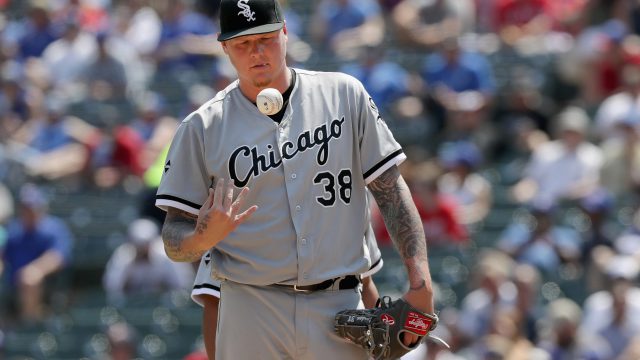
#92 – Melido Perez

melidoperezName: Melido Perez

Rank: 92

Position: P

Years With White Sox: 1988-1991

Melido Perez joined the White Sox organization on December 10, 1987 when he was acquired, along with Chuck Mount, John Davis, and Greg Hibbard, from the Royals for Floyd Bannister and Dave Cochrane.  Perez broke camp with the White Sox in 1988, joining the starting rotation and starting 32 games.  He finished the year with a 12-10 record and a 3.79 ERA.  His year was good enough for a 6th place finish in Rookie of the Year voting

Perez struggled in 1989, along with the rest of the White Sox, as his ERA ballooned up to 5.01 and his record fell to 11-14.

Perez was earned the opening day start for the White Sox in 1990, but his struggles continued as a much improved White Sox squad battled for the Western Division title.  The highlight of his year came on July 12, when he threw a rain-shortened no hitter against the Yankees.  He finished the year with a 13-14 record with a 4.61 ERA as the White Sox finished 9 games behind the eventual AL champion Oakland A’s.

With expectations raised after a 94 win season, Perez found himself left out of the starting rotation for the first time.  The change seemed to have agreed with him, as his ERA dropped to 3.12 and he set a career low in WHIP.

The following January, Perez was packaged, along with Domingo Jean and Bob Wickman, in a trade to the Yankees for Steve Sax.

Perez’s numbers in a White Sox uniform, both for games I attended and overall, were:

Continue reading →
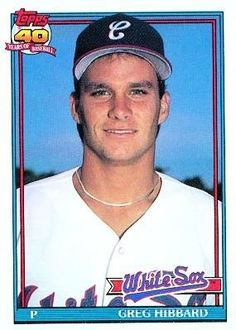
#93 – Greg Hibbard

hibbard

Name: Greg Hibbard

Rank: 93

Position: P

Years With White Sox: 1989-1992

Greg Hibbard joined the White Sox organization on December 10, 1987 when he was acquired, along with Chuck Mount, John Davis, and Melido Perez, from the Royals for Floyd Bannister and Dave Cochrane.  He made his major league debut on May 31, 1989, going 6 strong innings in the White Sox loss to the Tigers.  He remained in the starting rotation for the remainder of the year, going 6-7 with an impressive 3.21 ERA.

1990 was a special year for the White Sox, as they prepared to close down Comiskey Park and ended up surprising everybody by fielding their first competitive club in 5 years.  Hibbard played a big role in that resurgence, going 14-9 with a 3.16 ERA as the upstart White Sox battled the defending World Series champion Oakland A’s for the Western Division crown.

As the White Sox moved across the street in 1991, Hibbard started to struggle more than he had before in his career.  His record evened out at 11-11 and his ERA jumped up to 4.31, giving up the most runs (both earned and overall) of his career.

1992 was more of the same for Hibbard, as his ERA continued to rise, now to 4.40, despite posting a winning record at 10-7.  Following the season, Hibbard was left unprotected in the expansion draft and he was selected by the newly formed Florida Marlins, ending his White Sox career.

Hibbard’s numbers in a White Sox uniform, both for games I attended and overall, were:

Continue reading →