#36 – Jose Contreras

Name: Jose Contreras

Rank: 36

Position: P

Years With White Sox: 2004-2009

Acquired at the trade deadline in 2004 from the Yankees in exchange for Esteban Loaiza, Jose Contreras joined the White Sox rotation for the remainder of the season, pitching inconsistently.  He finished the year 5-4 for the White Sox, with a 5.30 ERA in 13 starts.

Contreras got off to a slow start in 2005, entering the All Star break with a 4-3 record.  Thanks to an improved arm angle, Contreras caught fire in the second half, becoming one of the most dominating pitchers in the league.  He finished the year with a 15-7 record with a 3.61 ERA as the White Sox won their first AL Central title in 5 years.  Contreras got the nod in game 1 of the ALDS against the Red Sox, giving up 2 runs in 7 2/3 innings as the White Sox blew out the defending champions 14-2.  Contreras made two appearances in the ALCS, losing game 1 to the Angels before bouncing back and throwing the team’s fourth straight complete game in game 5, earning the victory and sending the White Sox to their first World Series since 1959.  He was back on the mound for game 1 of the Series, getting the victory as the White Sox defeated the Astros 5-3.

2006 saw Contreras continue his hot ways.  He started the season 9-0, breaking the team record for consecutive regular season victories previously held by LaMarr Hoyt and Wilson Alvarez.  He managed to extend his streak to 17 games, before losing to the Yankees on July 14.  After the All Star break, Contreras started to come back down to Earth, due in part to the extra workload from the previous post-season.  He posted a 5.40 ERA in the second half and finished the year 13-9 with a 4.27 ERA.

2007 was a down year for both the White Sox and Contreras.  His ERA jumped to 5.57 and finished the year 10-17.  2008 was starting to look a little better for Contreras, before a ruptured Achilles tendon ended his season on August 9th, causing him to miss the post-season.  He ended up with a 7-6 record and a 4.54 ERA.

Contreras started the 2009 season 0-5, earning himself a trip to Triple A Charlotte on May 10.  A month later, he was recalled to start the first game of a doubleheader against the Tigers, earning his first victory of the year.  He managed to improve his record to 5-13 with a 5.42 ERA by August 31, when he was traded to the Rockies.

Contreras’s numbers in a White Sox uniform, both for games I attended and overall, were:

Continue reading →

#43 – Freddy Garcia

Name: Freddy Garcia

Rank: 43

Position: P

Years With White Sox: 2004-2006, 2009-2010

Freddy Garcia was acquired by the White Sox, along with Ben Davis, from the Mariners for Mike Morse, Miguel Olive, and Jeremy Reed on June 27, 2004.  Garcia, a friend of White Sox manager Ozzie Guillen, was cautiously optimistic about the move.  “You’ve got to be a professional,” Garcia said.  “Everybody knows he’s my friend, but I want to do business.  I’ll go there and pitch the way I can pitch.”  General Manager Kenny Williams thought the move gave the White Sox the ability to “challenge for the division in a better way.”  Garcia went 9-4 for the White Sox over the second half of the season, with a 4.46 ERA as the team did not exactly challenge for the division title.

Things fell into place for Garcia and the White Sox in 2005.  In 33 starts, Garcia went 14-8 with a 3.87 ERA as the White Sox did indeed earn that division title.  Garcia then added an additional 3 wins in 3 appearances during the post-season, including the clinching game 3 of the ALDS against the Red Sox and game 4 of the World Series against the Astros, where he threw 7 scoreless innings.

The 2006 season started under a bit of a cloud for Garcia, who tested positive for marijuana during the World Baseball Classic.  Once the season started, Garcia set numerous personal milestones, including his 1000th career strikeout and, on April 29, becoming the winningest Venezuelan native in baseball history, surpassing former White Sox hurler Wilson Alvarez.  He finished the year 17-9 with a 4.53 ERA.  On December 6, he was traded to the Phillies for young pitchers Gavin Floyd and Gio Gonzalez.

Garcia rejoined the White Sox organization on June 8, 2009, more than a month after being released by the Mets.  He made his first start in the big leagues on August 18 against the Royals, giving up 5 runs in only 4 1/3 innings.  He made 8 additional starts for the team and finished 3-4 with a 4.34 ERA.

He returned to the starting rotation in 2010, making 28 starts and going 12-6 with a 4.64 ERA.  After the season, he became a free agent.

Garcia’s numbers in a White Sox uniform, both for games I attended and overall, were:

Continue reading →

#54 – Keith Foulke

Name: Keith Foulke

Rank: 54

Position: P

Years With White Sox: 1997-2002

Keith Foulke was acquired by the White Sox, along with Brian Manning, Lorenzo Barcelo, Mike Caruso, Bob Howry, and Ken Vining, on July 31, 1997 as part of the White Flag trade that sent Wilson Alvarez, Danny Darwin, and Roberto Hernandez to the Giants.  He appeared in one game for Triple A Nashville before joining the White Sox bullpen for the remainder of the season, putting up a 3.45 ERA in 16 games and earning his first 3 career saves.

1998 saw Foulke serve as the set-up man for closers Matt Karchner and Bill Simas.  He appeared in 54 games, putting up a 3-2 record and a 4.13 ERA.

Foulke returned to the set-up role in 1999 and had an excellent season.  Working over 105 innings spread across 67 games, Foulke was 3-3 with 9 saves, a 2.22 ERA, and a WHIP of 0.883.  His work earned him a tie for 10th place in the Cy Young Award voting.

With Bob Howry struggling as closer in 2000, Foulke stepped in and, saving 34 games, helped the young White Sox win their first division title since 1993.  Appearing in 72 games, he went 3-1 with a 2.97 ERA during the regular season.  Unfortunately, the ALDS did not go as well.  Foulke pitched in 2 of the 3 games against the Mariners, giving up 3 earned runs in 2 and 1/3 innings pitched.

Foulke remained as closer in 2001 and continued to excel.  He lead the AL by finishing 67 games and set a career high with 42 saves while lowering his ERA to 2.33.  Manager Jerry Manuel lost faith in Foulke during 2002 and he finished the year with only 11 saves, one of 3 White Sox pitchers in double digits.  He went 2-4 with an outlandish 2.90 ERA.

On December 3, Foulke, along with Mark Johnson, Joe Valentine, and cash, was traded to the A’s for Billy Koch, Neal Cotts, and Daylan Holt.

Foulke’s numbers in a White Sox uniform, both for games I attended and overall, were:

Continue reading →

#69 – Roberto Hernandez

roberto-hernandezName: Roberto Hernandez

Rank: 69

Position: P

Years With White Sox: 1991-1997

Roberto Hernandez was acquired by the White Sox, along with Mark Doran, via trade with the Angels in exchange for Mark Davis on August 4, 1989.  After falling victim to numbness in his hands caused by blood clots and emergency surgery to transplant veins from his thigh into his forearm, he made his major league debut on September 2, 1991, getting the start and going 7 innings for the victory in the White Sox win over the Royals.  He appeared in 9 games in the final month of the season, making the only 3 starts of his career, and finished the year with a 7.80 ERA.

In 1992, Hernandez split the year between Triple A Vancouver and Chicago, eventually supplanting Bobby Thigpen as the team’s primary closer.  He finished the year with 12 saves and a sparkling 1.65 ERA.

Hernandez had another great year in 1993, saving 38 games in 70 appearances with a 2.29 ERA as the White Sox won their final AL West title.  During the ALCS against the Blue Jays, Hernandez threw 4 scoreless innings in 4 appearances, earning 1 save.

In the strike-shortened 1994 season, Hernandez struggled.  His ERA jumped to 4.91 and he saved only 14 games before the season ended on August 12, despite leading the league in games finished.

When baseball returned in 1995, Hernandez bounced back somewhat, once again leading the league in games finished and lowering his ERA by nearly a full run to 3.92.

1996 was a true return to form for Hernandez.  He led the league in games finished for the third straight year and lowered his ERA by 2 full runs to 1.91.  He earned his first All Star selection and, with 38 saves, finished 6th in Cy Young Award voting.

Hernandez was well on his way to another strong season in 1997, with 27 saves and a 2.44 ERA, when he was included in the infamous White Flag trade on July 31.  With Jerry Reinsdorf announcing that “Anyone who thinks we can catch Cleveland is crazy,” Hernandez, along with Wilson Alzarez and Danny Darwin, to the Giants for Brian Manning, Lorenzo Barcelo, Mike Caruso, Keith Foulke, Bob Howry, and Ken Vining.

Hernandez’s numbers in a White Sox uniform, both for games I attended and overall, were:

Continue reading →

#85 – Scott Fletcher

fletcherName: Scott Fletcher

Rank: 85

Position: SS/2B

Years With White Sox: 1983-1985, 1989-1991

Scott Fletcher first joined the White Sox on January 25, 1983 when he was acquired from the crosstown Cubs, along with Randy Martz, Pat Tabler, and Dick Tidrow, in exchange for Warren Brusstar and Steve Trout.  He split time at shortstop with Jerry Dybzinski for the 1983 squad, who ran away and hid with the Western Division title, their first post-season appearance since the 1959 World Series.  Fletcher appeared in 114 games, hitting only .237.  During the ALCS against the Orioles, he went hitless in 7 at bats across 3 games.

Fletcher became the primary shortstop in 1984 and saw his numbers improve.  His average jumped up to .250 while appearing in 149 games.  Despite the improvement, his job became less secure over the offseason, as the White Sox acquired a young shortstop named Ozzie Guillen.  When Guillen was named the starting shortstop for 1985 during spring training, Fletcher reacted poorly.  “Taking nothing away from the way Ozzie can play,” Fletcher said, “he hasn`t been that great to take the job away from me. He hasn`t just put it on fire and clearly won it.”  Despite the reduced playing time, Fletcher once again improved his numbers, with this average rising to .256 in only 301 at bats.

Following the 1985 season, Fletcher, along with Ed Correa and Jose Mota, was traded to the Rangers for Dave Schmidt and Wayne Tolleson.  He returned at the trade deadline in 1989, when he, along with Wilson Alvarez and Sammy Sosa, were acquired from the Rangers for Harold Baines and Fred Manrique.  With his former nemesis Ozzie Guillen entrenched at shortstop, Fletcher became the team’s starting second baseman.  He hit .272 for the White Sox after the trade, despite constant criticism from the fans who were angry at the loss of Baines.

1990 was the final season for the White Sox at Comiskey Park, and Scott Fletcher again manned second base for the suddenly contending team.  Ironically, Fletcher put up his worst numbers since 1983, the last time the team contended for a division title.  Across the street in the new Comiskey Park, Fletcher again saw diminished playing time as Joey Cora established himself as the everyday second baseman.  Appearing in only 90 games, his lowest total since getting cups of coffee with the Cubs in the early 80s, Fletcher’s average dropped to .206.  Following the season, he became a free agent.

Fletcher’s numbers in a White Sox uniform, both for games I attended and overall, were:
Continue reading →

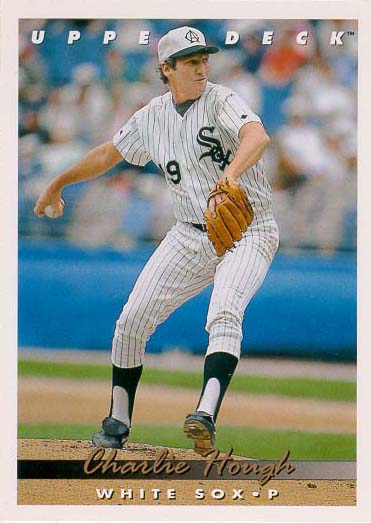
#149 – Charlie Hough

Hough_Charlie_93UD_WhiteSox

Name: Charlie Hough

Rank: 149

Position: P

Years With White Sox: 1991-1992

A month shy of his 43rd birthday, Charlie Hough signed with the White Sox as a free agent in December of 1990.  The knuckleballer filled out the rotation for a White Sox team that had surprising success in 1990 and looked to go further in their new stadium the following year.

Hough ended up going 9-10, failing to win 10 games for the first time since becoming a full-time starter in 1982.  His 4.02 ERA was second to only Jack McDowell in the starting rotation.

Hough returned to the White Sox in 1992.  He improved his ERA slightly to 3.93, but saw his record fall 7-12 in 27 starts.  He moved to the bullpen in August to make room for young starter Wilson Alvarez, but returned to the rotation to replace the struggling Greg Hibbard.

With the Marlins and Rockies joining the league for the 1993 season, the White Sox let Hough become a free agent, with the intention of bringing him back should the team lose a pitcher in the expansion draft.  They didn’t, so Hough signed elsewhere, ironically with the Marlins, ending his White Sox career.

Hough’s numbers in a White Sox uniform were:

Continue reading →

#158 – Bob Howry

howry

Name: Bob Howry

Rank: 158

Position: P

Years With White Sox: 1998-2002

Acquired in the infamous White Flag trade, Bob Howry joined the White Sox organization on July 31, 1997, along with Keith Foulke, Lorenzo Barcelo, Mike Caruso, Ken Vining, and Brian Manning, from the Giants in exchange for Wilson Alvarez, Danny Darwin, and Roberto Hernandez.  Howry made his major league debut on June 21, 1998, pitching 2 innings of scoreless relief in the White Sox loss to the Twins.

Howry stuck with the big league club and eventually became the closer, saving 9 games down the stretch.  He finished the year 0-3 with a 3.15 ERA in 44 appearances.

Howry remained as the closer for most of 1999, until he was replaced by Keith Foulke.  He finished the year with a winning record, at 5-3, and saw his ERA rise slightly to 3.59.  His 28 saves led the team and was 9th best in the AL.

His most infamous moment in a White Sox uniform came in early 2000, when the White Sox and Tigers were involved in 2 brawls during their April 23 game, which the Sox won 14-6.  Howry was ejected in the 9th inning after hitting Shane Halter, igniting the second brawl of the day and earning himself a 3 game suspension.  Many claim that the brawl united the young White Sox team, spurring them on to winning the AL Central title.  Howry finished the year with a 2-4 record and a 3.17 ERA, picking up 7 saves.  He appeared in 2 of the 3 games against the Mariners in the ALDS, giving up 1 run in 2 2/3 innings.

The White Sox faltered in their bid to repeat as division champs in 2001, and Howry was part of the problem.  His ERA ballooned to 4.69 and he blew more saves than he converted.  He finished the year with a 4-5 record and only 5 saves, giving up more hits than innings pitched for the first time in his career.

Howry bounced back somewhat in 2002, but was still above his career norms for runs and hits allowed.  As the White Sox were floundering at the trade deadline, Howry, despite still being under contract for 2003, was shipped to the Red Sox for Frank Francisco and another minor league pitcher.  “The opportunity presented itself and we told Bobby it was an offer we felt too good to pass up,” GM Kenny Williams said.

Howry’s numbers in a White Sox uniform, both for games I attended and overall, were:

Continue reading →

#169 – Mike Caruso

mcarusoName: Mike Caruso

Rank: 169

Position: SS

Years With White Sox: 1998-1999

Mike Caruso was the centerpiece coming back to the White Sox, along with Keith Foulke, Bob Howry, Lorenzo Barcelo, Brian Manning, and Ken Vining, in the so-called White Flag trade on July 31, 1997 that sent Wilson Alvarez, Danny Darwin, and Roberto Hernandez to the Giants.  Caruso was a 20 year old in Class A who was expected to be the heir apparent to Ozzie Guillen on the left side of the White Sox infield.  He fought his way on to the opening day roster in 1998, beating out Benji Gil, and became an instant success story.

He made his major league debut on Opening Day 1998, going 1 for 5 in a White Sox victory against the Rangers.  By the time the year was over, he had compiled a .306 average, the highest rookie total by a Sox player since Minnie Minoso in 1951 and the best for a shortstop since Luis Aparicio in 1970.  He finished 3rd in Rookie of the Year voting, behind winner Ben Grieve and two spots ahead of teammate Magglio Ordonez.

Things started to go south in 1999.  Without veteran third baseman Robin Ventura to cover him, Caruso’s defense, already thought to be suspect, was exposed thanks to a strong arm and shrinking range.  Offensively, his average dropped to .250 and he managed only 17 extra base hits in 529 at bats, for a slugging percentage below .300.  Manager Jerry Manuel called out his young shortstop, for his poor production, lack of preparation, and a general lack of baseball smarts.

The 2000 season saw Caruso back in the minor leagues, thanks to the arrival of Jose Valentin.  While his former teammates went on to win the AL Central, Caruso struggled against minor league pitching before an injury ended his season prematurely.  Following the season, he was designated for assignment and was selected off of waivers by the Mariners.

Caruso’s numbers in a White Sox uniform, both for games I attended and overall, were:

Continue reading →

All Season Pitching Leaders – Through 2014

MLB: Cincinnati Reds at Los Angeles DodgersLast week, we took our first look at the offensive leaders per season since 2011.  Today, we do the same with the pitchers for all of the games I’ve attended from 1984 through the 2014 season.  As with the hitters, there is little change from our first look after the 2011 season, but the time was right for another perusal of the stats.  We start with that most maligned pitching stat:

Wins

Year Name Total
2008 Mark Buehrle 8
2003 Matt Clement 6
2006 Freddy Garcia 6
2003 Mark Prior 6
2004 Greg Maddux 6
2005 Mark Buehrle 6
2008 Gavin Floyd 6

Losses

Year Name Total
2003 Kerry Wood 6
2008 Javier Vazquez 6
2003 Matt Clement 5
2004 Greg Maddux 5
2011 Gavin Floyd 5
2005 Greg Maddux 5

ERA (> 8 IP)

Year Name Total
Continue reading →

#224 – Danny Darwin

DARWIN

Name: Danny Darwin

Rank: 224

Position: P

Year With White Sox: 1997

41-year old Danny Darwin signed with the White Sox for his 20th big league season on February 7, 1997.  Darwin was 4-8 with a 4.13 ERA in 17 starts for a White Sox squad that found itself only 3 1/2 games out of first place in the AL Central on July 31.  Chairman Jerry Reinsdorf did not see a bright future for the team, however, and allowed general manager Ron Schueler to pull the trigger on what would become known as the “White Flag” trade, sending Darwin, along with Wilson Alvarez and Roberto Hernandez, to the Giants in exchange for Keith Foulke, Bob Howry, Lorenzo Barcelo, Ken Vining, Mike Caruso, and Brian Manning.

Darwin called it “one of the most bizarre trades I’ve ever seen” and predicted that future free agents may think twice about joining the South Siders.  “If they need one or two players to get over the hump, it may hurt them in the future,” Darwin said. “I think (the trade) will be in the back of some guys’ minds–`Do I want to go over there?’ You hear (Reinsdorf) say: `You’ve got to be crazy to think we’re going to catch Cleveland.’ Do you want to play for someone like that?”

Darwin’s numbers in a White Sox uniform were:

Continue reading →