Throwback Thursday – Team Records Of The 1990s

Last week, we took a trip in the wayback machine to see all of the games that I attended during the 1980s.  This week, we turn our attention to the 1990s to see what my view of the baseball world looked like.

I’ve been able to identify 32 games I attended during the 90s, starting with a late April outing during the final season at Comiskey Park in 1990 through a September 2000 game at Wrigley Field, including my first visits to stadiums outside of Chicago starting with a July 1993 visit to County Stadium in Milwaukee.  All told, I saw games at eight different ballparks throughout the decade.

1990s Team Records
Team Name Won Loss Winning Pctg
Houston Astros 1 0 1.000
California Angels 1 0 1.000
Cincinnati Reds 1 0 1.000
Arizona Diamondbacks 1 0 1.000
Florida Marlins 1 0 1.000
New York Yankees 1 0 1.000
San Francisco Giants 1 0 1.000
Detroit Tigers 3 1 0.750
Oakland Athletics 2 1 0.667
Chicago White Sox 12 10 0.545
Chicago Cubs 6 5 0.545
Kansas City Royals Continue reading →

Throwback Thursday – Team Records Of The 1980s

With the 2022 season well underway, I thought it would be interesting to take a trip in the wayback machine and see what my view of the baseball world looked like in the long-ago period known as the 1980’s.

I’ve been able to identify 14 games I attended during the 80’s, starting with Luis Aparicio’s number retirement in 1984 through a September 1988 game at Wrigley Field, which turned out to be the second official night game.  There are more games that I remember something about attending, voting for the new White Sox uniform designs in 1981, Carlton Fisk bat day some point in the early 80s, getting a Cubs calendar in 1986,  and winning tickets from WGN radio for a game, but I haven’t been able to track down specifics about them as of yet.

1980s Team Records
Team Name Won Loss Winning Pctg
Toronto Blue Jays 1 0 1.000
San Diego Padres 1 0 1.000
Cleveland Indians 1 0 1.000
California Angels 1 0 1.000
Texas Rangers 1 1 0.500
Seattle Mariners 1 1 0.500
New York Mets 1 1 0.500
Baltimore Orioles 1 1 0.500
Chicago White Sox 5 6 0.455
Chicago Cubs 1 2 0.333
Kansas City Royals 0 1 0.000
Boston Red Sox 0 1 0.000

#SoxMath

For the uninitiated, Sox Math is a segment during every White Sox game broadcast on NBC Sports Chicago, where two or more trivia questions are linked together via a simple math equation to form a final numerical answer. Fans watching at home tweet in their answers and the first one in with the right answer is dubbed the winner.  Sunday, that winner was me.
Back in the before times, there was a prize shelf filled with random objects that announces Jason Benetti and Steve Stone had come across along with extra stadium giveaways.  Starting in 2020, thanks to the pandemic, they switched it up to letting the winner create a video that would introduce the segment on the next game.  Yes, that means I got to create the intro video for last night’s game.

My initial thought was to utilize my bobblehead, surrounded by White Sox bobbleheads, with me talking offscreen, but I thought that might end up being too static.  So instead, I started moving all (well, most) of the mess off of my desk and replacing it with different White Sox paraphernalia, including bobbleheads, pennants, a towel, a Chris Sale K placard, and some Robin Ventura print sent to season ticket holders.  After a few practice shots to get the camera set up correctly, I hit record and, after three takes, felt I had gotten what I needed to get.  Some quick trimming to get just the last take down to the correct length, and off it went.

As we approached the top of the 4th inning, when the segment usually airs, I started to get nervous.  I mean, there was a non-zero chance that I was about to make a fool out of myself on regional cable television.  But, it aired without incident, aside from my mother sleeping through it.  I managed a gain a few new Twitter followers, the video seemed to be a big hit on Facebook, and a co-worker happened to see it and passed a video around to some folks in the virtual office.

As for the original question itself, an educated guess led me to victory.  I assumed there was nothing noteworthy about Julio Franco and Robin Ventura going back-to-back once and, had they done it three times, that would be rare enough that I would know about it, so two seemed like the safe choice.  The second question was much easier, as Ventura wore #23 and Franco #14.

Now, I just need to win again.  I’ve got some more video ideas.


By The Numbers – 12

In 1929, uniform numbers appeared on the back of baseball jerseys for the first time, thanks to the Indians and the Yankees.  By 1937, numbers finally appeared across all uniforms, both home and away, across both major leagues.  Since that time, 81 distinct numbers have been worn by members of the White Sox, while the Cubs boast 76.

Today, we continue our look at those players, picking our favorite, if not the best, player to wear each uniform number for both Chicago teams with #12.  91 different players have donned #12 while playing in Chicago, 44 for the White Sox and 47 for the Cubs.

A.J. Pierzynski signed with the White Sox on January 6, 2005 and rewarded the organization with eight seasons of stability behind the plate that included one All-Star selection, two playoff appearances, and, of course, the 2005 World Series championship.  Over those 8 seasons, Pierzynski was involved in many key moments while wearing #12 that endeared him to the White Sox faithful, including:

  • The walk-off home run, and resulting bat flip (pictured above), against the Dodgers in 2005 while wearing 1959 throwbacks
  • The two home runs in a thrashing of the Red Sox in game one of the 2005 ALDS, the first White Sox home postseason victory since 1959
  • The controversial dropped third strike that led to a White Sox victory in game two of the 2005 ALCS against the Angels
  • The 2006 brawl against the Cubs where Michael Barrett sucker-punched him after Pierzynski enthusiastically scored a run against the crosstown rivals
  • Hanging on to the throw from Ken Griffey Jr. to preserve the shutout in the 2008 tie-breaker game that pushed the White Sox into the playoffs over the Twins
  • Being behind the plate for Mark Buehrle’s no-hitter in 2007 and Philip Humber’s perfect game in 2012

On the north side of town, a dynamic shortstop, the first player chosen in the 1982 draft, wore #12 when he made his major league debut in 1985.  Shawon Dunston quickly became a fan favorite.  In 1989, he entered the national consciousness thanks to the Shawon-O-Meter, a fan made sign that tracked Dunston’s batting average during each game.  The sign was seen in the Wrigley Field bleachers for a number of years and even made its way to San Francisco’s Candlestick Park for the 1989 NLCS.  Following the 1995 season, he left as a free agent before resigning with the team for the 1997 campaign.  He was traded to the Pirates at the end of August, ending his Cubs career for good.

The Time Of Your Life

After a disastrous 2021 that saw his reunion with the Cubs end with his August release followed by an even worse stint with the Padres, Jake Arrieta called it a career earlier this week.  Arrieta, 36, debuted with the Orioles in 2010.  He was acquired by the Cubs in July of 2013, in what turned out to be one of the best trades in team history, in a trade for Scott Feldman and Steve Clevenger.  He left the Cubs as a free agent after the 2017 season and signed with the Phillies on a 4-year deal.

After being acquired by the Cubs, Arrieta was sent to Triple A, where he made seven starts for Iowa before being recalled to the rebuilding big league club, showing vast improvement over the pitcher he was with the Orioles.  He turned into an ace for the Cubs in 2015, winning the NL Cy Young Award, and was a key contributor to their World Series championship in 2016.  He threw two no-hitters for the team, one in 2015 against the Dodgers and the second in 2016 against the Reds.  Injuries after the 2017 season left him a shell of his former self, but the Cubs rolled the dice for 2021, hoping for a miracle.  Instead, they got a rude awakening, as Arrieta set the team record for highest ERA for a pitcher in a season with at least 20 starts.  He followed up his last game, where he gave up 8 hits and 7 runs in the first inning, with a post-game tirade where he berated a reporter for wearing a mask, which he was required to do by city regulation, during a Zoom press conference.

For a brief period of time during the 2015 and 2016 seasons, Jake Arrieta was the best pitcher in baseball.  He was a key contributor to the 2016 World Series championship, earning him a place in Cubs lore for years to come.  His horrid performance in 2021, both on the field and as a functioning member of society, did little to hurt that standing.  I’m sure later this year or next year, there will be a Jake Arrieta Day at Wrigley Field, where he will rightly be feted as he throws out a first pitch and sings during the 7th inning stretch.

By The Numbers – 13

In 1929, uniform numbers appeared on the back of baseball jerseys for the first time, thanks to the Indians and the Yankees.  By 1937, numbers finally appeared across all uniforms, both home and away, across both major leagues.  Since that time, 81 distinct numbers have been worn by members of the White Sox, while the Cubs boast 76.

Today, we continue our look at those players, picking our favorite, if not the best, player to wear each uniform number for both Chicago teams with #13.  25 different players have donned #13 while playing in Chicago, 13 for the White Sox and 12 for the Cubs.

Acquired by the White Sox on December 6, 1984, from the Padres, Ozzie Guillen made his major league debut wearing #13 on Opening Day 1985, leading off against the Brewers and going 1-5 in the 4-2 victory at County Stadium.  Settling in as the everyday shortstop, Guillen finished the year with a .273 average, 21 doubles, and 9 triples.  Those totals were good enough to score Guillen the 1985 AL Rookie of the Year trophy.  Guillen saw a slight drop off in his sophomore season, as his average dropped to .250 and he managed 19 doubles and 4 triples.  1987 was a nice bounce back for Guillen, as he raised his average back up to .279 with a .656 OPS.  For the second straight year, he led the AL, and all of baseball, in Defensive WAR.  Guillen earned his first All Star nod in 1988 and, by season’s end, he once again led all of baseball in Defensive WAR, while seeing his average drop to .261 with 7 triples, the fifth highest total in the AL.

1989 was a tough year for Guillen.  He posted his worst offensive numbers since 1986 and, on the base paths, he fell victim to the hidden ball trick.  Twice. On June 23, against the Brewers, first baseman Greg Brock held the ball after a pickoff attempt and when Guillen took his hand off the base to stand up, Brock tagged him out.  Less than 2 months later, on August 5 against the Tigers, Dave Bergman made the same play.  He finished the year with .253 average and, despite his adventures on pick off attempts, a career high 36 stolen bases.  As the surprising White Sox challenged for the AL West title while saying goodbye to Comiskey Park, Guillen put in one of the finest seasons of his career.  He was named to his second All Star team, going 0-2, finished in 17th place in MVP voting, and earned his first, and only, Gold Glove.  He raised his average back up to .279 and knocked in a career high 58 RBIs.

Expectations were high for the White Sox as they moved across the street to the new Comiskey Park in 1991.  Guillen earned his third, and final, All Star nod, getting a sacrifice in his only plate appearance.  He ended the year with a .273 average and set a career high with 3 home runs.  Guillen’s 1992 season came to an early end when, on April 21 during a loss against the Yankees, a collision with outfielder Tim Raines ended in a severe knee injury.  Guillen recovered in 1993, though he appeared in only 134 games, his lowest total to date.  However, it was his most productive season offensively, posting a .280 batting average, and career highs with 4 home runs and a .666 OPS, as the White Sox won their first division title in a decade.  He hit .273 and scored 4 runs in a losing effort, as the White Sox were defeated in 6 games by the Blue Jays in the ALCS.  1994 looked to be the year that the White Sox finally broke through.  Guillen was up to the challenge, hitting a career high .288 with a .659 OPS.  Unfortunately, the year ended early when players went on strike on August 12 with the White Sox in first place in the newly created AL Central.

The 1995 season got off to a late start and had an abbreviated schedule due to the long work stoppage.  The success of the White Sox, and for Guillen himself, didn’t survive the long layoff.  Guillen saw his average drop to .248, his lowest over a “full” season in his career to this point.  His OPS dropped to its lowest total in a full season since 1989.  1996 saw a slight improvement for Guillen.  He appeared in 150 games, his highest total since his knee injury in 1992.  He raised his average back to .263 and tied his career high with 4 home runs.  However, 1997 was easily the worst season of Guillen’s White Sox career.  He had the lowest average of his career, coming in at .245, though he did once again tie his career high with 4 home runs.  Following the season, Guillen became a free agent and his playing career with the White Sox came to an end.

Guillen returned to the White Sox organization for the 2004 season as manager.  In 2005, he led the team to their first American League pennant since 1959 and their first World Series title in 88 years.  Ongoing personal difficulties with General Manager Kenny Williams led to his leaving with 2 games left in the 2011 season as the third winningest manager in franchise history.

On the north side of town, Neifi Pérez donned #13 over parts of three seasons with the Cubs.  He signed a minor league deal after being released by the Giants in 2004.  After only ten games in Triple A, Pérez joined the big-league club and became a spark plug in the lineup, going 6 for 6 in his first 6 at-bats and providing a needed backup to the ailing Nomar Garciaparra.  Dusty Baker named Pérez the starting shortstop in 2005 to replace Garciaparra, mainly on the strength of his defensive skills.  For the 2006 season Pérez lost the starting job at shortstop to Ronny Cedeño.  As his batting average sagged to .254 and his on-base percentage, never high, had fallen to .266, the Cubs traded him to the Tigers.

The Heroes Of Opening Day

This week I attended my 21st consecutive (except for the pandemic year of 2020 that had no fans) Opening Day at Comiskey Park II/US Cellular Field/Guaranteed Rate Field, and my 38th overall.  From my first, at old Comiskey Park in 1985, to my first as a Cubs season ticket holder at Wrigley Field in 2002, to road trips to Shea Stadium, in 2003, and Great American Ballpark, in 2004 and 2006, Opening Day remains a spring holiday proclaiming the theoretical beginning of summer.  This seemed like a good time to see who the best performers were on both sides of the ball from those 38 contests.

Home Runs

Name Total
Corey Patterson 3
Paul Konerko 3
Alejandro de Aza 2
Ray Durham 2
Jose Valentin 2
Joe Crede 2
Jim Thome 2

Hits

Name Total
Paul Konerko 15
Jermaine Dye 9
Aramis Ramirez 8
Victor Martinez 8
Mark Grudzielanek 8

Runs

Name Total
Paul Konerko 7
Derrek Lee 7
Alex Gonzalez 6
Joe Crede 6

RBI

Name Total
Paul Konerko 10
Corey Patterson 8
Moises Alou 8

Doubles

Name Total
Michael Barrett 4
Paul Konerko 3
Moises Alou 3
Jose Valentin 3
Victor Marinez 3
Alex Rios 3
Jose Abreu 3
Miguel Olivo 3
Jeromy Burnitz 3
Carlos Lee 3

Triples Continue reading →

Changes To The Ol’ Ballpark

The 2022 baseball season is underway and there have been some changes at Guaranteed Rate Field.  Three years ago, the right field stands behind what at the time was the Bullpen Sports Bar was renovated to align with a new beer sponsor, Goose Island.

This offseason, Miller replaced Budweiser as the beer vendor of choice, so the goose is gone and the area has been rebranded as the Miller Lite Landing.  The CTA car remains, but has been rebranded from a Green Line, which was one of Goose Island’s brands, to a Red Line, which serves the ballpark.

A division title in 2021 seems to be responsible for the next change, where the large banners attached to the outfield light supports which detailed the team’s division championships, league championships, and World Series championships, have been removed.  They look to have been replaced by much smaller notations painted onto the brick columns underneath the Kids Zone.

Now, if you are asking yourself “who the hell could possible read that?”, well, you are not alone.
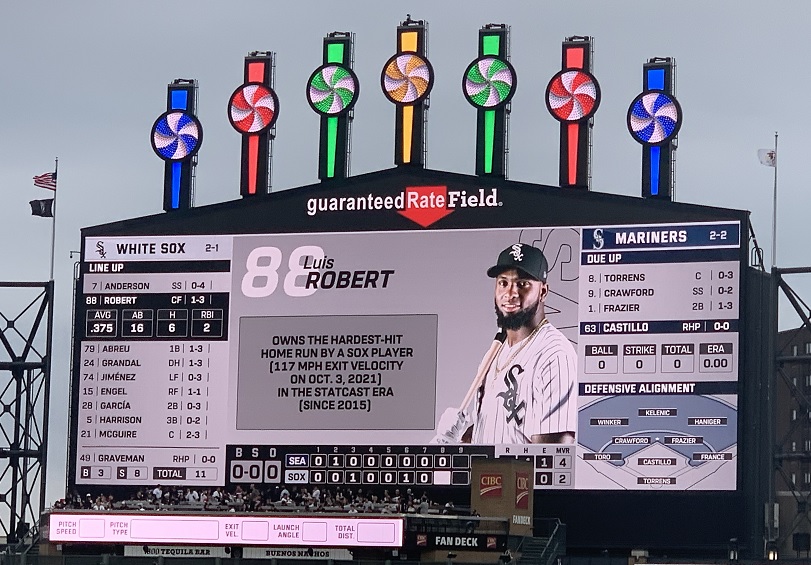
The final big change is to the graphics profile used on the scoreboards and ribbon boards throughout the park.  Gone is the format that had been in place since the scoreboard was upgraded in 2016 and, in its place, is a gray and black format with fewer ads and additional defensive information.

Overall, the new format is very clean, but, ironically, the fewer ads has hurt the overall product, as it has pushed down the line score to where it is being blocked by the brick stack on the Fan Deck.  From where I sat yesterday, it blocked to totals, but I could still see each individual inning and could figure out the score.  I worry more of it will be blocked once I get to my normal seats further down the first base line.

By The Numbers – 14

In 1929, uniform numbers appeared on the back of baseball jerseys for the first time, thanks to the Indians and the Yankees.  By 1937, numbers finally appeared across all uniforms, both home and away, across both major leagues.  Since that time, 81 distinct numbers have been worn by members of the White Sox, while the Cubs boast 76.

Today, we continue our look at those players, picking our favorite, if not the best, player to wear each uniform number for both Chicago teams with #14, the only number to be retired by both teams.  47 different players have donned the number while playing in Chicago, and no more will for the rest of time.

With apologies to Ted Lyons, Bill Skowron, and Bill Melton, the winner here, and the man that #14 was retired for, is Paul Konerko.  Konerko was traded to the White Sox on November 11, 1998 for center fielder Mike Cameron.  In his second full season, he helped lead the surprising White Sox to their first Central Division title, their first post-season appearance since 1993.  After tremendous struggles in 2003, Konerko won the Comeback Player of the Year award in 2004.  He did himself better in 2005, winning the ALCS MVP, hitting a grand slam in Game 2 of the World Series, and catching the final putout at first base in Game 4, giving the White Sox their first World Series title since 1917.  After the series, Konerko inked a 5-year deal that would keep him on the south side through at least 2010.

2008 saw Konerko make his 3rd post-season appearance for the Sox, the only player in history to do so.  Konerko retired following the 2014 season, finishing his career as the White Sox all time leader in total bases and second all time in home runs, RBIs, and games played.  In addition, he was a 6-time All Star and had served as team captain since 2006.  His #14 was retired in 2015.

Nicknamed Mr. Cub, Ernie Banks, played his entire 19 year career with the Cubs, earning back-to-back MVP honors in 1958 and 1959.  When he retired following the 1971 season, he ranked 9th all-time in home runs, with 512.  He was elected to the Hall of Fame in 1977 and became a team ambassador, never seen without a smile on his face.  Number 14 was retired in his honor in 1982, the first number ever retired by the Cubs.

Mornings With The Peacock

On the heels of last month’s announcement of an exclusive streaming deal with Apple TV+, MLB announced another streaming deal, this time with Peacock, owned by NBC.  Worth an estimated $30 million to the poor MLB owners, the deal gives Peacock an exclusive window on Sunday mornings through 12:30 PM CT.  Games will begin at 10:30 CT through June 12, then move to an 11 AM start time for the remainder of the season.  In addition, Peacock will be the exclusive home of the Futures Game during All Star festivities and will also feature classic MLB games, award-winning documentaries from the MLB Film & Video Archive, and highlight packages available on-demand in a new MLB hub.

The Peacock slate kicks off on May 8 with the White Sox visiting the Red Sox and will be simulcast on NBC.  The south siders make an additional appearance in August while visiting the Guardians.  The Cubs, meanwhile, make their sole appearance while visiting the Phillies in July.  It is a shame that all three of these games are on the road.  It would be interesting to attend a game with an 11:00 (or earlier) start.

As I said last month, I see MLB expanding its reach into the streaming world to be a good thing.  Some will say that with these new exclusive deals, MLB is spreading their product around a little too much and they do have a point.  In order to watch every White Sox game this season as it happens, one would have to have access to NBC Sports Chicago, FOX, FS1, ESPN, Apple TV+. and Peacock.  That’s a lot of different services.  But how many fans actually try to watch every single game?  For the casual fan, MLB having a wide footprint can only be a good thing as they try to build the next generation of hard-core fans.