#271 – Jerry Don Gleaton

Jerry-Don-Gleaton-White-SoxName: Jerry Don Gleaton

Rank: 271

Position: P

Years With White Sox: 1984-1985

With the White Sox struggling to repeat as AL West champions, they made a move to shore up the bullpen, sending Salome Barojas to the Mariners in exchange for Jerry Don Gleaton and Gene Nelson.  Gleaton put up good numbers in Triple A for the White Sox and was eventually called up to the big leagues, appearing in 11 games.

Gleaton again split the 1985 season between Triple A and the White Sox, with more success in Triple A.  He made it in to 31 games for the White Sox, but put up a 5.76 ERA.

Gleaton spent all of 1986 in Triple A before leaving the White Sox organization as a free agent.

Gleaton’s numbers in a White Sox uniform, both for games I attended and overall, were: Continue reading →

BBWAA Award Predictions

MLB: Cincinnati Reds at Los Angeles DodgersThe Baseball Writers of America have announced the finalists for their awards for the just completed baseball season.  It is a good bet that none of my original predictions for the winners will be accurate.  Hopefully, these new predictions will be slightly better, especially since I’ll have a 33% chance of being right.

American League

Most Valuable Player: Miguel Cabrera, Mike Trout, Chris Davis

Mike Trout was my pre-season selection to win this award, but I also picked the Angels to win the American League.  They dropped out of contention early, and I think the same can be said for Trout’s candidacy.  My guess is Miguel Cabrera, who was having an even better year than his triple crown winning season a year ago before nagging injuries dragged him down towards the end of the year, takes home his second straight MVP.

Cy Young Award: Yu Darvish, Hisashi Iwakuma, Max Scherzer

My initial guess of David Price obviously did not make the cut.  While books have been written about how wins are not a reliable way to track pitching effectiveness, my guess is that if you add in a 20 win season with a trip to the post-season, Max Scherzer will take home the prize.

Manager of the Year: John Farrell, Terry Francona, Bob Melvin

I didn’t make any predictions for this award prior to the season.  I imagine that Terry Francona, beloved former manager of the Red Sox, will take home the award for turning around a putrid Indians team and keeping them in contention for the majority of the year.

Rookie of the Year: Chris Archer, Jose Iglesias, Wil Myers

Another award I didn’t predict prior to the season.  It is somewhat ironic, given the current value placed on young talent, that all 3 finalists for the award were traded to their current teams, one during this past season.  My guess is that Wil Myers will win the award.

National League

Continue reading →

Cub News Abounds

rich_renteria_piratesYesterday was a busy day at the corner of Clark and Addison, as three different news stories broke about the Chicago Cubs.

1) Word broke early in the day yesterday that the Cubs are set to name Rick (formerly Rich) Renteria as their new manager today.  Renteria most recently was the bench coach for the Padres.  The hope is that he will be able to better communicate with the rising Latin American prospects because he is bi-lingual.

I’m not sure what to make of this hire. It seems foolish to hang a hiring decision solely on what languages a guy can speak, but hopefully Renteria brings a little more to the table than that.

2) The Cubs notified WGN that they are opting out of their current television deal following the 2014 season.  The station has 30 days to agree to a higher rights payment determined by a third party consultant hired by both WGN and the Cubs.  If they do not, the Cubs are able to take the 70 game package to the open market.

There doesn’t seem to be much of an option on free TV other than the current setup, and their deal with Comcast Sports Net prohibits them from going to another cable channel, so the odds are that they re-up, at least until 2019.  At that point, the CSN deal will also be up and the Cubs can start looking at creating their own network similar to NESN or YES.

3) As if that wasn’t enough, word broke yesterday afternoon that Keith Moreland, who took over the color analyst spot on WGN following the death of Ron Santo, would not be returning for a fourth season.  In a statement released by WGN, Moreland said that he wishes to spend more time back home in Texas.

I must admit that I have not listened to a lot of Cubs baseball these past few years, but Moreland seemed like he was doing a good job, certainly a more competent one than his predecessor.  Reaction to this news on the Interwebs, however, would indicate that Cub fandom was not enamored with his work and are happy to see him go.

Ballpark Tour: Wrigley Field

WrigleyField

Stadium Name: Wrigley Field

Location: Chicago

Home Team: Cubs

Years in Service: 1914 – Present

Visits: 313

Weeghman Park, home of the Chicago Chifeds (soon to be the Whales) of the Federal League, opened on April 23, 1914.  In December of 1915, when the Federal League folded, team owner Charles Weeghman was allowed to buy the rival Chicago Cubs and immediately moved them from the dilapidated West Side Park and into his Weeghman Park for the 1916 season.  The Cubs played their first game at Weeghman Park on April 20, 1916, besting the Cincinnati Reds 7–6 in eleven innings.

Also in 1916, Weeghman sold a minority interest in the Cubs to chewing gum magnate William Wrigley.  As Weeghman’s financial fortunes started to decline, Wrigley acquired an increasing number of shares in the club and took on a growing role in the team’s affairs until November 1918, when Weeghman gave up his remaining interest to Wrigley, resigned as president, and left baseball for good. Wrigley would acquire complete control of the Cubs by 1921, and, prior to the start of the 1927 season, the park was officially renamed Wrigley Field.

William’s son, Philip K. Wrigley, had intended to install lights at Wrigley Field prior to the 1942 season.  However, when the Japanese attacked Pearl Harbor in December of 1941 and the US entered World War II, Wrigley donated the materials for the lights to the war effort.  The Cubs eventually became the only team without lights, continuing to play day games at home exclusively until 1988, when lights were finally installed.  To this day, the Cubs are still limited in the number of night games they may schedule per season, though that number has increased significantly since the late 80s.

As Wrigley Field prepares to enter its second century, there are plans in motion to renovate the stadium and make it economically viable for the 21st century.  Those renovations were expected to start this offseason, but threats of lawsuits from the rooftop owners, who fear that new signage would block their views, have stalled those plans.

I’ve managed to identify 313 games I’ve attended at Wrigley Field, most of them since 2002, when I became a season ticket holder.  While it is hard to argue with the historical value of Wrigley Field, it is as hard to argue that the stadium needs work to satisfy the needs of fandom in the year 2013.  I hope that the bickering sides come to an agreement soon so that Wrigley Field can continue to be a viable home to the Cubs for the next 100 years.  Besides, they will need that time in order to bring their first World Series championship to the ballpark.

#272 – Olmedo Saenz

olmedo_saenz_autographName: Olmedo Saenz

Rank: 272

Position: 3B

Year With White Sox: 1994

Olmedo Saenz joined the White Sox organization as an amateur free agent on May 11, 1990.  He worked his way up through the system, eventually making his major league debut on May 28, 1994 against the Orioles, going 1-3 and getting his first major league hit against Ben McDonald.  He managed to make his way in to 4 additional games before being returned to the minor leagues, where he would stay until he left as a free agent in October of 1998.

Saenz’s numbers in a White Sox uniform were:

Continue reading →

#273 – Jon Adkins

jon_adkins_autograph

Name: Jon Adkins

Rank: 273

Position: P

Years With White Sox: 2003-2005

Jon Adkins was acquired by the White Sox on July 25, 2002 from the A’s in exchange for Ray Durham.  He made his major league debut on August 14, 2003 against the Angels, facing 3 hitters without getting an out in the White Sox 5-1 loss.  He made only 4 appearances that year for the big league club, but surprised everyone, including himself, when he made the 2004 squad out of spring training.  He spent the entire season n the big leagues, appearing in 50 games and putting up a 4.65 ERA.

Things did not go his way in 2005, when newcomers Dustin Hermanson and Luis Vizcaino took his place in the bullpen.  He did spend enough time in the major leagues to make 5 appearances, but his ERA skyrocketed to 8.64.  Unsurprisingly, he did not make the post-season roster, and, that December, he was granted free agency.

Adkins’ numbers in a White Sox uniform, both for games I attended and overall, were:

Continue reading →

#274 – Gary Glover

OLYMPUS DIGITAL CAMERA

Name: Gary Glover

Rank: 274

Position: P

Years With White Sox: 2001-2003

Gary Glover joined the White Sox on November 7, 2000 after being acquired from the Blue Jays in exchange for Scott Eyre.  Glover split the year between Chicago and Charlotte, and between the bullpen and the rotation.  He finished the year with a 5–5 record and a 4.93 ERA in 46 appearances, including 11 starts.

Glover spent the entire 2002 season with the White Sox, but again split his time between the rotation, where he was not very successful, and the bullpen, where he was.  In mid-September, manager Jerry Manuel announced that Glover would stay in the bullpen for the rest of 2002 and in 2003.

In 2003, Glover became the forgotten man in the White Sox bullpen.  Going as many as 19 days between appearances, Glover made his way in to only 24 games by the end of July, when he was moved along with two minor leaguers to the Angels for for veteran pitcher Scott Schoeneweis.

Glover’s numbers in a White Sox uniform, both for games I attended and overall, were:

Continue reading →

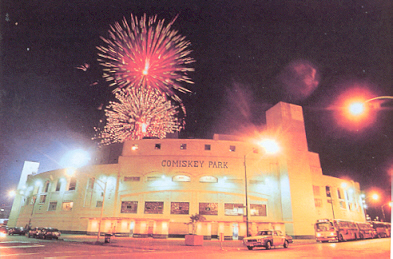
Ballpark Tour: Comiskey Park

comiskeyout2

Stadium Name: Comiskey Park

Location: Chicago

Home Team: White Sox

Years in Service: 1910 – 1990

Visits: 12 (that I’m aware of)

Comiskey Park, the so-called Baseball Palace of the World, was the home of the White Sox from 1910 through the 1990 season.  Built on a former city dump at the corner of 35th Street and Shields Avenue, the stadium opened as White Sox Park on July 1, 1910, as the White Sox lost to the St. Louis Browns 2-0.  In 1913, owner Charles Comiskey renamed the stadium after himself, and Comiskey Park was born.  From 1962 until 1975, the White Sox Park name was officially re-establshed, as new ownership groups tried to separate themselves from the Comiskey name.  However, Bill Veeck, in his second tour of duty as owner of the White Sox, put the Comiskey Park name back on the stadium in 1976, where it remained until 1990.  The final game for the old ballyard occurred on September 30, 1990, a 2-1 victory over the Mariners.

Comiskey Park was the host for 4 World Series contests, including 3 in a row from 1917-1919.  The White Sox won the World Series in 1917 against the New York Giants.  The Cubs, looking for a larger seating capacity, moved their home games in the 1918 series against the Red Sox to Comiskey Park.  The 1919 World Series, of course, was the Black Sox scandal, where the White Sox threw the series against the Reds.  The White Sox returned to the World Series 40 years later in 1959, but fell to the Dodgers.  The final post-season games to be played in Comiskey Park were games 3 and 4 of the 1983 ALCS, which the White Sox lost to the Baltimore Orioles.

Comiskey Park was also the host to 3 All-Star games.  The first All-Star game ever, in 1933, was held in conjunction with Century of Progress Exposition being held on Chicago’s lakefront.  The event returned to Chicago’s south side in 1950.  The final All-Star game at Comiskey Park was in 1983, the 50th anniversary of the first game.  Comiskey Park was also the frequent home of the Negro League East-West All-Star Game from 1933 to 1960.

In addition to White Sox baseball, Comiskey Park was also the home to the Chicago American Giants of the Negro Leagues, the Chicago Cardinals of the NFL, and the Chicago Sting of the NASL.  Comiskey Park also hosted numerous boxing matches, including the 1937 heavyweight title match where Joe Louis defeated then champion James J. Braddock.  The Beatles played two concerts at Comiskey Park in August of 1965.  Other musical acts to perform there include Aerosmith, AC/DC, The Eagles, The Police, Simon & Garfunkel, and The Jacksons, who performed 3 shows during their Victory tour in October of 1984.

Looking back, I’ve been able to piece together evidence of 12 games that I attended at Comiskey Park.  I know there are more, but I have not been able to pinpoint exact games yet.  The most memorable game I can remember would be the final night game, on September 29, 1990, where, after the game, the lights were symbolically turned off for the final time.

#275 – Danny Richar

Richar

Name: Danny Richar

Rank: 275

Position: 2B

Year With White Sox: 2007

Danny Richar joined the White Sox organization via trade from the Diamondbacks for Aaron Cunningham.  After a brief stint in Triple A, he joined the White Sox after Tadahito Iguchi was traded to the Phillies and made his major league debut on July 28, going 2-3 in a White Sox victory against the Blue Jays.  Richar finished out the year for the disappointing White Sox squad, putting up a .230 batting average.

Richar returned to Triple A in 2008, and, with the White Sox in contention for the division title, Richar was packaged to the Reds, along with Nick Masset, for future Hall of Famer Ken Griffey Jr.

Richar’s numbers in a White Sox uniform, both for games I attended and overall, were:

Continue reading →

#276 – Jon Rauch

jon_rauch_autograph

Name: Jon Rauch

Rank: 276

Position: P

Years With White Sox: 2002. 2004

Jon Rauch was selected in the 3rd round of the 1999 draft by the White Sox.  Rauch worked his way through the minor league system and made his major league debut on April 2, 2002, closing out the White Sox loss against the Mariners.  Rauch, who remains the tallest player in major leage history, struggled against major league hitters and was quickly demoted back to Triple A.

Rauch returned to the major leagues in 2004, but again had difficulty getting batters out.  On July 18, he was sent to the Expos along with Gary Majewski in exchange for Carl Everett.

Rauch’s numbers in a White Sox uniform, both for games I attended and overall, were:

Continue reading →