Vacation Recap: San Diego

SanDiegoThe long-awaited trip to San Diego got off to a rocky start when illness struck 2 days before I was supposed to leave.  So, I was a bit shaky when the car arrived to take me to the airport at 3:30 on a Wednesday morning.  For some reason, a 6 AM flight didn’t seem like a ridiculous idea back in January when I booked it.  So, feeling a little queasy, I boarded the plane heading to Denver.  Which also seemed like a good idea back on the cold January day.

After landing in Denver, the connecting flight to San Diego was close enough that I got off one plane and got right on the other.  Another quick 2 1/2 hour jaunt and we landed in beautiful San Diego around 10 AM.  A quick bus ride later and we arrived at the Manchester Grand Hyatt.  While we checked in to the hotel and got all of our conference information, our luggage was supposed to be delivered to our rooms.  So imagine my surprise when later that morning, I got a call from someone in the other tower of the hotel saying my luggage had made it to her room.  Not a huge deal, but issue #1 of the trip.

After getting the luggage situation worked out, I ventured out to reacquaint myself with the city.  It had been almost 10 years since my last visit, so I tried to retrace some of the steps from my previous visits.  First was a walk past the convention center, where I had attended a comic con or 3.  Next stop was PETCO Park, which is just up the street from the convention center.  When I first found out the dates of this trip, the first thing I checked was the Padres schedule.  Unfortunately, a game wasn’t in the cards this time, but I did get a look in to the stadium thanks to their open center field concourse.  From there, I headed off to Horton Plaza, looking to try and grab something for lunch.  This is where I ran into a little trouble because, for the life of me, I couldn’t find it.  I eventually had to resort to looking it up on my phone to see how to get there.  I guess 10 years really is a long time.

Wednesday night was the big gala event on the USS Midway.  Due to the chilly (for southern California) weather, we were moved from the flight deck down below, but still had access to roam the retired aircraft carrier.  Both before and after dinner, groups of the winners were called up to shake hands and get their picture taken with Suren and their AVP.  It was a nice way to wind down the first day in San Diego.
Continue reading →

100 Years Of Innovation

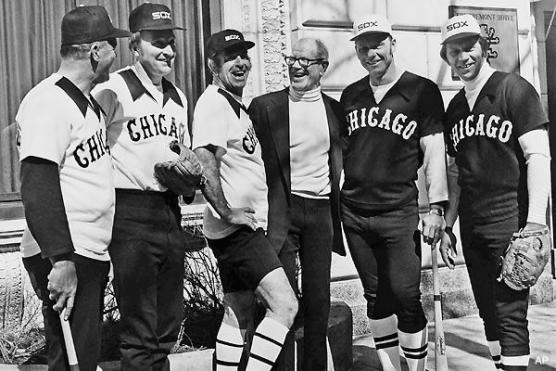
1976 Chicago White Sox100 years ago today, Bill Veeck, the former club treasurer for the Cubs and two-time owner of the White Sox, was born here in Chicago.  Veeck followed his father, the then president of the Cubs, into baseball.  As a 13 year old, Veeck came up with the idea of planting ivy to cover the outfield walls at Wrigley Field.  In 1937, as general manager, he oversaw the construction of the iconic hand operated scoreboard that is still in use today.

Veeck left the Cubs in 1941, striking out on his own and buying the minor league Milwaukee Brewers.  While he owned the team, he also served in the Marines during World War II, where he injured his leg, which required amputation.  After the war, Veeck sold his interests in the Brewers and bought the Cleveland Indians, returning to the major leagues.  In July of 1947, Veeck broke the color barrier in the American League by signing Larry Doby.  In 1948, the Indians won their first World Series title since 1920.  Veeck was forced to sell the Indians in 1949 due to his divorce.

2 years later, Veeck was back in business, purchasing the St. Louis Browns.  While trying to force the Cardinals out of town, Veeck came up with one of his most famous, or perhaps infamous, stunts, signing Eddie Gaedel, standing 3 feet and 7 inches tall, and sending him to the plate in the second game of a double header against the Detroit Tigers on August 19, 1951.  Gaedel walked on four pitches and was lifted for a pinch runner.  American League president Will Harridge voided Gaedel’s contract the next day, claiming that Veeck was making a mockery of the game. In response, Veeck threatened to request an official ruling on whether Yankees shortstop Phil Rizzuto, the reigning MVP, was a short ballplayer or a tall midget.

Continue reading →

Ballpark Tour: Wrigley Field

WrigleyField

Stadium Name: Wrigley Field

Location: Chicago

Home Team: Cubs

Years in Service: 1914 – Present

Visits: 313

Weeghman Park, home of the Chicago Chifeds (soon to be the Whales) of the Federal League, opened on April 23, 1914.  In December of 1915, when the Federal League folded, team owner Charles Weeghman was allowed to buy the rival Chicago Cubs and immediately moved them from the dilapidated West Side Park and into his Weeghman Park for the 1916 season.  The Cubs played their first game at Weeghman Park on April 20, 1916, besting the Cincinnati Reds 7–6 in eleven innings.

Also in 1916, Weeghman sold a minority interest in the Cubs to chewing gum magnate William Wrigley.  As Weeghman’s financial fortunes started to decline, Wrigley acquired an increasing number of shares in the club and took on a growing role in the team’s affairs until November 1918, when Weeghman gave up his remaining interest to Wrigley, resigned as president, and left baseball for good. Wrigley would acquire complete control of the Cubs by 1921, and, prior to the start of the 1927 season, the park was officially renamed Wrigley Field.

William’s son, Philip K. Wrigley, had intended to install lights at Wrigley Field prior to the 1942 season.  However, when the Japanese attacked Pearl Harbor in December of 1941 and the US entered World War II, Wrigley donated the materials for the lights to the war effort.  The Cubs eventually became the only team without lights, continuing to play day games at home exclusively until 1988, when lights were finally installed.  To this day, the Cubs are still limited in the number of night games they may schedule per season, though that number has increased significantly since the late 80s.

As Wrigley Field prepares to enter its second century, there are plans in motion to renovate the stadium and make it economically viable for the 21st century.  Those renovations were expected to start this offseason, but threats of lawsuits from the rooftop owners, who fear that new signage would block their views, have stalled those plans.

I’ve managed to identify 313 games I’ve attended at Wrigley Field, most of them since 2002, when I became a season ticket holder.  While it is hard to argue with the historical value of Wrigley Field, it is as hard to argue that the stadium needs work to satisfy the needs of fandom in the year 2013.  I hope that the bickering sides come to an agreement soon so that Wrigley Field can continue to be a viable home to the Cubs for the next 100 years.  Besides, they will need that time in order to bring their first World Series championship to the ballpark.