#252 – Atlee Hammaker

WhiteSox-atleehammakerName: Atlee Hammaker

Rank: 252

Position: P

Years With White Sox: 1994-1995

Atlee Hammaker first singed with the White Sox as a free agent on February 12, 1992.  An elbow injury in spring training put his career in jeopardy and he was released on March 18th.  After rehabbing for two years, he once again signed with the White Sox on April 12, 1994.

Hammaker spent the majority of 1994 with the Triple A Nashville Sounds.  He did manage to make it back to the major leagues for the first time since 1991, putting up 1.1 scoreless innings in 2 games before the season came to an untimely end due to the player’s strike.

He returned to Triple A in 1995 and again put up impressive numbers, but this time, he was unable to duplicate that success at the major league level.  He appeared in 13 games and gave up 9 runs in just over 6 innings.  His season, and major league career, came to an end on August 18th when he was released.

While not with the White Sox, Hammaker’s most infamous moment took place at Comiskey Park.  During the 1983 All Star Game, Hammaker, pitching for the National League, gave up the first grand slam in All Star Game history to Angels outfielder Fred Lynn.

Hammaker’s numbers in a White Sox uniform were:

Continue reading →

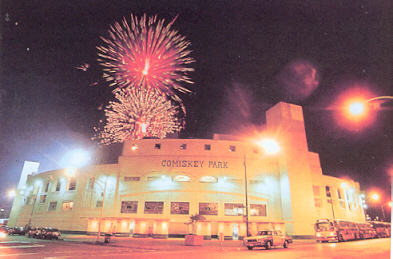
Ballpark Tour: Comiskey Park

comiskeyout2

Stadium Name: Comiskey Park

Location: Chicago

Home Team: White Sox

Years in Service: 1910 – 1990

Visits: 12 (that I’m aware of)

Comiskey Park, the so-called Baseball Palace of the World, was the home of the White Sox from 1910 through the 1990 season.  Built on a former city dump at the corner of 35th Street and Shields Avenue, the stadium opened as White Sox Park on July 1, 1910, as the White Sox lost to the St. Louis Browns 2-0.  In 1913, owner Charles Comiskey renamed the stadium after himself, and Comiskey Park was born.  From 1962 until 1975, the White Sox Park name was officially re-establshed, as new ownership groups tried to separate themselves from the Comiskey name.  However, Bill Veeck, in his second tour of duty as owner of the White Sox, put the Comiskey Park name back on the stadium in 1976, where it remained until 1990.  The final game for the old ballyard occurred on September 30, 1990, a 2-1 victory over the Mariners.

Comiskey Park was the host for 4 World Series contests, including 3 in a row from 1917-1919.  The White Sox won the World Series in 1917 against the New York Giants.  The Cubs, looking for a larger seating capacity, moved their home games in the 1918 series against the Red Sox to Comiskey Park.  The 1919 World Series, of course, was the Black Sox scandal, where the White Sox threw the series against the Reds.  The White Sox returned to the World Series 40 years later in 1959, but fell to the Dodgers.  The final post-season games to be played in Comiskey Park were games 3 and 4 of the 1983 ALCS, which the White Sox lost to the Baltimore Orioles.

Comiskey Park was also the host to 3 All-Star games.  The first All-Star game ever, in 1933, was held in conjunction with Century of Progress Exposition being held on Chicago’s lakefront.  The event returned to Chicago’s south side in 1950.  The final All-Star game at Comiskey Park was in 1983, the 50th anniversary of the first game.  Comiskey Park was also the frequent home of the Negro League East-West All-Star Game from 1933 to 1960.

In addition to White Sox baseball, Comiskey Park was also the home to the Chicago American Giants of the Negro Leagues, the Chicago Cardinals of the NFL, and the Chicago Sting of the NASL.  Comiskey Park also hosted numerous boxing matches, including the 1937 heavyweight title match where Joe Louis defeated then champion James J. Braddock.  The Beatles played two concerts at Comiskey Park in August of 1965.  Other musical acts to perform there include Aerosmith, AC/DC, The Eagles, The Police, Simon & Garfunkel, and The Jacksons, who performed 3 shows during their Victory tour in October of 1984.

Looking back, I’ve been able to piece together evidence of 12 games that I attended at Comiskey Park.  I know there are more, but I have not been able to pinpoint exact games yet.  The most memorable game I can remember would be the final night game, on September 29, 1990, where, after the game, the lights were symbolically turned off for the final time.

iTunes Top 100: #11 – 20

itunes_image My latest desktop computer arrived in late 2007, at which point I transitioned all of my music off of my laptop. 2 iPods, 2 iPhones, and an iPad later, that computer is still my main repository of music, with iTunes updating its stats every time I listen to something.

Having already gone through cassette tapes and CDs, it is now time to look at digital music with the Top 100 songs that I’ve listened to as of 6/2/2013, according to iTunes. Today we look at the the first half of the top 20.

#11: Harry Caray – Take Me Out To The Ballgame

Recorded in the mid-1970s, the Hall of Fame broadcaster leads a Comiskey Park crowd during the 7th inning stretch.

iTunes stats: 60 plays, most recently on 5/26/2013

#12: The Lonely Island – I’m On A Boat (ft. T-Pain)

The song, which debuted as a digital short on Saturday Night Live, was nominated for a Grammy for Best Rap/Sung Collaboration.

iTunes stats: 57 plays, most recently on 1/28/2013

#13: The Outfield – Your Love

The at-bat music for White Sox second baseman Gordon Beckham.

iTunes stats: 55 plays, most recently on 5/26/2013

#14: The Lonely Island – Natalie’s Rap (ft. Natalie Portman & Chris Parnell)

The second digital short from The Lonely Island featured Natalie Portman playing against type as a lewd gangsta.

iTunes stats: 47 plays, most recently on 1/16/2013

#15: Metallica – Harvester Of Sorrow

The at-bat music for White Sox first baseman Paul Konerko.

iTunes stats: 41 plays, most recently on 4/7/2013

Continue reading →

Ballpark Tour: Tiger Stadium

Stadium Name: Tiger Stadium

Location: Detroit

Home Team: Tigers

Years in Service: 1912 – 1999

Visits: 1

Tiger Stadium opened as Navin Field on April 20, 1912, the same date as Boston’s Fenway Park.  It would serve as the home of the Tigers until the final game on September 27, 1999, an 8-2 Tiger victory over the Royals.

My one and only trip to Tiger Stadium was during its final season, on August 2, 1999, when rookie Kip Wells made his major league debut for the White Sox, picking up the win in the victory against the Tigers.  The stadium reminded me of the old Comiskey Park, with the dark ramps and tunnels leading out to the glorious green of the field.

30 For 30 – See A Game At A Classic Ballpark

Cubs_L_flag_070602The fine folks at away.com have come up with a list of 30 Things Every Traveler Must Do Before They’re 30.  Of those 30, I’ve managed to accomplish 12 of them, or roughly 40% of them, some of which was even before I turned 30.  Today we look at #20 on their list, see a game at a classic ballpark.  Thankfully, I’ve never had to travel far to do this.

From my birth in 1974 until the end of the 1990 season, I was lucky enough to have two classic ballparks right here in my own backyard.  Comiskey Park was at one time considered to be the “Baseball Palace of the World”, although it had fallen on hard times by the time I was old enough to enjoy it.  Struggling White Sox ownership groups over the years had put off necessary repairs and preventative maintenance so that, by the time the group led by Jerry Reinsdorf and Eddie Einhorn purchased the club from Bill Veeck, the stadium needed a lot of work.  After deciding that it would be prohibitavely expensive to repair the park, the new owners worked at getting funding for a new stadium and, on September 30, 1990, the White Sox defeated the Mariners in the last game ever in what is now known as Old Comiskey Park.

The almost exact opposite was happening on the other side of town.  The Cubs were also under new ownership in the early 80s, but instead of telling everyone who would listen how run down their stadium was, they sold the history of the ballpark and the experience of it to great success.  The lore of the Friendly Confines was born, and, thanks to the superstation status of WGN television, people came from all over the country to be at Wrigley Field.  For some of them, the game itself was unimportant.  Wrigley Field in general, and the bleachers specifically, became Chicago’s biggest (and most expensive) beer garden.  Time, however, doesn’t care how much fun people are having or how much Old Style is flowing, and Wrigley Field has shown its age in recent years.  As we sit here one month into the 99th year of baseball at the corner of Clark and Addison, the Cubs are working hard on a plan to renovate the stadium so that it can be used well into its second century.  Maybe the Cubs will even win a World Series there.

I’ve been able to identify 12 games that I attended at the Old Comiskey Park before they tore her down, including the final night game on September 29, 1990.  My Wrigley Field attendance is currently at 312 games and counting.

Scoreboard Envy

scoreboards

Ever since the installation of the first exploding scoreboard at the old Comiskey Park in 1960, the White Sox and scoreboard technology have been synonymous.  However, it has been quite some time since the scoreboard at US Cellular Field has been updated, and, thanks to the news about the expected new board across town at Wrigley Field, we can see just how far the White Sox have fallen.

Ignoring the fact that it’s been about 15 years or so since the scoreboard at US Cellular Field actually showed a score, the graphic above shows that the White Sox board currently is larger than the lowly Oakland A’s, who are desperately looking for a new stadium.  Entering its 11th season, the current video board must be nearing its end of life, and one can only hope that a new board is in the cards for the near future, one which might actually let someone know what is going on in the game.

30 Years Of Winning Ugly

al_1983_chicagoThe White Sox announced yesterday that the team will honor the 1983 AL West division champions by wearing a 1983 throwback for Sunday home games this season.  The Sox had previously worn 1983 throwbacks for one game in both the 2003 and 2008 seasons for the 20th and 25th anniversary.

After introducing the idea of throwback uniforms with the first  Turn Back The Clock day in 1990 to celebrate the closing of old Comiskey Park, the White Sox have mostly shied away from throwbacks after 2001, when they wore a 1917-based alternate on Sundays to celebrate the 100th anniversary of the American League.  Last year, however, the team honored the 40th anniversary of the 1972 squad, featuring league MVP Dick Allen, by wearing the team’s red pinstripes at home on Sundays.

Games Per Stadium – All Time

The number of games I’ve attended by studium.  Note: Different names for the same stadium are counted separately.

StadiumName TotalGames
Wrigley Field 306
US Cellular Field 225
Comiskey Park II 38
Comiskey Park 11
Great American Ballpark 7
Ameriquest Field 4
Miller Park 4
Continue reading →