You Can Catch It All On WG… Oh, Wait

Wrigley FieldAfter a 90 year relationship, and a 57 year consecutive run, word broke yesterday that the Cubs would be leaving their radio home on WGN after this season and will be moving up the dial to WBBM.  The current broadcast team of Pat Hughes and Ron (It’s Not A) Coomer are expected to make the move as well.  So, really, there should be no difference to anyone who is able to work a radio dial.

Which, based on some of the Internet reaction, may not be many Cub fans.  The main complaints seem to be 1) History! and 2) the lyrics to Go Cubs Go are now factually incorrect.  While the Cubs have been associated with WGN for 90 years, this isn’t their first foray to other stations.  Not to mention, by the time the new deal expires, it is just as likely that as many, if not more people will be listening via the MLB AtBat app or through an online stream.  The broadcast station will likely be irrelevant.

To the second point, the song also claims that the Cubs are going to win today, and that has been inaccurate more often than not in the 30 years since the song was released.

#228 – Jeff Abbott

jeffabbott

Name: Jeff Abbott

Rank: 228

Position: OF

Years With White Sox: 1997-2000

Jeff Abbott was drafted by the White Sox in the 32nd round of the 1993 draft, but didn’t sign.  The White Sox took another chance on him the following year, selecting him in the 4th round, and this time he signed on.  Abbott rose quickly through the minor league system, making his major league debut nearly 3 years to the day he first signed with the White Sox, grounding out against Andy Pettite of the Yankees.  He would return to the big league club for the rest of the season in September, appearing in 19 games and batting .263.

1998 saw Abbott as the White Sox 4th outfielder, where he performed adequately offensively, but was a butcher in the field, finishing the year with a .971 fielding percentage.  Abbott got off to a slow start in 1999, hitting only .158 over the season’s first month, which resulted in his return to the minor leagues, where he would remain for the rest of the year.

In 2000, Abbott returned to the big leagues and regained his hitting stroke, but lost the power he had shown earlier.  He saw his first post-season action in game 2 of the Division Series against the Mariners, which the White Sox lost in 3 games.  Following the season, Abbott was sent to the Marlins in exchange for Julio Ramirez, and his White Sox career came to an end.

Abbott’s numbers in a White Sox uniform, both for games I attended and overall, were:

Continue reading →

#229 – Eric King

ericking

Name: Eric King

Rank: 229

Position: P

Years With White Sox: 1989-1990

Eric King came to the White Sox towards the end of spring training in 1989 in the trade that sent future GM Kenny Williams to the Tigers.  King joined the rotation and pitched well, starting 25 games and finishing with a 9-10 record and a 3.39 ERA for a White Sox team that finished 29 games out of first place.

In 1990, the final season at old Comiskey Park, King helped the White Sox achieve an epic turnaround from the year before, as the team improved their record by 25 wins.  His record improved to 12-4 in 25 starts and he finished the year with a career-low 3.28 ERA.

Following the season, the White Sox packaged King with fellow pitcher Shawn Hillegas in a trade to the Indians that would bring slugger Cory Snyder to the south side.

King’s numbers in a White Sox uniform, both for games I attended and overall, were:

Continue reading →

Ricketts Says F U

BartmanGameYesterday, Cubs owner Tom Ricketts gave a giant middle finger to the rooftop owners that he feels are holding up the renovations of Wrigley Field by announcing a new plan that greatly increases the amount of outfield signage.  The revised plan includes a slight reduction of the JumboTron in left field, a video board in right field, four LED advertising boards, additional outfield lighting, expanded bleacher seating and “open spaces”, expanded home and visitor clubhouses, and moving the bullpens from the field to under the bleachers.

It seems that Ricketts has decided that the time for negotiating with the rooftop owners is over.  The renovations were originally scheduled to begin this past offseason, but the threats of lawsuits from the rooftop owners put the kibosh on those plans.  These revised plans, aside from putting the screws to the rooftop owners, seems to hinge on a loophole in the revenue-sharing contract that the rooftops have been using to keep the Cubs at bay.  That agreement states that “any expansion of Wrigley Field approved by governmental authorities shall not be a violation of this agreement.”  By tying the new signage to a bleacher expansion, the hope is that the Cubs can violate the spirit of their contract while staying within the letter of the law.

Lawsuits seem to be a foregone conclusion at this point.  The Cubs claim they cannot afford to put a competitive product on the field and pay for the renovations without the additional income streams the new signage will provide.  The rooftop owners claim they have a right to unobstructed views of the Cubs product, thanks to that contract signed in January of 2004 by the team’s former owners.  At the end of the day, it seems the big winners will be the lawyers.

#230 – Don Slaught

Don Slaught (1996 White Sox)

Name: Don Slaught

Rank: 230

Position: C

Year With White Sox: 1996

Don Slaught joined the White Sox via an August 31, 1996 trade with the Angels in exchange for a player to be named later.  With the White Sox battling for a playoff spot, and catcher Ron Karkovice suffering from a sore knee, they needed another catcher to take the load off of Pat Borders, who had also been acquired from the Angels earlier in the year.

He appeared in 14 games in the final month, batting .250, as the White Sox fell out of contention, finishing 3 games out of the wild card race.  Following the year, Slaught left as a free agent.

Slaught’s numbers in a White Sox uniform were:

Continue reading →

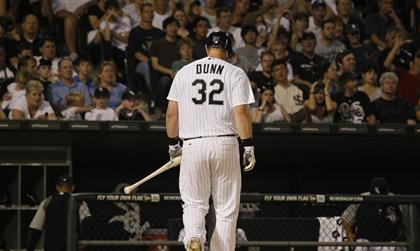
#231 – Adam Dunn

dunnx-wide-communityName: Adam Dunn

Rank: 231

Position: DH

Years With White Sox: 2011-Present

The White Sox first focused in on Adam Dunn at the trade deadline in 2010, but he wasn’t interested in moving to the American League and becoming a designated hitter.  Unfortunately, when he became a free agent that winter, the White Sox threw enough money at him to get him to change his mind.  It was a move that was wildly praised at the time, but may go down in history as one of the worst free agent deals of all time.

Dunn’s White Sox career got off to a strong start, as he went 4 for 14 with a home run and 5 RBIs in his first four games before coming down with appendicitis.  Sadly, after that, things went south.  Dunn finished the season with a .159 average, 11 home runs, 42 RBIs, and a team-record 177 strikeouts.  It was easily the worst season of his, or any one else’s, career.  Had he gotten an additional 6 at bats, qualifying him for the batting title, he would have put up the lowest batting average for a qualified player since Bill Bergen hit .139 for the 1909 Brooklyn Superbas, now known as the Dodgers.

In 2012, Dunn “bounced back”, regaining his power stroke but otherwise still struggling at the plate.  He managed to surpass his 2011 home run total by the end of May and finished with 41.  He also obliterated his team record for strikeouts and set the American League record with 222, one less than Mark Reynold’s major league record.  He also set a major league record for position players, striking out in 36 consecutive games.  When the season wrapped up, he finished with a .204 average and 96 RBIs, and the White Sox, who led the American League Central for most of the season, were out of the playoffs once again.

2013 saw minor improvements for Dunn as the White Sox fell to last place and were never in contention.  Dunn limited his strikeouts to 189 and raised his average up to .219.  As the 2014 season was about to get underway, Dunn’s career average for the White Sox was still under .200 and he’s struck out more than twice as often as he’s gotten a hit.  It’s hard to call his tenure on the south side as anything other than disastrous.

Dunn’s numbers in a White Sox uniform, both for games I attended and overall, were:

Continue reading →

Class Act

CubKonerkoPrior to last night’s finale of this year’s Crosstown series on the north side of town, the Cubs honored Paul Konerko, who is retiring at year’s end.  Jeff Samardzija, who hit Konerko in the head during a 2012 clash at Wrigley Field, presented Konerko with a number 14 from the scoreboard.  Despite not getting in to the game, Konerko finished his career at the Friendly Confines with a .311 average, 7 home runs and 26 RBIs in 35 games.

#232 – Charlie Haeger

Haegerpg-verticalName: Charlie Haeger

Rank: 232

Position: P

Years With White Sox: 2006-2007

Charlie Haeger was selected by the White Sox in the 25th round of the 2001 draft.  He retired after the 2002 season to pursue a career in golf, but returned to baseball and the White Sox organization in 2004.  He finally made his way to the major leagues in 2006, making his debut against the Angels in a 12-5 loss after Jose Contreras went down with a back issue.  After the start, he was quickly returned to Charlotte, but he eventually returned, appearing in 6 other games, all in relief, for the White Sox that year, finishing with a 3.44 ERA.

Haeger competed for the fifth starters spot during spring training in 2007, but was sent back to Charlotte again when the newly arrived John Danks won the competition.  As the 2007 season went south, Haeger was recalled in mid-July, and, like the rest of the team that year, did poorly.  He appeared in 8 games, giving up 9 earned runs in 11 1/3 innings.

Haeger spent most of 2008 at Triple A Charlotte, until he was designated for assignment and claimed by the Padres in September, ending his time in the White Sox organization.

Haeger’s numbers in a White Sox uniform, both for games I attended and overall, were: Continue reading →

Ballpark Tour: Dodger Stadium

dodgerstadium

Stadium Name: Dodger Stadium

Location: Los Angeles

Home Team: Dodgers

Years in Service: 1962 – Present

Visits: 1

Following the 1957 season, the Dodgers fled Brooklyn and headed west to California, landing in Los Angeles.  The team played in the LA Coliseum while they built a new stadium at Chavez Ravine.  In 1962, 3 years after breaking ground, Dodger Stadium opened as the Reds topped the Dodgers in the season opener.

The following year, the Dodgers won their first World Series in their new home.  Between 1962 and 1965, Sandy Koufax threw three no hitters at the stadium, including a perfect game against the Cubs.  Four home runs have been hit out of Dodger Stadium, two of which were hit by Pirate great Willie Stargell.

Dodger Stadium is currently the third oldest park still in use, behind Fenway Park and Wrigley Field.  Two weeks ago, I made my first visit to the stadium to see the second home game of the 2014 slate, with the Dodgers taking on their long time rival Giants.  Thanks to traffic, I didn’t get to my seat until the 4th inning, by which point the Giants had secured a substantial lead.  I sprung for decent seats, which put me down on the lower level.  One odd thing about those lower sections were the aisles, which are so narrow that people could only go in one direction at a time.  I did also manage to score a fabled Dodger Dog, or at least the all beef version of it.  I hope to make it back some day for a repeat performance.

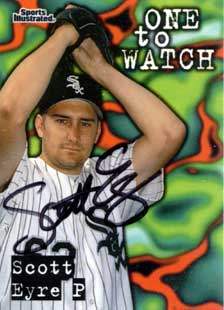
#233 – Scott Eyre

scott_eyre_autographName: Scott Eyre

Rank: 233

Position: P

Years With White Sox: 1997-2000

Scott Eyre joined the White Sox organization in a 1994 trade that sent Esteban Beltre to the Rangers.  He made his way to the major leagues on August 1, 1997, lasting 4 1/3 innings in a losing start against the Angels.  He would start 10 more games over the final two months of the season, finishing with a 4-4 record but with a 5.04 ERA.

Eyre split the 1998 season between the rotation and the bullpen.  His record dropped to 3-8 and his ERA rose to 5.38.  His struggles continued in 1999, where he started for Triple A Charlotte but worked exclusively in relief for the big league club.  His ERA ballooned up to 7.56, giving up 21 runs in his 21 games.

In 2000, he stuck to the bullpen, both in Triple A and, for the most part, for the White Sox.  He did manage to lower his ERA down to 6.63, but it wasn’t enough to make the playoff roster for the Central Division champions.

Following the season, Eyre was traded to the Blue Jays for fellow pitcher Gary Glover.

Eyre’s numbers in a White Sox uniform, both for games I attended and overall, were: Continue reading →