 Originally founded in 1869, the Chicago Cubs became a charter member of the National League in 1876. Over the next 150 seasons, the Cubs have played more than 22,000 games, scored over 103,000 runs and recorded more than 200,000 hits, more than any other team in baseball history. Nearly 2,300 players have worn a Cubs uniform, earning eight division titles, 17 NL pennants, and three World Series championships.
Fans have witnessed generations of unforgettable players, from historical heroes like Joe Tinker, Gabby Hartnett, Ernie Banks, and Billy Williams to more recent stars like Ryne Sandberg, Derrek Lee, Kerry Wood, and Anthony Rizzo. The team has called Wrigley Field home for 110 of those 150 seasons.
To celebrate this milestone, the Cubs are holding a fan vote to select the franchise’s anniversary team. Each week, we will go through the provided options for each position and declare who should, and, if different, who will, win the fan vote. We start today with the eight selections for second baseman.
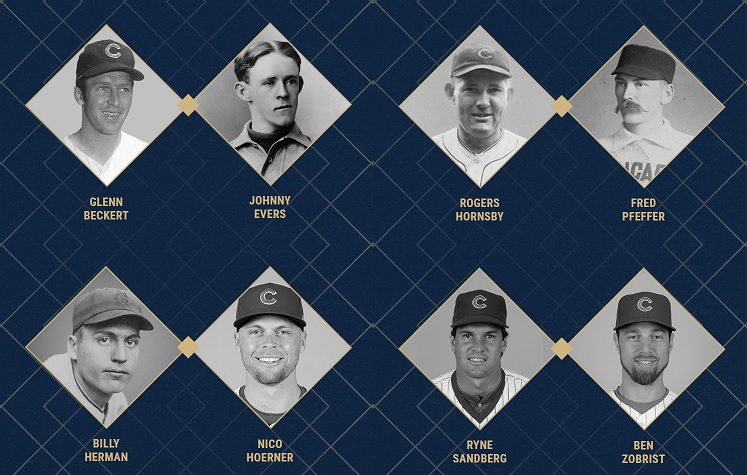 Glenn Beckert was called up by the Cubs in 1965, spending the next nine seasons as the team’s second baseman. He won the Gold Glove in 1968 and was a four-time All-Star. His best offensive season came in 1971, when he finished third in the NL with a career-best .342 batting average.
Johnny Evers played for the Orphans/Cubs from 1902 through 1913. Known as “The Human Crab” for his combative play and fights with umpires, he earned a place in baseball history as part of the famous “Tinker-to-Evers-to-Chance” double-play combination thanks to the poem Baseball’s Sad Lexicon. Evers was responsible for alerting umpires to the baserunning mistake that would come to be known as “Merkle’s Boner”. He was part of three NL pennant winners with the Cubs, winning the championship in 1907 and 1908, and was elected to the Hall of Fame in 1946.
Billy Herman spent the first eleven years of his career with the Cubs, hitting over .300 in seven of his first nine seasons. He led the league in games played (twice), hits, doubles, and triples across his nine full seasons. During that time, he was named an All-Star seven straight times, beginning in 1934. He was elected to the Hall of Fame in 1975.
Nico Hoerner was drafted by the Cubs in 2018. When Javier Baez and Addison Russell went down with injuries in early September of the following year, Hoerner was called up to step in despite already having returned home following the end of the minor league season, going 3-4 with four RBI in his debut. To date, he has won two Gold Glove awards. Earlier this year, he signed a six-year contract extension which should keep him on the north side through 2032.
Rogers Hornsby joined the Cubs in 1929 when financial difficulties forced the Braves to trade the star infielder. In his first season, he set team records, both of which still stand today, with a .380 batting average, the highest mark in the modern era, and 156 runs scored, while leading the team to the NL pennant and winning the MVP award. Unfortunately, that was the only year he would play a full season while with the Cubs. With four games left in the 1930 season, he became the team’s player-manager, a position he held until August of 1932, when he was fired and released, having played only 19 games.
Fred Pfeffer spent three tours of duty with the franchise that would eventually become known as the Cubs, first joining the White Stockings from 1883-1889. After moving to the upstart Player’s League in 1890, he returned to the Colts in 1891, before being traded away due to a strained relationship with manager Cap Anson. He returned in 1896 and retired after injuries limited him in 1897. A member of the so-called “stonewall infield”, he was a strong defensive player who was one of the last players who refused to wear a baseball glove.
Ryne Sandberg was acquired by the Cubs from the Phillies in January of 1982. After playing mostly third base that season, he transitioned to his more familiar second base starting in 1983, where he would become a mainstay for the next decade plus. He earned his first Gold Glove in 1983 before exploding in 1984, winning the NL MVP, Silver Slugger, and Gold Glove awards while leading the league with 114 runs and 19 triples as the Cubs made their first postseason appearance since 1945. Consistently a star from then on in, he struggled early in 1994 and, with rumored marital issues at home, he abruptly retired on June 13th. Following a divorce and a new marriage, Sandberg returned to the Cubs in 1996 before retiring for good following the 1997 season. He finished his career with ten All-Star selections, nine Gold Gloves, seven Silver Slugger awards, and, in 2005, he was inducted to the Hall of Fame and had his #23 retired. In 2024, a statue of Sandberg was unveiled on Gallagher Way outside Wrigley Field.
Ben Zobrist spent the final four seasons of his career with the Cubs. He made his mark immediately, earning 2016 World Series MVP honors after knocking in the winning runs in extra innings in Game 7 against Cleveland. The remainder of his tenure was mixed, and, due to marital issues, he missed a large part of the 2019 season. He retired following the season.
This one is a fairly easy pick, as Ryne Sandberg should easily take the top spot for this position.