The Time Of Your Life

After a disastrous 2021 that saw his reunion with the Cubs end with his August release followed by an even worse stint with the Padres, Jake Arrieta called it a career earlier this week.  Arrieta, 36, debuted with the Orioles in 2010.  He was acquired by the Cubs in July of 2013, in what turned out to be one of the best trades in team history, in a trade for Scott Feldman and Steve Clevenger.  He left the Cubs as a free agent after the 2017 season and signed with the Phillies on a 4-year deal.

After being acquired by the Cubs, Arrieta was sent to Triple A, where he made seven starts for Iowa before being recalled to the rebuilding big league club, showing vast improvement over the pitcher he was with the Orioles.  He turned into an ace for the Cubs in 2015, winning the NL Cy Young Award, and was a key contributor to their World Series championship in 2016.  He threw two no-hitters for the team, one in 2015 against the Dodgers and the second in 2016 against the Reds.  Injuries after the 2017 season left him a shell of his former self, but the Cubs rolled the dice for 2021, hoping for a miracle.  Instead, they got a rude awakening, as Arrieta set the team record for highest ERA for a pitcher in a season with at least 20 starts.  He followed up his last game, where he gave up 8 hits and 7 runs in the first inning, with a post-game tirade where he berated a reporter for wearing a mask, which he was required to do by city regulation, during a Zoom press conference.

For a brief period of time during the 2015 and 2016 seasons, Jake Arrieta was the best pitcher in baseball.  He was a key contributor to the 2016 World Series championship, earning him a place in Cubs lore for years to come.  His horrid performance in 2021, both on the field and as a functioning member of society, did little to hurt that standing.  I’m sure later this year or next year, there will be a Jake Arrieta Day at Wrigley Field, where he will rightly be feted as he throws out a first pitch and sings during the 7th inning stretch.

Mornings With The Peacock

On the heels of last month’s announcement of an exclusive streaming deal with Apple TV+, MLB announced another streaming deal, this time with Peacock, owned by NBC.  Worth an estimated $30 million to the poor MLB owners, the deal gives Peacock an exclusive window on Sunday mornings through 12:30 PM CT.  Games will begin at 10:30 CT through June 12, then move to an 11 AM start time for the remainder of the season.  In addition, Peacock will be the exclusive home of the Futures Game during All Star festivities and will also feature classic MLB games, award-winning documentaries from the MLB Film & Video Archive, and highlight packages available on-demand in a new MLB hub.

The Peacock slate kicks off on May 8 with the White Sox visiting the Red Sox and will be simulcast on NBC.  The south siders make an additional appearance in August while visiting the Guardians.  The Cubs, meanwhile, make their sole appearance while visiting the Phillies in July.  It is a shame that all three of these games are on the road.  It would be interesting to attend a game with an 11:00 (or earlier) start.

As I said last month, I see MLB expanding its reach into the streaming world to be a good thing.  Some will say that with these new exclusive deals, MLB is spreading their product around a little too much and they do have a point.  In order to watch every White Sox game this season as it happens, one would have to have access to NBC Sports Chicago, FOX, FS1, ESPN, Apple TV+. and Peacock.  That’s a lot of different services.  But how many fans actually try to watch every single game?  For the casual fan, MLB having a wide footprint can only be a good thing as they try to build the next generation of hard-core fans.

All Time Team Records

After a long lockout and an abbreviated spring training, the 2022 baseball season finally gets underway today, so, to celebrate, it is time once again to look at the all-time team records for games that I have identified as having attended dating back to 1984.  Last year, I tied 2004 for my 5th highest game total of all time and managed to see 25 out of the 30 teams, so there should be some nice changes.  Thanks to a name change, the all-time record of the Cleveland Indians become static moving forward, forever stuck at 4 games over .500.

The White Sox look to once again lead an improving AL Central and move past the ALDS in the post-season, while the Cubs are neither contending nor rebuilding.  The 2022 season should be an interesting one on both sides of town, even more interesting if we are able to see it in person.

All-Time Team Records
Team Name Won Loss Winning Pctg
California Angels 2 0 1.000
Arizona Diamondbacks 14 2 0.875
Florida Marlins 15 8 0.652
Colorado Rockies 10 6 0.625
New York Yankees 17 11 0.607
Boston Red Sox 19 13 0.594
Los Angeles Angels 20 14 0.588
Toronto Blue Jays 15 11 0.577
Philadelphia Phillies 11 9 0.550
Washington Nationals 7 6 0.538
Cleveland Indians 31 27 0.534
Chicago White Sox 335 307 0.522
Chicago Cubs 224 206 0.521
Houston Astros Continue reading →

2022 Predictions

After 99-day lockout and a truncated spring training schedule, the 2022 baseball season is finally scheduled to kick off tomorrow with a slate of games.  For the twelfth consecutive year, I’ve looked into the crystal ball to make my picks for the upcoming season, including an additional Wild Card pick for each league.

American League

East: Blue Jays

Central: White Sox

West: Astros

Wild Cards: Yankees, Angels, Red Sox

AL Champion: Yankees

Cy Young: Lucas Giolito

MVP: Vladimir Guerrero Jr.

National League

Continue reading →

By The Numbers – 19

In 1929, uniform numbers appeared on the back of baseball jerseys for the first time, thanks to the Indians and the Yankees.  By 1937, numbers finally appeared across all uniforms, both home and away, across both major leagues.  Since that time, 81 distinct numbers have been worn by members of the White Sox, while the Cubs boast 76.

Today, we continue our look at those players, picking our favorite, if not the best, player to wear each uniform number for both Chicago teams with #19.  83 different players have donned #19 while playing in Chicago, 32 for the White Sox, one of whom had it retired in his honor, and 51 for the Cubs.

With a new ownership group in place and looking to make a quick splash, the White Sox purchased Greg Luzinski from the Phillies on March 30, 1981.  Coming off a disappointing season, the Chicago-area native, wearing his familiar #19, responded well to the change, hitting .265 with 21 home runs in the strike-shortened season.  He earned Comeback Player of the Year honors, beating out teammate Bill Almon by 5 votes, and finished 23rd in MVP voting.  Luzinski had another strong year in 1982, raising his average to .292, his highest total since 1977, while hitting 18 home runs and driving in 102 runs.

In 1983, Luzinski was a powerful cog in leading the White Sox to their first division title.  He launched the 8th, 9th, and 10th rooftop home runs in Comiskey Park history between June 26 and August 28.  While his average dropped to .255, he hit 32 home runs and drove in 95, good enough to finish 17th in MVP voting.  Like the rest of his teammates, he struggled during the ALCS against the Orioles, hitting only .133 in the 4-game series.  Unfortunately, those struggles carried over in to 1984.  His average dropped again, down to .238, and his power output fell as well, finishing the year with only 13 home runs, his lowest total since 1974, and 58 RBIs.  He did manage to hit his fourth rooftop blast on July 3 against the Tigers.  He became a free agent following the year and decided to retire.

On the north side of town, Matt Murton donned #19 when he made his major league debut for the Cubs on July 8, 2005.  He appeared in 51 games for the Cubs, hitting .321 with a .908 OPS.  That helped earn him the starting nod in left field for 2006, where he managed to post a .297 batting average with 13 home runs and 62 RBIs.  Despite his success, Murton saw his playing time diminish in 2007 after the Cubs signed Cliff Floyd, even getting sent back to Triple A in June.  He returned in late July, and finished the year with a .281 average and a .791 OPS in only 94 games.  His playing time was diminished ever further in 2008, appearing in only 19 games before being traded, 4 years to the day of his major league debut, to the A’s, as part of the haul for Rich Harden.

Remember When There Was A 10,000 Step Club?

Things were a lot different two years ago, as I was finishing up my fifth year using a Fitbit.  I had just added 45 new 10,000 step days, my 3rd best year to date, and, with upcoming trips to Boston and California already on the docket, things were looking good to add a good number more and add some new tales to this list of my top 25 step days.  Then, the corona virus happened, and the world basically shut down for the next two years.  I’ve worked from home since March of 2020, which gives me a lot more free time, but also significantly cut down on my natural daily step totals.  All told, I managed only 5 10,000 step days for the just completed seventh year of Fitbit usage, which, granted, is better than last year and gives me a total of 270 since I started keeping track back in 2011.  With that in mind, here’s the list of my top 25 step days, which has stayed static for two years now.

1: 4/14/2018 – 27,470 steps

My best single day total is from my April 2017 trip to New York to see Angelina.  The day’s excursions included trips to the 9/11 Memorial & Museum, the Museum of the City of New York, Central Park, the Guggenheim museum, and the Empire State Building.

2: 7/21/2018 – 27,278 steps

My July 2017 trip to Virginia, to hike up Catawba Mountain to McAfee Knob with Jeff and Val, fell just short of the top spot.

3: 6/6/2013 – 24,988 steps

2013’s trip to Disney World, which spent 5 years as my single day best, included excursions to both Epcot Center and the Magic Kingdom, and yes, falling 12 steps short of 25,000 still irks me.

4: 6/3/2019 – 24,665 steps

The first full day of 2019’s summer trip to Washington DC spent most of the day at the Smithsonian Zoo.

5: 8/8/2019 – 23,866 steps

Late in the summer of 2019, I spent two weeks in San Francisco for a work trip.   On my last full day, I went out after work, walking to Pier 39 and then back the other direction to Oracle Park to see the Giants take on the Phillies.  My totals would have been even higher, but I was dead tired and took an Uber back to the hotel after the game.

6: 3/18/2018 – 23,780 steps

My first day in Las Vegas for the 2017 IBM Think conference, the day’s totals include gallivanting around town, including a late night trip up to Caesar’s Palace from the MGM Grand to see Absinthe.

7: 10/24/2018 – 23,362 steps

My October 2018 trip to Boston to see Angelina for our birthday gives us our next entry.  While she was in class, I took tours of Fenway Park and Harvard, before meeting up with her for a late lunch and then heading to the airport for the trip home.

8: 3/22/2016 – 22,493 steps

My one-time second highest day took place during the ill-fated trip to Disney World in March of 2016.  The day’s excursion started at Hollywood Studios before heading over to Epcot Center with Jeff and Val.

9: 7/27/2013 – 20,592 steps

Still my highest total at home in the state of Illinois, the next entry comes thanks to the 2013 BTN 5K and a, for lack of a better word, misunderstanding about where I should be picked up after the race.

10: 12/29/2018 – 20,374 steps

We wrap up the top 10 with 2018’s trip to California and the trip to Disneyland to see Danny perform with the Lincoln-Way Marching Band.

11: 8/5/2017 – 20,218 steps

The next entry came in August of 2017 on the first day of my trip to Boston with Danny and Michael.  After landing in town, we traipsed to the Science Museum, a breakfast joint, our hotel, and, finally, Fenway Park.

12: 7/14/2017 – 20,208 steps

Down to #12 is my 2017 trip to Disney World, a one day journey with Angelina to celebrate her high school graduation. Continue reading →

Against The Phillies All Time Leaders – Through 2021

Philadelphia_PhilliesIn the past, we’ve looked at the all time leaders in both offensive and defensive categories for all 30 teams.  This offseason, we will take our first ever look at those leaders against all 30 clubs.  We continue today with the Philadelphia Phillies.

The Phillies began life in 1883, and are the oldest continuous franchise that hasn’t moved cities or changed names.  I’ve seen them play 20 times, including three times in the city of San Francisco.

Home Runs

Name Total
Sammy Sosa 4
Aramis Ramirez 2
Anthony Rizzo 2

Hits

Name Total
Aramis Ramirez 12
Jacque Jones 8
Ryan Theriot 6
Alfonso Soriano 6

Runs

Name Total
Sammy Sosa 6
Derrek Lee 6
Aramis Ramirez 4
Anthony Rizzo 4

RBI

Name Total
Aramis Ramirez 8
Sammy Sosa 6
Jacque Jones 5

Doubles

Name Total
Aramis Ramirez 4
Jacque Jones 3
Mark Grudzielanek 3
Derrek Lee 2
Jeff Kent 2
Kris Bryant 2

Triples Continue reading →

By The Numbers – 22

In 1929, uniform numbers appeared on the back of baseball jerseys for the first time, thanks to the Indians and the Yankees.  By 1937, numbers finally appeared across all uniforms, both home and away, across both major leagues.  Since that time, 81 distinct numbers have been worn by members of the White Sox, while the Cubs boast 76.

Today, we continue our look at those players, picking our favorite, if not the best, player to wear each uniform number for both Chicago teams with #22.  76 different players have donned #22 while playing in Chicago, 26 for the White Sox and 50 for the Cubs.

Acquired from the Dodgers, along with Ivan DeJesus, in exchange for Rick Monday and Mike Garman, Bill Buckner joined the Cubs, wearing #22, in 1977.  A staph infection in his ankle the previous year caused the Cubs to move the former outfielder to first base, a position he would man for the rest of his career.  Appearing in 122 games, he hit .284 with 11 home runs and 27 doubles.  He improved in 1978, raising his average to .323 and placed 17th in MVP voting.  1979 was another steady year for Buckner.  On May 17th, in the infamous slugfest where the Cubs lost 23-22 to the Phillies, he went 4–for–7 with a grand slam and a career-high seven RBIs.  He finished the year hitting .284 with 14 home runs and 34 doubles, but was also described as “nuts” when manager Herman Franks resigned late in the season.

In 1980, Buckner won a batting title, hitting .324 while striking out only 18 times, earning him a 14th place finish in MVP voting.  In the strike-shortened 1981 season, he was the lone Cub representative for the All Star game and batted .311 while tying Cecil Cooper for the major league lead with 35 doubles.  1982 saw Buckner hit over .300 for the fourth time as a Cub while racking up career highs in hits, with 201, RBIs, with 105, and assists at first base, setting a major league record with 159.

In 1983, Buckner again led the NL with 38 doubles, but saw his batting average drop to .280, his lowest finish as a Cub.  With the acquisition of Gary Matthews in 1984 pushing Leon Durham to first base, Buckner found himself the odd man out.  Appearing mostly as a pinch hitter, Buckner hit a paltry .209 through the end of May, when he was traded to the Red Sox, ending his Cub tenure.

Scott Podsednik was acquired by the White Sox from the Brewers for Carlos Lee on December 13, 2004.  Wearing #22, he moved in to the leadoff spot and, after putting up a .294 average with 44 steals in the first half, he earned his first All Star game nod.  While injuries slowed him in the second half, he was back to full strength when the regular season came to an end and the White Sox embarked on their first post-season appearance in 5 years.  After going the entire regular season without a home run, Podsednik went deep against the Red Sox in Game 1 of the ALDS, helping the White Sox to a 14-2 victory on their way to a 3 game sweep of the defending champions.  Podsednik continued his steady play during the ALCS, hitting .294 with a triple and 3 stolen bases in the 5 game series.  The shining moment of his career came in Game 2 of the World Series, thanks to a walkoff home run against Brad Lidge in the 9th inning, giving the White Sox a 2-0 lead on their way to a sweep and their first world championship in 88 years.  For his efforts, Podsednik finished in 12th place for MVP voting.

As the White Sox looked to repeat in 2006, Podsednik found it difficult to duplicate his efforts from the year before.  His average was down 29 points, to .261, and his stolen base total was off by 19.  Injuries limited Podsednik to 62 games in 2007.  His offensive production continued to be lacking and, after the White Sox fell completely out of contention for the first time in years, the team decided to change their approach and gave Podsednik his release.  He returned to the White Sox organization in 2009, signing a minor league deal.  Injuries to Brian Anderson, Dewayne Wise, and Carlos Quentin gave him plenty of opportunity with the big league club, and he responded by hitting .304, his highest total since 2003.  Following the season, he became a free agent.

By The Numbers – 23

In 1929, uniform numbers appeared on the back of baseball jerseys for the first time, thanks to the Indians and the Yankees.  By 1937, numbers finally appeared across all uniforms, both home and away, across both major leagues.  Since that time, 81 distinct numbers have been worn by members of the White Sox, while the Cubs boast 76.

Today, we continue our look at those players, picking our favorite, if not the best, player to wear each uniform number for both Chicago teams with #23, one of the most famous and successful numbers in city history across all sports.  67 different players have donned #23 while playing in Chicago, 35 for the White Sox and 31 for the Cubs, including a familiar face for both sides of town.

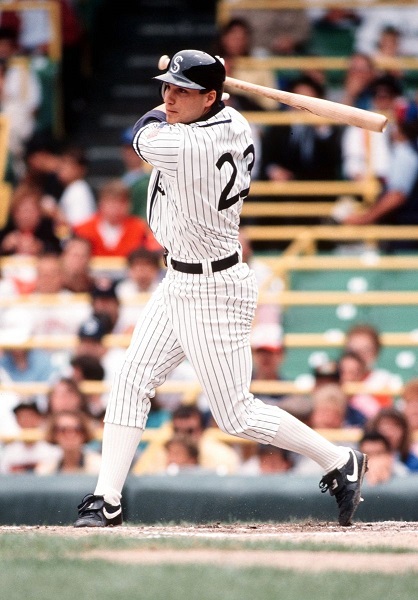
Robin Ventura made his major league debut donning #23 in September of 1989, appearing in 16 games down the stretch, hitting only .178 while driving in 7 runs in 45 at bats.  A good spring in 1990 led to Ventura breaking camp with the White Sox, but he struggled both on the field and at the plate, suffering through a horrendous 0-for-41 slump while committing 25 errors over the course of the season.  He finished the year with a .249 average, 5 home runs, and 54 RBIs and placed 7th in Rookie of the Year voting and was named to the Topps All Star Rookie team.

Ventura and the White Sox moved in to the new Comiskey Park in 1991, hoping to improve on the previous year’s growth.  He improved his fielding enough to earn his first Gold Glove award and, at the plate, he set a White Sox team record for RBIs by a third baseman, finishing with an even 100.  He upped his average to .284 and hit 23 home runs.  His work was enough to garner enough MVP votes to finish in 20th place.  1992 was another good year for Ventura.  He earned his first All Star nod, going 2-2 in the AL’s victory at Jack Murphy Stadium.  He finished the year with a .282 average, 16 home runs, and 93 RBIs.  He also snagged his second consecutive Gold Glove award.  Ventura continued his successful ways in 1993, collecting his 500th hit in May and, on August 4, entering the public consciousness with an event that would come to define his entire career.  While batting against the Rangers, Ventura was hit by a pitch thrown by Nolan Ryan and charged the mound.  Ryan, 20 years Ventura’s senior, placed him in a headlock and punched him several times, starting a bench-clearing brawl that was voted the best baseball brawl of all time by SportsCenter.  After the season, he was awarded his third consecutive Gold Glove award.

The strike in 1994 saw Ventura’s streak of 90 RBI seasons and Gold Gloves come to an end.  When baseball stopped in August, Ventura was hitting .282 with 18 home runs and 78 RBIs, while posting a new career high with an .832 OPS.  When play resumed in late April 1995, Ventura struggled out of the gate, committing ten errors in the first ten games.  As the White Sox started to tear down the team that had finished the previous two seasons on top of their division, trade rumors started to follow Ventura, though nothing came to fruition.  On September 4, he became the eighth player in history to hit two grand slams in one game, and the first since Frank Robinson in 1970.  He finished the year setting career highs with a .295 average, an .882 OPS, and 26 home runs while driving in 93 runs.  Ventura had the best year of his career to date in 1996, setting White Sox team records in career home runs by a third baseman, with 142, and grand slams, with 9.  He set new career highs with 34 home runs, 105 RBIs, 2 triples, an OPS of .888, and a .974 fielding percentage at the hot corner.  He hit .287, while earning his fourth Gold Glove award.

1997 turned into a dismal year for both Ventura and the White Sox.  During a spring training game, Ventura caught his foot in the mud while sliding into home plate and suffered a broken and dislocated right ankle.  Expected to miss the entire season, he returned on July 24, collecting the game-winning hit that night, and homered in his first at-bat the next night.  With the White Sox only 3.5 games behind the Indians in the standings, a healthy Ventura might have put them over the top.  A week later, the team threw in the towel in what eventually became to be known as the White Flag Trade, sending 3 pitchers to the Giants for prospects.  “We didn’t realize Aug. 1 was the end of the season,” said an upset Ventura.  He finished the year appearing in 54 games, hitting .262 with 6 home runs and 26 RBIs.  Entering the last year of his contract in 1998, the White Sox made little attempt to sign Ventura to an extension, with owner Jerry Reinsdorf claiming his skills were “deteriorating” after his injury the year before.  With more trade rumors following him throughout the season, he finished the year with a .263 average, 21 home runs, and 91 RBIs while earning his fifth Gold Glove award.  Following the season, he became a free agent, ending his White Sox playing career.

Continue reading →

By The Numbers – 25

In 1929, uniform numbers appeared on the back of baseball jerseys for the first time, thanks to the Indians and the Yankees.  By 1937, numbers finally appeared across all uniforms, both home and away, across both major leagues.  Since that time, 81 distinct numbers have been worn by members of the White Sox, while the Cubs boast 76.

Today, we continue our look at those players, picking our favorite, if not the best, player to wear each uniform number for both Chicago teams with #25.  87 different players have donned #25 while playing in Chicago, 51 for the White Sox and 36 for the Cubs.

Acquired by the Cubs following the 2003 season for Hee Seop Choi, Derrek Lee, wearing #25, quickly became a mainstay of the Cubs lineup.  He hit .278 with 32 home runs and 98 RBIs in his first year on the north side.  2005 was a career year for Lee, and that was just in the first half.  He led the majors with a .376 average and 72 RBIs while tying for the lead with 27 home runs.  For the full season, he hit 46 home runs and a .335 average, the highest for a Cub since Bill Madlock in 1976 and he notched the first batting title for a Cub since Bill Buckner in 1980.  When it was all said and done, he had won the Gold Glove and Silver Slugger awards and finished third in MVP voting.

A broken wrist limited Lee to 50 games in 2006, but he rebounded in 2007 to hit .317 with 22 home runs as the Cubs won their first NL Central title since 2003.  Lee went 4 for 12 as the Cubs were swept in 3 games by the Diamondbacks.  Another strong season in 2008, with a .291 average, 20 home runs, and 90 RBIs helped push the Cubs back to the post-season.  Lee did all he could, hitting .545 in the NLDS against the Dodgers, but the Cubs were once again swept.  Lee overcame a slow start in 2009 thanks to a 21 game hitting streak and finished with a .306 batting average, 35 home runs and 111 RBIs, which earned him enough votes to finish ninth in MVP voting.

2010 was a strange year for Lee and the Cubs.  On June 9th, he hit his 300th career home run.  Later that month, however, he would get in to a fight in the dugout with Carlos Zambrano, which led to a suspension for Zambrano.  In the last year of his contract and with the team going nowhere fast, Lee was traded to the Braves on August 18th, ending his Cub tenure.

Looking to reload after winning their first World Series championship in 88 years, the White Sox acquired Jim Thome from the Phillies for Aaron Rowand, Gio Gonzalez, and Daniel Haigwood.  Thome, wearing his familiar #25, made an immediate impact, setting a major league record by scoring in each of Chicago’s first 17 games and setting the team record with 10 home runs in April.  By season’s end, Thome had put up a .288 average with 42 home runs, 102 RBIs, and an OPS of 1.014.  One of the few bright spots for the 2007 White Sox came in mid-September, when Thome, on his bobblehead day, launched his 500th career home run, the first player to do so on a walk-off.  For the year, Thome hit .275, with 35 home runs and 96 RBIs.  2008 was a bit of a down year for Thome, as his average and OPS both fell, but he still managed 34 home runs and 90 RBIs.  The most important of each came in the 163rd game of the year, as he hit a solo home run to give the White Sox a 1-0 victory over the Twins and the Central Division title.  With the White Sox going nowhere in 2009, Thome was traded to the Dodgers on August 31 for a warm body.