150 Years Of Cubs Baseball – Starting Pitchers Part 3

Originally founded in 1869, the Chicago Cubs became a charter member of the National League in 1876.  Over the next 150 seasons, the Cubs have played more than 22,000 games, scored over 103,000 runs and recorded more than 200,000 hits, more than any other team in baseball history.  Nearly 2,300 players have worn a Cubs uniform, earning eight division titles, 17 NL pennants, and three World Series championships.

Fans have witnessed generations of unforgettable players, from historical heroes like Joe Tinker, Gabby Hartnett, Ernie Banks, and Billy Williams to more recent stars like Ryne Sandberg, Derrek Lee, Kerry Wood, and Anthony Rizzo.  The team has called Wrigley Field home for 110 of those 150 seasons.

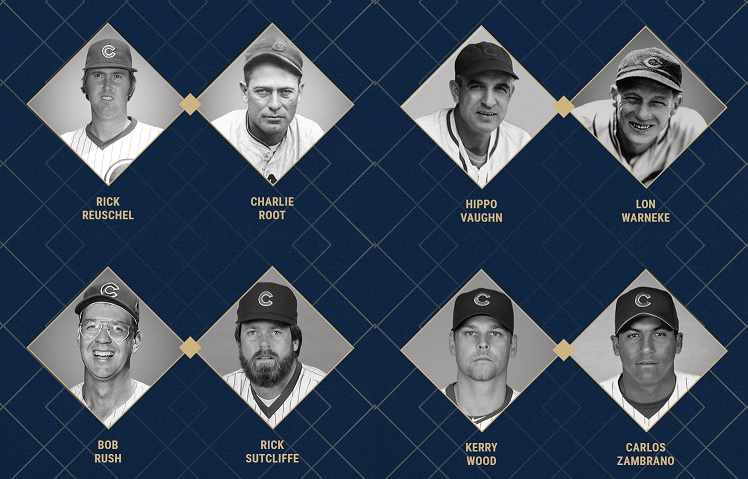
To celebrate this milestone, the Cubs are holding a fan vote to select the franchise’s anniversary team.  Each week, we will go through the provided options for each position and declare who should, and, if different, who will, win the fan vote.  We start today with the final eight selections for starting pitcher.

Rick Reuschel, a native of central Illinois, spent parts of twelve seasons across two stints with the Cubs, from 1972-1981 and again from 1983-1984.  From 1975-1978, he was teammates with his brother Paul, also a pitcher.  His best season came in 1977, when he won 20 games, made his lone All-Star team as a Cub, and finished third in Cy Young award voting.  After being traded in 1981, he returned to the Cubs in 1983 following a rotator cuff injury.  He is a member of the Cubs Hall of Fame.

Charlie Root spent the majority of his major league career with the Cubs, from 1926-1941.  In 1927, he led the National League with 26 wins, 48 games, 309 innings pitched, and, unfortunately, 117 walks.  In the 1932 World Series, Root was on the mound for Babe Ruth’s infamous called shot home run, though he would dispute the account.  Overall, he appeared in four World Series as a Cub and received some MVP support in five of his sixteen seasons.  He is a member of the team’s Hall of Fame.

Bob Rush debuted with the Cubs in 1948, spending ten seasons on the north side.  A two-time All-Star, he led the NL with 20 losses in 1950.  He was a steady, if unspectacular, mainstay of the Cub rotation during the fallow period following their final World Series appearance of the 20th century in 1945.

Continue reading →

150 Years Of Cubs Baseball – Outfielders Part 3

Originally founded in 1869, the Chicago Cubs became a charter member of the National League in 1876.  Over the next 150 seasons, the Cubs have played more than 22,000 games, scored over 103,000 runs and recorded more than 200,000 hits, more than any other team in baseball history.  Nearly 2,300 players have worn a Cubs uniform, earning eight division titles, 17 NL pennants, and three World Series championships.

Fans have witnessed generations of unforgettable players, from historical heroes like Joe Tinker, Gabby Hartnett, Ernie Banks, and Billy Williams to more recent stars like Ryne Sandberg, Derrek Lee, Kerry Wood, and Anthony Rizzo.  The team has called Wrigley Field home for 110 of those 150 seasons.

To celebrate this milestone, the Cubs are holding a fan vote to select the franchise’s anniversary team.  Each week, we will go through the provided options for each position and declare who should, and, if different, who will, win the fan vote.  We continue today with the final eight selections for outfielder.

Frank Schulte debuted for the Cubs in September of 1904.  He was part of four pennant-winning teams, including the back-to-back championships in 1907 and 1908.  He led the NL in home runs in 1910 and 1911, when he became the first player in MLB history to have 20 or more doubles, triples, home runs, and stolen bases in a single season.  That feat earned him the NL MVP award, then known as the Chalmers Award.  He remained with the Cubs through July of 1916.

Jimmy Sheckard spent seven seasons with the Cubs near the turn of the 20th Century, helping the team to four NL pennants and World Series Championships in 1907 and 1908.  One of the most versatile outfielders of his time, Sheckard still holds the record for most double plays as a left fielder, with twelve in 1911.  His best offensive season also came in 1911, leading the NL in runs and walks, and his 147 walks remains a team record.

Jimmy Slagle manned center field for seven seasons, helping the Cubs win back-to-back-to-back NL championships from 1906-1908, the latter two ending with World Series titles.  He is the first player to accomplish a straight steal of home plate in a World Series in 1907.  A classic leadoff man for his era, Slagle was known for his speed, contact hitting, and exceptional defense.

Continue reading →

150 Years Of Cubs Baseball – Third Basemen

Originally founded in 1869, the Chicago Cubs became a charter member of the National League in 1876.  Over the next 150 seasons, the Cubs have played more than 22,000 games, scored over 103,000 runs and recorded more than 200,000 hits, more than any other team in baseball history.  Nearly 2,300 players have worn a Cubs uniform, earning eight division titles, 17 NL pennants, and three World Series championships.

Fans have witnessed generations of unforgettable players, from historical heroes like Joe Tinker, Gabby Hartnett, Ernie Banks, and Billy Williams to more recent stars like Ryne Sandberg, Derrek Lee, Kerry Wood, and Anthony Rizzo.  The team has called Wrigley Field home for 110 of those 150 seasons.

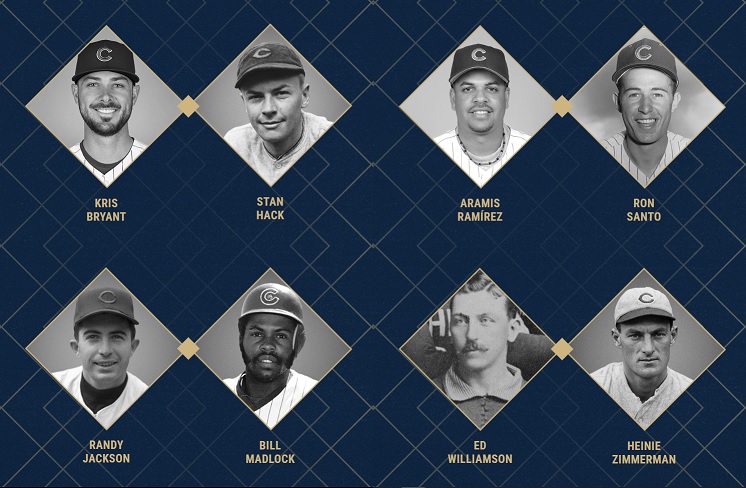
To celebrate this milestone, the Cubs are holding a fan vote to select the franchise’s anniversary team.  Each week, we will go through the provided options for each position and declare who should, and, if different, who will, win the fan vote.  We continue today with the eight selections for third baseman.

Kris Bryant was selected by the Cubs as the second-overall pick in the 2013 draft.  An injury to Mike Olt early in the 2015 season got Bryant called up to the big leagues and he did not waste time making his presence felt.  Hitting .275 with 26 HRs and 99 RBIs, Bryant won the Rookie of the Year award while leading the surprising Cubs to the NL Wild Card and an appearance in the NLCS.  Things were even better the following year, as Bryant won the NL MVP and the Cubs ended their 108-year title drought by defeating Cleveland in the World Series.  Unfortunately, neither Bryant nor the Cubs could replicate the highs of that year.  He was traded to the Giants at the trade deadline in 2021, finishing his time on the north side as a four-time All-Star and winner of the 2016 NL Hank Aaron Award.

Stan Hack spent his entire 16-year career with the Cubs, becoming the full-time third baseman in 1934.  He appeared in four World Series for the Cubs, losing efforts in 1932, 1935, 1938, and 1945.  When he retired following the 1947 season, he ranked second in team history behind Cap Anson in games played, at bats, and hits.  He twice led the National League in stolen bases and was a five-time All-Star selection.  He is a member of the Cubs Hall of Fame.

Randy Jackson spent parts of seven seasons across his two stints with the Cubs.  He debuted in 1950 and earned All-Star nods in 1954 and 1955.  Traded to the Dodgers following that 1955 season, he returned in 1959 for a final season after a knee injury derailed the trajectory of his career.

Continue reading →

150 Years Of Cubs Baseball – Catchers

Originally founded in 1869, the Chicago Cubs became a charter member of the National League in 1876.  Over the next 150 seasons, the Cubs have played more than 22,000 games, scored over 103,000 runs and recorded more than 200,000 hits, more than any other team in baseball history.  Nearly 2,300 players have worn a Cubs uniform, earning eight division titles, 17 NL pennants, and three World Series championships.

Fans have witnessed generations of unforgettable players, from historical heroes like Joe Tinker, Gabby Hartnett, Ernie Banks, and Billy Williams to more recent stars like Ryne Sandberg, Derrek Lee, Kerry Wood, and Anthony Rizzo.  The team has called Wrigley Field home for 110 of those 150 seasons.

To celebrate this milestone, the Cubs are holding a fan vote to select the franchise’s anniversary team.  Each week, we will go through the provided options for each position and declare who should, and, if different, who will, win the fan vote.  We continue today with the eight selections for catcher.

Willson Contreras first joined the Cubs in 2016 and became the 30th player in modern MLB history to hit a home run on the first pitch of his first major league at bat.  Contreras made it on to the post-season roster and helped the Cubs end their 108-year title drought in winning the 2016 World Series.  He became the everyday starting catcher in 2017 and was elected to the All-Star team three times.  He spent parts of seven seasons behind the plate for the Cubs, appearing in 30 postseason games across four seasons.

Jody Davis joined the Cubs in April of 1981, quickly becoming the team’s starter.  During his Cub tenure, he was named to two All-Star teams and won the Gold Glove in 1986, a season where he set the all-time MLB record for number of baserunners caught stealing with 89.  Davis remained with the Cubs through most of the 1988 season.  He will be inducted into the team’s Hall of Fame later this year.

Silver Flint played for the White Stockings from 1879-1889.  He, alongside pitcher Larry Corcoran, is believed to have developed the first system of signs between a pitcher and catcher to indicate pitch selection.  He was the first catcher in MLB history to catch three no-hitters.  Off the field, Flint had financial difficulties that nearly got him banned from the league.

Gabby Hartnett spent the first 19 years, from 1922-1940, of his career with the Cubs, appearing in six All-Star games and earning the MVP award in 1935.  Perhaps best remembered for the “Homer in the Gloamin’” in 1938, Hartnett was considered the best National League catcher until the emergence of Johnny Bench.  He was elected to the Hall of Fame in 1955.

Continue reading →

A Fallen Icon

For the second time in the month, a Chicago baseball legend has lost his life prematurely due to cancer.  Former Cubs second baseman Ryne Sandberg, who had been suffering from metastatic prostate cancer for over a year, died Monday at 65.

Ryne Sandberg was acquired by the Cubs, along with Larry Bowa, from the Phillies for Ivan DeJesus in January of 1982.  He was the primary third baseman for the Cubs during the 1982 season, hitting .271 with 7 home runs and 54 RBIs, good enough to place sixth in Rookie of the Year voting.  After the Cubs acquired Ron Cey following the season, they moved Sandberg to second base, where he would become a mainstay for the next decade plus.

1983 saw Sandberg garner his first Gold Glove while hitting .261 with 8 home runs and 48 RBIs.  He blossomed in 1984, as the Cubs made a surprising run at the NL East title.  Sandberg won the MVP, Silver Slugger, and Gold Glove awards while leading the league with 114 runs and 19 triples.  He hit .368 during the NLCS against the Padres, which the Cubs dropped in 5 games.  1985 saw him win another Silver Slugger and Gold Glove, while still earning MVP support despite the Cubs falling to the bottom of the division.  He earned another Gold Glove in 1986, hitting .284 with 14 home runs.  Injuries limited him to 132 games in 1987. but he still took home his fifth consecutive Gold Glove.

Sandberg posted a .741 OPS in 1988, good enough for his third Silver Slugger award and his sixth straight Gold Glove.  The Cubs returned to the post-season in 1989, as Sandberg hit .290 with 30 home runs, which garnered him yet another Silver Slugger and Gold Glove while coming in fourth for MVP voting.  He hit .400 and drove in four in the Cubs’ NLCS loss to the Giants in five games.  In 1990, Sandberg set a career high with 40 home runs, which led the National League, and duplicated his Silver Slugger, Gold Glove, and fourth place for MVP voting results from the previous year.  1991 saw Sandberg win his ninth consecutive, and final, Gold Glove award, breaking a tie with Bill Mazeroski.  In 1992, he won his fifth straight, and seventh overall, Silver Slugger award.  1993 saw Sandberg make his tenth consecutive, and final, All-Star team.

Sandberg struggled out of the gate in 1994, and with rumored marital issues at home, he abruptly retired on June 13th, saying “I lost the desire that got me ready to play on an everyday basis for so many years. Without it, I didn’t think I could perform at the same level I had in the past, and I didn’t want to play at a level less than what was expected of me by my teammates, coaches, ownership, and most of all, myself.”  Following a divorce and a new marriage, Sandberg returned to the Cubs in 1996, hitting .244 with 25 home runs and 92 RBIs.  With his OPS dropping to .711 in 1997, his lowest total since 1983, Sandberg retired for good following the 1997 season.  He was inducted to the Hall of Fame in 2005 and, that August, the Cubs retired his #23.  Last June, a statue of Sandberg was unveiled on Gallagher Way outside Wrigley Field

Crossing Sides Of Town

So far in 2025, Brad Keller, Mike Tauchman, Nicky Lopez, and Reese McGuire pushed the total of players I’ve seen take the field in person for both the Cubs and the White Sox to 47.  With the final round of crosstown kicking off tonight at Rate Field, here’s a look at those players, in alphabetical order.

David Aardsma

After posting a decent season with the Cubs in 2006, Aardsma was traded to the White Sox for Neal Cotts.  Aardsma lasted one season with the Sox, where he was unable to duplicate his success from the year before.

Jason Bere

Drafted by the White Sox in the 36th round in 1990, Bere debuted with the big-league club in 1993, finishing 2nd in Rookie of the Year voting.  After an All Star selection in 1994, injuries marred the remainder of his tenure on the South Side, which ended in 1998.  He resurfaced with the Cubs in 2001 and had a decent season, but he went 1-10 in 2002 before being let go.

Emilio Bonifacio

Bonifacio spent back-to-back partial seasons in Chicago, first for the Cubs in 2014 after signing as a free agent, where he played decently enough to be flipped at the trade deadline, along with James Russell, to the Braves for a young catching prospect by the name of Victor Caratini.  He returned to Chicago in 2015, signing with the White Sox, where he he did not do well at all, hitting .167 in 47 games before being released in August.

Welington Castillo

Debuting with the Cubs in 2010, Castillo spent time behind the plate for the Cubs until May of 2015, when, having been replaced in the starting lineup by Miguel Montero, he was flipped to the Mariners.  He returned to Chicago in 2018 after signing with the White Sox as a free agent.  On May 24th of that season, he was suspended 80 games for a violation of the PED policy.  The White Sox then cut bait following the 2019 season, shipping him off to the Rangers.

Neal Cotts

Acquired by the White Sox in the Billy Koch trade, he debuted with the team in 2003.  He was a key contributor in the bullpen during the 2005 championship season and was the only relief pitcher to appear in all 3 rounds of the playoffs that season.  Following the 2006 season, he was traded to the Cubs for David Aardsma, and he spent the next 3 injury filled seasons on the North Side.

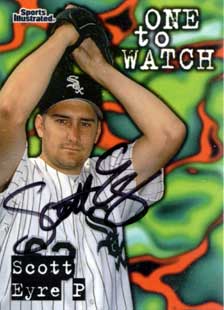
Scott Eyre

Joining the White Sox organization in a 1994 trade with the Rangers, he debuted with the big-league team in 1997.  He split the next 4 seasons between the rotation and the bullpen, not to mention between Chicago and Charlotte, before being moved to the Blue Jays following the 2000 ALDS loss to the Mariners.  He joined the Cubs as a free agent for the 2006 season and enjoyed 2 seasons of relative success, before falling apart in 2008, when he was traded to the Phillies.

Clint Frazier

After missing the second half of 2021 with an injury, Frazier was DFA’d by the Yankees.  He signed a deal with the Cubs that offseason, though he notched just 45 plate appearances before being DFA’s once again.  He chose to finish the year in the Cubs system before becoming a free agent following the season.  After failing to catch on with the Rangers, he signed a minor league deal with the White Sox, eventually hitting .197 in 33 games with the big-league club.

Kosuke Fukudome Continue reading →

The Hall Calls

Sunday night, the results of the Classic Baseball Era Veteran’s Committee vote was revealed, adding two players to the Hall of Fame class of 2025: Dick Allen and Dave Parker.  Parker was named on fourteen ballots from the 16-person committee, while Allen nabbed thirteen votes, the one more than the minimum needed for election.

Allen spent three of his fifteen big league seasons with the White Sox, earning the MVP award in 1972.  He was the Rookie of the Year in 1964 with the Phillies and also spent time with the Cardinals, Dodgers, and A’s.  He hit 20 or more home runs in nine consecutive seasons and finished his career with 351 homers, 1,119 RBI and a .292 career batting average.  Unfortunately, Allen passed away in December of 2020.

Parker, 73, was a seven-time All-Star in his 19-year career, hitting 339 home runs and posting a lifetime .290 batting average.  He won back-to-back batting titles with the Pirates in 1977 and 1978, winning the NL MVP award in ’78.  He earned All-Star MVP honors in 1979 while leading the Pirates to their last World Series championship.  After leaving the Pirates, he bounced around to the Reds, A’s, Brewers, Angels and Blue Jays, winning a second title with the A’s in 1989.

A Change Can Do You Good

New general manager Chris Getz put his first stamp on the White Sox organization yesterday, declining the team’s $14 million option on Tim Anderson’s contract for 2024, making him a free agent.  Anderson, who was arguably the face of the franchise, saw his fortunes fall in the second half of 2022 and continued to freefall in 2023.

Drafter by the White Sox in the first round in 2013, Tim Anderson made his major league debut on June 10, 2016, going 2-3 in a victory against the Royals at US Cellular Field.  Replacing veteran Jimmy Rollins, who would be released five days later, Anderson played 99 games, hitting .283 with nine home runs, and finished seventh in Rookie of the Year balloting.  Showing that he was still a work in progress, Anderson slashed .257/.276/.402 in 2017, with a 2.1% walk rate, the lowest in the major leagues.  Defensively, he led the major leagues in errors, with 28, as well as fielding errors (16) and throwing errors (12).  He showed slight improvements in 2018, with slight improvements in his OBP and slugging percentage, while reducing his overall errors.

2019 was Anderson’s coming out party.  He led the major leagues with a .335 average while raising his OPS to .865, setting career highs with 167 hits, 32 doubles, and 81 runs.  He still had some issues on defense, leading all major league players with 26 errors, leading to the lowest fielding percentage amongst all shortstops.  His hot bat continued into the pandemic-shortened 2020 season, notching a .322 average and an .886 OPS.  He won his first Silver Slugger award while leading the White Sox to their first post-season appearance since 2008.  He thrived in the Wild Card series against the A’s, going 9-14 in the three-game series.

Anderson continued to prove that he his offensive improvement wasn’t a fluke when baseball returned full time in 2021.  He was named to his first All Star team and, on the game’s biggest stage, he hit a walk-off home run against the Yankees in the inaugural Field of Dreams game in the cornfields of Iowa.  Overall, he hit .309 and posted an .807 OPS while hitting 17 home runs and driving in 61 RBIs.  Continuing where he left off the previous October, Anderson hit .368 in the ALDS against the Astros.

Things started to sour for Anderson in 2022, both on the field and off.  Injuries limited him to just 79 games and left him with his lowest OPS since 2018.  Off the field, an Instagram post by a woman who was not Anderson’s wife insinuated they were in a relationship, and he was the father of her unborn child.  Looking for a fresh start, Anderson played with Team USA in the 2023 World Baseball Classic, earning praise from manager Mark DeRose and outfielder Mike Trout.  Unfortunately, those good vibes did not spill over to the 2023 season.  After an early injury, Anderson struggled the entire year, his OPS dropped to a career-low .582 and he managed just a single home run.

Now Anderson will look to rebuild his career outside of the only franchise he has ever known while the White Sox look to find a stopgap shortstop for 2024 until 2021 first round draft pick Colson Montgomery is ready to take the reins.

Anderson’s numbers in a White Sox uniform, both for games I attended and overall, were:

Continue reading →

Moving On

Jose Abreu, who has been the mainstay at first base for the White Sox since 2014, has reportedly signed a three-year deal with the Astros.  Terms of the deal have yet to be disclosed, but are expected to be around $20 million per year.  He winds up ranking third on the team’s all-time home run list with 243 in his nine seasons with the White Sox.

Abreu, 35, signed with the White Sox in October of 2013, just months after defecting from Cuba.  Along the way, he won Rookie of the Year honors in 2014 and the MVP award in the corona virus-shortened 2020 season.  While still productive, he posted the worst power numbers of his career in 2022 as the White Sox fell to .500.

For the Astros sake, you hope that was a blip and not an indication of decline as Abreu plays through his mid-30s.  The White Sox, meanwhile, turn first base over to some combination of Andrew Vaughn and Gavin Sheets, both of whom have been forced to play out of position in the outfield over the past two years.  The White Sox will face the Astros on Opening Day 2023.

Abeu’s numbers in a White Sox uniform, both for games I’ve attended and overall, were:

Continue reading →

Fallen Hero

Former Cub Dwight Smith, who, as a rookie, was a key member of the 1989 NL Easy champions, died yesterday at the age of 58.  The Braves, with whom Smith played for after leaving the Cubs and earned a World Series ring in 1995, said he died of congestive heart and lung failure,

As a rookie, Smith hit .324 with an OPS of .875 in 109 games in 1989, finishing second in Rookie of the Year voting to teammate Jerome Walton.  He also sang the national anthem at Wrigley Field on July 21.  In his five seasons with the Cubs, he hit .285 with 32 home runs and 159 RBIs.  After the 1993 season, Smith was non-tendered by the Cubs and, following a nomadic 1994 season, he ended his career with the Braves from 1995-1996.  His son, Dwight Smith Jr., played parts of the 2017 through 2020 seasons with the Blue Jays and Orioles and is currently playing in the Mexican League.