Fitbit 12 – Week 13

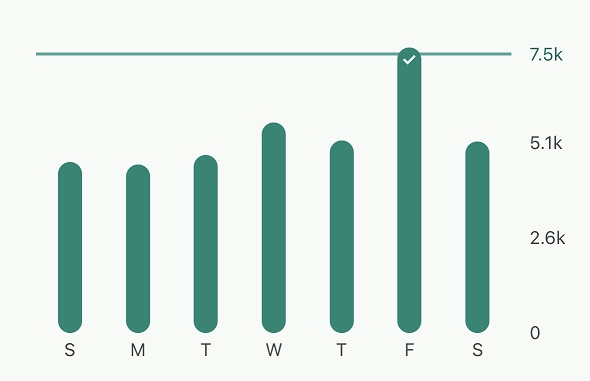
Things keep moving in the right directions as I kept my 30,000-step week streak alive for the tenth straight week while also running my streak of 4000+ days to 47.  The week got off to a good start on Sunday, needing a mere 2 additional steps to finish with 4600.  Monday was just slightly lower, ending with 4500 steps.  A nice improvement on Tuesday pushed me up to only 7 steps shy of 4800.  A lunchtime walk helped me to 5600 steps on Wednesday.  An additional 22 steps was all that stood between me and 5200 on Thursday.  An afternoon trip to Wrigley Field on Friday put me over my daily goal and just 25 steps away from 7700.  A trip to the Chicago Public Library in Bridgeport for a presentation on Dick Allen helped end the week with 5100 steps.

Total steps: 37,576

Daily average: 5368

Book 20 (of 52) – Chili Dog MVP

Chili Dog MVP: Dick Allen, The ’72 White Sox and a Transforming Chicago – John Owens and David J. Fletcher

The early 70s were a time of change on the south side of Chicago.  As the ballclub that called Comiskey Park home recovered from the then-worst season in franchise history in 1970 and threats to move the club out of the city they’d called home for seven decades, the demographics of the surrounding neighborhoods started to shift and noted White Sox fan Richard J. Daley, longtime mayor of the city, started to lose his vice-like grip on the Democratic party.  Those changes crystalized in 1972, with the arrival of Dick Allen, a baseball superstar whose reputation was perhaps less than stellar.  But, taking a young ballclub under his wing, he led the upstart White Sox to their best season in five years, challenging the budding dynasty in Oakland for the AL West title.

Chili Dog MVP: Dick Allen, The ’72 White Sox and a Transforming Chicago, by authors John Owens and David J. Fletcher and editor George Castle, tells the tale of that 1972 White Sox team, while also touching on the things going on around it, both physically and temporally.  They cover the ownership transfers from Arthur Allyn to his brother John in 1970 and then again to Bill Veeck in 1975.  The interconnected revival of Harry Caray’s career announcing for the White Sox with the rise of young organist Nancy Faust, who would spend 40 years with the franchise.  The arrival of Roland Hemond and Chuck Tanner in late 1970, who helped turn the franchise around and were instrumental in the acquisition of Allen and convincing him to come play in Chicago.  And, of course, the career of Dick Allen, especially his three years in Chicago, from the promising beginning to the bitter end, when he quit on the team and temporarily retired towards the end of the 1974 season.

The 1972 White Sox were just a little before my time, so this was a nice glimpse into the franchise just a few years before I was born.  If I have one complaint about its composition, it is that it is treated, and edited, more a collection of one-off essays rather than as a comprehensive story, so details and characters are re-introduced and re-described numerous times.  That small change could have streamlined the tale and probably cut a good ten pages or so from the tome.

Hall Of Fame Batting Leaders


The Hall of Fame Class of 2025, featuring hitters Ichiro Suzuki, Dick Allen, and Dave Parker, gets enshrined in Cooperstown today.  Though I’ve only seen one of the three new Hall of Famers play live, let’s check back in with the leaders on the offensive side of the ball amongst Hall of Famers for all of the games I’ve attended between 1984 and 2024.

Home Runs

Name Total
Jim Thome 35
Frank Thomas 15
Scott Rolen 7
David Ortiz 6
Vladimir Guerrero 6

Hits

Name Total
Jim Thome 110
Frank Thomas 54
Joe Mauer 43
Ken Griffey Jr 32
Fred McGriff 28

Runs

Name Total
Jim Thome 82
Frank Thomas 42
Joe Mauer 19
David Ortiz 16
Scott Rolen 14

RBI

Name Total
Jim Thome 84
Frank Thomas 38
Fred McGriff 23
David Ortiz 19
Continue reading →

A New Class Of Imortals

With temperatures hovering around four degrees Tuesday night in the hamlet of Cooperstown, New York, the attention of the baseball world turns to summer of the past now that the votes have been tallied, and the 2025 Hall of Fame class is complete.  Ichiro Suzuki, CC Sabathia, and Billy Wagner join Dick Allen and Dave Parker, who were elected by the Veteran’s Committee last month, in obtaining baseball immortality.  Suzuki and Sabathia make it on their first try while Wagner made it in his final shot.

Just two others scored greater than 50% of the vote, led by Carlos Beltran, who came just short at 70.3% and seems likely to make it next year.  Andruw Jones rose to 66.2% with two more years to go.

On the local front, Manny Ramirez, who spent a little more than a month with the White Sox at the tail end of his career, saw a small increase in support, finishing with 34.3% of the vote thanks to his multiple PED suspensions.  Jimmy Rollins, who spent the final 41 games of his career on the south side, picked up 18% in his fourth go-around.  The disgraced Omar Vizquel, accused of both sexual abuse of an autistic teen and spousal abuse since being added to the ballot, stayed stagnant with 17.8%.    Mark Buehrle saw a small increase, going up to 11.4% in his fifth time on the ballot, living to fight another day.  Former Cubs Carlos González, Fernando Rodney, and Ben Zobrist nabbed a single vote between them.

Ten players will fall off the ballot after failing to score 5% of the vote.

As for the newest Hall of Famers, I’ve seen Suzuki play fifteen times, Sabathia eight times, and Wagner five times.  They will get their day in the sun on Sunday, July 27.

Ichiro Suzuki’s numbers in games I’ve attended were: Continue reading →

The Hall Calls

Sunday night, the results of the Classic Baseball Era Veteran’s Committee vote was revealed, adding two players to the Hall of Fame class of 2025: Dick Allen and Dave Parker.  Parker was named on fourteen ballots from the 16-person committee, while Allen nabbed thirteen votes, the one more than the minimum needed for election.

Allen spent three of his fifteen big league seasons with the White Sox, earning the MVP award in 1972.  He was the Rookie of the Year in 1964 with the Phillies and also spent time with the Cardinals, Dodgers, and A’s.  He hit 20 or more home runs in nine consecutive seasons and finished his career with 351 homers, 1,119 RBI and a .292 career batting average.  Unfortunately, Allen passed away in December of 2020.

Parker, 73, was a seven-time All-Star in his 19-year career, hitting 339 home runs and posting a lifetime .290 batting average.  He won back-to-back batting titles with the Pirates in 1977 and 1978, winning the NL MVP award in ’78.  He earned All-Star MVP honors in 1979 while leading the Pirates to their last World Series championship.  After leaving the Pirates, he bounced around to the Reds, A’s, Brewers, Angels and Blue Jays, winning a second title with the A’s in 1989.

By The Numbers – 15

In 1929, uniform numbers appeared on the back of baseball jerseys for the first time, thanks to the Indians and the Yankees.  By 1937, numbers finally appeared across all uniforms, both home and away, across both major leagues.  Since that time, 81 distinct numbers have been worn by members of the White Sox, while the Cubs boast 76.

Today, we continue our look at those players, picking our favorite, if not the best, player to wear each uniform number for both Chicago teams with #15.  98 different players have donned #15 while playing in Chicago, 44 for the White Sox and 54 for the Cubs.

Dick Allen was acquired after the 1971 season, when attendance at Comiskey Park had cratered and the team had finished 22½ games out of first place.  The addition of Allen, donning #15, sparked an unforeseen pennant race in 1972, with the Sox in contention for most of the season, finishing 5½ games behind the A’s in the AL West and drawing more than 1.18 million fans, more than double what they drew in 1970.  Allen only spent 3 years in Chicago, making the All Star team each time.  A broken leg cut short his 1973 campaign and, with two weeks to go in the 1974 season, Allen left the team over a feud with teammate Ron Santo.  Not knowing if Allen planned to return to baseball, the Sox sold his contract to the Braves for $5000, at which point Allen temporarily retired.

Acquired by the Cubs for the stretch run in 1984, Davey Lopes switched to his familiar #15 in 1985.  Appearing in 99 games in his age 40 season, Lopes stole 47 bases, his highest total since 1977.  He made his way into 59 games in 1986 before being traded to the Astros for Frank DiPino.

RIP MVP

Former White Sox first baseman Dick Allen, who many claim saved the franchise with his MVP performance in 1972, passed away today at the age of 78.  Allen was acquired after the 1971 season, when attendance at Comiskey Park had cratered and the team had finished 22½ games out of first place.  The addition of Allen sparked an unforeseen pennant race in 1972, with the Sox in contention for most of the season, finishing 5½ games behind the A’s in the AL West and drawing more than 1.18 million fans, more than double what they drew in 1970.

Allen only spent 3 years in Chicago, making the All Star team each time.  A broken leg cut short his 1973 campaign and, with two weeks to go in the 1974 season, Allen left the team over a feud with teammate Ron Santo.  Not knowing if Allen planned to return to baseball, the Sox sold his contract to the Braves for $5000, at which point Allen retired.  He eventually returned to the game, playing parts of 3 seasons before retiring for good in 1977, finishing his career going 2 for 5 in a double header against, of course, the White Sox.

Allen was in the news recently, as Jose Abreu joined him as one of only 4 players to win the MVP award for the White Sox.  Allen was complimentary of both Abreu and Chicago, calling his tenure with the White Sox the best time of his career.

MVPito

On Thursday night, White Sox first baseman Jose Abreu took home MVP honors. becoming the fourth White Sox player to receive the award.  He received 21 first-place votes after leading the American League in hits, RBI, total bases, slugging percentage, and extra base hits.  The 2014 Rookie of the Year, he became just the 28th player to nab both awards.

Abreu follows Nellie Fox, Dick Allen, and Frank Thomas in winning the award for the White Sox and Zolio Versalles and Jose Canseco as Cuban-born winners.

Leading The League

As the 2019 season comes to an end, two members of the White Sox achieved some personal milestones.  Tim Anderson led the major leagues in batting average and Jose Abreu led the American League in RBIs.

Anderson finished the year with a .335 average, leading the American League and the major leagues.  The injured Christian Yelich of the Brewers and Ketel Marte of the Diamonbacks tied for the National League lead at .329, while Yankees infielder DJ LeMehieu finished second in the AL with .327 average.  White Sox third baseman Yoan Moncada used a torrid finish to come in 3rd in the AL, making for a fearsome left side of the infield for the South Siders heading into 2020.

Anderson becomes just the third player in White Sox history to win the batting title.  Luke Appling led the league in 1936 and 1943 and Frank Thomas wore the crown in 1997.

On the other side of the diamond,  Jose Abreu took home the RBI championship for the American League.  He finished just 3 behind the Nationals’ Anthony Rendon for the major league lead.  Abreu becomes just the second RBI leader in White Sox history, following Dick Allen in 1972.

#5 – Frank Thomas

Name: Frank Thomas

Rank: 5

Position: 1B/DH

Years With White Sox: 1990-2005

Frank Thomas was selected by the White Sox with the seventh pick in the first round of the 1989 draft.  A little more than 1 year later, he made his major league debut on August 2, 1990 against the Brewers at County Stadium, going hitless in 4 at bats with an RBI as the White Sox won 4-3.  The next night, he tripled off of Mark Knudson for his first major league hit.  On August 28, he hit the first home run of his career, off Gary Wayne, in a 12-6 loss against the Twins at the Metrodome.  He finished the year with a .330 average, with 7 home runs and 31 RBIs.

In 1991, as the White Sox moved into the new Comiskey Park, Thomas became one of the most feared hitters in the American League.  On April 22, he hit the first White Sox home run in the new stadium, in an 8-7 victory over the Orioles.  When the season ended, Thomas finished with a .318 average, 32 home runs, and 109 RBIs.  He lead the league in walks, OBP, OPS, and OPS+.  He won his first Silver Slugger award and finished 3rd in MVP voting.

Thomas continued his mastery in 1992.  He ended the year hitting .323, with 24 home runs and 115 RBIs. He led the league in doubles, walks, OBP, and OPS.  Those numbers were good enough for him to place 8th in MVP voting.

In 1993, Thomas helped the White Sox win their first division title since 1983.  He made his first All Star game appearance, getting a hit in his only at bat.  On August 31, he clubbed his 100th career home run against the Yankees at Yankee Stadium.  He finished the year batting .317 and set a club-record with 41 homers.  He added 128 RBI, 106 runs scored, and 112 walks, to join Babe Ruth, Lou Gehrig, Jimmie Foxx and Ted Williams as the only players in baseball history to eclipse .300 with more than 20 homers and more than 100 RBI, runs, and walks in three straight seasons.  In the ALCS against the Blue Jays, Thomas hit .353 in the 6 game series.  Thanks to his historic season, Thomas collected his second Silver Slugger award and all 28 first place votes for a unanimous AL MVP award, the first by a White Sox player since Dick Allen in 1972.

1994 was on track to be even better, before the strike ended the season in August.  Thomas was elected to start the All Star game and got 2 hits in his 2 at bats.  In only 113 games, Thomas had 38 home runs, 101 RBIs, 106 runs scored, and 109 walks.  He led the league in runs scored, walks, OBP, slugging percentage, OPS, and OPS+.  For the second year in a row, he took home the Silver Slugger and MVP awards, becoming just the second first baseman to earn consecutive MVP awards.

When baseball returned in 1995, Thomas picked up where he had left off.  He started his second straight All Star Game for the American League, hitting a home run off John Smiley.  At the end of the season, Thomas had hit .308 with 40 home runs and 111 RBIs while leading the league in games played, walks, sacrifice flies, and intentional walks.  He dropped to 8th place in MVP voting as the White Sox found themselves out of contention for the first time in his career.

The White Sox bounced back in 1996 and Thomas continued to be an offensive force.  He mashed his 200th career home run on June 9, going deep at Camden Yards against the Orioles.  He was named to his fourth straight All Star team, though he didn’t make it into the game.  He set a career high with a .349 average, while again hitting 40 home runs with 134 RBIs.  For the second straight year, he led the league in intentional walks and finished 8th in MVP voting.

1997 was another strong year for Thomas.  He was named to his fifth, and final, All Star team.  He led the league with a .347 average, a .456 OBP, a 1.067 OPS, and an OPS+ of 181, while hitting 35 home runs and knocking in 125.  He finished 3rd in MVP voting, his 7th top 10 finish in his 7 full seasons.

Off the field issues started to show an effect on Thomas’ production in 1998, his first as a full time designated hitter.  Marital problems messed with his head, leading him to think the umpires were screwing him, opposing pitchers were taking advantage of him, and the media were ganging up on him. “I was miserable, and I made everyone around me miserable,” Thomas said early in the 1999 season. “It was an extremely humbling season.”  He hit .265, 65 points lower than his career average entering the season, and finished with only 29 home runs, his lowest total in six years.  He started referring to himself as Five O’clock Frank, a batting-practice terror who at game time sank under the weight of self-pity and tired excuses.

Thomas, and the White Sox, hoped that he would bounce back in 1999.  “I think he had a lot on his mind, personal things that were weighing on him,” hitting coach Von Joshua said early in the season. “He didn’t talk about it, but you could just see it in his eyes. He’s a lot more settled this year.”  Unfortunately, things didn’t go well, though he did hit his 300th career home run on August 7 against the A’s.  While his average did rebound, back up to .305, he hit only 15 home runs and drove in just 77 while setting a career low with a .471 slugging percentage.  Bone spurs on his ankle limited him to just 135 games.

2000 got off to an explosive start, and not the good kind.  Thomas and manager Jerry Manuel went toe to toe in spring training over Thomas’ ability to participate in drills, following his surgery the previous September.  Once the regular season began, though, it looked like the old Thomas was back.  As the surprising White Sox ran off and won their first division title since 1993, Thomas, missing only 3 games all year, hit .328 and set career highs with 43 home runs and 143 RBIs.  Unfortunately, Thomas, like the rest of his teammates, struggled in the post-season, going hitless in the ALDS as the Mariners completed a 3 game sweep.  He won his fourth, and final, Silver Slugger award and finished 2nd in MVP voting, behind a juiced Jason Giambi.

2001 was a tough year for Thomas, both personally and professionally.  On April 27, he hurt his triceps diving for a ball while playing first base.  After spending 5 days back in Georgia due to the death of his father, Thomas returned to Chicago for tests, which revealed a muscle tear that would require surgery and end his season.  “This is the worst week of my life”, he said during a press conference. “First I lose my father, then come back and find out I’m lost for the season.”  In only 20 games, Thomas hit .221 with 4 home runs and 10 RBIs.

Thomas returned in 2002, but was obviously no longer the same player he was before the injury.  He struggled in the first half, before picking things up in the final month of the season, hitting .359 with 6 home runs in September.  He finished the season with a .252 average, 25 home runs and 92 RBIs.

2003 was a better year for Thomas, though still below his career norms.  On June 26th, he became the 36th player in history to reach the 400 career home run mark with a 5th inning shot against the Devil Rays at US Cellular Field.  At the end of the year, he had posted a .267 average with 42 home runs and 105 RBIs.

Injuries robbed Thomas of most of 2004.  He was placed on the disabled list on July 7th, with a .271 average, 18 home runs and 49 RBIs.  He underwent surgery in early October to remove debris from the ankle, perform a bone graft, and insert two screws.

Thomas began the 2005 season on the disabled list as he recovered from his ankle surgery.  He was activated on May 30, with the White Sox in first place in the AL Central.  On July 18, he clubbed his 448th and final home run with the White Sox against the Tigers at US Cellular Field.  He hit .219 with 12 home runs and 26 RBIs in 34 games before breaking his foot on July 21, causing him to miss the rest of the season and the post-season.  Thomas threw out the first pitch prior to game one of the ALDS against the Red Sox.

Thomas is the White Sox all time leader in home runs, runs scored, doubles, RBIs, walks, on-base percentage, slugging percentage, and OPS.  He is the only player in major league history to have seven consecutive seasons (1991-1997) with a .300 average and at least 100 walks, 100 runs, 100 runs batted in, and 20 home runs.  His number 35 was retired by the White Sox on August 29, 2010 and he was part of the 2014 Hall of Fame class, elected on the first ballot with 83.7% of the vote.

Thomas’s numbers in a White Sox uniform, both for games I attended and overall, were: Continue reading →