By The Numbers – 5

In 1929, uniform numbers appeared on the back of baseball jerseys for the first time, thanks to the Indians and the Yankees.  By 1937, numbers finally appeared across all uniforms, both home and away, across both major leagues.  Since that time, 81 distinct numbers have been worn by members of the White Sox, while the Cubs boast 76.

Today, we continue our look at those players, picking our favorite, if not the best, player to wear each uniform number for both Chicago teams with #5.  75 different players have donned #5 while playing in Chicago, 42 for the White Sox and 33 for the Cubs.

Selected in the fifth round of the 1990 draft, Ray Durham broke camp with the White Sox in 1995 and, wearing #5, made his major league debut on Opening Day, leading off and going 1-4 in the 12-3 loss to the Brewers at County Stadium.  Durham stuck in the leadoff spot and finished the year with a .257 average, 7 home runs, and 51 RBI, good enough for a 6th place finish in Rookie of the Year voting.  He saw improvement in 1996, raising his average to .275 and his OBP to .350.  His home run and RBI totals also jumped, going to 10 and 65 respectively.  1997 was another good year for Durham, as he hit .271 with 11 home runs.

In 1998, Durham earned his first All Star nod and finished the year setting career highs with a .285 average, 19 home runs, 67 RBIs, and 36 stolen bases.  Durham improved his average again in 1999, raising it to .296, his career best.  It was also his second of seven straight years with an OPS over .800.  Durham nabbed his second All Star selection in 2000.  When the season came to an end, Durham had a .280 average with 17 home runs and 75 RBIs and the White Sox were atop the AL Central for the first time.  Like the rest of his teammates, Durham struggled during the ALDS, hitting .200 in the three game sweep against the Mariners.

2001 saw Durham’s average drop to .267, his lowest total since his rookie year.  He did manage to set a new career high with 20 home runs as the White Sox failed to repeat.  Durham was hitting .299 with 9 home runs at the trade deadline in 2002 when, facing free agency, he was shipped to the A’s for Jon Adkins.  At the time of the trade, Durham was the club’s all-time leader in leadoff home runs, while placing in the top 10 in franchise history in steals (5th), doubles (7th), extra base hits (7th), and runs (8th).

Michael Barrett wore #5 for the Cubs when he was acquired for the 2004 season.  Barrett gave up his cherished # 5 in early August, handing it over to the newly acquired shortstop Nomar Garciaparra, while switching to #8, in tribute to former Hall of Fame catcher Yogi Berra.

By The Numbers – 10

In 1929, uniform numbers appeared on the back of baseball jerseys for the first time, thanks to the Indians and the Yankees.  By 1937, numbers finally appeared across all uniforms, both home and away, across both major leagues.  Since that time, 81 distinct numbers have been worn by members of the White Sox, while the Cubs boast 76.

Today, we continue our look at those players, picking our favorite, if not the best, player to wear each uniform number for both Chicago teams with #10.  65 different players have donned #16 while playing in Chicago, 26 for the White Sox and 22 for the Cubs, who retired the number in 2003.

Alexei Ramirez signed with the White Sox on December 21, 2007 after defecting from Cuba.  He made his major league debut the following March 31, wearing #10 while going 0-4 against the Indians while playing center field.  When Juan Uribe went down with an injury in May, Ramirez settled in at second base.  On September 19, Ramirez hit his 3rd grand slam of the year, tying the major league rookie record.  10 days later, he grabbed the record for himself, hitting his 4th slam against Gary Glover to push the White Sox to an 8-2 victory and the tiebreaking game 163.  He finished the regular season with .290 average and a career high 21 home runs.  During the ALDS, he hit .250 in the 4 game series against the Rays, with 2 RBI.  Once the season came to an end, Ramirez placed second in Rookie of the Year voting, behind Evan Longoria.

With Orlando Cabrera gone, Ramirez shifted over to shortstop for the 2009 season.  On July 23, he fielded the final out in Mark Buehrle’s perfect game.  He ended the year with a .277 average, 15 home runs, and 68 RBI.  2010 saw Ramirez earn his first Silver Slugger award, thanks to 18 home runs, 70 RBI, and a .282 average.  In 2011, his average dropped somewhat, but he remained consistent, hitting .269 with 15 home runs and 70 RBI.  Ramirez saw his power numbers slip in 2012, dropping to 9 home runs, but the rest of his game remained consistent with a .265 average and 73 RBIs, though he did set a new career high with 20 stolen bases.  His power fell off even further in 2013, finishing with only 6 home runs and 48 RBI, but he logged his highest average, .284, since his rookie year.  He also set a new career high with 30 stolen bases.

2014 may have been the finest season of his career.  On May 5, he notched his 1000th career hit, off Justin Grimm and the Cubs.  In July, he earned his first All Star selection and, after the season, his second Silver Slugger award.  He finished with a .273 average, 15 home runs, and 74 RBIs.  Ramirez struggled for much of the first half in 2015.  He rebounded in the second half, but still finished the year with the lowest batting average, .249, and OPS, .642, of his career.  Following the season, the White Sox declined his option for 2016, making him a free agent.

Ron Santo spent 14 of his 15 big league seasons with the Cubs, switching to #10 during his rookie season of 1960.  He earned 9 All Star game appearances and 5 Gold Gloves and followed his playing career with a long broadcasting stint with the team.   The Cubs retired number 10 in his honor in 2003 and he was posthumously elected to the Hall of Fame in 2012.

By The Numbers – 13

In 1929, uniform numbers appeared on the back of baseball jerseys for the first time, thanks to the Indians and the Yankees.  By 1937, numbers finally appeared across all uniforms, both home and away, across both major leagues.  Since that time, 81 distinct numbers have been worn by members of the White Sox, while the Cubs boast 76.

Today, we continue our look at those players, picking our favorite, if not the best, player to wear each uniform number for both Chicago teams with #13.  25 different players have donned #13 while playing in Chicago, 13 for the White Sox and 12 for the Cubs.

Acquired by the White Sox on December 6, 1984, from the Padres, Ozzie Guillen made his major league debut wearing #13 on Opening Day 1985, leading off against the Brewers and going 1-5 in the 4-2 victory at County Stadium.  Settling in as the everyday shortstop, Guillen finished the year with a .273 average, 21 doubles, and 9 triples.  Those totals were good enough to score Guillen the 1985 AL Rookie of the Year trophy.  Guillen saw a slight drop off in his sophomore season, as his average dropped to .250 and he managed 19 doubles and 4 triples.  1987 was a nice bounce back for Guillen, as he raised his average back up to .279 with a .656 OPS.  For the second straight year, he led the AL, and all of baseball, in Defensive WAR.  Guillen earned his first All Star nod in 1988 and, by season’s end, he once again led all of baseball in Defensive WAR, while seeing his average drop to .261 with 7 triples, the fifth highest total in the AL.

1989 was a tough year for Guillen.  He posted his worst offensive numbers since 1986 and, on the base paths, he fell victim to the hidden ball trick.  Twice. On June 23, against the Brewers, first baseman Greg Brock held the ball after a pickoff attempt and when Guillen took his hand off the base to stand up, Brock tagged him out.  Less than 2 months later, on August 5 against the Tigers, Dave Bergman made the same play.  He finished the year with .253 average and, despite his adventures on pick off attempts, a career high 36 stolen bases.  As the surprising White Sox challenged for the AL West title while saying goodbye to Comiskey Park, Guillen put in one of the finest seasons of his career.  He was named to his second All Star team, going 0-2, finished in 17th place in MVP voting, and earned his first, and only, Gold Glove.  He raised his average back up to .279 and knocked in a career high 58 RBIs.

Expectations were high for the White Sox as they moved across the street to the new Comiskey Park in 1991.  Guillen earned his third, and final, All Star nod, getting a sacrifice in his only plate appearance.  He ended the year with a .273 average and set a career high with 3 home runs.  Guillen’s 1992 season came to an early end when, on April 21 during a loss against the Yankees, a collision with outfielder Tim Raines ended in a severe knee injury.  Guillen recovered in 1993, though he appeared in only 134 games, his lowest total to date.  However, it was his most productive season offensively, posting a .280 batting average, and career highs with 4 home runs and a .666 OPS, as the White Sox won their first division title in a decade.  He hit .273 and scored 4 runs in a losing effort, as the White Sox were defeated in 6 games by the Blue Jays in the ALCS.  1994 looked to be the year that the White Sox finally broke through.  Guillen was up to the challenge, hitting a career high .288 with a .659 OPS.  Unfortunately, the year ended early when players went on strike on August 12 with the White Sox in first place in the newly created AL Central.

The 1995 season got off to a late start and had an abbreviated schedule due to the long work stoppage.  The success of the White Sox, and for Guillen himself, didn’t survive the long layoff.  Guillen saw his average drop to .248, his lowest over a “full” season in his career to this point.  His OPS dropped to its lowest total in a full season since 1989.  1996 saw a slight improvement for Guillen.  He appeared in 150 games, his highest total since his knee injury in 1992.  He raised his average back to .263 and tied his career high with 4 home runs.  However, 1997 was easily the worst season of Guillen’s White Sox career.  He had the lowest average of his career, coming in at .245, though he did once again tie his career high with 4 home runs.  Following the season, Guillen became a free agent and his playing career with the White Sox came to an end.

Guillen returned to the White Sox organization for the 2004 season as manager.  In 2005, he led the team to their first American League pennant since 1959 and their first World Series title in 88 years.  Ongoing personal difficulties with General Manager Kenny Williams led to his leaving with 2 games left in the 2011 season as the third winningest manager in franchise history.

On the north side of town, Neifi Pérez donned #13 over parts of three seasons with the Cubs.  He signed a minor league deal after being released by the Giants in 2004.  After only ten games in Triple A, Pérez joined the big-league club and became a spark plug in the lineup, going 6 for 6 in his first 6 at-bats and providing a needed backup to the ailing Nomar Garciaparra.  Dusty Baker named Pérez the starting shortstop in 2005 to replace Garciaparra, mainly on the strength of his defensive skills.  For the 2006 season Pérez lost the starting job at shortstop to Ronny Cedeño.  As his batting average sagged to .254 and his on-base percentage, never high, had fallen to .266, the Cubs traded him to the Tigers.

What’s New For 2022

With a new collective bargaining agreement in place and a shortened spring training due to the 99-day lockout, there are plenty of changes coming to MLB for this season and beyond.  It’s time to take a deeper dive into the new CBA and see what those changes are and what impact they may have on the game, intended or unintended.

The most expected outcome of the new CBA is the expansion of the designated hitter to the National League.  In addition to this, a new rule was added that if a team wants to have the same player (*cough*Ohtani*cough*) both pitch and hit, he may be his own DH and removing him as the pitcher will not impact him continuing on as the DH.

The postseason will be expanded to twelve teams, six from each league.  The two division winners with the best records will automatically advance to the Division Series.  The remaining division champion and the three wild card teams will face off in a three-game series.  There will not be any reseeding between the rounds.

Due to Canadian law, unvaccinated players will not be allowed to cross the border and, under the terms of the new CBA, they will not be paid or receive service time for the games missed.

The lowest level of the Competitive Balance Tax (CBT) Threshold, which most teams use as a hard salary cap, will jump to $230M for 2022.  After that, there are three additional surcharge levels, which, at this point, should impact only the Dodgers, Mets, and Padres.

The minimum salary for players has increased to $700K for 2022 and will increase over each year of the CBA.  In addition, there is a new pre-arbitration bonus pool of $50M has been established to reward successful seasons by younger players under team control.  MVP and Cy Young winners would $2.5M while 2nd, 3rd, and 4/5th place finishers would receive $1.75M, $1.5M, and $1M respectively.  Rookie of the Year winners get $750K and 2nd place finishers would take home $500K.  Players named first team All-MLB get $1M while second team gets $500K.  The remaining pool of bonus money will be distributed based on WAR.  A single player can only receive one bonus per season.

Umpires will start using a microphone to announce replay review decisions to the crowd, helping fans better understand the outcomes of those reviews and why.

Double headers will move back to being nine-inning affairs.  The ghost runner starting on second base for extra-inning games was initially eliminated, but was re-instated for 2022 due to the shortened spring training and worries about the impacts of long games to pitching staffs.

Rosters will expand to 28 players for the month of April due to the shortened spring training.  Also, a limit of five has been placed on the number of times a player can be optioned to the minor leagues during a season.  After that, the player must be put on waivers in order to send him down additional times.  Players optioned prior to May 1st will not have that option count against the limit due to the expanded roster.  This new limit does not impact the number of option years a player has.

Players now have expanded rights to engage in promotional and endorsement activities with sports betting companies.  I’m sure nothing bad will come of that.  Also, the MLBPA has agreed to drop their grievance from 2020 about the owners bargaining in good faith about the pandemic-shortened season as part of the new CBA.  An older grievance, concerning how the Pirates, A’s, Marlins, and Rays spend their revenue-sharing dollars, is still ongoing.

Other rules changes that were part of the negotiations, like a pitch clock, shift restrictions, larger bases, and automated balls and strikes, will not be implemented until the 2023 season at the earliest.

Starting in 2023, a lottery will be implemented to determine who gets the first six picks of the draft.  The 18 teams who did not make the previous postseason will be eligible with the three teams with the worst records getting a 16.5% chance at the pick and the six teams with the best records getting a less than 1% chance.  Teams that receive revenue-sharing payouts will not be eligible to receive a lottery pick for more than two years in a row and those that don’t can’t get a top-six choice in consecutive drafts.  Any team that is ineligible for the lottery will not be allowed to select higher than 10th overall.  The draft itself will remain 20 rounds.  A decision on the International Draft, and the corresponding removal of draft pick compensation, will be decided by July 25th.

MLB and MLBPA agreed to stage international games or tours over the next five years.  Regular-season games will be held in Mexico City each May from 2023-26, in London in June 2023, 2024, and 2026 and in Paris in June 2025, and in San Juan, Puerto Rico, in September 2025 and 2026.  A season-opening series is planned for somewhere in Asia for 2024 and Tokyo for 2025.  Postseason tours are planned for South Korea and Taiwan this year and for Latin America in 2023.  Spring training games are being envisioned for Puerto Rico and/or the Dominican Republic in 2024, and the World Baseball Classic returns in 2023 and 2026.

Starting in 2023, teams will play at least one series against every opponent in each league.  Because of the expanded wild card, the new schedule will feature fewer divisional games, and every team will play at least one series against every other opponent, including alternating home and away series every other year against teams in the other league.

Finally, teams will be adding ad patches on their jerseys and stickers on their batting helmets starting in 2023.  Unconfirmed reports say that the jersey patches will go on the sleeve and may be on different sleeves depending on which would give it more exposure.  No word yet on how that would work with teams that already have one (or two) sleeve patches.  The jersey sponsorships are being sold at the team level and can’t go to alcohol, gambling, or media brands.  Helmet sponsorships are expected to be handled by MLB.

By The Numbers – 17

In 1929, uniform numbers appeared on the back of baseball jerseys for the first time, thanks to the Indians and the Yankees.  By 1937, numbers finally appeared across all uniforms, both home and away, across both major leagues.  Since that time, 81 distinct numbers have been worn by members of the White Sox, while the Cubs boast 76.

Today, we continue our look at those players, picking our favorite, if not the best, player to wear each uniform number for both Chicago teams with #17.  79 different players have donned #17 while playing in Chicago, 42 for the White Sox and 37 for the Cubs.

Mark Grace moved to his iconic #17 during his rookie campaign in 1988.  He finished second in Rookie of the Year voting while hitting .296 with 7 home runs and 57 RBIs.  In 1989, he garnered some MVP consideration as the Cubs took home a surprising NL East title.  Grace hit .314 with 13 home runs and 79 RBIs during the regular season, before hitting .647 with a 1.799 OPS during the 5 game NLCS against the Giants.

In 1990, Grace began a decade of excellence, collecting the most hits, 1,754, and doubles, 364, of any player during the decade.  He won 4 Gold Glove awards, was named to 3 All Star teams, earned down-ballot MVP support in 3 different seasons.  Following the 2000 season, he left the Cubs, finishing that portion of his career with 2201 hits, 456 doubles, 148 home runs, 1004 RBIs, and a .308 average.

As the White Sox made their run towards the World Series title in 2005, general manager Kenny Williams attempted to acquire Ken Griffey Jr. from the Reds, but was rebuked when Reds ownership decided to veto the deal.  3 years later, with the White Sox again looking to make a run at a division title, he was finally able to acquire the aging superstar at the trade deadline in exchange for pitcher Nick Masset and second baseman Danny Richar.  At the time of the trade, the White Sox held a tenuous 1.5 game lead over the Twins.  Wearing #17, Griffey, who had spent most of the previous few seasons in right field to lessen the strain on his body, moved back to center field for the White Sox, displacing the disappointing Nick Swisher.  Griffey appeared in 41 games for the White Sox, hitting a decent .260 with only 3 home runs and 18 RBI.  His most important contribution came defensively, during the tie-breaking game 163 between the White Sox and the Twins, when he gunned down Michael Cuddyer, who was trying to score on a fly out to center, preserving the shutout and helping the White Sox win the division and advance the playoffs.  In the ALDS, Griffey appeared in 3 games against the Rays, garnering only 2 hits as the White Sox fell 3 games to 1.  Following the season, the White Sox declined Griffey’s $16 million option for 2009, making him a free agent.

Special bonus shout out to outfielder Carlos May, who played with the White Sox from 1968-1976.  May, who wore #17 for his entire White Sox career, is the only player in baseball history to wear his birthday, May 17th, on his jersey.

Baseball Unlocked

After 99 days, the MLB lockout has come to an end.  MLB and the MLBPA have come to an agreement on a new collective bargaining agreement, leading to a mad rush to get spring training up and running and a 162-game regular season in the books.  Free agency is set to start back up again tonight at 5 PM CT.  Players will be allowed to report to spring training as soon as tomorrow, with games starting next week.  Opening Day is likely to be April 7th, with double headers and a few days tacked to the end of the season to get to 162 games.

So where do we stand?  The CBT threshold has been raised to $230 million, a 9% increase, before penalties start being applied.  The minimum salary has been raised to $700,000, a 23% rise from the last deal.  The qualifying offer for free agents will go away if the two sides agree on an international draft by this summer.  A draft lottery will be implemented to help combat tanking.  Rookie of the Year winners will get credited with a full season of service time, regardless of how much time they spent in the major leagues, in a bid to do away with service time

On the field, the DH will be coming to the NL, ending the practice of pitchers hitting.  Double headers are returning back to 9 innings.  Extra innings will also revert to their normal rules, doing away with ghost runners.  The playoffs will be expanded to 12 teams.

The full extent of changes will trickle out over the days to come, but, for right now, the important thing is that baseball is back.  Time to play ball.

By The Numbers – 18

In 1929, uniform numbers appeared on the back of baseball jerseys for the first time, thanks to the Indians and the Yankees.  By 1937, numbers finally appeared across all uniforms, both home and away, across both major leagues.  Since that time, 81 distinct numbers have been worn by members of the White Sox, while the Cubs boast 76.

Today, we continue our look at those players, picking our favorite, if not the best, player to wear each uniform number for both Chicago teams with #18.  78 different players have donned #18 while playing in Chicago, 41 for the White Sox and 37 for the Cubs.

Bill Madlock essentially replaced two of the Cubs biggest stars of the 1960s when he joined the team for his rookie season in 1974.  Acquired for future Hall of Famer Ferguson Jenkins, Madlock took the spot of Hall of Famer Ron Santo at the hot corner.  If he felt any pressure, he didn’t show it, hitting .313 with 9 home runs, good enough for a third place finish in Rookie of the Year voting.  In 1975, he broke out in a big way, earning his first All Star nod on his way to a batting title.  In 1976, Madlock repeated as batting champion, hitting .339 and beating out Ken Griffey Sr. on the final day of the season.  With the dawn of free agency on the horizon, Madlock asked the Cubs for a multi-year contract with a salary of $200,000, more than double what he had earned in 1976.  Team owner Phillip K. Wrigley had other ideas, announcing that Madlock would be traded “to anyone foolish enough to want him.”  In February of 1977, that so-called foolish team turned out to be the Giants, who sent Bobby Murcer and Steve Ontiveros, among others, to the Cubs.  In July of 2016, this would be ranked as one of the five worst trades in Cub history.
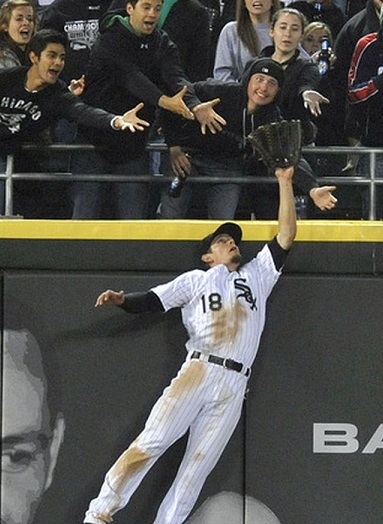
Acquired by the White Sox, along with Tyler Flowers and 2 minor leaguers, from the Braves in exchange for Javier Vazquez and Boone Logan, Brent Lillibridge donned #18 while hitting an anemic .158 in 95 at bats spread across 46 games for the 2009 White Sox.  Lillibridge stuck with the big league team in 2010, improving his average to .224 in only 64 games.  2011 was his best season, setting career highs in home runs, RBIs, batting average, and OPS.  On April 11, he hit the 10,000th home run in White Sox history off Dallas Braden and the A’s.  Lillibridge struggled again in 2012, with his average dropping down to .175 before the June 24th trade that sent him, along with Zach Stewart, to the Red Sox for Kevin Youkilis.

By The Numbers – 23 Bonus!

In 1929, uniform numbers appeared on the back of baseball jerseys for the first time, thanks to the Indians and the Yankees. By 1937, numbers finally appeared across all uniforms, both home and away, across both major leagues. Since that time, 81 distinct numbers have been worn by members of the White Sox, while the Cubs boast 76.

Sunday, we continued our look at those players, picking our favorite, if not the best, player to wear each uniform number for both Chicago teams with #23.  Today, we take a special bonus look at player who famously wore #23 for other Chicago teams, making it possibly the most successful jersey number in town.

Michael Jordan was selected by the Chicago Bulls with the third overall pick in the 1984 NBA draft.  He would go on to become the greatest player in the history of the NBA, leading the Bulls to six titles, nabbing six Finals MVP awards, five MVP awards, three All Star Game MVPs, one Defensive Player of the Year award, and the 1985 Rookie of the Year award.  He was a 14-time All Star, 10-time first team All NBA, 9-time first team All-Defensive, 10-time scoring champion, 3-time steals leader, and 2-time Slam Dunk Contest champion.  A member of the NBA’s 50th and 75th Anniversary teams, his #23 has been retired by both the Bulls and the Miami Heat, for whom he never played.

Selected by the Bears him in the second round of the 2006 NFL Draft, Devin Hester quickly became one of, if not the, greatest return specialists in NFL history.  In his first 13 weeks as a professional, Hester recorded six return touchdowns, including three punt returns, two kickoff returns, and a then-record tying 108-yard touchdown from a missed field goal against the New York Giants.  As the Bears advanced to the Super Bowl, Hester became the first and only person to return the opening kick of the Super Bowl back for a touchdown.  2007 added an additional 6 touchdowns, followed by 2 quieter seasons.  In 2010, he added an additional 3 punt returns for touchdowns, followed by 2 punt returns and 1 kickoff return in 2011.  He added an additional punt return in 2013, his final season with the Bears.  This past September, in his first year of eligibility, Hester was nominated for the induction into the Pro Football Hall of Fame.

By The Numbers – 23

In 1929, uniform numbers appeared on the back of baseball jerseys for the first time, thanks to the Indians and the Yankees.  By 1937, numbers finally appeared across all uniforms, both home and away, across both major leagues.  Since that time, 81 distinct numbers have been worn by members of the White Sox, while the Cubs boast 76.

Today, we continue our look at those players, picking our favorite, if not the best, player to wear each uniform number for both Chicago teams with #23, one of the most famous and successful numbers in city history across all sports.  67 different players have donned #23 while playing in Chicago, 35 for the White Sox and 31 for the Cubs, including a familiar face for both sides of town.

Robin Ventura made his major league debut donning #23 in September of 1989, appearing in 16 games down the stretch, hitting only .178 while driving in 7 runs in 45 at bats.  A good spring in 1990 led to Ventura breaking camp with the White Sox, but he struggled both on the field and at the plate, suffering through a horrendous 0-for-41 slump while committing 25 errors over the course of the season.  He finished the year with a .249 average, 5 home runs, and 54 RBIs and placed 7th in Rookie of the Year voting and was named to the Topps All Star Rookie team.

Ventura and the White Sox moved in to the new Comiskey Park in 1991, hoping to improve on the previous year’s growth.  He improved his fielding enough to earn his first Gold Glove award and, at the plate, he set a White Sox team record for RBIs by a third baseman, finishing with an even 100.  He upped his average to .284 and hit 23 home runs.  His work was enough to garner enough MVP votes to finish in 20th place.  1992 was another good year for Ventura.  He earned his first All Star nod, going 2-2 in the AL’s victory at Jack Murphy Stadium.  He finished the year with a .282 average, 16 home runs, and 93 RBIs.  He also snagged his second consecutive Gold Glove award.  Ventura continued his successful ways in 1993, collecting his 500th hit in May and, on August 4, entering the public consciousness with an event that would come to define his entire career.  While batting against the Rangers, Ventura was hit by a pitch thrown by Nolan Ryan and charged the mound.  Ryan, 20 years Ventura’s senior, placed him in a headlock and punched him several times, starting a bench-clearing brawl that was voted the best baseball brawl of all time by SportsCenter.  After the season, he was awarded his third consecutive Gold Glove award.

The strike in 1994 saw Ventura’s streak of 90 RBI seasons and Gold Gloves come to an end.  When baseball stopped in August, Ventura was hitting .282 with 18 home runs and 78 RBIs, while posting a new career high with an .832 OPS.  When play resumed in late April 1995, Ventura struggled out of the gate, committing ten errors in the first ten games.  As the White Sox started to tear down the team that had finished the previous two seasons on top of their division, trade rumors started to follow Ventura, though nothing came to fruition.  On September 4, he became the eighth player in history to hit two grand slams in one game, and the first since Frank Robinson in 1970.  He finished the year setting career highs with a .295 average, an .882 OPS, and 26 home runs while driving in 93 runs.  Ventura had the best year of his career to date in 1996, setting White Sox team records in career home runs by a third baseman, with 142, and grand slams, with 9.  He set new career highs with 34 home runs, 105 RBIs, 2 triples, an OPS of .888, and a .974 fielding percentage at the hot corner.  He hit .287, while earning his fourth Gold Glove award.

1997 turned into a dismal year for both Ventura and the White Sox.  During a spring training game, Ventura caught his foot in the mud while sliding into home plate and suffered a broken and dislocated right ankle.  Expected to miss the entire season, he returned on July 24, collecting the game-winning hit that night, and homered in his first at-bat the next night.  With the White Sox only 3.5 games behind the Indians in the standings, a healthy Ventura might have put them over the top.  A week later, the team threw in the towel in what eventually became to be known as the White Flag Trade, sending 3 pitchers to the Giants for prospects.  “We didn’t realize Aug. 1 was the end of the season,” said an upset Ventura.  He finished the year appearing in 54 games, hitting .262 with 6 home runs and 26 RBIs.  Entering the last year of his contract in 1998, the White Sox made little attempt to sign Ventura to an extension, with owner Jerry Reinsdorf claiming his skills were “deteriorating” after his injury the year before.  With more trade rumors following him throughout the season, he finished the year with a .263 average, 21 home runs, and 91 RBIs while earning his fifth Gold Glove award.  Following the season, he became a free agent, ending his White Sox playing career.

Continue reading →

By The Numbers – 26

In 1929, uniform numbers appeared on the back of baseball jerseys for the first time, thanks to the Indians and the Yankees.  By 1937, numbers finally appeared across all uniforms, both home and away, across both major leagues.  Since that time, 81 distinct numbers have been worn by members of the White Sox, while the Cubs boast 76.

Today, we continue our look at those players, picking our favorite, if not the best, player to wear each uniform number for both Chicago teams with #26.  71 different players have donned #26 while playing in Chicago, 58 for the White Sox and 13 for the Cubs, who have retired it for a Hall of Fame outfielder.

Sweet-Swinging Billy Williams first wore his familiar #26 in 1961, his first full season with the Cubs, where he played in 146 games, hitting 25 home runs with 86 RBIs, while earning Rookie of the Year honors.  Williams hit at least 20 home runs and drove in 84 or more runs in every season from 1961 to 1973, earning 6 All-Star team nods along the way, in 1962, 1964, 1965, 1968, 1972, and 1973.  In 1963, he started a consecutive game streak that would last into 1970, setting the National League record with 1,117.

In 1970, Williams batted .322 with 42 homers and 129 RBI and finished second in MVP voting.  He replicated that finish in 1972, winning the batting title with a .333 average, along with a .606 slugging percentage, 37 home runs, and 122 RBIs.  That gave him his 3rd top ten finish in 5 seasons.  Following the 1974 season, Williams was traded to the A’s for, amongst others, Manny Trillo.  Williams was elected to the Hall of Fame in 1987 and his number 26 was retired by the Cubs later that summer.

On the South Side of town, nobody has really made their mark wearing #26, though one of the greatest “what ifs” in team history did don the number in 1986.  Acquired in the Rule 5 draft from the Pirates in December of 1985, Bobby Bonilla made his major league debut with the White Sox on April 9, going 0-1 as a pinch hitter in the Sox loss to the Brewers.  Bonilla was putting together a pretty decent rookie campaign, especially since he was making the jump from A ball, hitting .269 with 2 home runs in 75 games when GM Ken Harrelson decided send Bonilla back to the Pirates, in exchange for pitcher Jose DeLeon.  DeLeon went 23-22 across parts of 5 seasons in 2 stints with the White Sox, while Bonilla made 6 All Star teams, earned three Silver Slugger awards, and two top ten MVP finishes over the next 10 seasons.