What Went Wrong

After winning a Wild Card slot in 2020 and running away with the Central Division title in 2021, the White Sox looked like an easy lock to make a third straight post-season appearance this October.  Unfortunately, something (or somethings) went wrong along the way and after a long season where nothing ever seemed to click, the team was officially eliminated on Sunday after dropping six straight against the Guardians and the Tigers.  So where did things fall apart?  Let’s take a deeper look.

Injuries

After injuries rocked the White Sox in 2021, they revamped their strength and conditioning staff, hoping a new program would help stem the tide.  Unfortunately, the lockout prevented the new staff from working with the players, leaving them to their own devices.  GM Rick Hahn said in June that, between the lockout and the shortened spring training, the new program “got stymied a little bit this offseason” and that it would “be difficult in-season to perhaps change the results over the next few weeks and months in terms of health.”  Boy, was he not kidding.

Things started at the end of spring training, when lefty reliever Garrett Crochet went down for the year with an elbow injury requiring Tommy John surgery.  Two days later, starter Lance Lynn left his final spring tune-up with a bum knee, putting him on the shelf until the middle of June.  Finally, before the White Sox arrived in Detroit for their season opener, Yoan Moncada suffered an oblique strain that knocked him out for a month and may have sunk his entire season.  Relief pitcher Joe Kelly, signed during the offseason, also started the season on the IL rehabbing an injury from the year before and wasn’t activated until May.

Outfielder AJ Pollock left the second game of the year with a hamstring injury, missing over three weeks.  The same day, Lucas Giolito was placed on the IL with an abdominal strain, keeping him out for nearly two weeks.  The day he was activated, Eloy Jimenez was placed on the IL with a strained hamstring suffered that day against the Twins.  It would be two and a half months before he returned.  This was all before the calendar turned to May!

Things never let up.  Andrew Vaughn missed time in May after getting hit in the hand by a pitch.  Aaron Bummer suffered a right knee strain that kept him out for two weeks.  Lucas Giolito and Luis Robert both missed time in May thanks to bouts with COVID.  Joe Kelly went back on the IL with a hamstring strain.  Tim Anderson missed three weeks with a groin strain, the same injury that kept Vince Velasquez for two weeks.

Aaron Bummer suffered another injury in mid-June which kept him out until September.  Yasmani Grandal was felled with lower back spasms for six weeks.  A right forearm strain put Liam Hendriks on the shelf for nearly three weeks.  A strained hamstring took down Yoan Moncada for nearly three weeks.  Adam Engel fell victim to the same injury for two weeks.  On July 6th, Jake Burger went down with a bruised hand following a hit by pitch, Vince Velasquez was felled by a blister on his right index finger, and Danny Mendick was lost for the year with a torn ACL.  We just now are getting to the All-Star break.  Shall I keep going?

Luis Robert was shut down with blurred vision.  A lower back strain put Reynaldo Lopez on the shelf.  A torn finger ligament knocked out Tim Anderson for the remainder of the year on August 9th.  Another lower back strain took down Leury Garcia.  A bum knee sent Michael Kopech to the IL, while another hamstring strain stopped Yoan Moncada for the third time this year.  Kopech was felled again with a shoulder strain on September 7th.  Finally, after suffering with a wrist injury for nearly a month and a half, Luis Robert was shut down and placed on the IL on Saturday with the 2022 title all but wrapped up for the Guardians.

Aside from the sheer number of injuries, this meant that the White Sox were very rarely at anything approaching full strength.  Some piece of the puzzle was always missing, and usually two or three pieces.  The bullpen injuries led to some early overwork for guys like Kendall Graveman, which impacted his performance in the second half.  Because of this, the White Sox never seemed to gel or to be able to string wins together to pull ahead.

Lack of Power

Continue reading →

What’s New For 2022

With a new collective bargaining agreement in place and a shortened spring training due to the 99-day lockout, there are plenty of changes coming to MLB for this season and beyond.  It’s time to take a deeper dive into the new CBA and see what those changes are and what impact they may have on the game, intended or unintended.

The most expected outcome of the new CBA is the expansion of the designated hitter to the National League.  In addition to this, a new rule was added that if a team wants to have the same player (*cough*Ohtani*cough*) both pitch and hit, he may be his own DH and removing him as the pitcher will not impact him continuing on as the DH.

The postseason will be expanded to twelve teams, six from each league.  The two division winners with the best records will automatically advance to the Division Series.  The remaining division champion and the three wild card teams will face off in a three-game series.  There will not be any reseeding between the rounds.

Due to Canadian law, unvaccinated players will not be allowed to cross the border and, under the terms of the new CBA, they will not be paid or receive service time for the games missed.

The lowest level of the Competitive Balance Tax (CBT) Threshold, which most teams use as a hard salary cap, will jump to $230M for 2022.  After that, there are three additional surcharge levels, which, at this point, should impact only the Dodgers, Mets, and Padres.

The minimum salary for players has increased to $700K for 2022 and will increase over each year of the CBA.  In addition, there is a new pre-arbitration bonus pool of $50M has been established to reward successful seasons by younger players under team control.  MVP and Cy Young winners would $2.5M while 2nd, 3rd, and 4/5th place finishers would receive $1.75M, $1.5M, and $1M respectively.  Rookie of the Year winners get $750K and 2nd place finishers would take home $500K.  Players named first team All-MLB get $1M while second team gets $500K.  The remaining pool of bonus money will be distributed based on WAR.  A single player can only receive one bonus per season.

Umpires will start using a microphone to announce replay review decisions to the crowd, helping fans better understand the outcomes of those reviews and why.

Double headers will move back to being nine-inning affairs.  The ghost runner starting on second base for extra-inning games was initially eliminated, but was re-instated for 2022 due to the shortened spring training and worries about the impacts of long games to pitching staffs.

Rosters will expand to 28 players for the month of April due to the shortened spring training.  Also, a limit of five has been placed on the number of times a player can be optioned to the minor leagues during a season.  After that, the player must be put on waivers in order to send him down additional times.  Players optioned prior to May 1st will not have that option count against the limit due to the expanded roster.  This new limit does not impact the number of option years a player has.

Players now have expanded rights to engage in promotional and endorsement activities with sports betting companies.  I’m sure nothing bad will come of that.  Also, the MLBPA has agreed to drop their grievance from 2020 about the owners bargaining in good faith about the pandemic-shortened season as part of the new CBA.  An older grievance, concerning how the Pirates, A’s, Marlins, and Rays spend their revenue-sharing dollars, is still ongoing.

Other rules changes that were part of the negotiations, like a pitch clock, shift restrictions, larger bases, and automated balls and strikes, will not be implemented until the 2023 season at the earliest.

Starting in 2023, a lottery will be implemented to determine who gets the first six picks of the draft.  The 18 teams who did not make the previous postseason will be eligible with the three teams with the worst records getting a 16.5% chance at the pick and the six teams with the best records getting a less than 1% chance.  Teams that receive revenue-sharing payouts will not be eligible to receive a lottery pick for more than two years in a row and those that don’t can’t get a top-six choice in consecutive drafts.  Any team that is ineligible for the lottery will not be allowed to select higher than 10th overall.  The draft itself will remain 20 rounds.  A decision on the International Draft, and the corresponding removal of draft pick compensation, will be decided by July 25th.

MLB and MLBPA agreed to stage international games or tours over the next five years.  Regular-season games will be held in Mexico City each May from 2023-26, in London in June 2023, 2024, and 2026 and in Paris in June 2025, and in San Juan, Puerto Rico, in September 2025 and 2026.  A season-opening series is planned for somewhere in Asia for 2024 and Tokyo for 2025.  Postseason tours are planned for South Korea and Taiwan this year and for Latin America in 2023.  Spring training games are being envisioned for Puerto Rico and/or the Dominican Republic in 2024, and the World Baseball Classic returns in 2023 and 2026.

Starting in 2023, teams will play at least one series against every opponent in each league.  Because of the expanded wild card, the new schedule will feature fewer divisional games, and every team will play at least one series against every other opponent, including alternating home and away series every other year against teams in the other league.

Finally, teams will be adding ad patches on their jerseys and stickers on their batting helmets starting in 2023.  Unconfirmed reports say that the jersey patches will go on the sleeve and may be on different sleeves depending on which would give it more exposure.  No word yet on how that would work with teams that already have one (or two) sleeve patches.  The jersey sponsorships are being sold at the team level and can’t go to alcohol, gambling, or media brands.  Helmet sponsorships are expected to be handled by MLB.

2022 Predictions

After 99-day lockout and a truncated spring training schedule, the 2022 baseball season is finally scheduled to kick off tomorrow with a slate of games.  For the twelfth consecutive year, I’ve looked into the crystal ball to make my picks for the upcoming season, including an additional Wild Card pick for each league.

American League

East: Blue Jays

Central: White Sox

West: Astros

Wild Cards: Yankees, Angels, Red Sox

AL Champion: Yankees

Cy Young: Lucas Giolito

MVP: Vladimir Guerrero Jr.

National League

Continue reading →

Moving On

Last July, with an eye towards the postseason, the White Sox acquired Craig Kimbrel from the Cubs for second baseman Nick Madrigal and reliever Codi Heuer.  To put it mildly, it didn’t work out.  Working mostly as a setup man to Liam Hendriks, Kimbril posted a 5.09 ERA in 24 appearances with the White Sox down the stretch and then gave up 2 earned runs in 2 innings against the Astros in the ALDS.
The White Sox picked up Kimbrel’s $16M option for 2022, looking to trade him and recoup some of the capital they spent to acquire him.  Then, the lockout happened.  When spring training camps opened with Kimbrel still on the roster, things looked dire.  But, today, the White Sox announced they have traded Kimbrel to the Dodgers for outfielder A.J. Pollock.

Pollock should fill a hole in right field, though he has very little experience there.  He also brings some needed pop against RHP, with an .802 career OPS against righties.  Best of all, he saves the White Sox $3-6 million, which will likely come in handy come trade deadline.  Kimbrel, hopefully, can regain his form by moving back into the closer role with the Dodgers.

Kimbrel’s numbers in a White Sox uniform, both for games I attended and overall, were:

Continue reading →

All Time Batting Leaders – Through 2021

Earlier this week, we took our annual look at the all-time leaders in pitching stats for the 1007 games I’ve attended (and identified) between 1984 and 2021.  With spring training games finally starting after the resolution of the long lockout, it’s time to move over to the other side of the ball and take a look at the offensive stat leaders for those games, starting with our first category:

Home Runs

Name Total
Paul Konerko 93
Jose Abreu 45
Sammy Sosa 42
Aramis Ramirez 41
Derrek Lee 40
Jermaine Dye 40

Hits

Name Total
Paul Konerko 366
Alexei Ramirez 300
Derrek Lee 255
Jose Abreu 242
A.J. Pierzynski 239

Runs

Name Total
Paul Konerko 200
Derrek Lee 140
Alexei Ramirez 134
Aramis Ramirez 120
Jose Abreu 116

RBI

Name Total
Paul Konerko 235
Aramis Ramirez 158
Jose Abreu 144
Alexei Ramirez 140
Derrek Lee 134

Doubles Continue reading →

All Time Pitching Leaders – Through 2021

With the lockout finally over, today is the mandatory reporting date for spring training as teams across Florida and Arizona finally hold their first spring workouts as they prepare for a postponed 2022 season.  I guess that means it is time for our annual look at the pitching leaders in the now 1007 games I’ve attended, and identified, between 1984 and 2021.  A big difference from last year, as I passed the 1000 game plateau in late August thanks to a crosstown matchup between the Cubs and the White Sox.  So, without further ado, let’s get things started with our first category, the always popular:

Wins

Name Total
Mark Buehrle 31
Gavin Floyd 24
Carlos Zambrano 21
Chris Sale 21
John Danks 19

Losses

Name Total
Mark Buehrle 17
Jose Quintana 17
John Danks 16
Carlos Zambrano 15
Gavin Floyd 15

ERA (>= 35 IP)

Name Total
David Robertson 2.17
DJ Carrasco 2.20
Nate Jones Continue reading →

Baseball Unlocked

After 99 days, the MLB lockout has come to an end.  MLB and the MLBPA have come to an agreement on a new collective bargaining agreement, leading to a mad rush to get spring training up and running and a 162-game regular season in the books.  Free agency is set to start back up again tonight at 5 PM CT.  Players will be allowed to report to spring training as soon as tomorrow, with games starting next week.  Opening Day is likely to be April 7th, with double headers and a few days tacked to the end of the season to get to 162 games.
So where do we stand?  The CBT threshold has been raised to $230 million, a 9% increase, before penalties start being applied.  The minimum salary has been raised to $700,000, a 23% rise from the last deal.  The qualifying offer for free agents will go away if the two sides agree on an international draft by this summer.  A draft lottery will be implemented to help combat tanking.  Rookie of the Year winners will get credited with a full season of service time, regardless of how much time they spent in the major leagues, in a bid to do away with service time

On the field, the DH will be coming to the NL, ending the practice of pitchers hitting.  Double headers are returning back to 9 innings.  Extra innings will also revert to their normal rules, doing away with ghost runners.  The playoffs will be expanded to 12 teams.

The full extent of changes will trickle out over the days to come, but, for right now, the important thing is that baseball is back.  Time to play ball.

2022 Tickets – Both Sides Edition

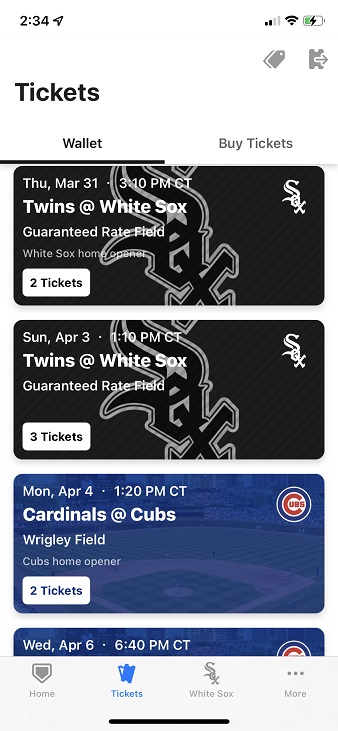
Once again, both the White Sox and the Cubs have eschewed physical tickets for their non-premium season ticket holders, meaning that, once again, this year’s ticket package is nothing more than digital bits on a website or the MLB Ballpark app.  While this does make the actual game day use of the tickets more convenient, it does lose some of the excitement of ticket arrival day and continues to be a disappointment for those of us who collect ticket stubs.  Hopefully the lockout will end in time to actually use some of these.

Another Disastrous Outcome

A week after Commissioner Rob Manfred, with a telling smile on his face, announced he was cancelling the first two series of the regular season due to the ongoing lockout, the two sides are still without an agreement on a new CBA and MLB released a statement cancelling another two series.  In total, the first two weeks of the regular season have now been wiped out.

Locally, the White Sox will miss a road trip to Detroit to battle the Tigers and a home series against the Mariners at Guaranteed Rate Field.  If nothing else gets canceled, their new Opening Day would be on Friday, April 15 against the Rays.  The Cubs would lose a four-game series at Wrigley Field against the Brewers and a quick tilt against the Pirates in Pittsburgh.

So where do things go from here?  Who knows?  The owners declined to counter to the MLBPA’s last, seemingly reasonable offer about an international draft.  How soon negotiations will start again is unknown at this point.  The longer this goes on, the longer I feel it will go on.

Taking A Bite Of The Apple

Apple announced a new partnership with MLB today, broadcasting a weekly Friday night doubleheader, with pre- and post-game shows, exclusively on Apple TV+, assuming, of course, that the lockout ever ends and the season begins.  In addition to the weekly live games, Apple will broadcast a live highlight show, MLB Big Inning, every weeknight during the regular season.  They will also host a new 24/7 livestream with MLB game replays, news and analysis, highlights, classic games, and more, as well as a full complement of on-demand programming, including highlights and MLB-themed original content.

From Apple’s standpoint, this move makes a lot of sense.  MLB’s built-in audience will need to eventually subscribe to their streaming service in order to watch these games, giving them a boost that they must hope will carry over to the offseason.  It also doesn’t hurt baseball’s image to be associated with a forward-looking company like Apple, and getting a streaming option with no blackouts is certainly a step in the right direction.