Post Mortem – Winning Time: The Rise of the Lakers Dynasty

NBA legend Jerry West, who passed away earlier this week at age 86, objected to his portrayal in Winning Time: The Rise of the Lakers Dynasty, saying it was “cruel” and “deliberately false.”  Which is totally how the Jerry West played by Jason Clarke in the show would have reacted.

The Showtime era of Lakers basketball, led by Magic Johnson, Kareem Abdul-Jabbar, and coach Pat Riley, featured an up-tempo offense and resulted in five NBA championships and four additional Finals appearances.  Winning Time, with a changed name because its home network of HBO competed against Showtime, dramatized the early days of the era, starting with the drafting of Johnson and the first championship won during his rookie season of 1979-1980.  A second season, covering the next four NBA campaigns, aired starting in August of 2023.

With Kareem retiring in 1989 and Pat Riley stepping down as coach the following year, the Showtime era came to a close in 1991, following a Finals loss to Michael Jordan and the Bulls and Magic Johnson retiring after testing positive for HIV later that year.  Winning Time came to an end in September of 2023, when HBO announced it was cancelling the series after just two seasons.

Travelling The 50 States – Wisconsin

Over my 48 years, I’ve done my fair share of travelling across these United States.  I thought it would be an interesting experiment go look back at those trips to each of the 31 states I have visited (62% isn’t bad, is it?) and see if, and when, I may be returning.  Working in alphabetical order, we wrap things up today with the 30th state to be added to the Union: Wisconsin.

State: Wisconsin
Joined the Union: 1848
Visits: 15

Over the years, I’ve made fifteen trips to the Badger State, first in 1993 and most recently in 2019, the majority revolving around sports.

I made my first trip to Wisconsin, and my only visit to County Stadium, with Scott and Joe for a White Sox/Brewers tilt on July 18, 1993.  Back in the days before cell phones and GPS, we were left to our own devices as far as directions.  I remember one of the signs for the highway saying it would take us to Madison, and, not wanting to go to Madison, Scott decided to get off the highway.  Which put is somewhere in Milwaukee with no idea of how to get to the ballpark.  Eventually we made it in time to see the White Sox pull off the victory thanks to a 2-run single by Bo Jackson in the 9th inning.

At some unknown point, I made a trip up to the woods of Wisconsin with my friend Mike, his father and brother, and Scott to clean up an old family cabin.  I have no idea where we were or how long we were there, but it was certainly an experience.

My next trip came in April of 1995.  When Michael Jordan returns to the NBA and every game in Chicago is a sellout, the next best thing is to take the long drive 90 miles to the north to see the Bulls battle the Bucks at the Bradley Center.  Despite 33 points from Michael Jordan, Glenn Robinson led the Bucks to a 104-100 victory, scoring 36.

With the opening of their new ballpark in 2001, the Brewers drew me back to Milwaukee in May.  In a pitching battle, the Cubs outlasted the Brewers 7-6 as closer Tom Gordon picked up his first save with the team.

I returned to Milwaukee in April of 2022, when Tina and I drove north to see The Kids In The Hall reunion show at the Riverside Theater.

My next three trips to Miller Park came in May of 2003 and July of 2004.  On May 12, I saw the Cubs, behind home runs from Damian Miller, Moises Alou, and Troy O’Leary, beat the Brewers 11-5.  The next July 5, Ben Sheets outdueled Matt Clement as the Brewers topped the Cubs 1-0.  Three weeks later, the Brewers topped the Cubs once again, winning 6-3.

After nearly a decade away, I returned to Wisconsin in October of 2013 for Keith Longwell’s bachelor party.  I travelled to the faraway land of Kewaunee, where the festivities included nights of video games and cards, nine holes of golf, where I mostly sat in the cart, and a trip out to some local bars, until we were asked to leave due to some drunken tomfoolery.

In July of 2014, Danny, Michael, and I stopped in Madison on our way to Minneapolis to do some miniature golfing at Vitense Golfland.  The highlights of the stop include Michael falling into one of the water hazards and plenty of picture opportunities, like with the Bucky Badger figure above. Continue reading →

Book 13 (of 52) – The Nineties

The Nineties: A Book – Chuck Klosterman

How does one define the Nineties?  Chronologically, the Nineties started January 1, 1990 and ended on New Year’s Eve 1999.  Culturally, it can be argued that the decade began on November 9, 1989 with the fall of the Berlin Wall and ended on a Tuesday September morning when the Twin Towers did the same.  Regardless of how you define it, Chuck Klosterman’s book takes a look back at the last decade of the 20th century, the decade that formed the background of Generation X.

Klosterman digs deep into the figures and events of the day, both the obvious and the less so.  From Singles, the prototypical Gen X movie (at least if you’re white) to the hullabaloo surrounding 2 Live Crew and Ice T’s controversial release Cop Killer.  The fast political rise and just-as-quick fall of Ross Perot and the Teflon-like nature of Bill Clinton.  The country’s brief obsession with clear drinks, like Crystal Pepsi and Zima.  Michael Jordan’s baseball career.  O.J. Simpson and the white Ford Bronco.  Dolly the cloned sheep.  And how the fallout from the election in 2000 has led to the political polarization we see today.

By The Numbers – 23 Bonus!

In 1929, uniform numbers appeared on the back of baseball jerseys for the first time, thanks to the Indians and the Yankees. By 1937, numbers finally appeared across all uniforms, both home and away, across both major leagues. Since that time, 81 distinct numbers have been worn by members of the White Sox, while the Cubs boast 76.

Sunday, we continued our look at those players, picking our favorite, if not the best, player to wear each uniform number for both Chicago teams with #23.  Today, we take a special bonus look at player who famously wore #23 for other Chicago teams, making it possibly the most successful jersey number in town.

Michael Jordan was selected by the Chicago Bulls with the third overall pick in the 1984 NBA draft.  He would go on to become the greatest player in the history of the NBA, leading the Bulls to six titles, nabbing six Finals MVP awards, five MVP awards, three All Star Game MVPs, one Defensive Player of the Year award, and the 1985 Rookie of the Year award.  He was a 14-time All Star, 10-time first team All NBA, 9-time first team All-Defensive, 10-time scoring champion, 3-time steals leader, and 2-time Slam Dunk Contest champion.  A member of the NBA’s 50th and 75th Anniversary teams, his #23 has been retired by both the Bulls and the Miami Heat, for whom he never played.

Selected by the Bears him in the second round of the 2006 NFL Draft, Devin Hester quickly became one of, if not the, greatest return specialists in NFL history.  In his first 13 weeks as a professional, Hester recorded six return touchdowns, including three punt returns, two kickoff returns, and a then-record tying 108-yard touchdown from a missed field goal against the New York Giants.  As the Bears advanced to the Super Bowl, Hester became the first and only person to return the opening kick of the Super Bowl back for a touchdown.  2007 added an additional 6 touchdowns, followed by 2 quieter seasons.  In 2010, he added an additional 3 punt returns for touchdowns, followed by 2 punt returns and 1 kickoff return in 2011.  He added an additional punt return in 2013, his final season with the Bears.  This past September, in his first year of eligibility, Hester was nominated for the induction into the Pro Football Hall of Fame.

By The Numbers – 45 Bonus!

In 1929, uniform numbers appeared on the back of baseball jerseys for the first time, thanks to the Indians and the Yankees. By 1937, numbers finally appeared across all uniforms, both home and away, across both major leagues. Since that time, 81 distinct numbers have been worn by members of the White Sox, while the Cubs boast 76.

Sunday, we continued our look at those players, picking our favorite, if not the best, player to wear each uniform number for both Chicago teams with #45.  Today, we take a special bonus look at someone who wore #45 during a Windy City Classic exhibition game in 1994.

After winning his third NBA championship in the summer of 1993, Michael Jordan retired from basketball.  He signed a contract with the White Sox in February of 1994, “I chose to try to play baseball just to see if I could,” Jordan said when he signed the contract.  “I’m not doing it as a distraction and I’m not doing it as a media hog or looking for the media exposure from it. It’s one of the wishes my father had and I had as a kid.”  Jordan’s father had been murdered the previous July and Jordan’s memories of his father played a large role in his deciding what he should do next.

Jordan, who hadn’t played baseball since high school, had a difficult spring training, hitting .152 in 46 at bats, and he was assigned to Double-A Birmingham.  First, though, was the annual exhibition game between the two Chicago teams on April 7 at Wrigley Field.  Jordan was penciled in to the starting lineup, batting sixth.  In the sixth inning, Jordan hit an RBI single off veteran Dave Otto, and in the seventh, he bounced a Chuck Crim pitch down the third-base line for a game-tying double.  The crowd, White Sox and Cubs fans alike, rose to their feet and roared, as Jordan smiled, stuck out his tongue, and tipped his helmet at second base.

Jordan finished the day 2 for 5, with 2 RBIs, an error, and base running gaffe.  “Who would ever think I would be out there playing in Wrigley Field?” Jordan said.  “It was a great feeling just to come out there and do well.”  Jordan reported to Birmingham the following day and, after the labor strife that ended the 1994 season early spread in to 1995, Jordan left baseball, returned to the Bulls, and won another three NBA championships.

200 Things To Do In Illinois – United Center

Illinois celebrated its bicentennial as a state in December of 2018. To celebrate, the Chicago Tribune published the Bicentennial Bucket List: 200 Things To Do In Illinois, celebrating the best the state has to offer in history, food, architecture, culture, sports, nature, drink, and oddities.  Now that the state is starting to open back up following the corona virus outbreak, I figured this was the second-best time to look through this collection and cover the ones I’ve done/eaten/seen.

We kick things off with one of the entries from the Sports category: United Center, from Chicago, IL.

Seeing the stars of the Bulls and the Blackhawks go to battle in the Madhouse on Madison is thrilling – or infuriating, depending on how the teams are doing.

But no trip to the Near West Side stadium is complete without genuflecting at a trio of statues commemorating former Chicago hockey and basketball greats Bobby Hull, Stan Mikita and Michael Jordan.  You’ll find Hull and Mikita outside, while His Airness is enshrined in an atrium that opened last year.

I’ve been to the United Center 10 times, for 4 Bulls games, 4 Blackhawks games, a 2011 NCAA tournament game, and a concert by the Royal Philharmonic Orchestra.  My first two Bulls games came in 1997, a month or two prior to Michael Jordan’s return to the team.  My only game during the championship years came in November of 1997, when I saw Jordan and Bulls defeat the Hornets.  3 of the Blackhawk games came during their lean years, with just one coming during their championship runs.  The NCAA tournament game saw the Purdue Boilermakers fall to VCU in a surprising upset.


Tearing It Down

derrick-roseAfter 8 years of hopes, dreams, and frustrations, the Bulls bid farewell to former MVP Derrick Rose yesterday, trading the former superstar to the Knicks, along with Justin Holiday and a second round pick in 2017, for Robin Lopez, Jose Calderon, and Jerian Grant.  Rose, the overall number one draft pick in the 2008 draft, had trouble staying on the court in the last 4 seasons of his tenure, missing more games than he played.

Rose’s career with the Bulls started off with great promise, leading the team to their best showings since Michael Jordan retired the second time following the 1997-1998 NBA Championship.  They looked to be a team on the rise following the 2010-2011 season, which they finished with the best regular season record in the league and lost a hard-fought Eastern Conference Finals against the Heat.  The following December, Rose signed a 5-year contract extension and the Bulls looked to again challenge for the Eastern Conference title.  Sadly, in the first game of the first round against the Sixers, Rose tore his ACL and the favored Bulls were quickly eliminated.

Rose missed the entire 2012-2013 season, despite being cleared by doctors to play in March.  He finally returned for the start of the 2013-2014 season, but a torn meniscus in late November again put him out for the season.  The next two seasons were marred by inconsistent play, more knee injuries, coaching turnover, and a sexual assault lawsuit.  When the Bulls failed to make the playoffs this past season, changes were bound to be made, with this being the first.

Book 17 (of 52) – From Black Sox To Threepeats

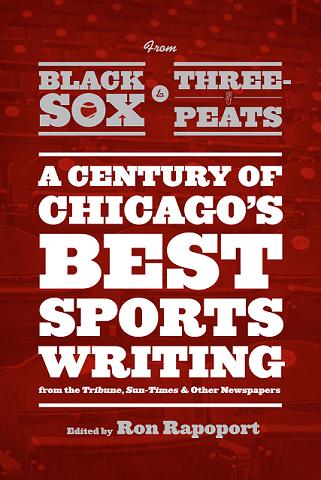
From Black Sox to Threepeats - Ron Rapoport

From Black Sox to Threepeats – Ron Rapoport

Former Sun-Times columnist Ron Rapoport put together this collection of the best writing in the Chicago sports pages over the last century and more.  From the sole crosstown World Series between the White Sox and Cubs in 1906 through the White Sox World Series championship of 2005, this collection covers all of the highs and lows in Chicago sports from all of the local newspapers.  There were the over the top champions of the 1985 Bears, the thrills of Michael Jordan and Scottie Pippen bringing home 6 titles in the 90s, and the (mostly) heartbreak of the local baseball teams who usually come up just a little (or a whole heck of a lot) short.

Alongside the traditional stories detailing the local teams, there are also those columns fighting against the segregation that followed black players to spring training, the bombings of both Oklahoma City and the Twin Towers, the murder of Israeli athletes at the 1972 Olympics in Munich, and many other stories of local, national, and international scope.

Fans of the local sports teams will likely enjoy this book, and may have even read some of the stories when they originally appeared in the newspaper.  It gives a nice historical look at the best writing the papers had to offer, as well as the historical highs and lows of our favorite teams.

#308 – Mike Huff

e571Name: Mike Huff

Rank: 308

Position: OF

Years With White Sox: 1991-1993

Mike Huff joined the White Sox in July of 1991 when he was selected off waivers from the Indians.  He performed well for the Sox in the second half of the 1991 season, hitting .268 in 51 games.  Unfortunately, that would be his high water mark as a member of the South Siders.

In 1992, Huff appeared in 60 games, but saw his average drop to .209.  Things were even worse the next year, as the White Sox headed to their 2nd and final AL West championship.  Huff only appeared in 43 games for the big league club, and finished with an anemic .182 average.

Spring training of 1994 brought an unexpected addition to the White Sox clubhouse: Michael Jordan.  Being on the bubble, Huff was vocal about the uneasiness of having a roster spot potentially taken by an unworthy player for marketing purposes.  He shouldn’t have worried, since neither he nor Michael Jordan would be spending the summer in Chicago.  As spring training was winding down and it became obvious that Huff was not going to make the team, GM Ron Schueler traded him to the Blue Jays in exchange for Domingo Martinez, commenting that the move “gives him a chance to stay in the big leagues.”

Huff has rejoined the White Sox organization in recent years, acting as a vice president for the Bulls/Sox training academy and filling in on the television broadcasts when Steve Stone is away.

Huff’s numbers in a White Sox uniform, both for games I attended and overall, were: Continue reading →

March Forth

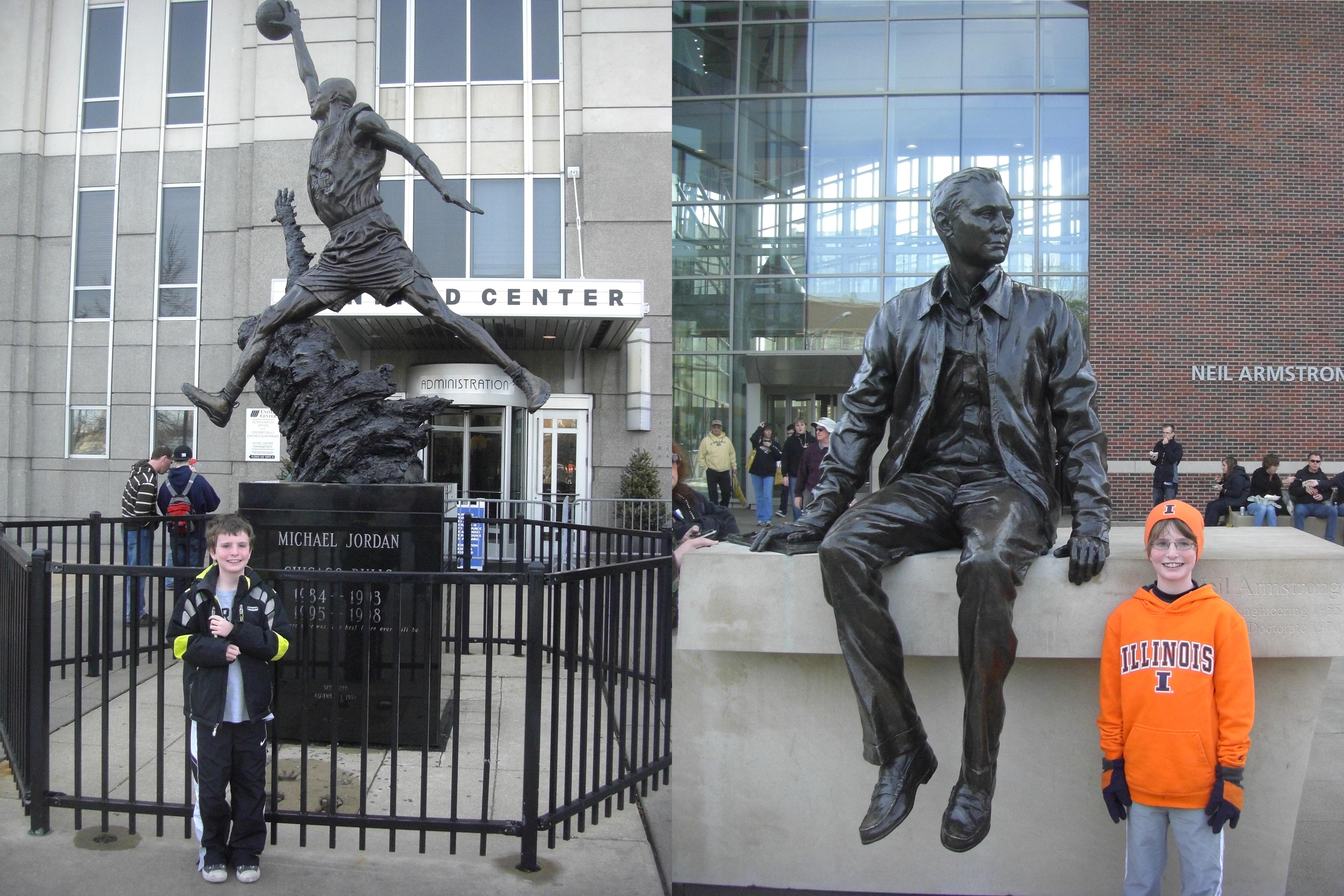
Danny takes center stage in March, with two portrait pictures combined into one to match the landscape format of the calendar.  The photo on the left shows Danny with the Michael Jordan statue outside of the United Center before Purdue’s unfortunate ouster in round two of the NCAA tournament last March.  In photo on the right, Danny poses with Neil Armstrong on the Purdue campus before the homecoming victory over the Fighting Illini last October.