Preparing For Stars

Before kicking off the second half of the season Friday night, the Cubs unveiled the logo for the 2027 All-Star Game, planned to be played at Wrigley Field next July 13.  The logo incorporates iconography of both the Wrigley Field marquee and the stars from the Chicago flag.
The game has been played at Wrigley Field three previous times, and each was honored as part of the ceremony.  Phil Cavaretta’s niece stood in for him for the 1947 game, with Billy Williams representing the 1962 game and Andre Dawson and Shawon Dunston representing the 1990 game.  Each installed a base with their game’s logo before the new one was unveiled at home plate.

Of course, the giant elephant in the room is the labor uncertainty thanks to an all-but-certain lockout coming following this season that threatens to interfere with the 2027 season.

150 Years Of Cubs Baseball – Outfielders Part 3

Originally founded in 1869, the Chicago Cubs became a charter member of the National League in 1876.  Over the next 150 seasons, the Cubs have played more than 22,000 games, scored over 103,000 runs and recorded more than 200,000 hits, more than any other team in baseball history.  Nearly 2,300 players have worn a Cubs uniform, earning eight division titles, 17 NL pennants, and three World Series championships.

Fans have witnessed generations of unforgettable players, from historical heroes like Joe Tinker, Gabby Hartnett, Ernie Banks, and Billy Williams to more recent stars like Ryne Sandberg, Derrek Lee, Kerry Wood, and Anthony Rizzo.  The team has called Wrigley Field home for 110 of those 150 seasons.

To celebrate this milestone, the Cubs are holding a fan vote to select the franchise’s anniversary team.  Each week, we will go through the provided options for each position and declare who should, and, if different, who will, win the fan vote.  We continue today with the final eight selections for outfielder.

Frank Schulte debuted for the Cubs in September of 1904.  He was part of four pennant-winning teams, including the back-to-back championships in 1907 and 1908.  He led the NL in home runs in 1910 and 1911, when he became the first player in MLB history to have 20 or more doubles, triples, home runs, and stolen bases in a single season.  That feat earned him the NL MVP award, then known as the Chalmers Award.  He remained with the Cubs through July of 1916.

Jimmy Sheckard spent seven seasons with the Cubs near the turn of the 20th Century, helping the team to four NL pennants and World Series Championships in 1907 and 1908.  One of the most versatile outfielders of his time, Sheckard still holds the record for most double plays as a left fielder, with twelve in 1911.  His best offensive season also came in 1911, leading the NL in runs and walks, and his 147 walks remains a team record.

Jimmy Slagle manned center field for seven seasons, helping the Cubs win back-to-back-to-back NL championships from 1906-1908, the latter two ending with World Series titles.  He is the first player to accomplish a straight steal of home plate in a World Series in 1907.  A classic leadoff man for his era, Slagle was known for his speed, contact hitting, and exceptional defense.

Continue reading →

150 Years Of Cubs Baseball – Outfielders Part 1

Originally founded in 1869, the Chicago Cubs became a charter member of the National League in 1876.  Over the next 150 seasons, the Cubs have played more than 22,000 games, scored over 103,000 runs and recorded more than 200,000 hits, more than any other team in baseball history.  Nearly 2,300 players have worn a Cubs uniform, earning eight division titles, 17 NL pennants, and three World Series championships.

Fans have witnessed generations of unforgettable players, from historical heroes like Joe Tinker, Gabby Hartnett, Ernie Banks, and Billy Williams to more recent stars like Ryne Sandberg, Derrek Lee, Kerry Wood, and Anthony Rizzo.  The team has called Wrigley Field home for 110 of those 150 seasons.

To celebrate this milestone, the Cubs are holding a fan vote to select the franchise’s anniversary team.  Each week, we will go through the provided options for each position and declare who should, and, if different, who will, win the fan vote.  We continue today with the first eight selections for outfielder.

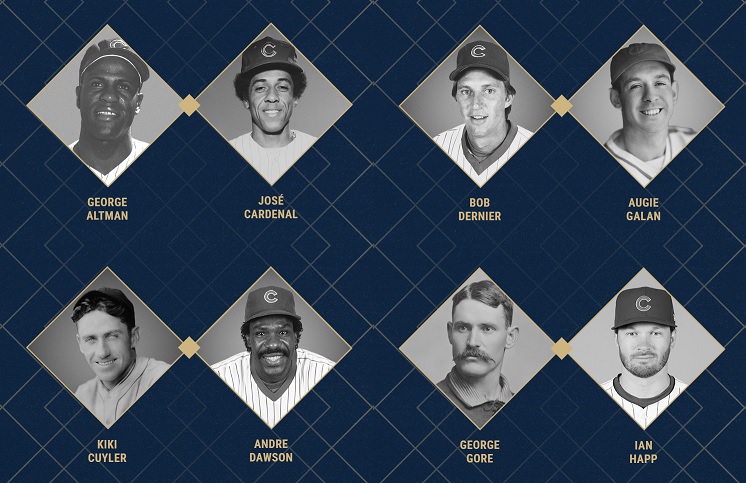
George Altman spent seven seasons with the Cubs across two stints.  Debuting with the club in 1959, he quickly emerged as one of the team’s most productive hitters, earning All-Star selections in both 1961 and 1962.  He accumulated 7.9 WAR across those two seasons while establishing himself as a dangerous power hitter.  He returned to the Cubs in 1965 but was unable to reclaim his former status and struggled to produce.  He finished his major league career in 1967, hitting just .111 in 15 games.

José Cardenal joined the Cubs for the 1972 season and stayed through 1977.  He was one of the most popular and productive players during his tenure, bridging the gap between the superstars of the 60s and the success coming in the 1980s.  He was named Cubs player of the year by local media in 1973.  His best season came in 1975, earning 3.1 WAR while hitting .317.  He was inducted into the Cubs Hall of Fame in 2022.

Kiki Cuyler joined the Cubs following the 1927 season and spent parts of eight years with the team.  During his tenure, Cuyler was one of the most dynamic offensive players in the league, helping the Cubs win two NL pennants.  He was named to his lone All-Star team in 1934 in its second year of existence.  He led the NL in three times, from 1928 through 1930.  In 1968, he was enshrined in Cooperstown as a member of the Hall of Fame.

Continue reading →

By The Numbers – 8

In 1929, uniform numbers appeared on the back of baseball jerseys for the first time, thanks to the Indians and the Yankees.  By 1937, numbers finally appeared across all uniforms, both home and away, across both major leagues.  Since that time, 81 distinct numbers have been worn by members of the White Sox, while the Cubs boast 76.

Today, we continue our look at those players, picking our favorite, if not the best, player to wear each uniform number for both Chicago teams with #8.  82 different players have donned #8 while playing in Chicago, 40 for the White Sox and 42 for the Cubs.

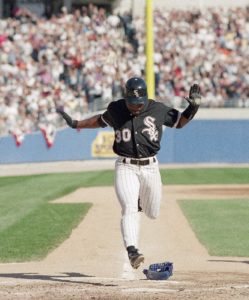
Vincent Edward “Bo” Jackson joined the White Sox as a free agent on April 3, 1991 after being released by the Royals following a catastrophic hip injury suffered in January during the NFL playoffs as a member of the Raiders.  “In making the business decision,” owner Jerry Reinsdorf said at the time, “I assume he will not play this year. If he does, it will be a big bonus.”  Jackson did spend most of 1991 on the disabled list, rehabbing the injury, but did eventually manage to make his way back to the field.  He appeared in 23 games, hitting only .225 with 3 home runs.

Diagnosed with avascular necrosis of the hip joint and having lost all of the cartilage supporting his hip, Jackson decided to undergo a hip replacement surgery, keeping him on the shelf for the entire 1992 season.  While rehabbing, Jackson promised his mother he would return to the major leagues and hit a home run for her.  Unfortunately, Jackson’s mother died before he could return, but, in his first at bat of the 1993 season, and his first with an artificial hip, he hit a home run to right field against the Yankees at Comiskey Park.  On September 27, Jackson belted a three-run home run off of the Mariners to help the White Sox clinch their first AL West Division title in a decade.  Jackson ended up appearing in 85 games for the White Sox, hitting .232 and hitting 16 home runs while driving in 45.  He appeared in 3 of the 6 ALCS games against the Blue Jays, going hitless in 10 at bats.  Following the season, he became a free agent, ending his White Sox playing career.  In 2014, he returned to the organization as an ambassador, a role he continues to play today.

A free agent following the 1986 season, Andre Dawson was looking for a new home with natural grass that would be easier on his injured knees.  With MLB owners colluding against the players by agreeing not to sign free agents, Dawson found himself without takers.  When the Cubs opened their spring training camp that spring, Dawson and his agent, Dick Moss, arrived with a signed blank contract in an attempt to get a job.  GM Dallas Green derided the stunt as a “dog and pony show,” but, after reviewing the contract, Green and Moss reached an agreement on a lowball salary of $500,000, the second-lowest salary amongst the team’s starters.  The Cubs easily got their money’s worth, as Dawson became the Cubs’ starting right fielder, and hit a major league leading 49 home runs and was named NL MVP, despite the Cubs finishing in last place.

Dawson played five more seasons with the Cubs and was one of the franchise’s most popular players during that time.  His worst individual season came in 1989, when the Cubs won the NL East title.  During the NLCS, Dawson slumped terribly, hitting .105 as the Giants beat the Cubs 4 games to 1.  Dawson’s .507 career slugging percentage with the Cubs is fourth highest in team history.

Franchise Four – NL East

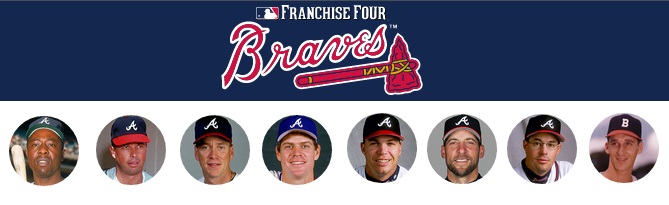
Major League Baseball is asking its fans to vote for the four most impactful players who best represent the history of each franchise.  The winners will be announced in July at the All Star Game in Cincinnati.  Today, I will give my Franchise Four picks for the National League East.

F4BravesWell, this is a nice collection of players selected to represent the Braves.  6 of the 8 have been elected to the Hall of Fame with a 7th sure to make it once he is eligible.  Hank Aaron and Warren Spahn rise above their Hall brethren, so they take the first two slots.  The last two slots come down to Eddie Mathews, with his 512 career home runs, and the 3 aces of the 90s, Greg Maddux, Tom Glavine, and John Smoltz.  I’m going to go with Mathews and Maddux.

F4Marlins

A much different scenario for the Marlins, who have only been in existence since 1993 and have a history of ownership who ships out any player that may be any good and, thus, command a decent salary.  The 8 players in the running have averaged less than 7 years in a Marlin uniform.  That said, I will pick Josh Beckett, Gary Sheffield, Mike Lowell, and current star Giancarlo Stanton.

F4Mets

Continue reading →

2010 Hall of Fame Inductees

The BBWAA will announce the results of their Hall of Fame voting for 2010 tomorrow afternoon. Yesterday, we looked at the 26 candidates and dismissed over half of them. Today, we’ll take a look at the remaining 8 who have a better chance and the 4 who should be elected.

Try Again Next Year: A case can be made, but will need to be made again next year.

  • Fred McGriff – Probably has the numbers to make it, but will suffer due to never being thought of as a potential Hall of Famer while he was playing.  He and Alan Trammell were probably hurt the most by the late-90’s offensive (and steroid) explosion.
  • Bert Blyleven – In his first year of eligibility, he got 26 fewer votes than Tommy John, and nobody is looking to put Tommy John in the Hall of Fame.
  • Harold Baines – He barely got enough votes last year to stay on the ballot, which is a shame.  He’s hurt by being a DH for the majority of his career after knee injuries, and played the majority of his career in the shadows of Chicago’s south side and Baltimore.  If Jim Rice makes it in, so should Harold.  But he won’t.
  • Lee Smith – He was the all-time saves leader when he retired, but benefited from the transition of the closer role from fireman to guy who gets the last three outs and racks up saves.  He’s already been passed twice on the career saves list.
  • Jack Morris – One of the best, if not the best, Game 7 World Series performance of all time, but, overall, an very good pitcher who wasn’t quite good enough to make the Hall of Fame.
  • Don Mattingly – No offense to Donnie Baseball, but being the best Yankee in a decade of bad Yankee teams does not a Hall of Famer make.  If it weren’t for injuries, he may have had a legitimate shot.
  • Edgar Martinez – Will probably make it some day, but will need to overcome the DH stigma.  Many are excusing that he didn’t hit the big numbers due to not making the majors full-time until age 27, but I don’t see why he gets a pass for that.
  • Barry Larkin – Again, will probably make it but not on the first shot.  Might be slightly overlooked after spending his entire career in Cincinnati.

The 2010 Hall of Fame Class (according to me)

Andre Dawson

Seeing as Jim Rice made it last year, Andre Dawson should have no problems punching his ticket this year.  While Rice may have been the “most feared” hitter in the AL during the 1970s, an argument could be made that Dawson filled a similar role in the NL.  In addition to the power numbers, Dawson was also able to play defense and wasn’t a hindrance on the base paths.  He was the 1977 NL Rookie of the Year and the 1987 NL Most Valuable Player.

Some of the things that will hold back his election is the low career OBP and his spending his formative years in the spotlight graveyard known as Montreal, but after getting 67% of the vote last year, he’s due for a bump this year.

Tim Raines

Last year, Raines garnered only 22.6% of the vote, which is mind-blowing.  He is quite possibly the best leadoff hitter in the history of the game not named Rickey Henderson, with a similar, if not as potent, blend of speed and power.

The only downsides are, again, his best years were spent in Montreal and his involvement in the Pittsburgh Drug Trials.  There’s really no reason why Raines shouldn’t be in Cooperstown.

Mark McGwire

So, what to say about McGwire.  His numbers speak for themselves, but he’s been locked out of Cooperstown so far due to a backlash against the “steroid era” stemming from his testimony, or lack thereof, in front of Congress.

I think this is the year that things start to turn around for McGwire.  For one, he is returning to the game as the hitting coach for the Cardinals.  Secondly, while McGwire was the first of the suspected users to come up for election, he won’t be the last and they are coming soon.  I seriously don’t see how the BBWAA can justify keeping Barry Bonds and Roger Clemens out of the HOF, given the numbers they put up before they “allegedly” started using PEDs.  And once you let one in, you’ll have to let the rest in.

So, while it may not be this year, but McGwire will end up in Cooperstown someday.

Roberto Alomar

Like McGwire, Alomar, numbers wise, is a sure bet for the Hall of Fame, but there is that one incident that casts doubt upon his candidacy.  Unlike McGwire, Alomar apologized, took responsibility for what he had done, and has continued to make amends through charity work.

On the field, there was no doubt that Alomar belongs in the Hall of Fame.  Certainly one of the best second baseman of all time, he combined offense and defense at a position where few had done so before.

So there you have it.  The Class of 2010 (according to me) for the Baseball Hall of Fame.