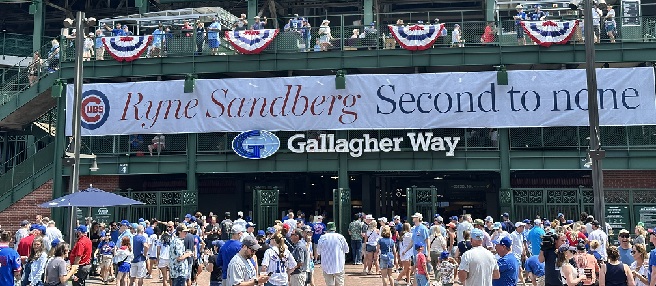
 The Cubs are starting construction today on a new archway entrance to Gallagher Way that will honor the franchise’s three World Series championship teams from 1907, 1908, and 2016. The arch will be on the southwest corner of the park outside of Wrigley Field, facing the corner of Clark and Addison. Currently called Champions Gate, although I’m sure a corporate sponsor will be added at some point, the new entryway is expected to be completed by July 18, when the Cubs will honor the tenth anniversary of the 2016 team.
Tag / Gallagher Way
150 Years Of Cubs Baseball – Second Basemen
 Originally founded in 1869, the Chicago Cubs became a charter member of the National League in 1876. Over the next 150 seasons, the Cubs have played more than 22,000 games, scored over 103,000 runs and recorded more than 200,000 hits, more than any other team in baseball history. Nearly 2,300 players have worn a Cubs uniform, earning eight division titles, 17 NL pennants, and three World Series championships.
Fans have witnessed generations of unforgettable players, from historical heroes like Joe Tinker, Gabby Hartnett, Ernie Banks, and Billy Williams to more recent stars like Ryne Sandberg, Derrek Lee, Kerry Wood, and Anthony Rizzo. The team has called Wrigley Field home for 110 of those 150 seasons.
To celebrate this milestone, the Cubs are holding a fan vote to select the franchise’s anniversary team. Each week, we will go through the provided options for each position and declare who should, and, if different, who will, win the fan vote. We start today with the eight selections for second baseman.
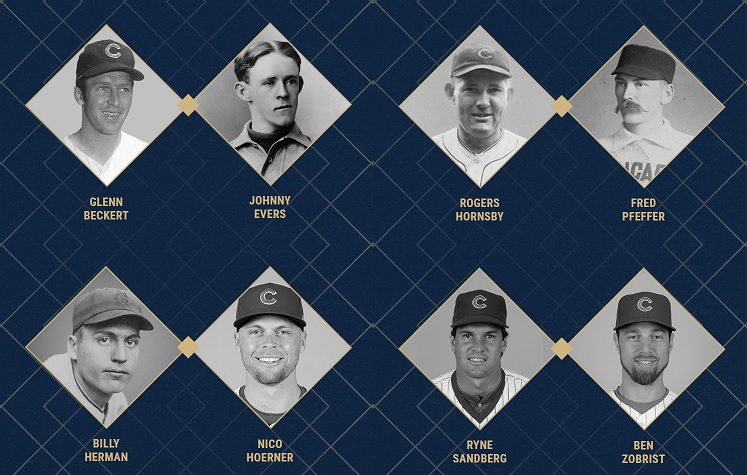 Glenn Beckert was called up by the Cubs in 1965, spending the next nine seasons as the team’s second baseman. He won the Gold Glove in 1968 and was a four-time All-Star. His best offensive season came in 1971, when he finished third in the NL with a career-best .342 batting average.
Johnny Evers played for the Orphans/Cubs from 1902 through 1913. Known as “The Human Crab” for his combative play and fights with umpires, he earned a place in baseball history as part of the famous “Tinker-to-Evers-to-Chance” double-play combination thanks to the poem Baseball’s Sad Lexicon. Evers was responsible for alerting umpires to the baserunning mistake that would come to be known as “Merkle’s Boner”. He was part of three NL pennant winners with the Cubs, winning the championship in 1907 and 1908, and was elected to the Hall of Fame in 1946.
Billy Herman spent the first eleven years of his career with the Cubs, hitting over .300 in seven of his first nine seasons. He led the league in games played (twice), hits, doubles, and triples across his nine full seasons. During that time, he was named an All-Star seven straight times, beginning in 1934. He was elected to the Hall of Fame in 1975.
A Fallen Icon
 For the second time in the month, a Chicago baseball legend has lost his life prematurely due to cancer. Former Cubs second baseman Ryne Sandberg, who had been suffering from metastatic prostate cancer for over a year, died Monday at 65.
Ryne Sandberg was acquired by the Cubs, along with Larry Bowa, from the Phillies for Ivan DeJesus in January of 1982. He was the primary third baseman for the Cubs during the 1982 season, hitting .271 with 7 home runs and 54 RBIs, good enough to place sixth in Rookie of the Year voting. After the Cubs acquired Ron Cey following the season, they moved Sandberg to second base, where he would become a mainstay for the next decade plus.
1983 saw Sandberg garner his first Gold Glove while hitting .261 with 8 home runs and 48 RBIs. He blossomed in 1984, as the Cubs made a surprising run at the NL East title. Sandberg won the MVP, Silver Slugger, and Gold Glove awards while leading the league with 114 runs and 19 triples. He hit .368 during the NLCS against the Padres, which the Cubs dropped in 5 games. 1985 saw him win another Silver Slugger and Gold Glove, while still earning MVP support despite the Cubs falling to the bottom of the division. He earned another Gold Glove in 1986, hitting .284 with 14 home runs. Injuries limited him to 132 games in 1987. but he still took home his fifth consecutive Gold Glove.
Sandberg posted a .741 OPS in 1988, good enough for his third Silver Slugger award and his sixth straight Gold Glove. The Cubs returned to the post-season in 1989, as Sandberg hit .290 with 30 home runs, which garnered him yet another Silver Slugger and Gold Glove while coming in fourth for MVP voting. He hit .400 and drove in four in the Cubs’ NLCS loss to the Giants in five games. In 1990, Sandberg set a career high with 40 home runs, which led the National League, and duplicated his Silver Slugger, Gold Glove, and fourth place for MVP voting results from the previous year. 1991 saw Sandberg win his ninth consecutive, and final, Gold Glove award, breaking a tie with Bill Mazeroski. In 1992, he won his fifth straight, and seventh overall, Silver Slugger award. 1993 saw Sandberg make his tenth consecutive, and final, All-Star team.
Sandberg struggled out of the gate in 1994, and with rumored marital issues at home, he abruptly retired on June 13th, saying “I lost the desire that got me ready to play on an everyday basis for so many years. Without it, I didn’t think I could perform at the same level I had in the past, and I didn’t want to play at a level less than what was expected of me by my teammates, coaches, ownership, and most of all, myself.” Following a divorce and a new marriage, Sandberg returned to the Cubs in 1996, hitting .244 with 25 home runs and 92 RBIs. With his OPS dropping to .711 in 1997, his lowest total since 1983, Sandberg retired for good following the 1997 season. He was inducted to the Hall of Fame in 2005 and, that August, the Cubs retired his #23. Last June, a statue of Sandberg was unveiled on Gallagher Way outside Wrigley Field
Celebrating Yourself
 The Cubs are holding a party tonight to celebrate the end of the 1060 Project and the completion of the remodeling of Wrigley Field and the build out of the surrounding area. The event, open to season ticket holders, includes the premiere of a new documentary about the renovations titled Saving Wrigley Field and the unveiling of two new plaques outside of the main gate: one to commemorate Wrigley Field’s official designation as a National Historic Landmark and the second to, and I quote, “commemorate the Ricketts family’s commitment to preserving Wrigley Field.”
The Cubs are also expected to unveil a new Hall of Fame, which was supposed to happen last year but was delayed due to the pandemic. The Hall of Fame, which will be located on the left field bleacher concourse, will have its inaugural class of 56 inductees(!) announced at the event and will allow the Cubs to hold subsequent induction events on a yearly basis. Those 56 inductees represent the 41 individuals previously enshrined in the original Cubs Hall of Fame (1982-86), nine additional individuals enshrined in the Cubs Walk of Fame (1992-98), five Cubs recently recognized by the National Baseball Hall of Fame and a new 2021 inductee, Margaret Donahue, who broke gender barriers as Major League Baseball’s first female officer who was not a team owner. The plaques will be on display starting Friday.
I will, of course, be missing this whole hullabaloo, as I’m currently driving to Florida for vacation. One must wonder on the timing of this event, coming on the heels of a late July tradeoff and another long losing streak, especially since it was all intended to roll out last year and was just announced a few weeks back.
Opening A New Book
 The Cubs received approval this week from the Commission on Chicago Landmarks to build a two-story sportsbook at the corner of Sheffield and Addison. The 22,350-square-foot structure, which would be home to a DraftKings Sportsbook at Wrigley Field as part of a sponsorship deal the team struck with DraftKings last year and looks to make gambling an integral part of the game day experience at the Friendly Confines. Though the new building would be connected to the ballpark, the addition would be open to anyone, as Major League Baseball rules prohibit a sportsbook operating where a game ticket is required for entry.
Yesterday’s approval is only the first step in what is sure to be a long process to get this extension put in place. Approval is still needed from the City Council, both for the development itself but also on allowing sports betting inside the city’s stadiums. The National Park Service, which designated the restored ballpark as a National Historic Landmark, would also need to approve the plans for the new building.
While the timing is likely coincidental, it is somewhat amusing that the hearing on this came up a week after the Cubs traded off all of their star players because they couldn’t “afford” to offer them market-value extensions. Also, it is amusing in a sad way that you must have a ticket to sit in the lovely park the Cubs built on the other side of the stadium in Gallagher Way, but you will be able to enter this new facility without one. Like it or not, baseball, and the Cubs, have hitched their wagon to legal gambling and they will try to wring every dollar they can out of the arrangement.