 Originally founded in 1869, the Chicago Cubs became a charter member of the National League in 1876. Over the next 150 seasons, the Cubs have played more than 22,000 games, scored over 103,000 runs and recorded more than 200,000 hits, more than any other team in baseball history. Nearly 2,300 players have worn a Cubs uniform, earning eight division titles, 17 NL pennants, and three World Series championships.
Fans have witnessed generations of unforgettable players, from historical heroes like Joe Tinker, Gabby Hartnett, Ernie Banks, and Billy Williams to more recent stars like Ryne Sandberg, Derrek Lee, Kerry Wood, and Anthony Rizzo. The team has called Wrigley Field home for 110 of those 150 seasons.
To celebrate this milestone, the Cubs are holding a fan vote to select the franchise’s anniversary team. Each week, we will go through the provided options for each position and declare who should, and, if different, who will, win the fan vote. We continue today with the eight selections for shortstop.
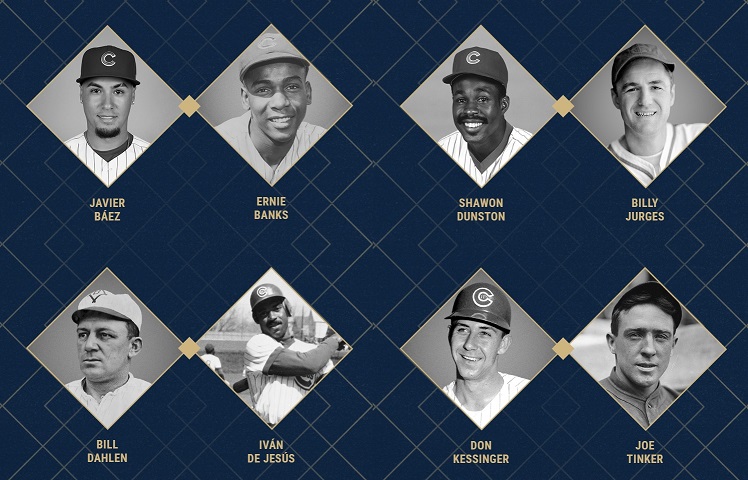 Javier Baez was drafted by the Cubs in the first round in 2011 and debuted with the big-league club in 2014. He became a starter in 2016, helping the Cubs end their 108-year championship drought by winning the World Series. His best season came in 2018, when he led the league in RBI and finished second in MVP voting. His tenure with the Cubs ended in 2021, traded to the Mets for a young prospect named Pete Crow-Armstrong. During his time on the north side, he was a two-time All-Star, the 2016 NLCS MVP, and won both a Gold Glove and a Silver Slugger.
Ernie Banks played his entire 19-year career with the Cubs, earning back-to-back MVP honors in 1958 and 1959. At the time of his retirement following the 1971 season, he ranked ninth all-time in career home runs with 512. He was elected to the Hall of Fame in 1977 and became a team ambassador, never seen without a smile on his face. Known as Mr. Cub, his #14 was retired by the team in 1982, making him the first Cub to receive that honor.
Bill Dahlen spent eight seasons with the Colts and Orphans through most of the 1890s. Playing in a dead ball era, he had a good amount of power, finishing among the NL’s top ten players in home runs four times and in slugging percentage three times. He set a new record with a 42-game hitting streak in 1894. He was traded away following the 1898 season. He is considered to have the most career WAR of any eligible player, except those tainted by scandal, to not be in the Hall of Fame.

 Acquired from the Dodgers, along with Ivan DeJesus, in exchange for Rick Monday and Mike Garman, Bill Buckner joined the Cubs, wearing #22, in 1977. A staph infection in his ankle the previous year caused the Cubs to move the former outfielder to first base, a position he would man for the rest of his career. Appearing in 122 games, he hit .284 with 11 home runs and 27 doubles. He improved in 1978, raising his average to .323 and placed 17th in MVP voting. 1979 was another steady year for Buckner. On May 17th, in the infamous slugfest where the Cubs lost 23-22 to the Phillies, he went 4–for–7 with a grand slam and a career-high seven RBIs. He finished the year hitting .284 with 14 home runs and 34 doubles, but was also described as “nuts” when manager Herman Franks resigned late in the season.
 Acquired by the Cubs following the 2003 season for Hee Seop Choi, Derrek Lee, wearing #25, quickly became a mainstay of the Cubs lineup. He hit .278 with 32 home runs and 98 RBIs in his first year on the north side. 2005 was a career year for Lee, and that was just in the first half. He led the majors with a .376 average and 72 RBIs while tying for the lead with 27 home runs. For the full season, he hit 46 home runs and a .335 average, the highest for a Cub since Bill Madlock in 1976 and he notched the first batting title for a Cub since Bill Buckner in 1980. When it was all said and done, he had won the Gold Glove and Silver Slugger awards and finished third in MVP voting.
