By The Numbers – 43

In 1929, uniform numbers appeared on the back of baseball jerseys for the first time, thanks to the Indians and the Yankees.  By 1937, numbers finally appeared across all uniforms, both home and away, across both major leagues.  Since that time, 81 distinct numbers have been worn by members of the White Sox, while the Cubs boast 76.

Today, we continue our look at those players, picking our favorite, if not the best, player to wear each uniform number for both Chicago teams with #43.  71 different players have donned #43 while playing in Chicago, 23 for the White Sox and 48 for the Cubs.

Dennis Eckersley donned #43 for the Cubs after being acquired on May 25, 1984 from the Red Sox for Bill Buckner.  He went 10-8 with a 3.03 ERA while helping the Cubs into the postseason for the first time since 1945.  He lost Game 3 of the NLCS, giving up 5 runs in 5 1/3 innings pitched in his playoffs debut.  Along with the rest of the Cubs rotation in 1985, Eckersley spent time on the DL, causing the team to drop from a 4-game division lead on June 11 to finishing in 4th place, 23 1/2 games back.  Eckersley returned to full physical strength in 1986, but struggled, going 6-11 with a 4.57 ERA as he battled alcoholism.  After an offseason spent in rehab, Eckersley was traded to the A’s following spring training in 1987, where, he, of course, moved to the bullpen and became a Hall of Famer.

Known as “The Milkman”, Herbert Perry wore #43 when he joined the White Sox on April 21, 2000 after being selected off waivers from the Devil Rays.  Solid defense and a hot bat led to him getting more and more playing time, eventually becoming the everyday third baseman as the White Sox cruised to their first Central Division title.  He finished the year with a .308 average, 12 home runs, and 61 RBIs and was one of the few regulars who continued to hit in the post-season, putting up a .444 average in the ALDS against the Mariners.  Injuries and the acquisition of Royce Clayton limited Perry to 92 games in 2001, as his average dropped to .256 and his home runs fell to 7.  After the season, he was traded to the Rangers for a player to be named later.
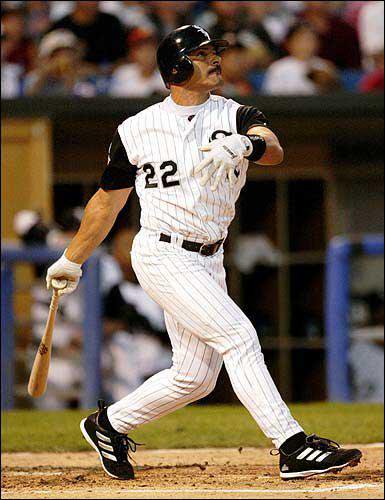
#35 – Jose Valentin

Name: Jose Valentin

Rank: 35

Position: SS/3B

Years With White Sox: 2000-2004

Jose Valentin was acquired by the White Sox, along with Cal Eldred, on January 12, 2000 from the Brewers in exchange for Jaime Navarro and John Snyder.  Valentin replaced Mike Caruso at shortstop, and provided an offensive punch that had been missing.  On April 27, against the Orioles, he hit for a natural cycle, becoming just the fifth, and the most recent, White Sox player to hit for the cycle.  While Valentin provided an offensive spark, hitting .273 with 25 home runs and 92 RBI, he was a butcher in the field.  He led the American League with 36 errors.  Despite this, Valentin helped lead the White Sox to their first division title since 1993.  He hit .300 in the ALDS against the Mariners, where the White Sox were swept out of the playoffs.

To help improve their defense, the White Sox acquired Royce Clayton to play shortstop for 2001, forcing Valentin to move around the field in order to keep his bat in the lineup.  He split most of his time between center field and third base, before moving back to shortstop when Clayton failed to hit at all.  Valentin’s average dropped down to .258, but he set a career high with 28 home runs.  He still managed to place second in the AL with 22 errors, despite only appearing in 124 games.

With Clayton getting another shot in 2002, Valentin shifted back over to third base, which is where he spent the majority of the year.  When Clayton struggled offensively again, Valentin again spent time back at shortstop, starting 47 games.  He ended the year with a .249 average and 25 home runs.

After Royce Clayton left as a free agent, Valentin again became the everyday shortstop in 2003.  While he continued to struggle defensively, finishing 3rd in the AL with 20 errors, he started to struggle offensively as well.  Despite tying his career high with 28 home runs, his average dropped to .237, his lowest total as a member of the White Sox.

In 2004, Valentin’s offense continued to slip.  His average dropped to .216, a career low, but he did manage to set a new career high with 30 home runs in only 450 at bats.  Following the season, he became a free agent and his White Sox career drew to a close.

Valentin’s numbers in a White Sox uniform, both for games I attended and overall, were:

Continue reading →

#57 – Herbert Perry

herbertName: Herbert Perry

Rank: 57

Position: 3B

Years With White Sox: 2000-2001

Herbert Perry joined the White Sox on April 21, 2000 after being selected off waivers from the Devil Rays.  Perry initially was a backup to Greg Norton, but solid defense and a hot bat led to him getting more and more playing time, eventually becoming the everyday third baseman as the White Sox cruised to their first Central Division title.  He finished the year with a .308 average, 12 home runs, and 61 RBIs.  Perry was one of the few White Sox regulars who continued to hit in the post-season, putting up a .444 average in the ALDS against the Mariners.

Injuries and the acquisition of Royce Clayton limited Perry to 92 games in 2001.  His average dropped to .256 and his home runs fell to 7.  After the season, he was traded to the Rangers for a player to be named later.

Perry’s numbers in a White Sox uniform, both for games I attended and overall, were:

Continue reading →

#227 – Royce Clayton

royceclayton

Name: Royce Clayton

Rank: 227

Position: SS

Years With White Sox: 2001-2002

Following their division title in 2000, the White Sox looked to improve their defense by moving Jose Valentin to center field and acquiring Royce Clayton from the Rangers in exchange for Aaron Myette and Brian Schmack.  Unfortunately, things went south for both the White Sox and Clayton.  On June 25, when the White Sox reached .500 for the first time since early April, Clayton went 2-4 and managed to raise his average to a season-high .180.  He also decided that was the perfect time to criticize manager Jerry Manuel for not playing him every day.

“If I don’t [hit] I’m on the bench,” Clayton said.  “I know what I’m dealing with now.  Early in the season I really wasn’t aware of it.  Now I am aware of what I have to do in order to play, and I have a problem with it.”  Did I mention he was hitting .180 at the end of June?  Somehow, Clayton managed to raise his average to .263 by the end of the year, but his relationship with Sox fans and management seemed irreparable.

Clayton was back at shortstop in 2002, with Jose Valentin shifted now to third base.  Despite a good spring, Clayton again struggled as the season began, with his average at .198 at the end of May, leading to another benching from Manual.  Again, he did eventually manage to raise his average to .251, but the damage had been done and, with 3 weeks left in the season, he was released.  “It’s for the best,” Clayton said.  “I wasn’t playing here.  A couple weeks left, maybe I’ll go play somewhere else for the remainder of the season and help somebody else.  It’s best to put the situation behind me as soon as possible and go on.”

Clayton’s numbers in a White Sox uniform, both for games I attended and overall, were:

Continue reading →

#323 – Aaron Myette

Aaron Myette (White Sox) 2

Name: Aaron Myette

Rank: 323

Position: P

Years With White Sox: 1999-2000

Aaron Myette was the White Sox first round pick in the 1997 draft.  He moved quickly through the White Sox system and made his major league debut in September of 1999, appearing in 4 games with the big league club.  He spent most of the 2000 season in Charlotte, making only 2 appearances with the White Sox.

Following the 2000 season, he was packaged with Brian Schmack in a trade with the Rangers for the immortal Royce Clayton.

Myette’s numbers in a White Sox uniform were:

Continue reading →

Hall Of Fame Ballot Newcomers

24 newcomers, who played their last major league game in 2007, are on this year’s ballot for the Baseball Hall of Fame.  Balloting started yesterday and runs through December 31st, with the results announced on January 9th, 2013.  Here’s my quick read on the chances of these first timers.

Sandy Alomar Jr.

The former White Sox backstop had a very good career and will likely get enough support to stick around on the ballot, but he will not be joining his brother in the Hall.

Craig Biggio

The career Astro might have to wait a few years, but he will eventually be enshrined.

Barry Bonds

And this is where things get interesting.  Bonds was a surefire first ballot Hall of Famer when, by all accounts, he got jealous of the amount of attention being heaped on Sammy Sosa and Mark McGwire.  Barry responded by ingesting enough steroids to make his head grow three sizes, and because of that he is likely to spend the next few years, if not forever, on the outside looking in.

Jeff Cirillo

Royce Clayton

Likely to become the newest members of the zero vote club.

Roger Clemens

Clemens initially retired following the 2003 season, and had he stayed retired, he would have been easily elected on the first ballot.  Unfortunately for him, he unretired, came back with the Astros, and got himself entangled in the whole steroids scandal and a lawsuit with his former trainer.  Like Bonds, he is likely to be held up as an example.

Continue reading →