Dodgers All Time Leaders – Through 2025

dodgersTo paraphrase from a famous movie, the one constant through all the years has been baseball.  As we head into 2026, we continue our look at the all-time leaders in both offensive and defensive categories for all 30 teams. Today, we take a deeper dive into the defending World Series champion Los Angeles Dodgers.

The Dodgers began life in Brooklyn in 1883, moving to their current home on the west coast, along with their rival Giants, in 1957.  I’ve seen 177 players wearing the Dodger blue in the 30 games I’ve seen them play live, including the first two games of their 2008 NLDS sweep against the Cubs and their pennant-clinching victory in the 2017 NLCS.

Home Runs

Name Total
Kiké Hernandez 5
Matt Kemp 2
James Loney 2
Manny Ramirez 2
Justin Turner 2
Cody Bellinger 2

Hits

Name Total
James Loney 20
Matt Kemp 14
Russell Martin 14

Runs

Name Total
James Loney 12
Russell Martin 8
Rafael Furcal 8

RBI

Name Total
James Loney 12
Kiké Hernandez 10
Matt Kemp 9

Doubles

Name Total
James Loney 5
Matt Kemp 3
Juan Pierre 3
Freddie Freeman 3

Triples Continue reading →

Giants All Time Leaders – Through 2025

To paraphrase from a famous movie, the one constant through all the years has been baseball.  With a little more than a month until regular season baseball, we continue our look at the all-time leaders in both offensive and defensive categories for all 30 teams. Today, we take a deeper dive into the San Francisco Giants.

The Giants began life in 1883 in New York, before moving west to San Francisco in 1957. I’ve seen 177 players don the Giants uniforms in the 26 of their games I’ve attended live, first at their old home at Candlestick Park in 1999 and most recently this past June at Rate Field against the White Sox.

Home Runs

Name Total
Mike Yastrzemski 3
Wilmer Flores 2
Pedro Feliz 2
Brandon Crawford 2
David Villar 2

Hits

Name Total
Buster Posey 9
Pedro Feliz 8
Mike Yastrzemski 7
Brandon Crawford 7

Runs

Name Total
Mike Yastrzemski 6
Brandon Crawford 5
Wilmer Flores 5

RBI

Name Total
Pablo Sandoval 6
Mike Yastrzemski 6
David Villar 5

Doubles

Name Total
Buster Posey 3
9 tied with 2

Triples Continue reading →

Mets All Time Leaders – Through 2025

21st-CENTURY-METS_01To paraphrase from a famous movie, the one constant through all the years has been baseball.  Now that 2026 is here, we continue our look at the all-time leaders in both offensive and defensive categories for all 30 teams. Today, we take a deeper dive into the New York Mets.

The Mets began life in 1962, joining the National League following the abandonment of the New York market by both the Dodgers and Giants in 1957.  I’ve seen 174 players don the Mets uniforms in the 19 games of theirs that I’ve attended live, including Opening Day at Shea Stadium in 2003, Tom Glavine’s 300th career victory, their pennant clinching victory in the 2015 NLCS, and, most recently, in August of 2024 at Guaranteed Rate Field.

Home Runs

Name Total
Pete Alonso 3
Cliff Floyd 2
Daniel Murphy 2

Hits

Name Total
David Wright 7
Pete Alonso 7
Daniel Murphy 6

Runs

Name Total
David Wright 7
Pete Alonso 5
Daniel Murphy 4
Carlos Beltran 4

RBI

Name Total
Pete Alonso 7
Lucas Duda 6
Cliff Floyd 5

Doubles

Name Total
Carlos Delgado 3
Lucas Duda 2
David Wright 2
Jeromy Burnitz 2
Pete Alonso 2

Triples Continue reading →

2025 Final Standings

After fighting back of an 0-2 hole against the Brewers in the NLDS, the Cubs dropped the decisive Game 5 last night, bringing the 2025 Chicago baseball season to a close.  Despite blowing an early season lead in the NL Central, the Cubs held on to take the top Wild Card slot and managed to advance to the second round of the playoffs.  The White Sox managed to improve on their record-setting season from 2024 and managed to not be the worst team in MLB, but still managed to lose 100 games for the third straight year.  Overall, I managed to attend 39 games, tied for my thirteenth highest total.  Along the way, I managed to see 21 of the 30 teams.

2025 Team Records

Team Name Won Loss Winning Pctg
St. Louis Cardinals 2 0 1.000
Toronto Blue Jays 2 0 1.000
Houston Astros 1 0 1.000
Arizona Diamondbacks 1 0 1.000
Chicago Cubs 8 2 0.800
Cleveland Guardians 3 2 0.600
Miami Marlins 1 1 0.500
Baltimore Orioles 1 1 0.500
Boston Red Sox 1 1 0.500
New York Yankees 1 1 0.500
Kansas City Royals 1 1 0.500
Chicago White Sox 15 18 0.455
Continue reading →

All Time Playoff Team Records

We’ve made it through 162 games and, for the first time since 2020, the Cubs are in the post-season as the top-seeded Wild Card in the National League.  In a rematch of the 1984 NLCS, they start a best of three series against the Padres at Wrigley Field today.  The winner of that series will advance to the NLDS and face the Brewers starting Saturday.

It’s time to take an updated look at the team records for the now 33 playoff contests I have attended. These contests come from the 2018 Wild Card game, the ALDS in 2000, 2005, 2008, and 2021, the NLDS in 2003, 2007, 2008, 2015, 2016, and 2017, the NLCS in 2003, 2015, 2016, and 2017, the ALCS in 2005, and, of course, the 2005 and 2016 World Series.

Post-Season Team Records

Team Name Won Loss Winning Pctg
Florida Marlins 3 0 1.000
Seattle Mariners 2 0 1.000
New York Mets 2 0 1.000
Colorado Rockies 1 0 1.000
Arizona Diamondbacks 1 0 1.000
Chicago White Sox 6 5 0.545
Los Angeles Dodgers 3 3 0.500
Atlanta Braves 1 1 0.500
Cleveland Indians 1 1 0.500
Los Angeles Angels 1 1 0.500
Washington Nationals 1 1 0.500
Tampa Bay Rays 1 1 0.500
Chicago Cubs 9 13 0.409
Houston Astros 1 2 0.333
San Francisco Giants 0 2 0.000
St. Louis Cardinals 0 1 0.000
Boston Red Sox 0 2 0.000

Looking Ahead To 2026

Eschewing their traditional day after the All-Star Game release, Major League Baseball released their tentative 2026 schedule on a random Tuesday at the end of August.  For the fourth year in a row, MLB is keeping with a balanced schedule, playing 52 games against division opponents, 64 games against non-division opponents in the same league, and 46 interleague games, with series against every team in the opposite league.  With a young and improving White Sox team already looking ahead to next year and the Cubs trying to lock down a Wild Card spot, the 2026 season looks like it could be an interesting one for the city of Chicago.  So, for one day, at least, let’s turn our attention to next summer for both teams.

The White Sox open their season on March 26, the earliest North American start in league history, under the dome in Milwaukee against the Brewers, followed by a trip to South Beach to face the Marlins.  They open up their home schedule against the Blue Jays on April 2.

Aside from the Brewers and Marlins, the interleague schedule sees the White Sox going on the road to face the Phillies, Cardinals, Diamondbacks, and Padres, while the Pirates, Reds, Dodgers, Braves, Mets, Rockies, and Nationals make their way to Rate Field.  The rivalry with their north side foes continues with a three-game weekend series at home Wrigley Field in mid-May followed by a weekday series at Wrigley Field in mid-August.

The White Sox wrap up the 2026 season in September with series against the Twins, Guardians, and Tigers, should it matter.  The season ends at home with a three-game series against the Rockies.

On the north side, the Cubs kick off their season at home against the Nationals and the Angels before heading out on the road in early April.  Aside from the Angels, the Cubs will host the Twins, A’s, Yankees, Blue Jays, and Tigers, while travelling to visit the Mariners, Orioles, Guardians, Red Sox, and Royals.

Twelve of their 24 games in September are against their NL Central rivals, with six coming against the Brewers, which could make a difference should the Cubs find themselves in contention once again.  They end the year with a three-game road trip to Boston to face the Red Sox.

A Fallen Icon

For the second time in the month, a Chicago baseball legend has lost his life prematurely due to cancer.  Former Cubs second baseman Ryne Sandberg, who had been suffering from metastatic prostate cancer for over a year, died Monday at 65.

Ryne Sandberg was acquired by the Cubs, along with Larry Bowa, from the Phillies for Ivan DeJesus in January of 1982.  He was the primary third baseman for the Cubs during the 1982 season, hitting .271 with 7 home runs and 54 RBIs, good enough to place sixth in Rookie of the Year voting.  After the Cubs acquired Ron Cey following the season, they moved Sandberg to second base, where he would become a mainstay for the next decade plus.

1983 saw Sandberg garner his first Gold Glove while hitting .261 with 8 home runs and 48 RBIs.  He blossomed in 1984, as the Cubs made a surprising run at the NL East title.  Sandberg won the MVP, Silver Slugger, and Gold Glove awards while leading the league with 114 runs and 19 triples.  He hit .368 during the NLCS against the Padres, which the Cubs dropped in 5 games.  1985 saw him win another Silver Slugger and Gold Glove, while still earning MVP support despite the Cubs falling to the bottom of the division.  He earned another Gold Glove in 1986, hitting .284 with 14 home runs.  Injuries limited him to 132 games in 1987. but he still took home his fifth consecutive Gold Glove.

Sandberg posted a .741 OPS in 1988, good enough for his third Silver Slugger award and his sixth straight Gold Glove.  The Cubs returned to the post-season in 1989, as Sandberg hit .290 with 30 home runs, which garnered him yet another Silver Slugger and Gold Glove while coming in fourth for MVP voting.  He hit .400 and drove in four in the Cubs’ NLCS loss to the Giants in five games.  In 1990, Sandberg set a career high with 40 home runs, which led the National League, and duplicated his Silver Slugger, Gold Glove, and fourth place for MVP voting results from the previous year.  1991 saw Sandberg win his ninth consecutive, and final, Gold Glove award, breaking a tie with Bill Mazeroski.  In 1992, he won his fifth straight, and seventh overall, Silver Slugger award.  1993 saw Sandberg make his tenth consecutive, and final, All-Star team.

Sandberg struggled out of the gate in 1994, and with rumored marital issues at home, he abruptly retired on June 13th, saying “I lost the desire that got me ready to play on an everyday basis for so many years. Without it, I didn’t think I could perform at the same level I had in the past, and I didn’t want to play at a level less than what was expected of me by my teammates, coaches, ownership, and most of all, myself.”  Following a divorce and a new marriage, Sandberg returned to the Cubs in 1996, hitting .244 with 25 home runs and 92 RBIs.  With his OPS dropping to .711 in 1997, his lowest total since 1983, Sandberg retired for good following the 1997 season.  He was inducted to the Hall of Fame in 2005 and, that August, the Cubs retired his #23.  Last June, a statue of Sandberg was unveiled on Gallagher Way outside Wrigley Field

Crossing Sides Of Town

So far in 2025, Brad Keller, Mike Tauchman, Nicky Lopez, and Reese McGuire pushed the total of players I’ve seen take the field in person for both the Cubs and the White Sox to 47.  With the final round of crosstown kicking off tonight at Rate Field, here’s a look at those players, in alphabetical order.

David Aardsma

After posting a decent season with the Cubs in 2006, Aardsma was traded to the White Sox for Neal Cotts.  Aardsma lasted one season with the Sox, where he was unable to duplicate his success from the year before.

Jason Bere

Drafted by the White Sox in the 36th round in 1990, Bere debuted with the big-league club in 1993, finishing 2nd in Rookie of the Year voting.  After an All Star selection in 1994, injuries marred the remainder of his tenure on the South Side, which ended in 1998.  He resurfaced with the Cubs in 2001 and had a decent season, but he went 1-10 in 2002 before being let go.

Emilio Bonifacio

Bonifacio spent back-to-back partial seasons in Chicago, first for the Cubs in 2014 after signing as a free agent, where he played decently enough to be flipped at the trade deadline, along with James Russell, to the Braves for a young catching prospect by the name of Victor Caratini.  He returned to Chicago in 2015, signing with the White Sox, where he he did not do well at all, hitting .167 in 47 games before being released in August.

Welington Castillo

Debuting with the Cubs in 2010, Castillo spent time behind the plate for the Cubs until May of 2015, when, having been replaced in the starting lineup by Miguel Montero, he was flipped to the Mariners.  He returned to Chicago in 2018 after signing with the White Sox as a free agent.  On May 24th of that season, he was suspended 80 games for a violation of the PED policy.  The White Sox then cut bait following the 2019 season, shipping him off to the Rangers.

Neal Cotts

Acquired by the White Sox in the Billy Koch trade, he debuted with the team in 2003.  He was a key contributor in the bullpen during the 2005 championship season and was the only relief pitcher to appear in all 3 rounds of the playoffs that season.  Following the 2006 season, he was traded to the Cubs for David Aardsma, and he spent the next 3 injury filled seasons on the North Side.

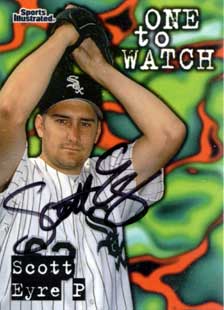
Scott Eyre

Joining the White Sox organization in a 1994 trade with the Rangers, he debuted with the big-league team in 1997.  He split the next 4 seasons between the rotation and the bullpen, not to mention between Chicago and Charlotte, before being moved to the Blue Jays following the 2000 ALDS loss to the Mariners.  He joined the Cubs as a free agent for the 2006 season and enjoyed 2 seasons of relative success, before falling apart in 2008, when he was traded to the Phillies.

Clint Frazier

After missing the second half of 2021 with an injury, Frazier was DFA’d by the Yankees.  He signed a deal with the Cubs that offseason, though he notched just 45 plate appearances before being DFA’s once again.  He chose to finish the year in the Cubs system before becoming a free agent following the season.  After failing to catch on with the Rangers, he signed a minor league deal with the White Sox, eventually hitting .197 in 33 games with the big-league club.

Kosuke Fukudome Continue reading →

2025 All Star Break Standings

We reach the traditional (if not numerical) midpoint of the 2025 baseball season as the Midsummer Classic lands in Atlanta for the third time.  As the stars of the baseball world gather at Truist Park for tonight’s showdown, it’s time to take a look at the team records for the 23 games, featuring 57% of the teams in the league, that I attended in the first half of the baseball season.

2025 Team Records

Team Name Won Loss Winning Pctg
Chicago Cubs 3 0 1.000
St. Louis Cardinals 2 0 1.000
Toronto Blue Jays 2 0 1.000
Houston Astros 1 0 1.000
Arizona Diamondbacks 1 0 1.000
Cleveland Guardians 2 1 0.667
Miami Marlins 1 1 0.500
Boston Red Sox 1 1 0.500
Kansas City Royals 1 1 0.500
Chicago White Sox 9 12 0.429
Milwaukee Brewers 0 1 0.000
San Diego Padres 0 1 0.000
Colorado Rockies 0 1 0.000
San Francisco Giants 0 1 0.000
Seattle Mariners 0 1 0.000
Texas Rangers 0 1 0.000
Los Angeles Angels 0 1 0.000

Historic Games

With Vinny Capra and the White Sox falling victim to Clayton Kershaw on Wednesday night, giving him his 3000th career strikeout, I decided to take a look back at the historic games I’ve attended over the years.  Here is part one, featuring six games where an individual hit a career plateau or a team clinched a division title.

June 30, 1998 – Diamondbacks 4, Cubs 3

Sammy Sosa had broken the June record for home runs nine days earlier, surpassing the fifteen previously reached by Babe Ruth, Bob Johnson, Roger Maris, and Pedro Guerrero.  In the 8th inning of the final game of the month, Sosa connected against Alan Embree for his 20th home run of the month, setting the record not just for June, but for any month of the season.

September 27, 2003 – Cubs 7, Pirates 2

After winning the first game of a double header against the Pirates, the Cubs were in position to clinch at least a portion of their first Central Division title heading into the nightcap.  After the second-place Astros lost their game, a victory would give the Cubs the championship.  They jumped on Pirates starter Ryan Vogelsong early, scoring six runs in his 1 1/3 innings of work.  Dave Veres induced former Cub José Hernández to ground into a double play to wrap up the victory.

July 26, 2005 – Giants 3, Cubs 2

Following a nearly three-hour rain delay, Greg Maddux took the mound against the Giants sitting on 2998 strikeouts for his career.  In the third inning, Giants shortstop Omar Vizquel stepped up to the plate. With a 2-2 count, Maddux unleashed a sinker that Vizquel flinched away from, taking a third strike as the ball drifted back over the plate.  Maddux, who finished the game with three strikeouts, became just the 13th pitcher to reach 3000 strikeouts and the ninth to also have surpassed 300 victories.

August 5, 2007 – Mets 8, Cubs 3

On a warm Sunday night in Chicago, Tom Glavine took the mound for the Mets, sitting at 299 career victories.  The 41-year-old lefty tossed 6 1/3 innings, giving up just two runs to secure the win and his place in history.  Glavine became only the 23rd pitcher, and just the fifth southpaw, to reach the 300-win plateau.

September 16, 2007 – White Sox 9, Angels 3

Sitting at 499 home runs, Jim Thome entered the Sunday series finale, which just so happened to be Jim Thome bobblehead day, looking to reach 500 in Chicago.  With the score tied at seven in the bottom of the ninth, Thome came to the plate with a runner on first.  Having gone 0-4 to that point, Thome took Dustin Moseley to a 3-2 count before launching the walk-off milestone home run.  He became the 23rd major leaguer to reach the 500 home run mark and the third to do so in 2007.  He was the first slugger to reach the milestone with a walk-off.

September 30, 2008 – White Sox 1, Twins 0

After winning a makeup game against the Tigers to force a tie in the AL Central after 162 games, the White Sox took the field against the Twins in a tiebreaker to determine who would move on to the playoffs.  The Twins looked to strike first following a double by Michael Cuddyer to lead off the fifth inning, but a throw home by Ken Griffey Jr. nailed Cuddyer trying to score on a fly out to center field, ending the threat.  The game remained scoreless until the seventh, when Jim Thome blasted a home run to straight away centerfield.  Bobby Jenks came in to close down the game and the White Sox won their second division title in four years.