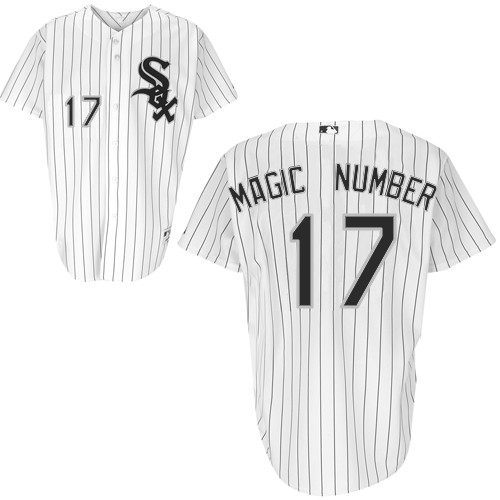
 While the White Sox were idle today before starting a three game series in Oakland tomorrow, Cleveland dropped their series opener against the Twins, 5-2, bringing the magic number down to 17.
Tag / White Sox
Prolific Authors – 2 Books
 Way back in December of 2011 (and again every other December since), we’ve taken a look at the authors I have read the most, dating back to high school. This year, since I’ve far surpassed my reading output of any year on record, I thought it would be nice to take a deeper dive into those books I’ve read through August. Since our last check-in, I’ve read an additional 60 books from 54 different authors. There shouldn’t be much movement over the past 2 years, but it’s time to take another look and see if my “favorite” authors have changed much in that time span. Today, we start things off with the 35 authors I’ve read twice.
Max Barry
An Australian author, I’ve enjoyed the two novels of his I’ve read, Jennifer Government and Company.
Laura Caldwell
I have no idea how I came across the work of this local author, but I must have enjoyed it enough to go back for seconds. Unfortunately, she passed away last year.

The Amazing Adventures Of Kavalier & Clay – Michael Chabon
Michael Chabon
Winner of the 2001 Pulitzer Prize for Fiction for The Amazing Adventures of Kavalier & Clay, the most recent of the two works of his I’ve read. I have another, Wonder Boys, waiting in the to read pile, so he rise up some day.
Matthew V. Clemens
The co-author, with Max Allan Collins, of the final two chapters of the Reeder and Rogers trilogy.
 Felicia Day
The first author here that I’ve happened to meet in person.
Cameron Dokey
She makes the list based on two entries in the Buffy the Vampire Slayer series.
Diane Duane
Living in Ireland, she is responsible for a Star Trek: The Next Generation book and a Spider-Man novel, of all things.
Warren Ellis
The comic writer, currently in exile after being called out for abusing women, makes the list thanks to two prose novels.
David Fisher Continue reading →
By The Numbers – 40
 In 1929, uniform numbers appeared on the back of baseball jerseys for the first time, thanks to the Indians and the Yankees. By 1937, numbers finally appeared across all uniforms, both home and away, across both major leagues. Since that time, 81 distinct numbers have been worn by members of the White Sox, while the Cubs boast 76.
Today, we continue our look at those players, picking our favorite, if not the best, player to wear each uniform number for both Chicago teams with #40. 55 different players have donned #40 while playing in Chicago, 25 for the White Sox and 30 for the Cubs.
 Acquired in mid-June, along with George Frazier and Ron Hassey, from the Indians in exchange for Mel Hall, Joe Carter, Don Schulze, and Darryl Banks, Rick Sutcliffe, wearing #40, quickly became the ace of the Cubs staff, going 16-1 with a 2.69 ERA in leading the Cubs to their first division title and his first Cy Young Award. He then homered in and won Game 1 of the NLCS, the first post-season game at Wrigley Field since the 1945 World Series, before dropping the deciding Game 5 in San Diego. A free agent after the season, Sutcliffe signed a long term deal with the Cubs.
A hamstring injury limited him to 20 starts in 1985, while arm injuries in 1986 led him to a 5-14 record with a 4.64 ERA in 28 appearances. He bounced back in 1987, leading the league with 18 wins in 34 starts for the last place Cubs, finishing second in the Cy Young Award voting. He went 13-14 in 1988, but did somehow manage a steal of home plate on July 29th in a victory against the Phillies. A resurgence in 1989 helped lead the Cubs to their second divisional title, and he made one start against the Giants in the NLCS. Recurring arm injuries caused Sutcliffe to miss most of the 1990 and 1991 seasons, with only 24 appearances between the two years, and the Cubs let him leave as a free agent following the 1991 season.

On the other side of town, Wilson Alvarez was acquired by the White Sox, along with Scott Fletcher and Sammy Sosa, for Harold Baines and Fred Manrique on July 29, 1989, making his White Sox debut on August 11, 1991 by throwing an unlikely no hitter against the Orioles at Memorial Stadium. He made 8 additional starts for the White Sox down the stretch, finishing the year with a 3-2 record and a respectable 3.51 ERA. 1992 saw Alvarez work mostly out of the bullpen, getting only 9 starts out of his 34 appearances. He posted a career high 1.674 WHIP, giving up 65 walks in just over 100 innings. This led to an unfortunate 5.20 ERA, despite a 5-3 record. In 1993, Alvarez managed to break in to the rotation full time. Despite leading the league with 122 walks, he finished second in the AL with an ERA of 2.95 and ended up with a 15-8 record as the White Sox won the AL West title for the first time in a decade. He was the winning pitcher in Game 3 of the ALCS, holding the Blue Jays to a single run while throwing a complete game.
Alvarez improved in 1994, earning his first (and only) All Star nod and cutting his walk total nearly in half, helped by the player strike that ended the season in August, and he finished the year with a 12-8 record and a 3.45 ERA. When baseball returned in 1995, Alvarez struggled to regain his groove, finishing with a losing record for the first time and an ERA of 4.32. 1996 saw a nice bounce back for Alvarez. While his ERA was still an elevated 4.22, he tied his career high with 15 wins and set career highs for innings pitched and strikeouts. He continued to impress in 1997, putting up a 9-8 record with a 3.03 ERA by the end of July, when, with the White Sox a mere 3 games back in the standings, he, along with Danny Darwin and Roberto Hernandez, was sent to the Giants for Brian Manning, Lorenzo Barceló, Mike Caruso, Keith Foulke, Bob Howry, and Ken Vining in what would become known as the White Flag Trade.
Time To Start Counting Down
 With last night’s victory over the Royals combined with Cleveland’s loss earlier in the night to the Red Sox, the White Sox dropped their magic number to clinch their first division title since 2008 to 18.
By The Numbers – 41
In 1929, uniform numbers appeared on the back of baseball jerseys for the first time, thanks to the Indians and the Yankees. By 1937, numbers finally appeared across all uniforms, both home and away, across both major leagues. Since that time, 81 distinct numbers have been worn by members of the White Sox, while the Cubs boast 76.
Today, we continue our look at those players, picking our favorite, if not the best, player to wear each uniform number for both Chicago teams with #41. 69 different players have donned #41 while playing in Chicago, 28 for the White Sox and 41 for the Cubs, including two future Hall of Famers.

The White Sox claimed Tom Seaver, and his familiar #41, from the Mets on January 20, 1984 as compensation for Dennis Lamp leaving as a free agent. Seaver was a steady force in the rotation, going 15-11 with a 3.95 ERA in his first go around through the junior circuit. The highlight of the year came on May 9, when he pitched the final inning of a suspended, 25 inning contest from the day before and then started the regularly scheduled game against the Brewers, earning the victory in both. With LaMarr Hoyt traded in the offseason, Seaver was on the mound for his 15th opening day in 1985, breaking Walter Johnson’s record of 14 Opening Day starts. On August 4, back in New York against the Yankees, Seaver threw a complete game to earn his 300th career victory. He finished the year with a 16-11 record and a sterling 3.17 ERA. Seaver again got the opening day nod in 1986, extending his record to 16. With the White Sox going nowhere, Seaver, now 41 years old, was looking to return to the east coast to be near his family after the death of his mother in May. When a bum shoulder put him on the disabled list, he informed the White Sox he was thinking of retiring. When manager Tony LaRussa was fired on June 20, his replacement, Jim Fregosi, said Seaver’s wishes should be honored. On June 29, after going 2-6 with a 4.38 ERA in 12 starts, Seaver was traded to the Red Sox for Steve Lyons.
A young Billy Williams, in his second cup of coffee with the Cubs in 1960, donned #41 for 12 games. He hit .277 and knocked out his first two career home runs. The following year, he would switch to his familiar #26, win the Rookie of the Year award, and kick his Hall of Fame career into high gear.
Lighting It Up
 A high scoring affair on the south side last night as the White Sox battled their crosstown rivals led me to think: what was the highest scoring game I’ve ever attended? Some quick calculations have produced these top 9 scoring games that I have seen in person, starting with last night’s tilt.
30 runs
8/27/2021
After putting up 6 runs in the top half of the first, the Cubs, for the second time this season, coughed up the lead. Yasmani Grandal, in his first game action since a knee injury on July 5th, hit two home runs and drove in 8 runs as the White Sox won 17-13. The 17 runs are the 4th largest output I’ve seen in person, while the 13 runs put up by the Cubs was the largest I’ve seen in a losing effort.
26 runs
7/2/2006
Another high scoring crosstown tilt, as Michael Barrett and Carlos Zambrano both homered off of Mark Buehrle in a 7 run first inning. Despite home runs from Juan Uribe, Jim Thome, Joe Crede, and Tadahito Iguchi, the Cubs held on to win 15-11 while avoiding a three game sweep.
9/2/2017
Powered by backup catcher Rene Rivera’s first career grand slam, the Cubs built an 11-4 lead heading to the 7th inning against the Braves. The Cubs bullpen then managed to give up 8 runs over the final three innings, which would have given the Braves the victory, but they also managed to tack on 3 insurance runs, giving the Cubs a 14-12 win.
24 runs
4/30/2008
Two three-run homers from Geovany Soto led the Cubs to a 19-5 victory over the Brewers, their highest single game output since 2001.
23 runs
Fitbit VII – Week 30
 All told, a pretty decent week, as I managed to pass 40,000 steps for the first time since late May. Things got off to a bad start on Sunday, as I did next to nothing and ended up 12 steps shy of 2200. Things improved dramatically on Monday, as I started a string of White Sox games where I didn’t have pre-paid parking and chose to save money with street parking and the long(ish) walk to the stadium put me over 9600 steps. A repeat performance on Tuesday left me a little lighter, but I was still over 9400 steps. Wednesday fell back down again, to 6600 steps, because I broke down and decided to pay for parking for my third straight game. I managed to score 4000 steps on Thursday, despite spending the majority of the day driving from home to Atlanta. Friday finished about 300 steps better, as I completed my trip to St. Petersburg, Florida. Saturday came in just 9 steps over 5000, as I made my maiden voyage to Tropicana Field.
Total steps: 41,229
Daily average: 5889.9
By The Numbers – 42
In 1929, uniform numbers appeared on the back of baseball jerseys for the first time, thanks to the Indians and the Yankees. By 1937, numbers finally appeared across all uniforms, both home and away, across both major leagues. Since that time, 81 distinct numbers have been worn by members of the White Sox, while the Cubs boast 76.
Today, we continue our look at those players, picking our favorite, if not the best, player to wear each uniform number for both Chicago teams with #42. 41 different players donned #42 while playing in Chicago, 18 for the White Sox and 23 for the Cubs, prior to its league-wide retirement for Jackie Robinson in 1997.

Ron Kittle made his major league debut for the White Sox, with #42 on his back, on September 2, 1982, pinch hitting for Aurelio Rodriguez and striking out in the White Sox 6-5 victory over the Rangers at Comiskey Park. Kittle got sporadic playing time over the final month of the season, earning just 29 at bats in 20 games while hitting .241 with a single home run. He broke out in a big way in 1983, earning an All Star nod and finishing the year with a team rookie record of 35 home runs while hitting .254 and driving in 100 as the White Sox notched their first division title. Kittle was knocked out of the ALCS against the Orioles after getting hit by a pitch in Game 3, finishing the series with just 2 hits in 7 at bats, but still easily earned Rookie of the Year honors.
1984 was a bit of a letdown for Kittle, as he failed to perform up to the expectations set the previous year, falling to a .215 average. His power numbers remained, as he clubbed 32 home runs, but his OPS was down by 70 points. There was a slight improvement in 1985, with his average improving to .230, but he hit only 26 home runs and drove in just 58 runs in 116 games. In 1986, Kittle was hitting .213 with 17 home runs at the trade deadline when he, along with Joel Skinner and Wayne Tolleson, were sent to the Yankees for Ron Hassey, Carlos Martinez, and a player to be named later. He re-signed with the White Sox prior to the 1989 season, but injuries limited Kittle to just 51 games and, in 169 at bats, he hit .302 with 11 home runs and 37 RBI. He returned in 1990, seeing his average drop to .245 with 16 home runs in 83 games when, again at the trade deadline, he was sent to the Orioles in exchange for Phil Bradley. Kittle returned for one final hurrah with the White Sox in 1991, signing as a free agent on June 19 before being released on August 15. In between, he appeared in 17 games and hit only .191 with 2 home runs.
On the north side, relief pitcher Bruce Sutter wore #42 during his 5 years with the Cubs from 1976 through 1980. Over that time, he piled up 4 All Star nods, numerous MVP votes, and a Cy Young Award. However, a lock down All Star closer is a luxury for a team that never managed to finish over .500 during those 5 years, so Sutter was dealt to the Cardinals in December of 1980, for Leon Durham, Ken Reitz, and Ty Waller.
By The Numbers – 43
In 1929, uniform numbers appeared on the back of baseball jerseys for the first time, thanks to the Indians and the Yankees. By 1937, numbers finally appeared across all uniforms, both home and away, across both major leagues. Since that time, 81 distinct numbers have been worn by members of the White Sox, while the Cubs boast 76.
Today, we continue our look at those players, picking our favorite, if not the best, player to wear each uniform number for both Chicago teams with #43. 71 different players have donned #43 while playing in Chicago, 23 for the White Sox and 48 for the Cubs.
 Dennis Eckersley donned #43 for the Cubs after being acquired on May 25, 1984 from the Red Sox for Bill Buckner. He went 10-8 with a 3.03 ERA while helping the Cubs into the postseason for the first time since 1945. He lost Game 3 of the NLCS, giving up 5 runs in 5 1/3 innings pitched in his playoffs debut. Along with the rest of the Cubs rotation in 1985, Eckersley spent time on the DL, causing the team to drop from a 4-game division lead on June 11 to finishing in 4th place, 23 1/2 games back. Eckersley returned to full physical strength in 1986, but struggled, going 6-11 with a 4.57 ERA as he battled alcoholism. After an offseason spent in rehab, Eckersley was traded to the A’s following spring training in 1987, where, he, of course, moved to the bullpen and became a Hall of Famer.
Known as “The Milkman”, Herbert Perry wore #43 when he joined the White Sox on April 21, 2000 after being selected off waivers from the Devil Rays. Solid defense and a hot bat led to him getting more and more playing time, eventually becoming the everyday third baseman as the White Sox cruised to their first Central Division title. He finished the year with a .308 average, 12 home runs, and 61 RBIs and was one of the few regulars who continued to hit in the post-season, putting up a .444 average in the ALDS against the Mariners. Injuries and the acquisition of Royce Clayton limited Perry to 92 games in 2001, as his average dropped to .256 and his home runs fell to 7. After the season, he was traded to the Rangers for a player to be named later.
Fitbit VII – Week 28

An up-and-down week, as I started off slow, but finished strong with 3 straight days over goal for the first time since March. Things got off to a slow start on Sunday, as I came 18 steps shy of 2200. Monday was better, as I jumped all the way up to nearly 4100 steps. Tuesday was even better, with over 5000 steps. Wednesday fell back down again, coming in 5 steps away from 2600. Things took a turn for the better starting on Thursday, thanks to a trip to the Museum of Science & Industry, which put me at 7600 steps. Friday was pretty steady, finishing one step past 7600, thanks to the start of crosstown battles at Wrigley Field. A haircut and game 2 of hostilities between the White Sox and the Cubs put me over 7500 steps on Saturday.
Total steps: 36,719
Daily average: 5245.6