By The Numbers – 44

In 1929, uniform numbers appeared on the back of baseball jerseys for the first time, thanks to the Indians and the Yankees.  By 1937, numbers finally appeared across all uniforms, both home and away, across both major leagues.  Since that time, 81 distinct numbers have been worn by members of the White Sox, while the Cubs boast 76.

Today, we continue our look at those players, picking our favorite, if not the best, player to wear each uniform number for both Chicago teams with #44.  57 different players have donned #44 while playing in Chicago, 39 for the White Sox and a mere 18 for the Cubs.

Anthony Rizzo was acquired by the Cubs on January 6, 2012, the first piece of the rebuilding puzzle that Theo Epstein and Jed Hoyer brought to Chicago after their hiring.  He started the 2012 season in Triple A, but eventually earned the promotion and took over first base,  In 2014, he earned his first All Star nod and his first MVP votes.  In 2015, as the Cubs made a surprising run to the NLCS, Rizzo led the league in games and plate appearances and placed fourth in MVP voting.

In 2016, Rizzo replicated his fourth place MVP finish while also picking up a Gold Glove and a Silver Slugger award as he helped lead the Cubs to their first World Series title in 108 years.  On Opening Night in 2017, he walked the Commissioner’s Trophy on to the field (following a long rain delay).  He finished that year with more MVP attention as the Cubs made their third straight NLCS, losing to the Dodgers.  Rizzo added 3 additional Gold Gloves to his collection from 2018 – 2020.  The shine rubbed off of Rizzo a little in June of 2021, as he announced, on the day Chicago opened back up from COVID restrictions, that he had decided not to get vaccinated, leaving the Cubs as one of 8 teams still under restrictions for failing to reach the 85% plateau.  He was then, of course, traded to the Yankees and, just this morning, was placed on the IL with COVID.

On the other side of town, Dan Pasqua donned #44 after being acquired from the Yankees for Richard Dotson following the 1997 season.  His first season with the White Sox ended with a career high 20 home runs despite a disappointing .227 average, but a broken wrist suffered during the first week of the 1989 season limited him to just 73 games and 11 home runs.  Pasqua lost his regular slot in the lineup in 1990, as manager Jeff Torborg decided to start Sammy Sosa every day.  He appeared in 112 games, but had only 325 at bats despite a .274 average.

1991 saw Pasqua appear in a career high 134 games, with a .259 average and 18 home runs, his highest total since 1988.  A hamstring injury reduced Pasqua’s playing time again in 1992 and, with George Bell and Bo Jackson splitting time at DH in 1993, Pasqua again was the odd man out.  Pasqua’s 1994 season was cut short by arthroscopic knee surgery in May, which limited him to just 11 appearances and only 23 at bats, and he decided to retire after the season.

Two Sides Of The Same Town

cws-chiFollowing last week’s trade deadline deals, Ryan Tepera and Craig Kimbrel became the 36th and 37th people I’ve seen play in person for both the Cubs and the White Sox.  With the first round of crosstown kicking off this afternoon at Wrigley, here’s a look at those players, in alphabetical order.

David Aardsma

After posting a decent season with the Cubs in 2006, Aardsma was traded to the White Sox for Neal Cotts.  Aardsma lasted one season with the Sox, where he was unable to duplicate his success from the year before.

Jason Bere

Drafted by the White Sox in the 36th round in 1990, Bere debuted with the big league club in 1993, finishing 2nd in Rookie of the Year voting.  After an All Star selection in 1994, injuries marred the remainder of his tenure on the South Side, which ended in 1998.  He resurfaced with the Cubs in 2001 and had a decent season, but he went 1-10 in 2002 before being let go.

Emilio Bonifacio

Bonifacio spent back-to-back partial seasons in Chicago, first for the Cubs in 2014 after signing as a free agent, where he played decently enough to be flipped at the trade deadline, along with James Russell, to the Braves for a young catching prospect by the name of Victor Caratini.  He returned to Chicago in 2015, signing with the White Sox, where he he did not do well at all, hitting .167 in 47 games before being released in August.

Welington Castillo

Debuting with the Cubs in 2010, Castillo spent time behind the plate for the Cubs until May of 2015, when, having been replaced in the starting lineup by Miguel Montero, he was flipped to the Mariners.  He returned to Chicago in 2018 after signing with the White Sox as a free agent.  On May 24th of that season, he was suspended 80 games for a violation of the PED policy.  The White Sox then cut bait following the 2019 season, shipping him off to the Rangers.

Neal Cotts

Acquired by the White Sox in the Billy Koch trade, he debuted with the team in 2003.  He was a key contributor in the bullpen during the 2005 championship season, and was the only relief pitcher to appear in all 3 rounds of the playoffs that season.  Following the 2006 season, he was traded to the Cubs for David Aardsma, and he spent the next 3 injury filled seasons on the North Side.

Scott Eyre

Joining the White Sox organization in a 1994 trade with the Rangers, he debuted with the big league team in 1997.  He split the next 4 seasons between the rotation and the bullpen, not to mention between Chicago and Charlotte, before being moved to the Blue Jays following the 2000 ALDS loss to the Mariners.  He joined the Cubs as a free agent for the 2006 season and enjoyed 2 seasons of relative success, before falling apart in 2008, when he was traded to the Phillies.

Kosuke Fukudome Continue reading →

Keeping Our Eyes On Next Year’s Prize

With a little more than 8 weeks remaining in the 2020 season, Major League Baseball released their tentative 2021 schedule yesterday.  For the first time in quite a while, the White Sox will be looking to compete for a title while the Cubs will be “retooling” after trading off all of their stars last week.  Assuming, of course, that the 2022 season goes off as planned and the end of the collective bargaining agreement doesn’t lead to a long work stoppage.  So, for one day, at least, let’s turn our attention to next summer for both teams.

The White Sox open their season at home against the Twins on March 31 for a three game tilt before heading on the road.  Nothing like a potential snowstorm to get the season off to a good start.  They face the Guardians for the first time on April 18 in Cleveland.

The interleague schedule pits the White Sox against the NL West, with trips to San Francisco, Colorado, and San Diego and home series against the Dodgers, Diamondbacks, and Rockies. The rivalry with their north side foes continues with a 2-game series at Wrigley at the beginning of May and a follow-up at Guaranteed Rate Field Memorial Day weekend.

The season ends with a 6 game road trip to Minnesota and San Diego.

On the north side, the Cubs open their season up on the road in Cincinnati, also on March 31.  They come home the following Monday to open their home slate against the Cardinals.

The interleague schedule pits the Cubs against the AL East, with trips to Baltimore, New York, and Toronto and home series against the Rays, Red Sox, and Orioles.

Of their 28 games in September/October, only 7 are against their NL Central rivals, though, with the Cubs not likely to contend, that shouldn’t make much of a difference.  They end the year with a 6 game homestand, facing the Phillies and the Reds.

A Flurry Of Activity

The Cubs have seemingly turned Wrigley Field upside down, shook real hard, and let the pieces fall where they may.  With less than an hour until the trade deadline, they’ve made two huge deals, sending closer Craig Kimbrel to the White Sox for second baseman Nick Madrigal and reliever Codi Heuer and, in a separate deal, sending Javier Baez and Trevor Williams to the Mets in exchange for Pete Crow-Armstrong.

The first move, along with yesterday’s acquisition of Ryan Tepera, fortifies the White Sox bullpen as they look towards October baseball, giving them two All Star closers to choose from as Tony LaRussa sees fit.  Madrigal, the fourth overall selection in the 2018 draft, should hold down second base on the north side for years to come, assuming he can stay healthy.  He’s been out since early June with a hamstring tear and is expected to be ready for spring training.  Heuer has been a workhorse, and is the pitcher I’ve seen in the most games this year, but has gotten knocked around a bit more than the White Sox expected.

Baez, the ninth overall pick in the 2011 draft and the runner in the 2018 MVP race, has been a centerpiece of the Cubs run these last 7 years, debuting in 2014 and cementing himself in the lineup in 2016.  He is reunited with his friend and Team Puerto Rico teammate Francisco Lindor with the Mets.  Crow-Armstrong was the first round selection of the Mets in the 2020 draft and is currently their 5th ranked prospect, according to MLB.com.

With all of this, the one guy everyone expected the Cubs to move, Kris Bryant, is the last man standing.  Will something happen in these last couple of minutes?  Time will tell.

Crosstown Dealings

In his second move of the day, Rick Hahn went shopping in Wrigleyville for a new relief pitcher, picking up Ryan Tepera from the Cubs for Bailey Horn, a pitcher in Class A Winston-Salem.  Tepera, best known for garnering a National League MVP vote last season thanks to a misclick by a St. Louis writer, has put up a career-best 2.91 ERA this season, with 50 strikeouts in 43.1 innings.

Horn, 23, was selected in the 5th round of the 2020 draft and posted a 13.09 ERA with Winston-Salem, issuing 11 walks and 12 hits over 11 innings. with the Dash.  To make room for Tepera on the 40-man roster, pitcher Evan Marshall has been moved to the 60-day IL.

With a little less than 23 hours until the trade deadline, the Cubs have made 3 moves and the White Sox 2.  I have a gut feeling that the White Sox are done, but the Cubs still have some work to do.

Trade Winds Are A Brewin’

With a little more than 24 hours remaining before the trade deadline, the White Sox finally made a move, acquiring second baseman César Hernández from Cleveland for Double A pitcher Konnor Pilkington.  Hernández, who won a Gold Glove and led the AL in doubles last year, has hit a career high 18 home runs while hitting .231 with 47 RBIs and a .738 OPS.  The White Sox have been looking for a second baseman since Nick Madrigal went down with a torn right hamstring in early June.

Pilkington, the third round pick of the White Sox in the 2018 draft, is 4-4 with a 3.48 ERA in 14 starts this year for Birmingham.  He was rated as the 17th best prospect in the White Sox system by Baseball America at the start of the 2020 season.  To make room for Hernández on the 40-man roster, the White Sox released right-handed pitcher Tyler Johnson.

Meanwhile, on the north side of town, Anthony Rizzo and Kris Bryant are not in the lineup for today’s tilt between the Cubs and the Reds.  One or both of them are expected to be moved prior to tomorrow’s deadline.

By The Numbers – 45 Bonus!

In 1929, uniform numbers appeared on the back of baseball jerseys for the first time, thanks to the Indians and the Yankees. By 1937, numbers finally appeared across all uniforms, both home and away, across both major leagues. Since that time, 81 distinct numbers have been worn by members of the White Sox, while the Cubs boast 76.

Sunday, we continued our look at those players, picking our favorite, if not the best, player to wear each uniform number for both Chicago teams with #45.  Today, we take a special bonus look at someone who wore #45 during a Windy City Classic exhibition game in 1994.

After winning his third NBA championship in the summer of 1993, Michael Jordan retired from basketball.  He signed a contract with the White Sox in February of 1994, “I chose to try to play baseball just to see if I could,” Jordan said when he signed the contract.  “I’m not doing it as a distraction and I’m not doing it as a media hog or looking for the media exposure from it. It’s one of the wishes my father had and I had as a kid.”  Jordan’s father had been murdered the previous July and Jordan’s memories of his father played a large role in his deciding what he should do next.

Jordan, who hadn’t played baseball since high school, had a difficult spring training, hitting .152 in 46 at bats, and he was assigned to Double-A Birmingham.  First, though, was the annual exhibition game between the two Chicago teams on April 7 at Wrigley Field.  Jordan was penciled in to the starting lineup, batting sixth.  In the sixth inning, Jordan hit an RBI single off veteran Dave Otto, and in the seventh, he bounced a Chuck Crim pitch down the third-base line for a game-tying double.  The crowd, White Sox and Cubs fans alike, rose to their feet and roared, as Jordan smiled, stuck out his tongue, and tipped his helmet at second base.

Jordan finished the day 2 for 5, with 2 RBIs, an error, and base running gaffe.  “Who would ever think I would be out there playing in Wrigley Field?” Jordan said.  “It was a great feeling just to come out there and do well.”  Jordan reported to Birmingham the following day and, after the labor strife that ended the 1994 season early spread in to 1995, Jordan left baseball, returned to the Bulls, and won another three NBA championships.

By The Numbers – 45

In 1929, uniform numbers appeared on the back of baseball jerseys for the first time, thanks to the Indians and the Yankees. By 1937, numbers finally appeared across all uniforms, both home and away, across both major leagues. Since that time, 81 distinct numbers have been worn by members of the White Sox, while the Cubs boast 76.

Today, we continue our look at those players, picking our favorite, if not the best, player to wear each uniform number for both Chicago teams with #45. 92 different players have donned #45 while playing in Chicago, but only one of whom notched the final out in a World Series clincher.

Bobby Jenks joined the White Sox organization on December 17, 2004, when he was selected off waivers from the Angels.  After starting the 2005 season in Double A, he was called up to the big league club on July 5 and made his major league debut the following day, ending the season as the closer after Shingo Takatsu proved ineffective and Dustin Hermanson went down with a back injury.  In the ALDS against the Red Sox, he threw 3 scoreless innings and picked up 2 saves in the 3 game sweep.  Thanks to the 4 complete games in the ALCS against the Angels, Jenks was well rested for the World Series.  He appeared in all 4 games against the Astros, throwing 5 innings and earning the save in Games 1 and 4.

With a World Championship under his belt, Jenks became the full time closer in 2006, earning his first All Star nod and becoming the first White Sox pitcher to notch a save in the Mid-Summer Classic.  2007 was a good year for Jenks, as he made his second straight All Star team and tied a major league record by retiring his 41st consecutive batter, becoming the first reliever to achieve the feat.  He continued his dominant ways in 2008, as the White Sox bounced back in to contention, and he threw a scoreless inning and picked up the save in the only White Sox victory in the ALDS against the Rays.

Jenks started to struggle in 2009, as he saw his save total drop to 29, his lowest full-season total to date.  2010 was even worse, as his ERA rose again, to 4.44, and his WHIP was up again as well.  Despite his highest strike out total since 2006, he ended the year with a 1-3 record and only 27 saves.  Following the season, the White Sox declined to tender him a contract for the 2011 season, making him a free agent.

On the north side of town, reliever Tom Gordon donned #45 in 2001 and the first part of 2002, earning 27 saves before being shipped to the Astros for, basically, nothing.

Judgment Day

A strange day yesterday as Yermin Mercedes seemingly announced his retirement from baseball on Instagram, scrubbing his feed of any White Sox related content in the process.  Mercedes posted an Instagram story earlier in the day, suggesting he was mulling over retirement, and then followed that up with a post last night, after being lifted for a pinch hitter in the sixth inning of Triple A Charlotte’s game, saying “it’s over” with a caption saying that he is walking away from baseball for a while.

The White Sox followed up with a statement saying they were aware of the post but had heard nothing from Mercedes directly and that he was still a part of the active roster in Charlotte.  In his post-game interview following last night’s loss to the Twins, manager Tony LaRussa said he had just heard about the drama and planned to reach out to Mercedes, who, he believes, still has a future in the big leagues.

After starting the season with eight consecutive hits and finishing April with a .415 average and a 1.113 OPS, Mercedes fell off considerably in May and June, posting a .196 average and a .536 OPS, prompting his demotion back to Charlotte.  With the emergence of Gavin Sheets and Jake Burger and the upcoming return of Eloy Jimenez and Luis Robert from the injured list, there does not appear to be a path back to the major leagues, at lest in Chicago, for Mercedes.  That frustration may have lead to this seemingly rash decision.  I expect we will hear more over the days and weeks to come.

By The Numbers – 46

In 1929, uniform numbers appeared on the back of baseball jerseys for the first time, thanks to the Indians and the Yankees. By 1937, numbers finally appeared across all uniforms, both home and away, across both major leagues. Since that time, 81 distinct numbers have been worn by members of the White Sox, while the Cubs boast 76.

Today, we continue our look at those players, picking our favorite, if not the best, player to wear each uniform number for both Chicago teams with #46. 40 players have donned #52 while playing in Chicago, 34 each for the White Sox and 22 for the Cubs.

Lee Arthur Smith was the 2nd round selection of the Cubs in the 1975 draft.  He made his major league debut on September 1, 1980, becoming a fixture in the Cubs bullpen wearing #46.  He took over the closer role in 1982 and became a force, leading the league in saves in 1983 while earning his first All Star nod and post-season support for both the Cy Young award and MVP.  Following the 1987 season, he was traded to the Red Sox for Al Nipper and Calvin Schiraldi, ending his Cubs career with a 40-51 record and a 2.92 ERA with 180 saves and 342 games finished.  In 2019, he was elected to the Hall of Fame by the Veteran’s Committee.

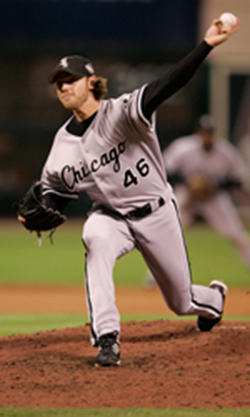
On the South side of town, Neal Cotts donned #46 after being acquired by the White Sox, along with Billy Koch and Daylan Holt, from the A’s in exchange for Keith Foulke, Mark Johnson, and Joe Valentine in December of 2002.  He made his major league debut on August 12, 2003, lasting only 2 1/3 innings in a start against the Angels, and made 3 additional starts, finishing the year with an 8.10 ERA in only 13 1/3 innings pitched.  Cotts moved to the bullpen in 2004 and, in 2005, things finally clicked.  He appeared in 69 regular season games and posted a sparkling 1.94 ERA, before facing one batter in the ALDS and becoming the only White Sox reliever to appear in the ALCS, getting the final 2 outs in the Game 1 loss to the Angels.  As the White Sox moved on to their first World Series since 1959, Cotts appeared in all 4 games, winning Game 2 and giving up only 1 hit in an inning and a third.  Cotts reverted back to his previous form in 2006 and, following the season, he was traded across town to the Cubs for fellow relief pitcher David Aardsma.