#4 – Robin Ventura

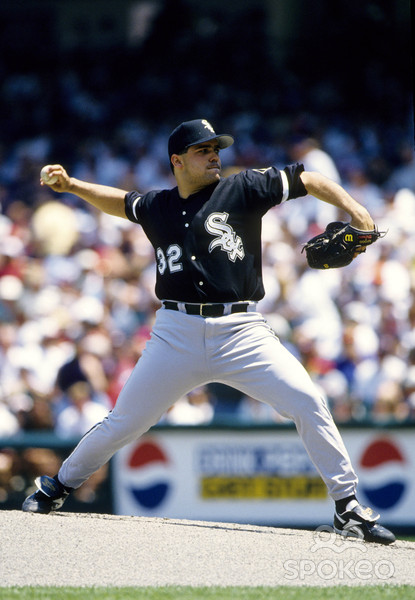
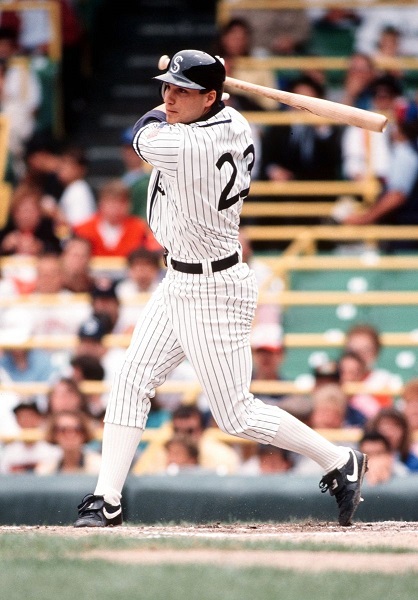
Name: Robin Ventura

Rank: 4

Position: 3B

Years With White Sox: 1989-1998

Robin Ventura joined the White Sox organization as the 10th overall pick in the 1988 draft.  He made his major league debut the following September, going 1-4 with an RBI in a 11-1 victory over the Orioles at Memorial Stadium.  He appeared in 16 games down the stretch, hitting only .178 while driving in 7 runs in 45 at bats.

A good spring in 1990 led to Ventura breaking camp with the White Sox.  He struggled, both on the field and at the plate, suffering through a horrendous 0-for-41 slump while committing 25 errors over the course of the season.  However, he did lead AL rookies with 150 games played and his 123 hits were the most by a White Sox rookie since Ozzie Guillen in 1985.  He finished the year with a .249 average, 5 home runs, and 54 RBIs.  He placed 7th in Rookie of the Year voting and was named to the Topps All Star Rookie team.

Ventura and the White Sox moved in to the new Comiskey Park in 1991, hoping to improve on the previous year’s growth.  He improved his fielding enough to earn his first Gold Glove award and led the league in putouts.  At the plate, he set a White Sox team record for RBIs by a third baseman, finishing with an even 100.  He upped his average to .284 and hit 23 home runs.  His work was enough to garner enough MVP votes to finish in 20th place.

1992 was another good year for Ventura.  He earned his first All Star nod, going 2-2 in the AL’s victory at Jack Murphy Stadium.  He finished the year with a .282 average, 16 home runs, and 93 RBIs.  He also snagged his second consecutive Gold Glove award.

Ventura continued his successful ways in 1993.  He collected his 500th hit in May and, on August 4, he entered the public consciousness with an event that would come to define his entire career.  While batting against the Rangers, Ventura was hit by a pitch thrown by Nolan Ryan and charged the mound.  Ryan, 20 years Ventura’s senior, placed him in a headlock and punched him several times, starting a bench-clearing brawl that was voted the best baseball brawl of all time by SportCenter.  Ventura saw his average drop to .262, but his OPS set a new career high.  His 94 RBIs made him the first AL third baseman with three consecutive 90-RBI seasons since Graig Nettles in the mid 70s.  During the ALCS against the Blue Jays, Ventura hit .200, with just 1 home run and 5 RBIs across the six game series.  After the season, he was awarded his third consecutive Gold Glove award.

The strike in 1994 saw Ventura’s streak of 90 RBI seasons and Gold Gloves come to an end.  When baseball stopped in August, Ventura was hitting .282 with 18 home runs and 78 RBIs, while posting a new career high with an .832 OPS.

When play resumed in late April 1995, Ventura struggled out of the gate, committing ten errors in the first ten games.  As the White Sox started to tear down the team that had finished the previous two seasons on top of their division, trade rumors started to follow Ventura, though nothing came to fruition.  On September 4, he became the eighth player in history to hit two grand slams in one game, and the first since Frank Robinson in 1970.  He finished the year setting career highs with a .295 average, an .882 OPS, and 26 home runs while driving in 93 runs.

Ventura had the best year of his career to date in 1996.  He set White Sox team records in career home runs by a third baseman, with 142, and grand slams, with 9.  He set new career highs with 34 home runs, 105 RBIs, 2 triples, an OPS of .888, and a .974 fielding percentage at the hot corner.  He hit .287, while earning his fourth Gold Glove award.

1997 turned into a dismal year for Ventura and the White Sox.  During a spring training game at Ed Smith Stadium, Ventura caught his foot in the mud while sliding into home plate and suffered a broken and dislocated right ankle.  Expected to miss the entire season, he returned on July 24, collecting the game-winning hit that night, and homered in his first at-bat the next night.  With the White Sox only 3.5 games behind the Indians in the standings, a healthy Ventura might have put them over the top.  A week later, the team threw in the towel in what eventually became to be known as the White Flag Trade, sending Wilson Alvarez, Roberto Hernandez, and Danny Darwin to the Giants for prospects.  “We didn’t realize Aug. 1 was the end of the season,” said an upset Ventura.  He finished the year appearing in 54 games, hitting .262 with 6 home runs and 26 RBIs.

As Ventura entered the last year of his contract in 1998, the White Sox made little attempt to sign him to an extension, with owner Jerry Reinsdorf claiming his skills were “deteriorating” after his injury the year before.  With more trade rumors following him throughout the season, he finished the year with a .263 average, 21 home runs, and 91 RBIs while earning his fifth Gold Glove award.  Following the season, he became a free agent, ending his White Sox playing career.

On October 6, 2011, Ventura returned to the White Sox as their 39th manager.  He resigned following the 2016 season, finishing with a career record of 375-435 for a winning percentage of .463.

For his career, Ventura ranks 6th in White Sox history with 39.4 WAR, 8th with 28.8 OWAR, 8th with 12.9 DWAR, 6th with 171 home runs, 8th with 741 RBIs, and 5th with 668 walks.

Ventura’s numbers in a White Sox uniform, both for games I attended and overall, were:
Continue reading →

#5 – Frank Thomas

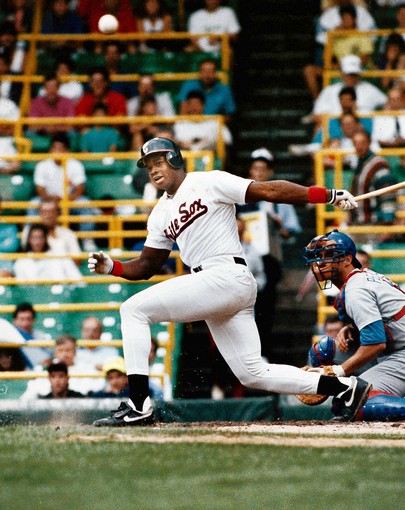
Name: Frank Thomas

Rank: 5

Position: 1B/DH

Years With White Sox: 1990-2005

Frank Thomas was selected by the White Sox with the seventh pick in the first round of the 1989 draft.  A little more than 1 year later, he made his major league debut on August 2, 1990 against the Brewers at County Stadium, going hitless in 4 at bats with an RBI as the White Sox won 4-3.  The next night, he tripled off of Mark Knudson for his first major league hit.  On August 28, he hit the first home run of his career, off Gary Wayne, in a 12-6 loss against the Twins at the Metrodome.  He finished the year with a .330 average, with 7 home runs and 31 RBIs.

In 1991, as the White Sox moved into the new Comiskey Park, Thomas became one of the most feared hitters in the American League.  On April 22, he hit the first White Sox home run in the new stadium, in an 8-7 victory over the Orioles.  When the season ended, Thomas finished with a .318 average, 32 home runs, and 109 RBIs.  He lead the league in walks, OBP, OPS, and OPS+.  He won his first Silver Slugger award and finished 3rd in MVP voting.

Thomas continued his mastery in 1992.  He ended the year hitting .323, with 24 home runs and 115 RBIs. He led the league in doubles, walks, OBP, and OPS.  Those numbers were good enough for him to place 8th in MVP voting.

In 1993, Thomas helped the White Sox win their first division title since 1983.  He made his first All Star game appearance, getting a hit in his only at bat.  On August 31, he clubbed his 100th career home run against the Yankees at Yankee Stadium.  He finished the year batting .317 and set a club-record with 41 homers.  He added 128 RBI, 106 runs scored, and 112 walks, to join Babe Ruth, Lou Gehrig, Jimmie Foxx and Ted Williams as the only players in baseball history to eclipse .300 with more than 20 homers and more than 100 RBI, runs, and walks in three straight seasons.  In the ALCS against the Blue Jays, Thomas hit .353 in the 6 game series.  Thanks to his historic season, Thomas collected his second Silver Slugger award and all 28 first place votes for a unanimous AL MVP award, the first by a White Sox player since Dick Allen in 1972.

1994 was on track to be even better, before the strike ended the season in August.  Thomas was elected to start the All Star game and got 2 hits in his 2 at bats.  In only 113 games, Thomas had 38 home runs, 101 RBIs, 106 runs scored, and 109 walks.  He led the league in runs scored, walks, OBP, slugging percentage, OPS, and OPS+.  For the second year in a row, he took home the Silver Slugger and MVP awards, becoming just the second first baseman to earn consecutive MVP awards.

When baseball returned in 1995, Thomas picked up where he had left off.  He started his second straight All Star Game for the American League, hitting a home run off John Smiley.  At the end of the season, Thomas had hit .308 with 40 home runs and 111 RBIs while leading the league in games played, walks, sacrifice flies, and intentional walks.  He dropped to 8th place in MVP voting as the White Sox found themselves out of contention for the first time in his career.

The White Sox bounced back in 1996 and Thomas continued to be an offensive force.  He mashed his 200th career home run on June 9, going deep at Camden Yards against the Orioles.  He was named to his fourth straight All Star team, though he didn’t make it into the game.  He set a career high with a .349 average, while again hitting 40 home runs with 134 RBIs.  For the second straight year, he led the league in intentional walks and finished 8th in MVP voting.

1997 was another strong year for Thomas.  He was named to his fifth, and final, All Star team.  He led the league with a .347 average, a .456 OBP, a 1.067 OPS, and an OPS+ of 181, while hitting 35 home runs and knocking in 125.  He finished 3rd in MVP voting, his 7th top 10 finish in his 7 full seasons.

Off the field issues started to show an effect on Thomas’ production in 1998, his first as a full time designated hitter.  Marital problems messed with his head, leading him to think the umpires were screwing him, opposing pitchers were taking advantage of him, and the media were ganging up on him. “I was miserable, and I made everyone around me miserable,” Thomas said early in the 1999 season. “It was an extremely humbling season.”  He hit .265, 65 points lower than his career average entering the season, and finished with only 29 home runs, his lowest total in six years.  He started referring to himself as Five O’clock Frank, a batting-practice terror who at game time sank under the weight of self-pity and tired excuses.

Thomas, and the White Sox, hoped that he would bounce back in 1999.  “I think he had a lot on his mind, personal things that were weighing on him,” hitting coach Von Joshua said early in the season. “He didn’t talk about it, but you could just see it in his eyes. He’s a lot more settled this year.”  Unfortunately, things didn’t go well, though he did hit his 300th career home run on August 7 against the A’s.  While his average did rebound, back up to .305, he hit only 15 home runs and drove in just 77 while setting a career low with a .471 slugging percentage.  Bone spurs on his ankle limited him to just 135 games.

2000 got off to an explosive start, and not the good kind.  Thomas and manager Jerry Manuel went toe to toe in spring training over Thomas’ ability to participate in drills, following his surgery the previous September.  Once the regular season began, though, it looked like the old Thomas was back.  As the surprising White Sox ran off and won their first division title since 1993, Thomas, missing only 3 games all year, hit .328 and set career highs with 43 home runs and 143 RBIs.  Unfortunately, Thomas, like the rest of his teammates, struggled in the post-season, going hitless in the ALDS as the Mariners completed a 3 game sweep.  He won his fourth, and final, Silver Slugger award and finished 2nd in MVP voting, behind a juiced Jason Giambi.

2001 was a tough year for Thomas, both personally and professionally.  On April 27, he hurt his triceps diving for a ball while playing first base.  After spending 5 days back in Georgia due to the death of his father, Thomas returned to Chicago for tests, which revealed a muscle tear that would require surgery and end his season.  “This is the worst week of my life”, he said during a press conference. “First I lose my father, then come back and find out I’m lost for the season.”  In only 20 games, Thomas hit .221 with 4 home runs and 10 RBIs.

Thomas returned in 2002, but was obviously no longer the same player he was before the injury.  He struggled in the first half, before picking things up in the final month of the season, hitting .359 with 6 home runs in September.  He finished the season with a .252 average, 25 home runs and 92 RBIs.

2003 was a better year for Thomas, though still below his career norms.  On June 26th, he became the 36th player in history to reach the 400 career home run mark with a 5th inning shot against the Devil Rays at US Cellular Field.  At the end of the year, he had posted a .267 average with 42 home runs and 105 RBIs.

Injuries robbed Thomas of most of 2004.  He was placed on the disabled list on July 7th, with a .271 average, 18 home runs and 49 RBIs.  He underwent surgery in early October to remove debris from the ankle, perform a bone graft, and insert two screws.

Thomas began the 2005 season on the disabled list as he recovered from his ankle surgery.  He was activated on May 30, with the White Sox in first place in the AL Central.  On July 18, he clubbed his 448th and final home run with the White Sox against the Tigers at US Cellular Field.  He hit .219 with 12 home runs and 26 RBIs in 34 games before breaking his foot on July 21, causing him to miss the rest of the season and the post-season.  Thomas threw out the first pitch prior to game one of the ALDS against the Red Sox.

Thomas is the White Sox all time leader in home runs, runs scored, doubles, RBIs, walks, on-base percentage, slugging percentage, and OPS.  He is the only player in major league history to have seven consecutive seasons (1991-1997) with a .300 average and at least 100 walks, 100 runs, 100 runs batted in, and 20 home runs.  His number 35 was retired by the White Sox on August 29, 2010 and he was part of the 2014 Hall of Fame class, elected on the first ballot with 83.7% of the vote.

Thomas’s numbers in a White Sox uniform, both for games I attended and overall, were: Continue reading →

#10 – Ozzie Guillen

Name: Ozzie Guillen

Rank: 10

Position: SS

Years With White Sox: 1985-1997

Acquired by the White Sox, along with Tim Lollar, Bill Long, and Luis Salazar, on December 6, 1984 from the Padres for Kevin Kristan, Todd Simmons, and LaMarr Hoyt, Ozzie Guillen made his major league debut on Opening Day 1985, leading off against the Brewers and going 1-5 in the 4-2 victory at County Stadium.  Settling in as the everyday shortstop, Guillen finished the year with a .273 average, 21 doubles, and 9 triples.  Those totals were good enough to score Guillen the 1985 AL Rookie of the Year trophy.

Guillen saw a slight drop off in his sophomore season.  His average dropped to .250 and he managed 19 doubles and 4 triples.  Defensively, he led the American League in Defensive WAR.

1987 was a nice bounce back for Guillen.  He raised his average back up to .279 with a .656 OPS.  For the second straight year, he led the AL, and all of baseball, in Defensive WAR.

Guillen earned his first All Star nod in 1988, though he didn’t get in to the game.  By the end of the season, he once again led all of baseball in Defensive WAR, while seeing his average drop to .261 with 7 triples, the fifth highest total in the AL.

1989 was a tough year for Guillen.  He posted his worst offensive numbers since 1986 and, on the base paths, he fell victim to the hidden ball trick.  Twice. On June 23, against the Brewers, first baseman Greg Brock held the ball after a pickoff attempt and when Guillen took his hand off the base to stand up, Brock tagged him out.  Less than 2 months later, on August 5 against the Tigers, Dave Bergman made the same play.  He finished the year with .253 average and, despite his adventures on pick off attempts, a career high 36 stolen bases.

As the surprising White Sox challenged for the AL West title while saying goodbye to Comiskey Park, Guillen put in one of the finest seasons of his career.  He was named to his second All Star team, going 0-2, finished in 17th place in MVP voting, and earned his first, and only, Gold Glove.  He raised his average back up to .279 and knocked in a career high 58 RBIs.

Expectations were high for the White Sox as they moved across the street to the new Comiskey Park in 1991.  Guillen earned his third, and final, All Star nod, getting a sacrifice in his only plate appearance.  He ended the year with a .273 average and set a career high with 3 home runs.

Guillen’s 1992 season came to an early end when, on April 21 during a loss against the Yankees, a collision with outfielder Tim Raines ended in a severe knee injury.  Appearing in only 20 games, he hit a career low .200 in only 40 at bats.

Guillen recovered in 1993, though he appeared in only 134 games, his lowest total to date.  However, it was his most productive season offensively, posting a .280 batting average, and career highs with 4 home runs and a .666 OPS, as the White Sox won their first division title in a decade.  He hit .273 and scored 4 runs in a losing effort, as the White Sox were defeated in 6 games by the Blue Jays in the ALCS.

1994 looked to be the year that the White Sox finally broke through.  Guillen was up to the challenge, hitting a career high .288 with a .659 OPS.  Unfortunately, the year ended early when players went on strike on August 12 with the White Sox in first place in the newly created AL Central.

The 1995 season got off to a late start and had an abbreviated schedule due to the long work stoppage.  The success of the White Sox, and for Guillen himself, didn’t survive the long layoff.  Guillen saw his average drop to .248, his lowest over a “full” season in his career to this point.  His OPS dropped to its lowest total, excepting 1992, since 1989.

1996 saw a slight improvement for Guillen.  He appeared in 150 games, his highest total since his knee injury in 1992.  He raised his average back to .263 and tied his career high with 4 home runs.

1997 was easily the worst season of Guillen’s White Sox career.  He had the lowest average of his career, coming in at .245, though he did once again tie his career high with 4 home runs.  Following the season, Guillen became a free agent and his playing career with the White Sox came to an end.

Guillen returned to the White Sox organization for the 2004 season as manager.  In 2005, he led the team to their first American League pennant since 1959 and their first World Series title in 88 years.  Ongoing personal difficulties with General Manager Kenny Williams led to his leaving with 2 games left in the 2011 season as the third winningest manager in franchise history.

Guillen’s numbers in a White Sox uniform, both for games I attended and overall, were:

Continue reading →

#11 – Bo Jackson

Name: Bo Jackson

Rank: 11

Position: RF/DH

Years With White Sox: 1991, 1993

Vincent Edward “Bo” Jackson joined the White Sox as a free agent on April 3, 1991 after being released by the Royals following a hip injury suffered in January during the NFL playoffs as a member of the Raiders.  “In making the business decision,” owner Jerry Reinsdorf said at the time, “I assume he will not play this year. If he does, it will be a big bonus.”  Jackson did spend most of 1991 on the disabled list, rehabbing the injury, but did eventually manage to make his way back to the field.  He appeared in 23 games, hitting only .225 with 3 home runs.

Diagnosed with avascular necrosis of the hip joint and having lost all of the cartilage supporting his hip, Jackson decided to undergo a hip replacement surgery, keeping him on the shelf for the entire 1992 season.  While rehabbing, Jackson promised his mother he would return to the major leagues and hit a home run for her.

Unfortunately, Jackson’s mother died before he could return, but, in his first at bat of the 1994 season, and his first with an artificial hip, he hit a home run to right field against the Yankees at Comiskey Park.  On September 27, Jackson belted a three-run home run off of the Mariners to help the White Sox clinch their first AL West Division title in a decade.  Jackson ended up appearing in 85 games for the White Sox, hitting .232 and hitting 16 home runs while driving in 45.  He appeared in 3 of the 6 ALCS games against the Blue Jays, going hitless in 10 at bats.

Following the season, he became a free agent, ending his White Sox playing career.  In 2014, he returned to the organization as an ambassador, a role he continues to play today.

Jackson’s numbers in a White Sox uniform, both for games I attended and overall, were:

Continue reading →

#12 – Jack McDowell

Name: Jack McDowell

Rank: 12

Position: P

Years With White Sox: 1987-1988, 1990-1994

Jack McDowell was selected as the fifth overall pick in the 1987 draft by the White Sox.  After 6 appearances split between Rookie ball and AA, he made his major league debut September 15, throwing 7 shutout innings and earning the win against the Twins at Comiskey Park.  He made 3 more starts to finish out the season, ending with a 3-0 record, a 1.93 ERA, and a seemingly bright future on the South Side.

In 1988, the success McDowell saw in his first stint in the big leagues was hard to find.  In 158.2 innings pitched, he struck out only 84 batters while walking 68.  While his ERA was a respectable 3.97, he finished with a 5-10 record.

Injuries, and a 6.13 ERA in 16 starts for AAA Vancouver, kept McDowell out of the big leagues in 1989.  He returned to the majors for good in 1990 and helped lead a surprising White Sox team to a 94-68 record and a season long battle with the A’s for the AL West crown.  McDowell finished with a 14-9 record and a 3.82 ERA and nearly doubled his strikeout total from 1988 in only about 50 more innings.

Expectations were high as the White Sox moved into their new stadium in 1991.  McDowell earned his first All Star game selection on his way to a 17-10 record and a 3.41 ERA.  Those numbers were good enough for a 9th place finish in Cy Young Award voting.

1992 was even better for McDowell.  He earned his second straight All Star Game nod, pitching a scoreless second inning and retiring Fred McGriff, Terry Pendleton, and Andy Van Slyke in order.  When all was said and done, he ended up with a 20-10 record and a 3.18 ERA, good enough for a 2nd place finish in Cy Young Award voting, behind Dennis Eckersley, and 19th place in MVP voting.

Everything came together for the White Sox and McDowell in 1993.  As the team ran off to their first division title in a decade, McDowell led the league with 22 victories and 4 shutouts, ending at 22-10 with a 3.37 ERA.  He nabbed his 3rd straight All Star selection, earning the victory while throwing a scoreless 5th inning, and finally claimed his first Cy Young Award.  He also finished 9th in MVP voting, behind teammate Frank Thomas.  McDowell made 2 starts during the ALCS against the Blue Jays, losing both and giving up 10 runs total in 9 innings pitched.

The 1994 season again had high expectations for the White Sox and McDowell.  Unfortunately, those expectations would be squashed, not on the field, where the White Sox held first place in the newly formed AL Central division, but in the boardrooms, where the end of the 1994 season and the post season were cancelled due to a work stoppage.  In just 25 starts, his fewest since 1987, McDowell went 10-9 with a 3.73 ERA.

In December, with the 1995 season in doubt, McDowell was traded to the Yankees, for Keith Heberling and a player to be named later who turned out to be Lyle Mouton.

McDowell’s numbers in a White Sox uniform, both for games I attended and overall, were:

Continue reading →

2018 Final Standings

Despite holding a 5 game lead in the NL Central on Labor Day, the Cubs lost the tie-breaking game 163 on Monday to give the division title to the Brewers and then fell in the Wild Card game yesterday to the Rockies, prematurely ending their season and bringing my game-attending portion of 2018 to an end.  I made it to only 29 games this season, tied for my lowest total since acquiring season tickets in 2002.  I didn’t even manage to attend any games outside of the 2 Chicago stadiums.  Here are the final standings for those games and the 18 different teams I saw in person, through both the regular season and the Wild Card.

2018 Team Records
Team Name Won Loss Winning Pctg
Houston Astros 2 0 1.000
Colorado Rockies 2 0 1.000
Boston Red Sox 1 0 1.000
Cleveland Indians 1 0 1.000
Los Angeles Angels 1 0 1.000
Oakland Athletics 1 0 1.000
Detroit Tigers 3 1 0.750
Minnesota Twins 2 1 0.667
Chicago Cubs 4 3 0.571
Continue reading →

All Time Team Records

The 2018 baseball season gets underway today, with an early start brought about due to the last collective bargaining agreement, which added additional off days for each team throughout the year.  To celebrate, it is time once again to look at the all-time team records for games that I have identified as having attended dating back to 1984. The Cubs look to avenge last year’s NLCS loss and make it back to the World Series, while the rebuilding White Sox hope to finally start seeing their young talent blossom.  The 2018 season should be an exciting one on both sides of town.

All-Time Team Records
Team Name Won Loss Winning Pctg
California Angels 1 0 1.000
Arizona Diamondbacks 13 2 0.867
Florida Marlins 15 8 0.652
Philadelphia Phillies 10 6 0.625
Toronto Blue Jays 13 9 0.591
New York Yankees 14 10 0.583
Colorado Rockies 8 6 0.571
Los Angeles Angels 16 13 0.552
Boston Red Sox 16 13 0.552
Kansas City Royals 27 24 0.529
Chicago White Sox 284 256 0.526
Chicago Cubs 209 189 0.525
Continue reading →

The Ever Growing 10,000 Step Club

Last year, as I was finishing up my second year with the Fitbit, I took my last look at the top 25 step days I’ve had since I first started tracking my steps way back in July of 2011.  At the time, I had surpassed the 10,000 step plateau 116 times.  In the past year, I have managed to add an additional 49 occurrences, raising the total to 165.  With my third year using the Fitbit coming to an end last week, I thought it would be appropriate to take a new look at my top 25 step days over the past 6 1/2 years, featuring 7 new entries.

btn10K-41: 6/6/2013 – 24,988 steps

My best single day total continues to be from my 2013 trip to Disney World.  The day’s excursion to both Epcot Center and the Magic Kingdom ended up with a total of approximately 12.5 miles.  And yes, it still bothers me that I didn’t get those 12 additional steps to reach 25,000.

2: 3/22/2016 – 22,493 steps

My second highest day shares much in common with my #1 day, taking place in Disney World in March of 2016.  The day’s excursion started at Hollywood Studios before heading over to Epcot Center with Jeff and Val.

3: 7/27/2013 – 20,592 steps

My third highest total came nearly 2 months after my highest, thanks to the BTN 5K and a, for lack of a better word, misunderstanding about where I should be picked up after the race.

4: 8/5/2017 – 20,218 steps

The first new entry came last August on the first day of my trip to Boston with Danny and Michael.  After landing in town, we traipsed to the Science Museum, a breakfast joint, our hotel, and, finally, Fenway Park.

5: 7/14/2017 – 20,208 steps

Our second new entry came last July, as Angelina and I took a day trip to Disney World to celebrate her high school graduation.

6: 9/19/2017 – 20,028 steps

The third straight new entry, which helped to double my total of 20,000 step days from the previous 5+ years, had a myriad of activities.  First was the latest edition of the Sprint and Stride, followed by a trip to Best Buy with Val to buy a new TV, then off to her apartment to install the new TV, and, finally, Season Ticker Holder Family Night at Wrigley Field.

7: 11/11/2017 – 19,590 steps

Our fourth straight new entry came thanks to last fall’s trip to California to see Angelina skate.  This day was spent in Anaheim at Disneyland.

8: 6/2/2016 – 18,725 steps

Day #8, which dropped 4 spots, comes from June 2016’s trip to Universal Studios.  Our first full day at the park, we split the day between Universal and Islands of Adventure, taking in all of the different Harry Potter options.

9: 6/4/2016 – 18,617 steps

Our next entry is also from the June 2016 trip to Universal Studios.  The day included another trip to Islands of Adventure, and would have ended up even higher but for an afternoon trip to the hotel pool.

10: 6/21/2017 – 18,290 steps Continue reading →

2017 Predictions Revisited

Six months ago, as the 2017 baseball season was scheduled to kick off, I made my annual predictions as to who would win what.  Now that the regular season has come to an end, it is time revisit those predictions and see what, if anything, I got right.

American League

East: Red Sox

1 for 1 so far, as the Red Sox held off a late surge from the Yankees to clinch on the season’s second to last day.

Central: Indians

The Indians finished with the best record in the American League thanks to a 32-4 run to close out the season.

West: Mariners

Well, I was a little off on this one, as the Mariners finished in third place, a mere 23 games behind the Astros.

Wild Cards: Blue Jays, Tigers

Both teams finished in last place in their respective divisions, with the Tigers finishing with the worst record in baseball.

AL Champion: Red Sox

It’s a good sign that my pick made the playoffs.

Cy Young: Chris Sale

There is a very good possibility of this coming to fruition.

MVP: Francisco Lindor

There is very little possibility of this coming to fruition.

National League

Continue reading →

#21 – Alex Fernandez

Name: Alex Fernandez

Rank: 21

Position: P

Years With White Sox: 1990-1996

Selected 4th overall by the White Sox in the 1990 draft, Alex Fernandez started 8 games in the minor leagues before making his major league debut on August 2, getting a no decision despite throwing 7 strong innings against the Brewers at County Stadium.  Over the last 2 months of the season, he made a total of 13 starts for the White Sox, going 5-5 with a 3.80 ERA.

Fernandez struggled in 1991, setting career highs in walks, WHIP, and ERA.  He finished the year 9-13 with a 4.51 ERA.  1992 saw a slight improvement, thanks to a drastic reduction in walks.  While he still had a losing record, at 8-11, his ERA fell to 4.27.

1993 was Fernandez’s breakout season.  He went 18-9 with a 3.13 ERA as the White Sox took home their first division championship in a decade.  He set a career high with over 247 innings and a career low WHIP of 1.164.  Despite giving up only 3 earned runs in 15 innings, he lost 2 games in the ALCS against the Blue Jays.  His season was good enough to earn 4 MVP votes from the BBWAA.

Fernandez was having another strong year in 1994.  He was 11-7 with a 3.86 ERA in 24 starts when the season came to a premature end thanks to the strike.  When baseball resumed in 1995, he picked up where he had left off, going 12-8 with a 3.80 ERA.

1996 was another strong year for Fernandez, his best since 1993.  He went 16-10 with a 3.45 ERA in a career high 35 starts.  He finished 6th in Cy Young Award voting.  Following the season, he became a free agent.

Fernandez’s numbers in a White Sox uniform, both for games I attended and overall, were:

Continue reading →