In 1929, uniform numbers appeared on the back of baseball jerseys for the first time, thanks to the Indians and the Yankees. By 1937, numbers finally appeared across all uniforms, both home and away, across both major leagues. Since that time, 81 distinct numbers have been worn by members of the White Sox, while the Cubs boast 76.
Today, we continue our look at those players, picking our favorite, if not the best, player to wear each uniform number for both Chicago teams with #16. 65 different players have donned #16 while playing in Chicago, 24 for the White Sox, who retired the number in 1987, and 41 for the Cubs.
 Aramis Ramirez switched to his familiar #16 shortly after being acquired by the Cubs from the Pirates. Ramírez finished the 2003 season strong, appearing in 63 games down the stretch and hitting 15 home runs while helping the Cubs capture their first division title since 1989. He managed 11 hits during the post-season, including 4 home runs and 10 RBIs and hitting the first playoff grand slam in Cubs’ history during Game 4 of the NLCS. The following year, Ramirez became the 14th player in baseball history to hit 3 home runs in 2 different games in the same season. While his offense remained strong, posting a .951 OPS, his defense was a bit of a liability, as he posted the lowest range factor among all third basemen.
Ramirez was elected to his first All-Star Game in 2005. He finished the season with 31 home runs and 92 RBIs despite missing the last month of the year with a strained quadriceps femoral muscle. While his defense continued to suffer in 2006, with his third straight season with the lowest range factor, his offense continued to carry the load. He collected his 1000th hit in July against the Mets and ended up with 38 home runs, 119 RBIs, and an OPS of .912. A free agent at the end of the season, he re-signed with the Cubs, scoring a 5-year, $73 million contract.
In April of ’07, Ramirez launched his 200th career home run. His continued offensive presence helped lead the Cubs back to the post-season in 2007 and 2008, winning division titles both seasons. Unfortunately, Ramirez, like his teammates, went cold in both series as the Cubs were swept in the NLDS each season. In 2009, Ramirez christened the season with his 250th career home run on Opening Day against Roy Oswalt. He followed that with #300 in July of 2011 against the White Sox. Following that season, he declined his portion of a mutual option and became a free agent.
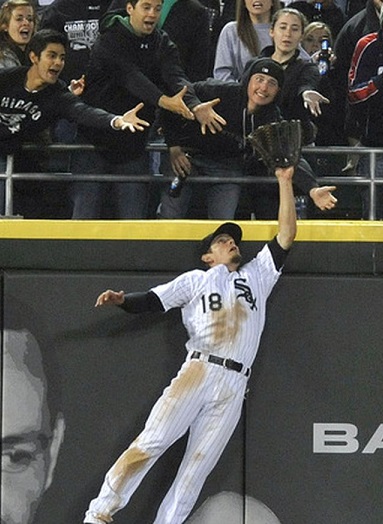
 Julio Cruz wore #16 on the southside following his June 1983 acquisition from the Mariners, when he gave the White Sox the spark they were looking for, helping the team go on a 72-31 run to finish the season and go from 6 1/2 games back to 20 games ahead. Cruz scored the winning run on a Harold Baines sacrifice fly against, of all teams, the Mariners on September 17, clinching the first division title in White Sox history. Cruz hit .333 during the ALCS against the Orioles, swiping 2 bases in the 4-game series. Heading in to the 1984 season, Cruz re-signed with the White Sox with a 6-year deal, thought to be worth between $3.6 to $4.8 million. Unfortunately, time, and injuries, were starting to take their toll. 1984 was the best year of the deal, and Cruz saw his average drop to .222 and he stole only 14 bases, a career low to date. Following that season, Cruz changed his number from #16 to #12.




 Bill Madlock essentially replaced two of the Cubs biggest stars of the 1960s when he joined the team for his rookie season in 1974. Acquired for future Hall of Famer Ferguson Jenkins, Madlock took the spot of Hall of Famer Ron Santo at the hot corner. If he felt any pressure, he didn’t show it, hitting .313 with 9 home runs, good enough for a third place finish in Rookie of the Year voting. In 1975, he broke out in a big way, earning his first All Star nod on his way to a batting title. In 1976, Madlock repeated as batting champion, hitting .339 and beating out Ken Griffey Sr. on the final day of the season. With the dawn of free agency on the horizon, Madlock asked the Cubs for a multi-year contract with a salary of $200,000, more than double what he had earned in 1976. Team owner Phillip K. Wrigley had other ideas, announcing that Madlock would be traded “to anyone foolish enough to want him.” In February of 1977, that so-called foolish team turned out to be the Giants, who sent Bobby Murcer and Steve Ontiveros, among others, to the Cubs. In July of 2016, this would be ranked as one of the five worst trades in Cub history.