All Time Division Series Team Records

We’ve gotten through 162 games and the post-season is set.  The White Sox travel to Houston to take on the Astros in the ALDS.  I seem to remember something good happening the last time these two teams met up in the post-season.

Normally, I would take a renewed view of the team records for the 30 playoff contests I have attended.  Thanks to the corona virus pandemic that kept fans home last season, however, nothing has changed since I looked at those records last year.  Instead, I figured it was worth our while to focus on the Division Series for the first time and see how teams have performed in the 16 games I’ve attended in that first playoff round from 2000, 2003, 2005, 2007, 2008, 2015, 2016, and 2017.

Division Series Team Records
Team Name Won Loss Winning Pctg
Seattle Mariners 2 0 1.000
Los Angeles Dodgers 2 0 1.000
Arizona Diamondbacks 1 0 1.000
Washington Nationals 1 1 0.500
Tampa Bay Rays 1 1 0.500
Chicago White Sox 3 3 0.500
Chicago Cubs 5 5 0.500
Atlanta Braves 1 1 0.500
St. Louis Cardinals 0 1 0.000
San Francisco Giants 0 2 0.000
Boston Red Sox 0 2 0.000

2021 Predictions Revisited

What a difference six months makes.  Back in March, at the dawn of the 2021 baseball season, I made my annual predictions as to who would win what with little idea if the season would go off as planned.  Now that the regular season has come to an end, it is time revisit those predictions and see what, if anything, I got right.

American League

East: Yankees

Well, that’s one down.  Despite losing two starting pitchers from last year’s staff, the Rays managed to repeat as champs of the AL East.

Central: Twins

I was all set to go with the White Sox here, until a late injury to Eloy Jimenez in spring training left me feeling bad.  The Twins fell off the face of the Earth, while the White Sox overcame injuries all season to cruise to their first division title since 2008.

West: Astros

Hey, here’s one I got right.  The Astros return to the top of the division after a one year break.

Wild Cards: White Sox, Blue Jays

Talk about coming down to the wire.  With a potential 4-way tie for the two Wild Card spots heading in to the final day of the season, the Yankees and the Red Sox both took control of their destinies with victories on Sunday, leaving the Blue Jays and the Mariners on the outside looking in.

AL Champion: Yankees

The Rays do seem to be the class of the league.

Cy Young: Lucas Giolito

That seems very unlikely.  Blue Jays ace Robbie Ray seems like a popular choice.

MVP: Aaron Judge

A fine choice, but who could have seen Shohei Ohtani coming?  The two-way Angels star will run away and hide with this award.

National League

Continue reading →

By The Numbers – 41

In 1929, uniform numbers appeared on the back of baseball jerseys for the first time, thanks to the Indians and the Yankees.  By 1937, numbers finally appeared across all uniforms, both home and away, across both major leagues.  Since that time, 81 distinct numbers have been worn by members of the White Sox, while the Cubs boast 76.

Today, we continue our look at those players, picking our favorite, if not the best, player to wear each uniform number for both Chicago teams with #41.  69 different players have donned #41 while playing in Chicago, 28 for the White Sox and 41 for the Cubs, including two future Hall of Famers.

The White Sox claimed Tom Seaver, and his familiar #41, from the Mets on January 20, 1984 as compensation for Dennis Lamp leaving as a free agent.  Seaver was a steady force in the rotation, going 15-11 with a 3.95 ERA in his first go around through the junior circuit.  The highlight of the year came on May 9, when he pitched the final inning of a suspended, 25 inning contest from the day before and then started the regularly scheduled game against the Brewers, earning the victory in both.  With LaMarr Hoyt traded in the offseason, Seaver was on the mound for his 15th opening day in 1985, breaking Walter Johnson’s record of 14 Opening Day starts.  On August 4, back in New York against the Yankees, Seaver threw a complete game to earn his 300th career victory.  He finished the year with a 16-11 record and a sterling 3.17 ERA.  Seaver again got the opening day nod in 1986, extending his record to 16.  With the White Sox going nowhere, Seaver, now 41 years old, was looking to return to the east coast to be near his family after the death of his mother in May.  When a bum shoulder put him on the disabled list, he informed the White Sox he was thinking of retiring.  When manager Tony LaRussa was fired on June 20, his replacement, Jim Fregosi, said Seaver’s wishes should be honored.  On June 29, after going 2-6 with a 4.38 ERA in 12 starts, Seaver was traded to the Red Sox for Steve Lyons.

A young Billy Williams, in his second cup of coffee with the Cubs in 1960, donned #41 for 12 games.  He hit .277 and knocked out his first two career home runs.  The following year, he would switch to his familiar #26, win the Rookie of the Year award, and kick his Hall of Fame career into high gear.

By The Numbers – 43

In 1929, uniform numbers appeared on the back of baseball jerseys for the first time, thanks to the Indians and the Yankees.  By 1937, numbers finally appeared across all uniforms, both home and away, across both major leagues.  Since that time, 81 distinct numbers have been worn by members of the White Sox, while the Cubs boast 76.

Today, we continue our look at those players, picking our favorite, if not the best, player to wear each uniform number for both Chicago teams with #43.  71 different players have donned #43 while playing in Chicago, 23 for the White Sox and 48 for the Cubs.

Dennis Eckersley donned #43 for the Cubs after being acquired on May 25, 1984 from the Red Sox for Bill Buckner.  He went 10-8 with a 3.03 ERA while helping the Cubs into the postseason for the first time since 1945.  He lost Game 3 of the NLCS, giving up 5 runs in 5 1/3 innings pitched in his playoffs debut.  Along with the rest of the Cubs rotation in 1985, Eckersley spent time on the DL, causing the team to drop from a 4-game division lead on June 11 to finishing in 4th place, 23 1/2 games back.  Eckersley returned to full physical strength in 1986, but struggled, going 6-11 with a 4.57 ERA as he battled alcoholism.  After an offseason spent in rehab, Eckersley was traded to the A’s following spring training in 1987, where, he, of course, moved to the bullpen and became a Hall of Famer.

Known as “The Milkman”, Herbert Perry wore #43 when he joined the White Sox on April 21, 2000 after being selected off waivers from the Devil Rays.  Solid defense and a hot bat led to him getting more and more playing time, eventually becoming the everyday third baseman as the White Sox cruised to their first Central Division title.  He finished the year with a .308 average, 12 home runs, and 61 RBIs and was one of the few regulars who continued to hit in the post-season, putting up a .444 average in the ALDS against the Mariners.  Injuries and the acquisition of Royce Clayton limited Perry to 92 games in 2001, as his average dropped to .256 and his home runs fell to 7.  After the season, he was traded to the Rangers for a player to be named later.

Two Sides Of The Same Town

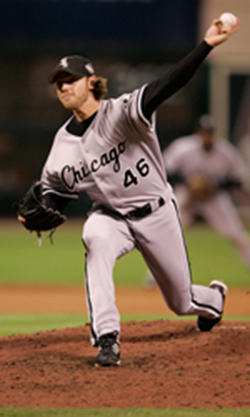
cws-chiFollowing last week’s trade deadline deals, Ryan Tepera and Craig Kimbrel became the 36th and 37th people I’ve seen play in person for both the Cubs and the White Sox.  With the first round of crosstown kicking off this afternoon at Wrigley, here’s a look at those players, in alphabetical order.

David Aardsma

After posting a decent season with the Cubs in 2006, Aardsma was traded to the White Sox for Neal Cotts.  Aardsma lasted one season with the Sox, where he was unable to duplicate his success from the year before.

Jason Bere

Drafted by the White Sox in the 36th round in 1990, Bere debuted with the big league club in 1993, finishing 2nd in Rookie of the Year voting.  After an All Star selection in 1994, injuries marred the remainder of his tenure on the South Side, which ended in 1998.  He resurfaced with the Cubs in 2001 and had a decent season, but he went 1-10 in 2002 before being let go.

Emilio Bonifacio

Bonifacio spent back-to-back partial seasons in Chicago, first for the Cubs in 2014 after signing as a free agent, where he played decently enough to be flipped at the trade deadline, along with James Russell, to the Braves for a young catching prospect by the name of Victor Caratini.  He returned to Chicago in 2015, signing with the White Sox, where he he did not do well at all, hitting .167 in 47 games before being released in August.

Welington Castillo

Debuting with the Cubs in 2010, Castillo spent time behind the plate for the Cubs until May of 2015, when, having been replaced in the starting lineup by Miguel Montero, he was flipped to the Mariners.  He returned to Chicago in 2018 after signing with the White Sox as a free agent.  On May 24th of that season, he was suspended 80 games for a violation of the PED policy.  The White Sox then cut bait following the 2019 season, shipping him off to the Rangers.

Neal Cotts

Acquired by the White Sox in the Billy Koch trade, he debuted with the team in 2003.  He was a key contributor in the bullpen during the 2005 championship season, and was the only relief pitcher to appear in all 3 rounds of the playoffs that season.  Following the 2006 season, he was traded to the Cubs for David Aardsma, and he spent the next 3 injury filled seasons on the North Side.

Scott Eyre

Joining the White Sox organization in a 1994 trade with the Rangers, he debuted with the big league team in 1997.  He split the next 4 seasons between the rotation and the bullpen, not to mention between Chicago and Charlotte, before being moved to the Blue Jays following the 2000 ALDS loss to the Mariners.  He joined the Cubs as a free agent for the 2006 season and enjoyed 2 seasons of relative success, before falling apart in 2008, when he was traded to the Phillies.

Kosuke Fukudome Continue reading →

Keeping Our Eyes On Next Year’s Prize

With a little more than 8 weeks remaining in the 2020 season, Major League Baseball released their tentative 2021 schedule yesterday.  For the first time in quite a while, the White Sox will be looking to compete for a title while the Cubs will be “retooling” after trading off all of their stars last week.  Assuming, of course, that the 2022 season goes off as planned and the end of the collective bargaining agreement doesn’t lead to a long work stoppage.  So, for one day, at least, let’s turn our attention to next summer for both teams.

The White Sox open their season at home against the Twins on March 31 for a three game tilt before heading on the road.  Nothing like a potential snowstorm to get the season off to a good start.  They face the Guardians for the first time on April 18 in Cleveland.

The interleague schedule pits the White Sox against the NL West, with trips to San Francisco, Colorado, and San Diego and home series against the Dodgers, Diamondbacks, and Rockies. The rivalry with their north side foes continues with a 2-game series at Wrigley at the beginning of May and a follow-up at Guaranteed Rate Field Memorial Day weekend.

The season ends with a 6 game road trip to Minnesota and San Diego.

On the north side, the Cubs open their season up on the road in Cincinnati, also on March 31.  They come home the following Monday to open their home slate against the Cardinals.

The interleague schedule pits the Cubs against the AL East, with trips to Baltimore, New York, and Toronto and home series against the Rays, Red Sox, and Orioles.

Of their 28 games in September/October, only 7 are against their NL Central rivals, though, with the Cubs not likely to contend, that shouldn’t make much of a difference.  They end the year with a 6 game homestand, facing the Phillies and the Reds.

End Of The Road

The rebirth of the Cubs, which began with the hiring of Theo Epstein in October of 2011 and culminated with their first World Series title in 108 years, officially came to an end this afternoon, as new GM Jed Hoyer shipped team leader Anthony Rizzo to the Yankees for rookie ball outfielder Kevin Alcantara and High-A righty Alexander Vizcaino.  The Cubs agreed to pay Rizzo’s remaining salary.

Vizcaino, 24, is already on the 40-man roster and ranked as the Yankees 11th best prospect at FanGraphs and 12th at Baseball America.  He is working his way back from a shoulder issue and has posted a combined 9.00 ERA in 6 games across two levels.  Alcantara, 18, is hitting .360 in 8 rookie league games and ranked 7th at FanGraphs and 14th at Baseball America.

Rizzo, who had been drafted by the Red Sox when Epstein and Hoyer were in their front office and was acquired by Hoyer when he became GM of the Padres, was the first big acquisition when the two reunited in Chicago.  He began the 2012 season in Triple A.  Recalled at the end of June, he quickly became a mainstay of the lineup and a crowd favorite, as the Cubs were rebuilding around him.  In 2013, he signed a long term contract extension, which expires at the end of this season.  He cemented his position in Cubs lore by catching the final out of the 2016 World Series, ending the longest championship drought in American professional sports.  However, as the Cubs have struggled to repeat the team success of that season, Rizzo has also struggled in later years, contributing to an offense that has severely regressed since 2016 and was one of the Cubs who refused to get the COVID vaccine, keeping the team below the 85% threshold for this 2021 season.

Rizzo’s numbers in a Cubs uniform, both for games I attended and overall, were:

Continue reading →