150 Years Of Cubs Baseball – Catchers

Originally founded in 1869, the Chicago Cubs became a charter member of the National League in 1876.  Over the next 150 seasons, the Cubs have played more than 22,000 games, scored over 103,000 runs and recorded more than 200,000 hits, more than any other team in baseball history.  Nearly 2,300 players have worn a Cubs uniform, earning eight division titles, 17 NL pennants, and three World Series championships.

Fans have witnessed generations of unforgettable players, from historical heroes like Joe Tinker, Gabby Hartnett, Ernie Banks, and Billy Williams to more recent stars like Ryne Sandberg, Derrek Lee, Kerry Wood, and Anthony Rizzo.  The team has called Wrigley Field home for 110 of those 150 seasons.

To celebrate this milestone, the Cubs are holding a fan vote to select the franchise’s anniversary team.  Each week, we will go through the provided options for each position and declare who should, and, if different, who will, win the fan vote.  We continue today with the eight selections for catcher.

Willson Contreras first joined the Cubs in 2016 and became the 30th player in modern MLB history to hit a home run on the first pitch of his first major league at bat.  Contreras made it on to the post-season roster and helped the Cubs end their 108-year title drought in winning the 2016 World Series.  He became the everyday starting catcher in 2017 and was elected to the All-Star team three times.  He spent parts of seven seasons behind the plate for the Cubs, appearing in 30 postseason games across four seasons.

Jody Davis joined the Cubs in April of 1981, quickly becoming the team’s starter.  During his Cub tenure, he was named to two All-Star teams and won the Gold Glove in 1986, a season where he set the all-time MLB record for number of baserunners caught stealing with 89.  Davis remained with the Cubs through most of the 1988 season.  He will be inducted into the team’s Hall of Fame later this year.

Silver Flint played for the White Stockings from 1879-1889.  He, alongside pitcher Larry Corcoran, is believed to have developed the first system of signs between a pitcher and catcher to indicate pitch selection.  He was the first catcher in MLB history to catch three no-hitters.  Off the field, Flint had financial difficulties that nearly got him banned from the league.

Gabby Hartnett spent the first 19 years, from 1922-1940, of his career with the Cubs, appearing in six All-Star games and earning the MVP award in 1935.  Perhaps best remembered for the “Homer in the Gloamin’” in 1938, Hartnett was considered the best National League catcher until the emergence of Johnny Bench.  He was elected to the Hall of Fame in 1955.
Continue reading →

150 Years Of Cubs Baseball – Managers

Originally founded in 1869, the Chicago Cubs became a charter member of the National League in 1876.  Over the next 150 seasons, the Cubs have played more than 22,000 games, scored over 103,000 runs and recorded more than 200,000 hits, more than any other team in baseball history.  Nearly 2,300 players have worn a Cubs uniform, earning eight division titles, 17 NL pennants, and three World Series championships.

Fans have witnessed generations of unforgettable players, from historical heroes like Joe Tinker, Gabby Hartnett, Ernie Banks, and Billy Williams to more recent stars like Ryne Sandberg, Derrek Lee, Kerry Wood, and Anthony Rizzo.  The team has called Wrigley Field home for 110 of those 150 seasons.

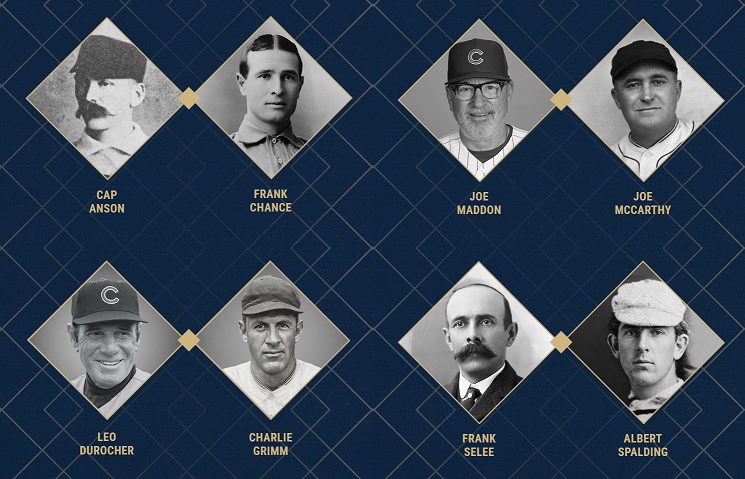
To celebrate this milestone, the Cubs are holding a fan vote to select the franchise’s anniversary team.  Each week, we will go through the provided options for each position and declare who should, and, if different, who will, win the fan vote.  We start today with the eight selections for manager.

Cap Anson was one of the first superstars of professional baseball.  He joined the Cubs franchise, then known as the White Stockings, in 1876, the first year of the new National League.  In 1879, he became the player-manager, leading the team to five pennants between 1880 and 1886.  He introduced new tactics that are commonplace today, including having a third base coach, having fielders back up one another, using signs to the batter, and having a set pitching rotation.  He was fired as manager following the 1897 season, his last as a player.  Off the field, Anson was an outspoken proponent of segregation in baseball and was known to gamble on games.

Frank Chance debuted with the Cubs in 1898, becoming their full-time first baseman in 1903, where he became immortalized as part of the “Tinker-to-Evers-to-Chance” trio thanks to the poem Baseball’s Sad Lexicon.  He became the player-manager in 1905, becoming the first of only eight managers to lead their team to four 100-win seasons.  The Cubs would win four NL pennants and two World Series championships under Chance.  He was let go by the team as both a player and a manager following the 1912 season.  He remains the winningest manager in Cubs history, by winning percentage.

Leo Durocher returned to major league baseball after an eleven-year break to become the manager of the Cubs in 1966.  He inherited a team that had finished in eighth place the year before and, within two years, he led them to only their second winning season since 1946.  1969 appeared to be their year, as the Cubs led the new NL East for 105 days, but a late season fade left them eight games behind the so-called Miracle Mets.  During his tenure, Durocher faced trouble in the locker room, nearly coming to blows with Ron Santo and dealing with the decline phase of franchise legend Ernie Banks.  With a 46-44 record midway through the 1972 season, Durocher was fired.  He would later state that his biggest regret in baseball was not winning a pennant for Cubs owner Phillip Wrigley.

Continue reading →

Welcoming A New Class

Two weeks ago, the attention of the baseball world turned to the small hamlet of Cooperstown, New York and to summers past as the votes for the 2026 Hall of Fame class were tallied and the results announced.  Carlos Beltran and Andruw Jones join Jeff Kent, who was elected by the Veteran’s Committee last month, in obtaining baseball immortality.  Beltran was on his fourth year of eligibility while Jones was in his ninth.

Chase Utley was the only other player to score greater than 50% of the vote, finishing with 59.1%.

Aside from Jones, who spent the 2010 season with the White Sox, things started looking up for our local heroes.  Manny Ramirez, who spent a little more than a month with the White Sox at the tail end of his career, saw another small increase in support, finishing with 38.8% of the vote thanks to his multiple PED suspensions. Jimmy Rollins, who spent the final 41 games of his career on the south side, picked up 25.4% in his fifth go-around.  Cole Hamels, who spent a little less than a year and a half with the Cubs, debuted with 23.8%.  Mark Buehrle saw a strong increase, jumping up to 20% in his sixth go-around.  The disgraced Omar Vizquel, accused of both sexual abuse of an autistic teen and spousal abuse since being added to the ballot, stayed stagnant with 18.4%.  Former Pale Hose Edwin Encarnacion and Gio Gonzalez nabbed six votes between them.

Eleven players will fall off the ballot after failing to score 5% of the vote.

As for the newest Hall of Famers, I’ve seen Beltran play nine times and Jones 37.  They will get their day in the sun on Sunday, July 26.

Carlos Beltran’s numbers in games I’ve attended were:

Continue reading →

Everything’s Coming Up Jerry

For the first time since 1977, the White Sox will have the top overall pick in next July’s MLB draft.  Despite having the second worst record in baseball in 2025, the White Sox entered last night’s draft lottery with the best chance at the #1 pick, as the Rockies were ineligible for a top-nine pick due to consecutive years picking in the lottery.  Ironically, that same rule is what stuck the White Sox with the 10th pick in this year’s draft, despite finishing last year with the most losses in the history of the league.

This will be the third time the White Sox have had the overall #1 pick in the draft.  In 1971, they selected Danny Goodwin, a catcher out of Peoria High School.  In typical White Sox fashion, they lowballed him and he chose to go to college instead, becoming the first top pick to not sign.  Things went a little better in 1977, when they selected Harold Baines with the top pick.  He would, of course, eventually have his number retired by the team and be elected to the Hall of Fame.  Not to put any pressure on whoever the team ends up selecting come July.

2026 Hall Of Fame Ballot – The Newcomers

Last Monday, the BBWAA released their ballot for the Hall of Fame class of 2026, with the results of the vote are due to be revealed on January 20th, and induction taking place July 26th.  With CC Sabathia, Ichiro Suzuki, and Billy Wagner as the electees last year, the new ballot contains fifteen holdovers along with a dozen newcomers.

On Wednesday, we looked at the returning candidates.  Today, it’s time to look at the newcomers, all of whom saw their last MLB action during the weirdness that was the 2020 season, and see who may be thankful come January.

Ryan Braun

The long-time Brewer had a fine career, minus his 2013 suspension for PEDs, but has no real shot at enshrinement.

Shin-Soo Choo

Choo left MLB as the record holder for most career home runs hit by an Asian-born player, but that isn’t going to get him much support.

Edwin Encarnación

424 career home runs was good, but good enough to push him over the top.

Gio González

A perfectly serviceable pitcher who has no real chance of getting a vote, let alone sticking around for a second election.

Alex Gordon

Again, not likely to get much support.

Cole Hamels

The 2008 World Series MVP will need to buy a ticket if he wants to get into the Hall.

Matt Kemp

A perfectly decent career, just not one that leads to enshrinement.

Howie Kendrick Continue reading →

2026 Hall Of Fame Ballot – The Holdovers

Monday, the BBWAA released their ballot for the Hall of Fame class of 2026.  The results of the vote are due to be revealed on January 20th, with induction taking place July 26th.  CC Sabathia, Ichiro Suzuki, and Billy Wagner were elected in last year’s voting, leaving fifteen holdovers along with another twelve newcomers.

Today, let’s take a look at the fifteen returning candidates.

Bobby Abreu
Years on ballot: 6
2025 Percentage: 19.5

A slight increase for Abreu, who has a long way to go and not a lot of time to do it.

Carlos Beltran
Years on ballot: 3
2025 Percentage: 70.3

A big bump in his third go-around for Beltran means the “punishment” for his role in the Astros cheating scandal might just be about to come to an end.

Mark Buehrle
Years on ballot: 5
2025 Percentage: 11.4

Buehrle keeps bouncing up and down but lives to fight another day in his uphill climb to make it to Cooperstown.

Felix Hernandez
Years on ballot: 1
2025 Percentage: 20.6

A decent debut for Hernandez, who dominated but didn’t put up the traditional numbers and flamed out rather young.

Torii Hunter
Years on ballot: 5
2025 Percentage: 5.1

A big decrease left Hunter barely remaining on the ballot for another year.

Andruw Jones
Years on ballot: 8
2025 Percentage: 66.2

Jones keeps trending in the right direction but only has two elections left to make up the remaining 9%.

Dustin Pedroia
Years on ballot: 1
2025 Percentage: 11.9

A nice debut for Pedroia, but he has a long way to go if he’s going to make it to Cooperstown.

Andy Pettitte
Years on ballot: 7
2025 Percentage: 27.9

Continue reading →

A Fallen Icon

For the second time in the month, a Chicago baseball legend has lost his life prematurely due to cancer.  Former Cubs second baseman Ryne Sandberg, who had been suffering from metastatic prostate cancer for over a year, died Monday at 65.

Ryne Sandberg was acquired by the Cubs, along with Larry Bowa, from the Phillies for Ivan DeJesus in January of 1982.  He was the primary third baseman for the Cubs during the 1982 season, hitting .271 with 7 home runs and 54 RBIs, good enough to place sixth in Rookie of the Year voting.  After the Cubs acquired Ron Cey following the season, they moved Sandberg to second base, where he would become a mainstay for the next decade plus.

1983 saw Sandberg garner his first Gold Glove while hitting .261 with 8 home runs and 48 RBIs.  He blossomed in 1984, as the Cubs made a surprising run at the NL East title.  Sandberg won the MVP, Silver Slugger, and Gold Glove awards while leading the league with 114 runs and 19 triples.  He hit .368 during the NLCS against the Padres, which the Cubs dropped in 5 games.  1985 saw him win another Silver Slugger and Gold Glove, while still earning MVP support despite the Cubs falling to the bottom of the division.  He earned another Gold Glove in 1986, hitting .284 with 14 home runs.  Injuries limited him to 132 games in 1987. but he still took home his fifth consecutive Gold Glove.

Sandberg posted a .741 OPS in 1988, good enough for his third Silver Slugger award and his sixth straight Gold Glove.  The Cubs returned to the post-season in 1989, as Sandberg hit .290 with 30 home runs, which garnered him yet another Silver Slugger and Gold Glove while coming in fourth for MVP voting.  He hit .400 and drove in four in the Cubs’ NLCS loss to the Giants in five games.  In 1990, Sandberg set a career high with 40 home runs, which led the National League, and duplicated his Silver Slugger, Gold Glove, and fourth place for MVP voting results from the previous year.  1991 saw Sandberg win his ninth consecutive, and final, Gold Glove award, breaking a tie with Bill Mazeroski.  In 1992, he won his fifth straight, and seventh overall, Silver Slugger award.  1993 saw Sandberg make his tenth consecutive, and final, All-Star team.

Sandberg struggled out of the gate in 1994, and with rumored marital issues at home, he abruptly retired on June 13th, saying “I lost the desire that got me ready to play on an everyday basis for so many years. Without it, I didn’t think I could perform at the same level I had in the past, and I didn’t want to play at a level less than what was expected of me by my teammates, coaches, ownership, and most of all, myself.”  Following a divorce and a new marriage, Sandberg returned to the Cubs in 1996, hitting .244 with 25 home runs and 92 RBIs.  With his OPS dropping to .711 in 1997, his lowest total since 1983, Sandberg retired for good following the 1997 season.  He was inducted to the Hall of Fame in 2005 and, that August, the Cubs retired his #23.  Last June, a statue of Sandberg was unveiled on Gallagher Way outside Wrigley Field

Hall Of Fame Batting Leaders


The Hall of Fame Class of 2025, featuring hitters Ichiro Suzuki, Dick Allen, and Dave Parker, gets enshrined in Cooperstown today.  Though I’ve only seen one of the three new Hall of Famers play live, let’s check back in with the leaders on the offensive side of the ball amongst Hall of Famers for all of the games I’ve attended between 1984 and 2024.

Home Runs

Name Total
Jim Thome 35
Frank Thomas 15
Scott Rolen 7
David Ortiz 6
Vladimir Guerrero 6

Hits

Name Total
Jim Thome 110
Frank Thomas 54
Joe Mauer 43
Ken Griffey Jr 32
Fred McGriff 28

Runs

Name Total
Jim Thome 82
Frank Thomas 42
Joe Mauer 19
David Ortiz 16
Scott Rolen 14

RBI

Name Total
Jim Thome 84
Frank Thomas 38
Fred McGriff 23
David Ortiz 19
Continue reading →

Hall Of Fame Pitching Leaders


Tomorrow, the Hall of Fame class of 2025 will be inducted in Cooperstown and CC Sabathia and Billy Wagner will boost the number of Hall of Fame pitchers I’ve seen live to twelve.  To celebrate this momentous occasion, we will take another look at the pitching leaders amongst Hall of Famers in games I have attended between 1984 and 2024.

Wins

Name Total
Greg Maddux 9
CC Sabathia 6
Tom Glavine 1
Rich Gossage 1
Roy Halladay 1
Mike Mussina 1

Losses

Name Total
Greg Maddux 12
Tom Glavine 2
Tom Seaver 2
Mike Mussina 2
Roy Halladay 1
Rich Gossage 1

ERA

Name Total
Lee Smith 0.00
Mariano Rivera 0.00
Billy Wagner 1.59
Trevor Hoffman 2.25
Roy Halladay 3.00

Strikeouts

Name Total
Greg Maddux 92
CC Sabathia 48
Continue reading →

Eligible For The Hall

Last week, MLB Commissioner Rob Manfred announced that anyone on the league’s permanently ineligible list that was now deceased would be removed, making them eligible for Hall of Fame consideration.  In a statement, Manfred said, “In my view, once an individual has passed away, the purposes of Rule 21 have been served.  Obviously, a person no longer with us cannot represent a threat to the integrity of the game.”  Later in the statement, he said, “I have concluded that permanent ineligibility ends upon the passing of the disciplined individual.”

The driving force behind this change was, of course, Pete Rose.  Rose, who died last September, agreed to be banned by then-Commissioner Bart Giamatti in 1989 after a report by investigator John Dowd confirmed that he had bet on Reds games while he was the manager.  That agreement prohibited Dowd from further investigation which likely would have uncovered that Rose had bet on his team to lose.  Complicating matters, Giamatti died of a heart attack eight days later, making his successors hesitant to remove Rose from the ineligible list during his lifetime.

Along with Rose, this decision applies to 16 other deceased individuals, including members of the 1919 White Sox like Shoeless Joe Jackson and Buck Weaver, among others.  2028 would be the earliest any of the newly eligible players could be inducted into the Hall of Fame, as the Classic Baseball Era Committee will next meet and vote in December 2027.  The two most likely to get any consideration are Rose and Jackson, and neither is the shoe-in their supporters may think.