Against The Yankees All Time Leaders – Through 2021

YankeesIn the past, we’ve looked at the all time leaders in both offensive and defensive categories for all 30 teams. This offseason, we will take our first ever look at those leaders against all 30 clubs.  We continue today with the New York Yankees.

The Yankees began life in 1901 as the Baltimore Orioles, moving to New York in time for the 1903 season.  I’ve seen them play 28 times, first in 1997 and most recently this past August at Truist Park in Atlanta.

Home Runs

Name Total
Paul Konerko 4
Alexei Ramirez 4
Jim Thome 3

Hits

Name Total
Paul Konerko 21
Gordon Beckham 16
A.J. Pierzynski 13

Runs

Name Total
Paul Konerko 8
Jim Thome 7
Gordon Beckham 6
Carlos Quentin 6

RBI

Name Total
Paul Konerko 9
Alexei Ramirez 8
Gordon Beckham 7

Doubles

Name Total
Gordon Beckham 7
Jose Abreu 5
Alexei Ramirez 3
A.J. Pierzynski 3

Triples Continue reading →

By The Numbers – 22

In 1929, uniform numbers appeared on the back of baseball jerseys for the first time, thanks to the Indians and the Yankees.  By 1937, numbers finally appeared across all uniforms, both home and away, across both major leagues.  Since that time, 81 distinct numbers have been worn by members of the White Sox, while the Cubs boast 76.

Today, we continue our look at those players, picking our favorite, if not the best, player to wear each uniform number for both Chicago teams with #22.  76 different players have donned #22 while playing in Chicago, 26 for the White Sox and 50 for the Cubs.

Acquired from the Dodgers, along with Ivan DeJesus, in exchange for Rick Monday and Mike Garman, Bill Buckner joined the Cubs, wearing #22, in 1977.  A staph infection in his ankle the previous year caused the Cubs to move the former outfielder to first base, a position he would man for the rest of his career.  Appearing in 122 games, he hit .284 with 11 home runs and 27 doubles.  He improved in 1978, raising his average to .323 and placed 17th in MVP voting.  1979 was another steady year for Buckner.  On May 17th, in the infamous slugfest where the Cubs lost 23-22 to the Phillies, he went 4–for–7 with a grand slam and a career-high seven RBIs.  He finished the year hitting .284 with 14 home runs and 34 doubles, but was also described as “nuts” when manager Herman Franks resigned late in the season.

In 1980, Buckner won a batting title, hitting .324 while striking out only 18 times, earning him a 14th place finish in MVP voting.  In the strike-shortened 1981 season, he was the lone Cub representative for the All Star game and batted .311 while tying Cecil Cooper for the major league lead with 35 doubles.  1982 saw Buckner hit over .300 for the fourth time as a Cub while racking up career highs in hits, with 201, RBIs, with 105, and assists at first base, setting a major league record with 159.

In 1983, Buckner again led the NL with 38 doubles, but saw his batting average drop to .280, his lowest finish as a Cub.  With the acquisition of Gary Matthews in 1984 pushing Leon Durham to first base, Buckner found himself the odd man out.  Appearing mostly as a pinch hitter, Buckner hit a paltry .209 through the end of May, when he was traded to the Red Sox, ending his Cub tenure.

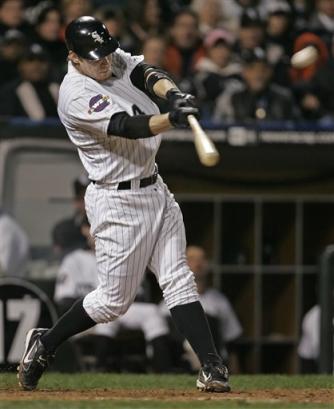
Scott Podsednik was acquired by the White Sox from the Brewers for Carlos Lee on December 13, 2004.  Wearing #22, he moved in to the leadoff spot and, after putting up a .294 average with 44 steals in the first half, he earned his first All Star game nod.  While injuries slowed him in the second half, he was back to full strength when the regular season came to an end and the White Sox embarked on their first post-season appearance in 5 years.  After going the entire regular season without a home run, Podsednik went deep against the Red Sox in Game 1 of the ALDS, helping the White Sox to a 14-2 victory on their way to a 3 game sweep of the defending champions.  Podsednik continued his steady play during the ALCS, hitting .294 with a triple and 3 stolen bases in the 5 game series.  The shining moment of his career came in Game 2 of the World Series, thanks to a walkoff home run against Brad Lidge in the 9th inning, giving the White Sox a 2-0 lead on their way to a sweep and their first world championship in 88 years.  For his efforts, Podsednik finished in 12th place for MVP voting.

As the White Sox looked to repeat in 2006, Podsednik found it difficult to duplicate his efforts from the year before.  His average was down 29 points, to .261, and his stolen base total was off by 19.  Injuries limited Podsednik to 62 games in 2007.  His offensive production continued to be lacking and, after the White Sox fell completely out of contention for the first time in years, the team decided to change their approach and gave Podsednik his release.  He returned to the White Sox organization in 2009, signing a minor league deal.  Injuries to Brian Anderson, Dewayne Wise, and Carlos Quentin gave him plenty of opportunity with the big league club, and he responded by hitting .304, his highest total since 2003.  Following the season, he became a free agent.

Against The Braves All Time Leaders – Through 2021

bravesIn the past, we’ve looked at the all time leaders in both offensive and defensive categories for all 30 teams.  This offseason, we will take our first ever look at those leaders against all 30 clubs.  We continue today with the Atlanta Braves.

The Braves began life in Boston, moving to Milwaukee in 1953 and finally landing in Atlanta in 1966.  I’ve seen them play 20 times, 12 against the Cubs, 7 against the White Sox, and once against the Yankees, including games 3 and 4 of the 2003 NLDS against the Cubs.

Home Runs

Name Total
Derrek Lee 2
Eric Karros 2
Frank Thomas 2

Hits

Name Total
Moises Alou 9
Alex Rios 8
Alexei Ramirez 7
Aramis Ramirez 7

Runs

Name Total
Aramis Ramirez 5
Alexei Ramirez 5
Alex Rios 4
Alejandro de Aza 4
Derrek Lee 4

RBI

Name Total
Alex Rios 9
Jeromy Burnitz 5
Derrek Lee 4
Rene Rivera 4

Doubles

Name Total
Derrek Lee 2
Alex Gonzalez 2
Mark Grudzielanek 2
Josh Phegley 2

Triples Continue reading →

By The Numbers – 23 Bonus!

In 1929, uniform numbers appeared on the back of baseball jerseys for the first time, thanks to the Indians and the Yankees. By 1937, numbers finally appeared across all uniforms, both home and away, across both major leagues. Since that time, 81 distinct numbers have been worn by members of the White Sox, while the Cubs boast 76.

Sunday, we continued our look at those players, picking our favorite, if not the best, player to wear each uniform number for both Chicago teams with #23.  Today, we take a special bonus look at player who famously wore #23 for other Chicago teams, making it possibly the most successful jersey number in town.

Michael Jordan was selected by the Chicago Bulls with the third overall pick in the 1984 NBA draft.  He would go on to become the greatest player in the history of the NBA, leading the Bulls to six titles, nabbing six Finals MVP awards, five MVP awards, three All Star Game MVPs, one Defensive Player of the Year award, and the 1985 Rookie of the Year award.  He was a 14-time All Star, 10-time first team All NBA, 9-time first team All-Defensive, 10-time scoring champion, 3-time steals leader, and 2-time Slam Dunk Contest champion.  A member of the NBA’s 50th and 75th Anniversary teams, his #23 has been retired by both the Bulls and the Miami Heat, for whom he never played.

Selected by the Bears him in the second round of the 2006 NFL Draft, Devin Hester quickly became one of, if not the, greatest return specialists in NFL history.  In his first 13 weeks as a professional, Hester recorded six return touchdowns, including three punt returns, two kickoff returns, and a then-record tying 108-yard touchdown from a missed field goal against the New York Giants.  As the Bears advanced to the Super Bowl, Hester became the first and only person to return the opening kick of the Super Bowl back for a touchdown.  2007 added an additional 6 touchdowns, followed by 2 quieter seasons.  In 2010, he added an additional 3 punt returns for touchdowns, followed by 2 punt returns and 1 kickoff return in 2011.  He added an additional punt return in 2013, his final season with the Bears.  This past September, in his first year of eligibility, Hester was nominated for the induction into the Pro Football Hall of Fame.

2021: The Year In Travel

In normal times, this is where I would take a look back at all of the trips I took over the past year and look ahead to what, if any. travel plans I already have for 2022.  Unfortunately, 2021 continued to be far from normal times, as the global pandemic raged on for a second year, though things did manage to open back up slightly.

My first “trip” of the year, if you can call it that, was in March.  On a Friday afternoon, I drove down to Purdue to pick up Danny, before continuing on to Indianapolis so we could watch Purdue in the NCAA tournament.  They managed to completely crap the bed, which made the whole effort worthwhile.  After the game, we traveled back the way we came and I was home early the next morning.

In August, I made my only big trip of the year, driving down to Florida for some fun in the sun.  I had rented a condo on AirBNB that was right on the water, which, thanks to the spacious deck, let me enjoy the view while relaxing and reading.  I also managed to make my first two trips to Tropicana Field, as the White Sox were in town to battle the Rays.  Those experiences did not turn out quite as well.

On the drive home, I stopped in Atlanta and managed to take in a game at Truist Park to see the Yankees battle the Braves.  The following day I completed my journey, making it home in the midst of a torrential downpour, which made the last hour or so of driving so much fun.

The only other trips were back down to Purdue for football games, one in October and two in November.  We didn’t manage to make the second game in November, but it’s the drive that matters.

Looking ahead to 2022, despite the rise in COVID cases due to the omicron variant, I’m planning to return to Hawaii later this month and the family is headed to Boston in May for Angelina’s graduation.  Other than that, there are some baseball trips I want to take this year, but nothing is solid just yet.  Here’s hoping that the world returns to some sort of normalcy, though I’m not optimistic.

By The Numbers – 23

In 1929, uniform numbers appeared on the back of baseball jerseys for the first time, thanks to the Indians and the Yankees.  By 1937, numbers finally appeared across all uniforms, both home and away, across both major leagues.  Since that time, 81 distinct numbers have been worn by members of the White Sox, while the Cubs boast 76.

Today, we continue our look at those players, picking our favorite, if not the best, player to wear each uniform number for both Chicago teams with #23, one of the most famous and successful numbers in city history across all sports.  67 different players have donned #23 while playing in Chicago, 35 for the White Sox and 31 for the Cubs, including a familiar face for both sides of town.
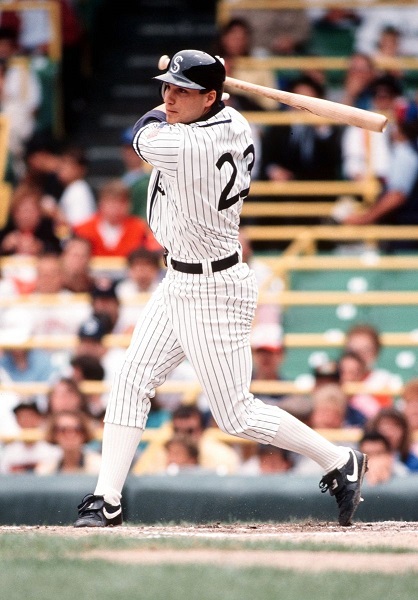
Robin Ventura made his major league debut donning #23 in September of 1989, appearing in 16 games down the stretch, hitting only .178 while driving in 7 runs in 45 at bats.  A good spring in 1990 led to Ventura breaking camp with the White Sox, but he struggled both on the field and at the plate, suffering through a horrendous 0-for-41 slump while committing 25 errors over the course of the season.  He finished the year with a .249 average, 5 home runs, and 54 RBIs and placed 7th in Rookie of the Year voting and was named to the Topps All Star Rookie team.

Ventura and the White Sox moved in to the new Comiskey Park in 1991, hoping to improve on the previous year’s growth.  He improved his fielding enough to earn his first Gold Glove award and, at the plate, he set a White Sox team record for RBIs by a third baseman, finishing with an even 100.  He upped his average to .284 and hit 23 home runs.  His work was enough to garner enough MVP votes to finish in 20th place.  1992 was another good year for Ventura.  He earned his first All Star nod, going 2-2 in the AL’s victory at Jack Murphy Stadium.  He finished the year with a .282 average, 16 home runs, and 93 RBIs.  He also snagged his second consecutive Gold Glove award.  Ventura continued his successful ways in 1993, collecting his 500th hit in May and, on August 4, entering the public consciousness with an event that would come to define his entire career.  While batting against the Rangers, Ventura was hit by a pitch thrown by Nolan Ryan and charged the mound.  Ryan, 20 years Ventura’s senior, placed him in a headlock and punched him several times, starting a bench-clearing brawl that was voted the best baseball brawl of all time by SportsCenter.  After the season, he was awarded his third consecutive Gold Glove award.

The strike in 1994 saw Ventura’s streak of 90 RBI seasons and Gold Gloves come to an end.  When baseball stopped in August, Ventura was hitting .282 with 18 home runs and 78 RBIs, while posting a new career high with an .832 OPS.  When play resumed in late April 1995, Ventura struggled out of the gate, committing ten errors in the first ten games.  As the White Sox started to tear down the team that had finished the previous two seasons on top of their division, trade rumors started to follow Ventura, though nothing came to fruition.  On September 4, he became the eighth player in history to hit two grand slams in one game, and the first since Frank Robinson in 1970.  He finished the year setting career highs with a .295 average, an .882 OPS, and 26 home runs while driving in 93 runs.  Ventura had the best year of his career to date in 1996, setting White Sox team records in career home runs by a third baseman, with 142, and grand slams, with 9.  He set new career highs with 34 home runs, 105 RBIs, 2 triples, an OPS of .888, and a .974 fielding percentage at the hot corner.  He hit .287, while earning his fourth Gold Glove award.

1997 turned into a dismal year for both Ventura and the White Sox.  During a spring training game, Ventura caught his foot in the mud while sliding into home plate and suffered a broken and dislocated right ankle.  Expected to miss the entire season, he returned on July 24, collecting the game-winning hit that night, and homered in his first at-bat the next night.  With the White Sox only 3.5 games behind the Indians in the standings, a healthy Ventura might have put them over the top.  A week later, the team threw in the towel in what eventually became to be known as the White Flag Trade, sending 3 pitchers to the Giants for prospects.  “We didn’t realize Aug. 1 was the end of the season,” said an upset Ventura.  He finished the year appearing in 54 games, hitting .262 with 6 home runs and 26 RBIs.  Entering the last year of his contract in 1998, the White Sox made little attempt to sign Ventura to an extension, with owner Jerry Reinsdorf claiming his skills were “deteriorating” after his injury the year before.  With more trade rumors following him throughout the season, he finished the year with a .263 average, 21 home runs, and 91 RBIs while earning his fifth Gold Glove award.  Following the season, he became a free agent, ending his White Sox playing career.

Continue reading →

By The Numbers – 24

In 1929, uniform numbers appeared on the back of baseball jerseys for the first time, thanks to the Indians and the Yankees.  By 1937, numbers finally appeared across all uniforms, both home and away, across both major leagues.  Since that time, 81 distinct numbers have been worn by members of the White Sox, while the Cubs boast 76.

Today, we continue our look at those players, picking our favorite, if not the best, player to wear each uniform number for both Chicago teams with #24.  104 different players have donned #24 while playing in Chicago, 49 for the White Sox and 55 for the Cubs.

Joe Crede earned a September call-up from Double A in 2000, and, wearing #24, made his major league debut on September 12, replacing Herbert Perry and going 0-1 in the Tigers 10-3 victory at Comiskey Park.  Crede appeared in 7 games, making the most of his 14 at bats, and finished with a .357 average.  Crede got another cup of coffee with the big league club in September of 2001, earning a little more playing time, but he was less successful, finishing with a .220 average in 50 at bats over 17 games.  Crede returned to the White Sox for good in July of 2002.  On August 12, he hit his first major league home run off of former teammate James Baldwin and he finished with 12 home runs, 35 RBIs, and a .285 average.  Crede established himself as the starting third baseman in 2003.  He appeared in a career high 151 games and launched 19 home runs with 75 RBIs while posting a .261 average.  He struggled in 2004, seeing his average drop to .239 while hitting 21 home runs with 69 RBIs.

In 2005, Crede started to come in to his own.  While he improved his average to .252 and hit 22 home runs with 62 RBIs, he came alive in the second half, culminating with a game winning, and possible season saving, home run in the 10th inning against the Indians on September 20, which pushed the White Sox to a 3.5 game lead and propelled them into the playoffs.  Crede had a rough series in the ALDS against the Red Sox, getting only 1 hit in 9 at bats, but rebounded in the ALCS and World Series, hitting .368 and .294 respectively, with 2 home runs in each series.  2006 was Joe Crede’s breakout season.  He hit .283 with career highs in home runs, with 30, and RBIs, with 94, winning his first, and only, Silver Slugger award.  A back injury in 2007 limited him to 47 games and only 4 home runs.  He returned with a bang in 2008, hitting a grand slam on opening day against the Twins and parlayed a good first half into his first All Star selection, but the back injury recurred and kept him out for most of the second half of the season, including the playoffs, thus ending his White Sox career.

On the north side of town, Dexter Fowler joined Cubs via trade prior to the 2015 season.  Donning #24, he ended the year with a .250 average, 102 runs scored, 46 RBIs, 17 home runs, and 20 stolen bases as the Cubs made a surprise run for the NL Wild Card.  Fowler helped propel the Cubs to the NLDS, putting up three hits, three runs scored, a home run, and a stolen base in defeating the Pirates.  In nine postseason games, Fowler batted .396 with two home runs and three RBIs, as the Cubs made it to the NLCS against the Mets.

Fowler became a free agent after the season and was unsigned into the start of spring training.  Despite reportedly agreeing to a three-year contract with the Orioles, Fowler arrived in Cubs camp and signed a one year deal.  And what a year it was.  Fowler finished the year with a .276 average, 13 home runs, 48 RBIs, and 84 runs scored as the Cubs won the NL Central.  Fowler’s .333 average with 4 RBI helped the Cubs win the NLCS against the Dodgers, advancing to the World Series for the first time since 1945.  On October 25, 2016, Dexter Fowler became the first African-American to appear and to bat for the Cubs in a World Series game.  Fowler led off Game 7 of the World Series with a home run, becoming the first player in history to do so, and helping the Cubs win 8–7 in 10 innings, giving the team their first championship in 108 years.

By The Numbers – 25

In 1929, uniform numbers appeared on the back of baseball jerseys for the first time, thanks to the Indians and the Yankees.  By 1937, numbers finally appeared across all uniforms, both home and away, across both major leagues.  Since that time, 81 distinct numbers have been worn by members of the White Sox, while the Cubs boast 76.

Today, we continue our look at those players, picking our favorite, if not the best, player to wear each uniform number for both Chicago teams with #25.  87 different players have donned #25 while playing in Chicago, 51 for the White Sox and 36 for the Cubs.

Acquired by the Cubs following the 2003 season for Hee Seop Choi, Derrek Lee, wearing #25, quickly became a mainstay of the Cubs lineup.  He hit .278 with 32 home runs and 98 RBIs in his first year on the north side.  2005 was a career year for Lee, and that was just in the first half.  He led the majors with a .376 average and 72 RBIs while tying for the lead with 27 home runs.  For the full season, he hit 46 home runs and a .335 average, the highest for a Cub since Bill Madlock in 1976 and he notched the first batting title for a Cub since Bill Buckner in 1980.  When it was all said and done, he had won the Gold Glove and Silver Slugger awards and finished third in MVP voting.

A broken wrist limited Lee to 50 games in 2006, but he rebounded in 2007 to hit .317 with 22 home runs as the Cubs won their first NL Central title since 2003.  Lee went 4 for 12 as the Cubs were swept in 3 games by the Diamondbacks.  Another strong season in 2008, with a .291 average, 20 home runs, and 90 RBIs helped push the Cubs back to the post-season.  Lee did all he could, hitting .545 in the NLDS against the Dodgers, but the Cubs were once again swept.  Lee overcame a slow start in 2009 thanks to a 21 game hitting streak and finished with a .306 batting average, 35 home runs and 111 RBIs, which earned him enough votes to finish ninth in MVP voting.

2010 was a strange year for Lee and the Cubs.  On June 9th, he hit his 300th career home run.  Later that month, however, he would get in to a fight in the dugout with Carlos Zambrano, which led to a suspension for Zambrano.  In the last year of his contract and with the team going nowhere fast, Lee was traded to the Braves on August 18th, ending his Cub tenure.

Looking to reload after winning their first World Series championship in 88 years, the White Sox acquired Jim Thome from the Phillies for Aaron Rowand, Gio Gonzalez, and Daniel Haigwood.  Thome, wearing his familiar #25, made an immediate impact, setting a major league record by scoring in each of Chicago’s first 17 games and setting the team record with 10 home runs in April.  By season’s end, Thome had put up a .288 average with 42 home runs, 102 RBIs, and an OPS of 1.014.  One of the few bright spots for the 2007 White Sox came in mid-September, when Thome, on his bobblehead day, launched his 500th career home run, the first player to do so on a walk-off.  For the year, Thome hit .275, with 35 home runs and 96 RBIs.  2008 was a bit of a down year for Thome, as his average and OPS both fell, but he still managed 34 home runs and 90 RBIs.  The most important of each came in the 163rd game of the year, as he hit a solo home run to give the White Sox a 1-0 victory over the Twins and the Central Division title.  With the White Sox going nowhere in 2009, Thome was traded to the Dodgers on August 31 for a warm body.


By The Numbers – 26

In 1929, uniform numbers appeared on the back of baseball jerseys for the first time, thanks to the Indians and the Yankees.  By 1937, numbers finally appeared across all uniforms, both home and away, across both major leagues.  Since that time, 81 distinct numbers have been worn by members of the White Sox, while the Cubs boast 76.

Today, we continue our look at those players, picking our favorite, if not the best, player to wear each uniform number for both Chicago teams with #26.  71 different players have donned #26 while playing in Chicago, 58 for the White Sox and 13 for the Cubs, who have retired it for a Hall of Fame outfielder.

Sweet-Swinging Billy Williams first wore his familiar #26 in 1961, his first full season with the Cubs, where he played in 146 games, hitting 25 home runs with 86 RBIs, while earning Rookie of the Year honors.  Williams hit at least 20 home runs and drove in 84 or more runs in every season from 1961 to 1973, earning 6 All-Star team nods along the way, in 1962, 1964, 1965, 1968, 1972, and 1973.  In 1963, he started a consecutive game streak that would last into 1970, setting the National League record with 1,117.

In 1970, Williams batted .322 with 42 homers and 129 RBI and finished second in MVP voting.  He replicated that finish in 1972, winning the batting title with a .333 average, along with a .606 slugging percentage, 37 home runs, and 122 RBIs.  That gave him his 3rd top ten finish in 5 seasons.  Following the 1974 season, Williams was traded to the A’s for, amongst others, Manny Trillo.  Williams was elected to the Hall of Fame in 1987 and his number 26 was retired by the Cubs later that summer.

On the South Side of town, nobody has really made their mark wearing #26, though one of the greatest “what ifs” in team history did don the number in 1986.  Acquired in the Rule 5 draft from the Pirates in December of 1985, Bobby Bonilla made his major league debut with the White Sox on April 9, going 0-1 as a pinch hitter in the Sox loss to the Brewers.  Bonilla was putting together a pretty decent rookie campaign, especially since he was making the jump from A ball, hitting .269 with 2 home runs in 75 games when GM Ken Harrelson decided send Bonilla back to the Pirates, in exchange for pitcher Jose DeLeon.  DeLeon went 23-22 across parts of 5 seasons in 2 stints with the White Sox, while Bonilla made 6 All Star teams, earned three Silver Slugger awards, and two top ten MVP finishes over the next 10 seasons.

By The Numbers – 27

In 1929, uniform numbers appeared on the back of baseball jerseys for the first time, thanks to the Indians and the Yankees.  By 1937, numbers finally appeared across all uniforms, both home and away, across both major leagues.  Since that time, 81 distinct numbers have been worn by members of the White Sox, while the Cubs boast 76.

Today, we continue our look at those players, picking our favorite, if not the best, player to wear each uniform number for both Chicago teams with #27.  103 different players have donned #27 while playing in Chicago, 52 for the White Sox and 51 for the Cubs.

Acquired on December 19, 2016 from the Nationals, Lucas Giolito made his White Sox debut the following summer donning #27.  In 7 starts, he put up a sparkling 2.38 ERA while compiling a 3-3 record.  Things went south In 2018, as Giolito was, statistically, the worst starting pitcher in baseball with a 6.13 ERA, leading the league (the bad way) in WHIP and walks per 9 innings.  That offseason, he began rebuilding his game from the ground up, leading to a 2019 All Star appearance en route to a 14-9 record with a 3.41 ERA.  In the COVID-shortened 2020 season, he held the hapless Pirates hitless on August 25th, striking out 13 while facing one batter over the minimum of 27.  He made his post-season debut in Game 1 of the Wild Card series against the A’s, retiring the first 18 batters in order before giving up 2 hits and a walk in the 7th inning, earning the victory in the White Sox only win during the series.  In 2021, Giolito made 31 starts, finishing with a record of 11-9 and a 3.53 ERA.

During his second go-around with the North Siders, Joe Girardi wore #27 for the 2001 and 2002 seasons.  On June 22, 2002, Girardi addressed a sold-out Wrigley Field to announce the day’s game was cancelled following the death of Cardinal pitcher Darryl Kile.  Following that season, he became a free agent and left the team for the second, and final, time.