Looking Ahead To 2026

Eschewing their traditional day after the All-Star Game release, Major League Baseball released their tentative 2026 schedule on a random Tuesday at the end of August.  For the fourth year in a row, MLB is keeping with a balanced schedule, playing 52 games against division opponents, 64 games against non-division opponents in the same league, and 46 interleague games, with series against every team in the opposite league.  With a young and improving White Sox team already looking ahead to next year and the Cubs trying to lock down a Wild Card spot, the 2026 season looks like it could be an interesting one for the city of Chicago.  So, for one day, at least, let’s turn our attention to next summer for both teams.

The White Sox open their season on March 26, the earliest North American start in league history, under the dome in Milwaukee against the Brewers, followed by a trip to South Beach to face the Marlins.  They open up their home schedule against the Blue Jays on April 2.

Aside from the Brewers and Marlins, the interleague schedule sees the White Sox going on the road to face the Phillies, Cardinals, Diamondbacks, and Padres, while the Pirates, Reds, Dodgers, Braves, Mets, Rockies, and Nationals make their way to Rate Field.  The rivalry with their north side foes continues with a three-game weekend series at home Wrigley Field in mid-May followed by a weekday series at Wrigley Field in mid-August.

The White Sox wrap up the 2026 season in September with series against the Twins, Guardians, and Tigers, should it matter.  The season ends at home with a three-game series against the Rockies.

On the north side, the Cubs kick off their season at home against the Nationals and the Angels before heading out on the road in early April.  Aside from the Angels, the Cubs will host the Twins, A’s, Yankees, Blue Jays, and Tigers, while travelling to visit the Mariners, Orioles, Guardians, Red Sox, and Royals.

Twelve of their 24 games in September are against their NL Central rivals, with six coming against the Brewers, which could make a difference should the Cubs find themselves in contention once again.  They end the year with a three-game road trip to Boston to face the Red Sox.

Crossing Sides Of Town

So far in 2025, Brad Keller, Mike Tauchman, Nicky Lopez, and Reese McGuire pushed the total of players I’ve seen take the field in person for both the Cubs and the White Sox to 47.  With the final round of crosstown kicking off tonight at Rate Field, here’s a look at those players, in alphabetical order.

David Aardsma

After posting a decent season with the Cubs in 2006, Aardsma was traded to the White Sox for Neal Cotts.  Aardsma lasted one season with the Sox, where he was unable to duplicate his success from the year before.

Jason Bere

Drafted by the White Sox in the 36th round in 1990, Bere debuted with the big-league club in 1993, finishing 2nd in Rookie of the Year voting.  After an All Star selection in 1994, injuries marred the remainder of his tenure on the South Side, which ended in 1998.  He resurfaced with the Cubs in 2001 and had a decent season, but he went 1-10 in 2002 before being let go.

Emilio Bonifacio

Bonifacio spent back-to-back partial seasons in Chicago, first for the Cubs in 2014 after signing as a free agent, where he played decently enough to be flipped at the trade deadline, along with James Russell, to the Braves for a young catching prospect by the name of Victor Caratini.  He returned to Chicago in 2015, signing with the White Sox, where he he did not do well at all, hitting .167 in 47 games before being released in August.

Welington Castillo

Debuting with the Cubs in 2010, Castillo spent time behind the plate for the Cubs until May of 2015, when, having been replaced in the starting lineup by Miguel Montero, he was flipped to the Mariners.  He returned to Chicago in 2018 after signing with the White Sox as a free agent.  On May 24th of that season, he was suspended 80 games for a violation of the PED policy.  The White Sox then cut bait following the 2019 season, shipping him off to the Rangers.

Neal Cotts

Acquired by the White Sox in the Billy Koch trade, he debuted with the team in 2003.  He was a key contributor in the bullpen during the 2005 championship season and was the only relief pitcher to appear in all 3 rounds of the playoffs that season.  Following the 2006 season, he was traded to the Cubs for David Aardsma, and he spent the next 3 injury filled seasons on the North Side.

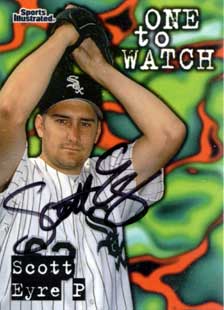
Scott Eyre

Joining the White Sox organization in a 1994 trade with the Rangers, he debuted with the big-league team in 1997.  He split the next 4 seasons between the rotation and the bullpen, not to mention between Chicago and Charlotte, before being moved to the Blue Jays following the 2000 ALDS loss to the Mariners.  He joined the Cubs as a free agent for the 2006 season and enjoyed 2 seasons of relative success, before falling apart in 2008, when he was traded to the Phillies.

Clint Frazier

After missing the second half of 2021 with an injury, Frazier was DFA’d by the Yankees.  He signed a deal with the Cubs that offseason, though he notched just 45 plate appearances before being DFA’s once again.  He chose to finish the year in the Cubs system before becoming a free agent following the season.  After failing to catch on with the Rangers, he signed a minor league deal with the White Sox, eventually hitting .197 in 33 games with the big-league club.

Kosuke Fukudome Continue reading →

It Has Indeed Been A While

As we hit the halfway point of the 2025 season, I’ve seen fourteen teams already this year, just under half of the league.  Stretching back to the start of 2024, that number jumps to 25, which leaves a quarter of the teams I’ve not seen in quite some time.

Of the remaining five, the Nationals hold the top stop, as it has been over four years now since I have seen them live and in person.  The Twins are the biggest surprise, since going two plus seasons without seeing a division rival is pretty rare. I do have the opportunity to add each of these five teams to this season’s slate in the second half.  Anyway, here’s a look at each team and the last time I saw them play.

Most Recent Game By Team

Team Date
Washington Nationals 5/19/2021
New York Yankees 5/15/2022
Minnesota Twins 10/5/2022
Philadelphia Phillies 6/29/2023
San Francisco Giants 9/5/2023
Cincinnati Reds 4/13/2024
Tampa Bay Rays 4/28/2024
Cleveland Guardians 5/12/2024
Atlanta Braves 5/21/2024
Baltimore Orioles 5/25/2024
Toronto Blue Jays 5/28/2024
Los Angeles Dodgers 6/24/2024
Pittsburgh Pirates 7/14/2024
Detroit Tigers 8/25/2024
New York Mets 8/31/2024
Oakland Athletics 9/15/2024
Los Angeles Angels 3/27/2025
San Diego Padres 4/5/2025
Boston Red Sox 4/13/2025
Milwaukee Brewers 5/1/2025
Houston Astros 5/3/2025
Miami Marlins 5/10/2025
Seattle Mariners 5/20/2025
Texas Rangers 5/24/2025
Colorado Rockies 5/26/2025
Chicago Cubs 5/26/2025
Kansas City Royals 6/8/2025
St. Louis Cardinals 6/19/2025
Chicago White Sox 6/24/2025
Arizona Diamondbacks 6/24/2025

Position Players Pitching

In the mid-2010s, putting in a position player to pitch in an effort to save overworked bullpens became more popular than ever before in the history of Major League Baseball.  Starting in 2023, rules changes restricted position players from pitching unless their team is leading by ten or more runs in the 9th inning, their team is losing by eight or more runs at any time, or the game is in extra innings.  This weekend, i saw my tenth eighth position player pitch, so it seemed like a good time to review.

5/6/2017
With a depleted bullpen and down by five against the Yankees, Joe Maddon turned to catcher Miguel Montero to pitch the final inning.  Montero’s inning could generously be called effectively wild, as he walked two and sailed one pitch over Chris Carter’s head but managed to escape without giving up a run.  Maddon’s notion to avoid going back to his bullpen proved prescient, as the following night the two teams went 18 innings, with the Cubs losing by one.

7/6/2017
Exactly two months later, Maddon again turned to his bench rather than his bullpen as the Brewers held a nine-run lead heading into the 9th inning.  This time he turned to veteran outfielder Jon Jay, who gave up just one hit while retiring the Brewers on just 16 pitches.

6/22/2019
Wrigley Field was again the stage for our next installment of position players pitching, as catcher Victor Caratini took the mound for the 9th inning with the Cubs down 10-1 to the Mets.  He did his part, throwing a 1-2-3 inning and giving the Cubs a chance to mount a comeback in the bottom of the 9th.  The rally fell short, however, as the Cubs lost 10-2.

8/17/2021
We move to the South Side for our next occurrence, this time for an opponent.  With the White Sox leading the A’s 9-0, first baseman Mitch Moreland came out to face the White Sox in the bottom of the 8th.  Facing the bottom of the batting order, Moreland gave up a single to Danny Mendick en route to a scoreless outing.

9/16/2021
Nearly a month later, the shoe was on the other foot as the White Sox were losing 9-3 to the Angels at Guaranteed Rate Field.  With two outs in the top of the 9th, Rick Renteria picks Romy Gonzalez to nail down the final out.  With Shohei Ohtani on first base, Gonzalez strikes out Max Stassi on four pitches to end the inning.

7/9/2022
With pitching in his genes, Kody Clemens took the mound for the bottom of the 8th with his Tigers trailing the White Sox 8-0.  Clemens did what none of his fellow Tigers could accomplish that day, giving up no hits and retiring the side on only fourteen pitches.

4/3/2023
The Giants had a big 7-3 lead against the White Sox heading into the 9th inning when Jose Ruiz took the mound looking to hold the line.  Instead, he faced six batters, giving up five runs on two home runs while only getting a single out.  Down by nine, rookie manager Pedro Grifol brought in infielder Hanser Alberto to mop up.  He gave up two hits but wrapped up the inning without giving up a run.

5/1/2025
With the White Sox holding a surprising 8-0 lead over the Brewers, Jake Bauers, who started the game in left field, came in to pitch the bottom of the 8th.  He quickly put down the White Sox, getting a 1-2-3 inning on just ten pitches.

All Time Team Records

After a long winter, the North American portion of the 2025 baseball season is set to get underway tomorrow.  To celebrate, it is time once again to look at the all-time team records for games that I have identified as having attended dating back to 1984.  Last year, I posted my lowest total since 2001, a decrease of 16 games from the year before, and managed to see 20 out of the 30 teams, so there should be some nice changes.

The White Sox are coming off the most losses in modern major league history and may be hard-pressed to avoid breaking that record again this year.  On the other side of town, the Cubs made some big moves to get back into playoff contention.  The 2025 season may look completely different on each side of town.

All-Time Team Records

Team Name Won Loss Winning Pctg
California Angels 2 0 1.000
Arizona Diamondbacks 16 4 0.800
Cleveland Guardians 4 2 0.667
Florida Marlins 15 8 0.652
New York Yankees 19 12 0.613
Toronto Blue Jays 18 12 0.600
Philadelphia Phillies 13 9 0.591
Colorado Rockies 11 8 0.579
Boston Red Sox 21 16 0.568
Los Angeles Angels 20 16 0.556
Washington Nationals 7 6 0.538
Detroit Tigers 35 30 0.538
Cleveland Indians 31 27 0.534
Chicago Cubs 238 215 0.525
Houston Astros 26 25 0.510
Chicago White Sox 372 360 0.508
Continue reading →

Ballpark Tour: Reds

Spring training is in full swing and opening day is coming up in a little less than 3 weeks, as we continue our tour of all of the baseball stadiums I’ve been to over the years.  Now tied for my most visited city, outside of Chicago for baseball contains the homes of the Cincinnati Reds.  Between the two stadiums that have been located on the riverfront of the Ohio River, I’ve seen 8 games.  So, without further ado, let’s take a deeper look at my history with Cinergy Field and Great American Ball Park.

Stadium Name: Riverfront Stadium/Cinergy Field

Years in Service: 1970 – 2002

Visits: 1

Riverfront Stadium, Cincinnati’s version of the cookie cutter stadium that popped up in the late 60s and early 70s, opened on June 30, 1970 as the Reds hosted the Atlanta Braves.  In 1996, the stadium was renamed Cinergy Field thanks to a sponsorship deal with the local energy company.  Prior to the 2001 season, after the Bengals moved to their new home down the street, the stadium was reconfigured for baseball-only use, and portions of the outfield stands were removed to make room for the construction of the Reds’ new home, the future Great American Ball Park.  The 2002 season was the final one for the stadium, with the final game played on September 22 and the stadium was imploded on December 29.

In 2000, Ken Griffey Jr. joined the Cincinnati Reds, which put two of the most feared sluggers in the game in the NL Central.  When Sammy Sosa and the Chicago Cubs were scheduled to make an opening week visit to Cincinnati in 2000 to face Griffey for the first time, the idea of a road trip was hatched.  Friday, April 7, 2000 started with Krispy Kreme donuts at the house before heading towards Cincinnati.  Along the way, there was a brief stop at Purdue. because why not, and the trifecta of a KFC/Taco Bell/Pizza Hut seemed like a good place to stop for lunch.  We arrived in Cincinnati well before the stadium opened, so some time was spent walking around the bustling metropolis that was, and continues to be, Cincinnati.

Our tickets were in the upper deck and, to be honest, I have little to no recollection of the game itself.  My one and only memory of the game is losing my balance and tumbling down 5-10 rows, landing on a group of fans below.  Certainly not my proudest moment.  I do recall some of the drive home after the game, which included listening to the White Sox/A’s game where Jose Valentin committed a number of errors for the eventual AL Central champs.

Stadium Name: Great American Ball Park

Years in Service: 2003 – Present

Visits: 7

After 32 1/2 seasons at Riverfront Stadium, the Reds moved next door to the newly built Great American Ball Park for the 2003 season, opening against the Pittsburgh Pirates.  Bronze statues of former stars Joe Nuxhall, Ernie Lombardi, Ted Kluszewski, and Frank Robinson are located in front of the main entrance.

Less than a month into the stadium’s existence, I made my first trip to the GABP with my friend Scott, who had moved to the Cincinnati area, to see the Reds take on the Padres.  The next season, the Cubs opened their season in Cincinnati against the Reds, so another trip was in order, where Vice President Dick Cheney threw out the first pitch.  In August of 2005, I attended the Reds game against the Diamondbacks, kicking off a string of 3 stadiums in 3 states in 9 days.  In 2006, the Cubs once again opened their season on the road against the Reds and again it constituted a road trip down to see, where this time President George W Bush threw out the first pitch.  I made a return trip that summer for interleague play to see the White Sox battle the Reds.  In 2007, when the Cubs were looking the clinch the division, I made the trip down, but missed it by one day.  The next year, I made my final, to date, trip down to Cincinnati and saw the Rockies defeat the Reds.

Of all the newer stadiums that have opened over the past 20 years, Great American Ball Park does not often illicit the praise that the others get.  However, I like it.  It’s a fine place to see a game and has plenty of the modern amenities that are required here in the 21st century.  I wouldn’t hesitate to return, despite the fact that it has been over 16 years since I’ve been there.

Ballpark Tour: Giants

With pitchers and catchers reporting within the week, is a little less than a month away as we continue our tour of all of the baseball stadiums I’ve been to over the years.  Today we travel west to the Bay area for the baseball homes of the San Francisco Giants.  Between the two stadiums that have been located in and around San Francisco, I’ve seen three games, all against the same opponent.  So, without further ado, let’s take a deeper look at my history with 3Com Park and Oracle Park.

Stadium Name: 3 Com Park

Years in Service: 1960 – 1999

Visits: 1

When the New York Giants moved west in 1958, the city of San Francisco began constructing a new ballpark for them, and Candlestick Park was born. The stadium opened in 1960 and was the home of the now-San Francisco Giants through the 1999 season. Along the way, the stadium has also played host to the Oakland Raiders, the San Francisco 49ers, dozens of commercials and movies, and, in 1965, the final commercial concert appearance by the Beatles.

In September of 1999, I headed out to the Bay Area to visit an old friend. One of the items on our agenda was to head out to Candlestick, which had been renamed 3Com Park by this point, to see a game before the Giants moved to their new home the following season. With only 13 home games left on the schedule, we set out to see the Giants take on the Phillies on September 2. The Giants, behind starter Joe Nathan, defeated the Phillies 3-2 on a cool autumn afternoon.

Stadium Name: AT&T Park/Oracle Park

Years in Service: 2000 – Present

Visits: 2

After flirting with a move to Tampa Bay, the Giants opened Pacific Bell Park in 2000 after 40 seasons at Candlestick Park. The ballpark was the first stadium built without public funds since the completion of Dodger Stadium in 1962. The stadium was renamed SBC Park in 2003 and then finally AT&T Park in 2006 thanks to the corporate upheaval in the telecommunications world. In April 2010, the stadium became the first MLB ballpark to receive LEED Silver Certification for Existing Buildings, Operations and Maintenance.

In May of 2008, I made my second trip out to Bay Area, this time to attend the Java One conference. The week started with the A’s in town while the Giants returned home for a weekend series, so I adjusted my schedule so that I could attend games at both stadiums. Friday night, after most of the techies had left town, I hopped on the bus down to AT&T Park to see the Giants, once again, take on the Phillies. I dropped some major coin for the best tickets in the house, which got me in a box between home plate and the Phillie dugout and a prime spot on the evening’s telecast. The Phillies, on their way to a World Series championship, defeated the Giants 7-4.

In August of 2018, I made my third trip to San Francisco, this time for a trip to one of our affiliates for talks about their entry into the broader corporate umbrella.  Wouldn’t you know it, but the Phillies were in town once again at the building now known as Oracle Park.  With Madison Bumgarner on the bump, the Giants shut down the Phillies as I took in the game a mere three rows behind the Giants’ dugout.

Ballpark Tour: A’s

With just under a month to go before pitchers and catchers start reporting to spring training camps, we continue our tour of all of the different baseball stadiums I’ve been to over the years. This week, we head to the Bay Area to look at the former Oakland A’s. So, without further ado, let’s take a deeper look at my history with the Oakland Coliseum.

Stadium Name: McAfee/Network Associates Coliseum

Years in Service: 1968 – Present

Visits: 2

The Oakland–Alameda County Coliseum opened in 1966 as the home of the Oakland Raiders.  Two years later, Charlie Finley moved his A’s from Kansas City to Oakland and became the baseball tenant of the stadium.  In 1998, the stadium became known as Network Associates Coliseum.  In mid-2004, Network Associates was renamed McAfee and the stadium was renamed McAfee Coliseum accordingly.  Following the 2008 season, the name reverted back to Oakland–Alameda County Coliseum until April 27, 2011, when it was renamed Overstock.com Coliseum. Just over a month later, the Coliseum was renamed O.co Coliseum, after Overstock.com’s marketing name.

Both times I’ve traveled to the Bay area, I’ve taken in both Giants and A’s games.  My first trip to what at the time was called Network Associates Coliseum was on September 6, 1999 while I was out west visiting my friend Scott.  The Tigers triumphed over the A’s that day, and my one memory of the stadium is that the seats were not necessarily positioned in such a way as to face the field for baseball purposes.

My second trip to the Bay area, for the JavaOne conference in 2008, actually started out with a BART trip out to Oakland for a 2-1 A’s victory over the Orioles on May 5th.  The A’s had opened up three sections of the third deck as designated All-You-Can-Eat seats, where, for the price of the ticket, free ballpark fare was included.  While I enjoyed the novelty of the free foodstuffs, the seats, while directly behind home plate, were horrible.  Leaving early in order to catch the train back to San Francisco led to the problem of trying to get out of the stadium, since none of the gates were open.

The A’s bid this stadium, and the city of Oakland, farewell following the 2024 season.  They plan to play their home games in Sacramento while a new stadium is being built in Las Vegas.  The funding for said stadium isn’t as secure as MLB and the A’s would lead you to believe, so the future home of this franchise is anyone’s guess.

Another Name Change

Eight years into a thirteen-year deal, Guaranteed Rate Field will now be known as Rate Field.  While the new name rolls off the tongue a little easier than the previous moniker, it is still a bit of a clunker.  Guaranteed Rate rebranded as simply Rate this past July, so the new name aligns with the corporate master.

In the time the park was known as Guaranteed Rate, I saw 203 games, including post-season play in 2021 and the worst team in modern MLB history in 2024.

All-Time Team Records

Team Name Won Loss Winning Pctg
Milwaukee Brewers 3 1 0.750
Cleveland Guardians 4 2 0.667
San Diego Padres 2 1 0.667
Arizona Diamondbacks 2 1 0.667
Chicago Cubs 7 4 0.636
Seattle Mariners 7 4 0.636
Toronto Blue Jays 5 3 0.625
Boston Red Sox 6 4 0.600
Cleveland Indians 7 5 0.583
New York Yankees 4 3 0.571
Detroit Tigers 13 10 0.565
Houston Astros 6 5 0.545
Cincinnati Reds 1 1 0.500
Los Angeles Angels 3 3 0.500
St. Louis Cardinals 2 2 0.500
Texas Rangers 3 3 0.500
Oakland Athletics 6 7 0.462
Chicago White Sox 93 110 0.458
Minnesota Twins 7 9 0.438
Kansas City Royals 8 12 0.400
Baltimore Orioles 3 5 0.375
San Francisco Giants 1 2 0.333
Tampa Bay Rays 2 5 0.286

Here We Go Again

Stop me if you’ve heard this one before.  In order to jumpstart their latest rebuilding effort, the White Sox have traded their stud left-handed starter to the Red Sox for four prospects.  Hopefully the end result will be different from the Chris Sale deal back in 2016.  This time around, Garrett Crochet is heading east, while the White Sox will receive catcher Kyle Teel, outfielder Braden Montgomery, infielder Chase Meidroth, and right-hander Wikelman Gonzalez.

Crochet was the 11th overall selection by the White Sox in the 2020 draft.  Thanks to the pandemic, he didn’t spend any time in the minor leagues before making his major league debut on September 18, throwing a scoreless inning with two strikeouts against the Reds.  Crochet worked out of the bullpen for the remainder of the year, giving up just three hits without allowing a run to score in five appearances as the White Sox made the post-season for the first time since 2008.  He made a single appearance in the Wild Card round against the A’s, striking out the two batters he faced.

Crochet returned to the bullpen in 2021, going 3-5 with a 2.82 ERA.  He appeared in three of the four games in the ALDS against the Astros, giving up five hits in just two and a third innings without surrendering a run.  An elbow injury and Tommy John surgery wiped out his 2022 season, and he returned to the big leagues in 2023, making thirteen appearances with a 3.55 ERA.

Last year, following the Dylan Cease trade, Crochet moved to the starting rotation full time and was named the opening day starter.  Coming off the injury and having totaled 73 total career innings, he was restricted to save his arm.  After notching his first All-Star, he struggled a little in the second half, finishing the season with 32 starts and a 6-2 record, posting a 3.58 ERA.

Teel, ranked as the #25 prospect in all of baseball, is the centerpiece of the deal.  A 22-year-old left-handed hitter, he was the first round draft choice of the Red Sox in 2023.  He split 2024 between Double A and Triple A and is expected to be ready to reach the major leagues next year.  Montgomery, a 21-year-old switch hitter, is ranked as the #54 prospect and was the top pick for the Red Sox in this summer’s draft.  Meidroth, a 23-year-old right hander, spent last season in Triple A, showing good plate discipline with little pop.  Gonzalez, 22, posted a 4.73 ERA in Double A last season, working mostly as a starter.

Will this deal work out better for the White Sox than the Sale trade did eight years ago?  Only time will tell, as the south siders look to bounce back from the worst season in baseball history.

Crochet’s numbers in a White Sox uniform, both for games I attended and overall, were: Continue reading →