2025 All Star Break Standings

We reach the traditional (if not numerical) midpoint of the 2025 baseball season as the Midsummer Classic lands in Atlanta for the third time.  As the stars of the baseball world gather at Truist Park for tonight’s showdown, it’s time to take a look at the team records for the 23 games, featuring 57% of the teams in the league, that I attended in the first half of the baseball season.

2025 Team Records

Team Name Won Loss Winning Pctg
Chicago Cubs 3 0 1.000
St. Louis Cardinals 2 0 1.000
Toronto Blue Jays 2 0 1.000
Houston Astros 1 0 1.000
Arizona Diamondbacks 1 0 1.000
Cleveland Guardians 2 1 0.667
Miami Marlins 1 1 0.500
Boston Red Sox 1 1 0.500
Kansas City Royals 1 1 0.500
Chicago White Sox 9 12 0.429
Milwaukee Brewers 0 1 0.000
San Diego Padres 0 1 0.000
Colorado Rockies 0 1 0.000
San Francisco Giants 0 1 0.000
Seattle Mariners 0 1 0.000
Texas Rangers 0 1 0.000
Los Angeles Angels 0 1 0.000

There Goes The Boom

Bobby Jenks, the man standing on the pitcher’s mound when the White Sox got the final out of the 2005 World Series, passed away yesterday in Portugal, near his wife’s family, after battling a form of stomach cancer.  Jenks, who turned 44 in March, was diagnosed with Stage 4 adenocarcinoma in January, just weeks after losing his home to the Palisades wildfires.

Jenks joined the White Sox organization following the 2004 season, after being selected off waivers from the Angels.  He started 2005 in Double A and was called up to the big-league club on July 5, making his major league debut the following day.  When Shingo Takatsu proved ineffective and Dustin Hermanson went down with a back injury, Jenks became the closer in September, finishing the regular season with six saves.  In the ALDS against the Red Sox, he threw three scoreless innings and picked up two saves in the three-game sweep.  Thanks to four consecutive complete games to finish the ALCS against the Angels, Jenks was well rested for the World Series.  He appeared in all four games against the Astros, throwing five innings and earning the save in Games 1 and 4.

He spent the next five seasons with the White Sox, making two All-Star teams and continuing to endear himself to White Sox fans.  In 2007, he tied a major league record by retiring 41 consecutive batters, becoming the first reliever to achieve the feat.  After the 2010 season, he left as a free agent, but injuries and a botched surgery ended his career.  He returned to Chicago in 2024, serving as the manager of the Windy City Thunderbolts independent team.

Next weekend, the White Sox are celebrating the 20th anniversary of that World Series team.  Jenks had been planning to attend, reportedly telling his doctors not to schedule any appointments for him in early July, but unfortunately it was not to be.

Jenks’ numbers in a White Sox uniform, both for games I attended and overall, were:

Continue reading →

Historic Games

With Vinny Capra and the White Sox falling victim to Clayton Kershaw on Wednesday night, giving him his 3000th career strikeout, I decided to take a look back at the historic games I’ve attended over the years.  Here is part one, featuring six games where an individual hit a career plateau or a team clinched a division title.

June 30, 1998 – Diamondbacks 4, Cubs 3

Sammy Sosa had broken the June record for home runs nine days earlier, surpassing the fifteen previously reached by Babe Ruth, Bob Johnson, Roger Maris, and Pedro Guerrero.  In the 8th inning of the final game of the month, Sosa connected against Alan Embree for his 20th home run of the month, setting the record not just for June, but for any month of the season.

September 27, 2003 – Cubs 7, Pirates 2

After winning the first game of a double header against the Pirates, the Cubs were in position to clinch at least a portion of their first Central Division title heading into the nightcap.  After the second-place Astros lost their game, a victory would give the Cubs the championship.  They jumped on Pirates starter Ryan Vogelsong early, scoring six runs in his 1 1/3 innings of work.  Dave Veres induced former Cub José Hernández to ground into a double play to wrap up the victory.

July 26, 2005 – Giants 3, Cubs 2

Following a nearly three-hour rain delay, Greg Maddux took the mound against the Giants sitting on 2998 strikeouts for his career.  In the third inning, Giants shortstop Omar Vizquel stepped up to the plate. With a 2-2 count, Maddux unleashed a sinker that Vizquel flinched away from, taking a third strike as the ball drifted back over the plate.  Maddux, who finished the game with three strikeouts, became just the 13th pitcher to reach 3000 strikeouts and the ninth to also have surpassed 300 victories.

August 5, 2007 – Mets 8, Cubs 3

On a warm Sunday night in Chicago, Tom Glavine took the mound for the Mets, sitting at 299 career victories.  The 41-year-old lefty tossed 6 1/3 innings, giving up just two runs to secure the win and his place in history.  Glavine became only the 23rd pitcher, and just the fifth southpaw, to reach the 300-win plateau.

September 16, 2007 – White Sox 9, Angels 3

Sitting at 499 home runs, Jim Thome entered the Sunday series finale, which just so happened to be Jim Thome bobblehead day, looking to reach 500 in Chicago.  With the score tied at seven in the bottom of the ninth, Thome came to the plate with a runner on first.  Having gone 0-4 to that point, Thome took Dustin Moseley to a 3-2 count before launching the walk-off milestone home run.  He became the 23rd major leaguer to reach the 500 home run mark and the third to do so in 2007.  He was the first slugger to reach the milestone with a walk-off.

September 30, 2008 – White Sox 1, Twins 0

After winning a makeup game against the Tigers to force a tie in the AL Central after 162 games, the White Sox took the field against the Twins in a tiebreaker to determine who would move on to the playoffs.  The Twins looked to strike first following a double by Michael Cuddyer to lead off the fifth inning, but a throw home by Ken Griffey Jr. nailed Cuddyer trying to score on a fly out to center field, ending the threat.  The game remained scoreless until the seventh, when Jim Thome blasted a home run to straight away centerfield.  Bobby Jenks came in to close down the game and the White Sox won their second division title in four years.


It Has Indeed Been A While

As we hit the halfway point of the 2025 season, I’ve seen fourteen teams already this year, just under half of the league.  Stretching back to the start of 2024, that number jumps to 25, which leaves a quarter of the teams I’ve not seen in quite some time.

Of the remaining five, the Nationals hold the top stop, as it has been over four years now since I have seen them live and in person.  The Twins are the biggest surprise, since going two plus seasons without seeing a division rival is pretty rare. I do have the opportunity to add each of these five teams to this season’s slate in the second half.  Anyway, here’s a look at each team and the last time I saw them play.

Most Recent Game By Team

Team Date
Washington Nationals 5/19/2021
New York Yankees 5/15/2022
Minnesota Twins 10/5/2022
Philadelphia Phillies 6/29/2023
San Francisco Giants 9/5/2023
Cincinnati Reds 4/13/2024
Tampa Bay Rays 4/28/2024
Cleveland Guardians 5/12/2024
Atlanta Braves 5/21/2024
Baltimore Orioles 5/25/2024
Toronto Blue Jays 5/28/2024
Los Angeles Dodgers 6/24/2024
Pittsburgh Pirates 7/14/2024
Detroit Tigers 8/25/2024
New York Mets 8/31/2024
Oakland Athletics 9/15/2024
Los Angeles Angels 3/27/2025
San Diego Padres 4/5/2025
Boston Red Sox 4/13/2025
Milwaukee Brewers 5/1/2025
Houston Astros 5/3/2025
Miami Marlins 5/10/2025
Seattle Mariners 5/20/2025
Texas Rangers 5/24/2025
Colorado Rockies 5/26/2025
Chicago Cubs 5/26/2025
Kansas City Royals 6/8/2025
St. Louis Cardinals 6/19/2025
Chicago White Sox 6/24/2025
Arizona Diamondbacks 6/24/2025

Position Players Pitching

In the mid-2010s, putting in a position player to pitch in an effort to save overworked bullpens became more popular than ever before in the history of Major League Baseball.  Starting in 2023, rules changes restricted position players from pitching unless their team is leading by ten or more runs in the 9th inning, their team is losing by eight or more runs at any time, or the game is in extra innings.  This weekend, i saw my tenth eighth position player pitch, so it seemed like a good time to review.

5/6/2017
With a depleted bullpen and down by five against the Yankees, Joe Maddon turned to catcher Miguel Montero to pitch the final inning.  Montero’s inning could generously be called effectively wild, as he walked two and sailed one pitch over Chris Carter’s head but managed to escape without giving up a run.  Maddon’s notion to avoid going back to his bullpen proved prescient, as the following night the two teams went 18 innings, with the Cubs losing by one.

7/6/2017
Exactly two months later, Maddon again turned to his bench rather than his bullpen as the Brewers held a nine-run lead heading into the 9th inning.  This time he turned to veteran outfielder Jon Jay, who gave up just one hit while retiring the Brewers on just 16 pitches.

6/22/2019
Wrigley Field was again the stage for our next installment of position players pitching, as catcher Victor Caratini took the mound for the 9th inning with the Cubs down 10-1 to the Mets.  He did his part, throwing a 1-2-3 inning and giving the Cubs a chance to mount a comeback in the bottom of the 9th.  The rally fell short, however, as the Cubs lost 10-2.

8/17/2021
We move to the South Side for our next occurrence, this time for an opponent.  With the White Sox leading the A’s 9-0, first baseman Mitch Moreland came out to face the White Sox in the bottom of the 8th.  Facing the bottom of the batting order, Moreland gave up a single to Danny Mendick en route to a scoreless outing.

9/16/2021
Nearly a month later, the shoe was on the other foot as the White Sox were losing 9-3 to the Angels at Guaranteed Rate Field.  With two outs in the top of the 9th, Rick Renteria picks Romy Gonzalez to nail down the final out.  With Shohei Ohtani on first base, Gonzalez strikes out Max Stassi on four pitches to end the inning.

7/9/2022
With pitching in his genes, Kody Clemens took the mound for the bottom of the 8th with his Tigers trailing the White Sox 8-0.  Clemens did what none of his fellow Tigers could accomplish that day, giving up no hits and retiring the side on only fourteen pitches.

4/3/2023
The Giants had a big 7-3 lead against the White Sox heading into the 9th inning when Jose Ruiz took the mound looking to hold the line.  Instead, he faced six batters, giving up five runs on two home runs while only getting a single out.  Down by nine, rookie manager Pedro Grifol brought in infielder Hanser Alberto to mop up.  He gave up two hits but wrapped up the inning without giving up a run.

5/1/2025
With the White Sox holding a surprising 8-0 lead over the Brewers, Jake Bauers, who started the game in left field, came in to pitch the bottom of the 8th.  He quickly put down the White Sox, getting a 1-2-3 inning on just ten pitches.

Ballpark Tour: White Sox

With Opening Day in the books, it is time to wrap up our tour of all of the baseball stadiums I’ve been to over the years with the ones I’ve been to the most: the homes of the Chicago White Sox.  Between the two stadiums that have been located at the corners of 35th and Shields, I’ve seen at least 668 games, all but one of which have involved the White Sox.  So, without further ado, let’s take a deeper look at my history with Comiskey Park and the facility currently known as Rate Field.
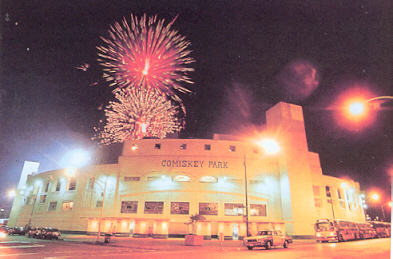
Stadium Name: Comiskey Park

Years in Service: 1910 – 1990

Visits: 13 (that I’m aware of)

Comiskey Park, the so-called Baseball Palace of the World, was the home of the White Sox from 1910 through the 1990 season.  Built on a former city dump at the corner of 35th Street and Shields Avenue, the stadium opened on July 1, 1910, as the White Sox lost to the St. Louis Browns 2-0.  The final game for the old ballyard occurred on September 30, 1990, a 2-1 victory over the Mariners.

Comiskey Park was the host for four World Series, including three in a row from 1917-1919.  The White Sox won the World Series in 1917 against the New York Giants.  The Cubs, looking for a larger seating capacity, moved their home games in the 1918 series against the Red Sox to Comiskey Park.  The 1919 World Series, of course, was the Black Sox scandal, where the White Sox threw the series against the Reds.  The White Sox returned to the World Series 40 years later in 1959 but fell to the Dodgers.  The final post-season games to be played in Comiskey Park were games 3 and 4 of the 1983 ALCS, which the White Sox lost to the Baltimore Orioles.

Comiskey Park was also the host to three All-Star games.  The first All-Star game, in 1933, was held in conjunction with Century of Progress Exposition being held on Chicago’s lakefront.  The event returned to Chicago’s south side in 1950 and the final All-Star game at Comiskey Park was in 1983, the 50th anniversary of the first game.  Comiskey Park was also the frequent home of the Negro League East-West All-Star Game from 1933 to 1960.

Looking back, I’ve now been able to piece together evidence of 13 games that I attended at Comiskey Park, either from pictures, stadium giveaways, or specific memories.  I know there are more, but I have not been able to pinpoint exact games as of yet.  The most memorable game I can remember would be the final night game, on September 29, 1990, where, after the game, the lights were symbolically turned off for the final time.

Stadium Name: Comiskey Park II/US Cellular Field/Guaranteed Rate Field/Rate Field

Years in Service: 1991 – Present

Visits: 655

On the evening of June 30, 1988, with the clock literally stopped, the Illinois legislature passed a bill that provided the financing for a new stadium for the White Sox, stopping them from moving to St. Petersburg, Florida.  Two and a half years later, on April 18, 1991, Comiskey Park II opened, the first new major facility built in Chicago since the erection of the Chicago Stadium in 1929.  Sadly, the White Sox were embarrassed by the Tigers, losing 16-0 in the opening of their new park.

Unfortunately for the White Sox, the new Comiskey Park was the last stadium to be built prior to the wave of retro ballparks that started with the opening of Camden Yards the following year.  Because of this, there have been numerous renovations to the park, starting in 2001 with the addition of nearly 2000 seats and the relocation of the bullpens.  More extensive renovations began in 2003 in preparation for that season’s All-Star Game and using the money generated from selling the naming rights to US Cellular, and continued through 2007, when the replacement of the blue seats with green seats was completed.  Less extensive renovations have occurred since, replacing the different video boards and creating premium seating areas.

The post-season came to the new Comiskey Park for the first time in 1993, as the White Sox battled the Blue Jays in the ALCS.  The stadium hosted its first World Series games in 2005, the first to be played in the city of Chicago since 1959, as the White Sox went on to sweep the Houston Astros and win their first World Series since 1917.

I attended my first game at the new Comiskey Park on April 20, 1991, the second game in the stadium’s history.  Since then, I’ve been to 654 other games at the stadium, the majority coming from 2005 on, when I became a season ticket holder.  I went to both games of the 2000 ALDS, which the White Sox lost to the Mariners, both games of the 2005 ALDS, which the White Sox won against the Red Sox, both games of the 2005 ALCS, which the White Sox split against the Angels, and game 2 of the 2005 World Series.  I attended game 163 of the 2008 season to break the tie between the White Sox and the Twins. and then the two ALDS games against the Rays, the first time I saw the White Sox actually end a post-season series, either in victory or defeat.

Notable regular season games I’ve seen at what is now known as Guaranteed Rate Field include the September 18, 2001 game against the Yankees as baseball returned following the attacks of 9/11, the April 16, 2005 game where Mark Buehrle defeated the Mariners in 1 hour and 39 minutes, the April 2, 2006 season opener against the Indians when the World Series championship banner was raised, the April 4, 2006 game where the players received their World Series rings, and the September 16, 2007 game where Jim Thome hit his 500th career home run against the Angels.  Not to mention a streak of 24 consecutive home openers.

All Time Team Records

After a long winter, the North American portion of the 2025 baseball season is set to get underway tomorrow.  To celebrate, it is time once again to look at the all-time team records for games that I have identified as having attended dating back to 1984.  Last year, I posted my lowest total since 2001, a decrease of 16 games from the year before, and managed to see 20 out of the 30 teams, so there should be some nice changes.

The White Sox are coming off the most losses in modern major league history and may be hard-pressed to avoid breaking that record again this year.  On the other side of town, the Cubs made some big moves to get back into playoff contention.  The 2025 season may look completely different on each side of town.

All-Time Team Records

Team Name Won Loss Winning Pctg
California Angels 2 0 1.000
Arizona Diamondbacks 16 4 0.800
Cleveland Guardians 4 2 0.667
Florida Marlins 15 8 0.652
New York Yankees 19 12 0.613
Toronto Blue Jays 18 12 0.600
Philadelphia Phillies 13 9 0.591
Colorado Rockies 11 8 0.579
Boston Red Sox 21 16 0.568
Los Angeles Angels 20 16 0.556
Washington Nationals 7 6 0.538
Detroit Tigers 35 30 0.538
Cleveland Indians 31 27 0.534
Chicago Cubs 238 215 0.525
Houston Astros 26 25 0.510
Chicago White Sox 372 360 0.508
Continue reading →

Ballpark Tour: Brewers

Spring training is in full swing and opening day is about a month away, as we continue our tour of all of the baseball stadiums I’ve been to over the years. The closest city, outside of Chicago, for baseball, contains the homes of the Milwaukee Brewers. Between the two stadiums that have been located in the heart of cheeseland, I’ve seen 8 games. So, without further ado, let’s take a deeper look at my history with County Stadium and Miller Park.

Stadium Name: County Stadium

Years in Service: 1953 – 2000

Visits: 1

Milwaukee County Stadium was built with the intention of drawing a major league baseball team to Milwaukee, and it worked quicker than anybody would have expected, as the Braves announced they would be moving from Boston 3 weeks before the stadium, and the 1953 season, opened.  The Braves would call Milwaukee home for the next 13 seasons before leaving for Atlanta for the 1966 season.

During the 1968 and 1969 seasons, the struggling Chicago White Sox wound up playing 20 home games at County Stadium in an effort to keep the baseball fandom alive in Milwaukee.  In 1970, local businessman Bud Selig purchased the expansion Seattle Pilots out of bankruptcy court and moved them to Milwaukee and rechristened them the Brewers.  The Brewers would call County Stadium home until 2000, when they would move next door in to the newly built Miller Park.

I made one trip up to County Stadium for a White Sox/Brewers tilt on July 18, 1993.  The White Sox were victorious thank to a 2-run single by Bo Jackson in the 9th inning. I remember sitting out in the bleachers, but, beyond that, have no particular memory of the stadium or what amenities, if any, it offered.

Stadium Name: Miller Park/American Family Field

Years in Service: 2003 – Present

Visits: 7

The Brewers broke ground on a new stadium on November 9, 1996, in a parking lot behind County Stadium, with plans to open the park for the 2000 season.  Construction was delayed in 1999 after a crane collapsed while lifting a 400-ton roof section, killing three workers.  This caused the opening to be delayed for a year, and the new Miller Park did not open until April 6, 2001.  In 2007, the stadium hosted an Indians series against the Angels after snowstorms in Cleveland forced the cancellation of the previous series against the Mariners.  The Astros called Miller Park home for two games in 2008 when Hurricane Ike stormed through Houston.  Prior to the 2021 season, the park was renamed American Family Field

I made the first of my seven visits to Miller Park during the inaugural season of 2001.  That May 7th contest had the Cubs squeaking out a 7-6 victory against the hosting Brewers.  My most recent trip up north was this past summer, to once again see the Cubs battle (or destroy) the Brewers.  Miller Park was a vastly superior replacement over County Stadium, and I’ve enjoyed each of my subsequent trips up to Milwaukee to see the local ballclubs.

Another Name Change

Eight years into a thirteen-year deal, Guaranteed Rate Field will now be known as Rate Field.  While the new name rolls off the tongue a little easier than the previous moniker, it is still a bit of a clunker.  Guaranteed Rate rebranded as simply Rate this past July, so the new name aligns with the corporate master.

In the time the park was known as Guaranteed Rate, I saw 203 games, including post-season play in 2021 and the worst team in modern MLB history in 2024.

All-Time Team Records

Team Name Won Loss Winning Pctg
Milwaukee Brewers 3 1 0.750
Cleveland Guardians 4 2 0.667
San Diego Padres 2 1 0.667
Arizona Diamondbacks 2 1 0.667
Chicago Cubs 7 4 0.636
Seattle Mariners 7 4 0.636
Toronto Blue Jays 5 3 0.625
Boston Red Sox 6 4 0.600
Cleveland Indians 7 5 0.583
New York Yankees 4 3 0.571
Detroit Tigers 13 10 0.565
Houston Astros 6 5 0.545
Cincinnati Reds 1 1 0.500
Los Angeles Angels 3 3 0.500
St. Louis Cardinals 2 2 0.500
Texas Rangers 3 3 0.500
Oakland Athletics 6 7 0.462
Chicago White Sox 93 110 0.458
Minnesota Twins 7 9 0.438
Kansas City Royals 8 12 0.400
Baltimore Orioles 3 5 0.375
San Francisco Giants 1 2 0.333
Tampa Bay Rays 2 5 0.286

The Hall Calls

Sunday night, the results of the Classic Baseball Era Veteran’s Committee vote was revealed, adding two players to the Hall of Fame class of 2025: Dick Allen and Dave Parker.  Parker was named on fourteen ballots from the 16-person committee, while Allen nabbed thirteen votes, the one more than the minimum needed for election.

Allen spent three of his fifteen big league seasons with the White Sox, earning the MVP award in 1972.  He was the Rookie of the Year in 1964 with the Phillies and also spent time with the Cardinals, Dodgers, and A’s.  He hit 20 or more home runs in nine consecutive seasons and finished his career with 351 homers, 1,119 RBI and a .292 career batting average.  Unfortunately, Allen passed away in December of 2020.

Parker, 73, was a seven-time All-Star in his 19-year career, hitting 339 home runs and posting a lifetime .290 batting average.  He won back-to-back batting titles with the Pirates in 1977 and 1978, winning the NL MVP award in ’78.  He earned All-Star MVP honors in 1979 while leading the Pirates to their last World Series championship.  After leaving the Pirates, he bounced around to the Reds, A’s, Brewers, Angels and Blue Jays, winning a second title with the A’s in 1989.