By The Numbers – 35

In 1929, uniform numbers appeared on the back of baseball jerseys for the first time, thanks to the Indians and the Yankees.  By 1937, numbers finally appeared across all uniforms, both home and away, across both major leagues.  Since that time, 81 distinct numbers have been worn by members of the White Sox, while the Cubs boast 76.

Today, we continue our look at those players, picking our favorite, if not the best, player to wear each uniform number for both Chicago teams with #35.  26 players have donned #35 on each side of town, including one Hall of Famer.

Frank Thomas

Frank Thomas was selected by the White Sox with the seventh pick in the first round of the 1989 draft and, a little more than a year later, he made his major league debut.  In 1991, as the White Sox moved into the new Comiskey Park, Thomas became one of the most feared hitters in the American League.  He won the MVP award in both 1993 and 1994, while leading the White Sox to their first division title since 1983.  In 1997, he earned his first batting title and notched his 7th top 10 finish in MVP voting in his first 7 full seasons.

Thomas became a full time DH in 1998 and struggled for the first time.  Injuries slowed him down in 1999, but he bounced back in a big way in 2000.  He hit .328 and set career highs with 43 home runs and 143 RBIs as the White Sox returned to the post-season for the first time since 1993.  A torn triceps cut his 2001 campaign short, and, when he returned in 2002, he was clearly no longer the offensive force he had been.  Foot injuries robbed him of most of the 2004 and 2005 seasons, and, after watching the only team he had even played for win the World Series without him, he became a free agent after the 2005 season.  His number 35 was retired by the White Sox on August 29, 2010 and he was part of the 2014 Hall of Fame class, elected on the first ballot with 83.7% of the vote.

The history of #35 on the north side of town is nowhere near as impressive.  Of the 26 players to wear the number, 4 came in 2000 alone.  While there are players I like a little more, we will go with shortstop Lennie Merullo, who was the first player to wear #35 for the Cubs, during the 1941 and 1942 seasons.  Merullo’s 7 year career was spent entirely with the Cubs.  He went 0-2 in the 1945 World Series.  His biggest claim to fame, at least to me, came off the field, as he is the grandfather of former White Sox catcher Matt Merullo.

By The Numbers – 38

In 1929, uniform numbers appeared on the back of baseball jerseys for the first time, thanks to the Indians and the Yankees.  By 1937, numbers finally appeared across all uniforms, both home and away, across both major leagues.  Since that time, 81 distinct numbers have been worn by members of the White Sox, while the Cubs boast 76.

Today, we continue our look at those players, picking our favorite, if not the best, player to wear each uniform number for both Chicago teams with #38.  89 different players have donned #38 while playing in Chicago, 45 for the White Sox and 44 for the Cubs.

From the time he made his debut in 2001 through the January 2012 trade that ended his Cubs career, Carlos Zambrano took the field with #38 on his back.  When he was on his game, which he was for much of his early career on the Northside, he was one of the best in the game, helping the Cubs to division titles in 2003, 2007, and 2008.  Towards the end, though, he was known more for the troubles he has caused, whether it was fighting with Michael Barrett, Derrek Lee, or a Gatorade machine before finally walking out on the team after a horrid start against the Braves in the August of 2011, where he was ejected, claimed he was retiring, and then was suspended for the remainder of the season.  In January, he was traded to the Marlins.

On the south side of town, Pablo Ozuna donned #38 during his 3+ years with the White Sox.  Signing as a free agent in January of 2005, Ozuna saw the most playing time of his career to that point, including scoring the winning run in Game 2 of the ALCS, pinch running for A.J. Pierzynski after the infamous dropped third strike call in the 9th inning, and kicking off he 8 game winning streak to close out the franchise’s first World Series title in 88 years.

Ozuna returned to the White Sox in 2006 and, on May 3, he hit his first career home run.  A broken leg suffered in late May of 2007 limited Ozuna to 27 games.  He returned from the injury in 2008 and was performing well, hitting .281 in 32 games, but was designated for assignment after a roster crunch in July.

A Central Division Title

For the first time since 2008, the American League Central crown resides in Chicago.  In game one of a twin bill, the White Sox defeated the Indians 7-2 behind home runs from Tim Anderson, Luis Robert, Eloy Jimenez, and Tim Anderson, lowering the magic number to zero.  Astonishingly, this is the first time in franchise history that they have reached the post-season in consecutive seasons.

The White Sox can spend the final week of the regular season preparing for their ALDS opponent, who looks to be the Astros, in a rematch of the 2005 World Series.  Hopefully, now that the pressure of clinching is off, the team can buckle down and get on a good run heading in to the playoffs.

Two Sides Of The Same Town

cws-chiFollowing last week’s trade deadline deals, Ryan Tepera and Craig Kimbrel became the 36th and 37th people I’ve seen play in person for both the Cubs and the White Sox.  With the first round of crosstown kicking off this afternoon at Wrigley, here’s a look at those players, in alphabetical order.

David Aardsma

After posting a decent season with the Cubs in 2006, Aardsma was traded to the White Sox for Neal Cotts.  Aardsma lasted one season with the Sox, where he was unable to duplicate his success from the year before.

Jason Bere

Drafted by the White Sox in the 36th round in 1990, Bere debuted with the big league club in 1993, finishing 2nd in Rookie of the Year voting.  After an All Star selection in 1994, injuries marred the remainder of his tenure on the South Side, which ended in 1998.  He resurfaced with the Cubs in 2001 and had a decent season, but he went 1-10 in 2002 before being let go.

Emilio Bonifacio

Bonifacio spent back-to-back partial seasons in Chicago, first for the Cubs in 2014 after signing as a free agent, where he played decently enough to be flipped at the trade deadline, along with James Russell, to the Braves for a young catching prospect by the name of Victor Caratini.  He returned to Chicago in 2015, signing with the White Sox, where he he did not do well at all, hitting .167 in 47 games before being released in August.

Welington Castillo

Debuting with the Cubs in 2010, Castillo spent time behind the plate for the Cubs until May of 2015, when, having been replaced in the starting lineup by Miguel Montero, he was flipped to the Mariners.  He returned to Chicago in 2018 after signing with the White Sox as a free agent.  On May 24th of that season, he was suspended 80 games for a violation of the PED policy.  The White Sox then cut bait following the 2019 season, shipping him off to the Rangers.

Neal Cotts

Acquired by the White Sox in the Billy Koch trade, he debuted with the team in 2003.  He was a key contributor in the bullpen during the 2005 championship season, and was the only relief pitcher to appear in all 3 rounds of the playoffs that season.  Following the 2006 season, he was traded to the Cubs for David Aardsma, and he spent the next 3 injury filled seasons on the North Side.

Scott Eyre

Joining the White Sox organization in a 1994 trade with the Rangers, he debuted with the big league team in 1997.  He split the next 4 seasons between the rotation and the bullpen, not to mention between Chicago and Charlotte, before being moved to the Blue Jays following the 2000 ALDS loss to the Mariners.  He joined the Cubs as a free agent for the 2006 season and enjoyed 2 seasons of relative success, before falling apart in 2008, when he was traded to the Phillies.

Kosuke Fukudome Continue reading →

By The Numbers – 45

In 1929, uniform numbers appeared on the back of baseball jerseys for the first time, thanks to the Indians and the Yankees. By 1937, numbers finally appeared across all uniforms, both home and away, across both major leagues. Since that time, 81 distinct numbers have been worn by members of the White Sox, while the Cubs boast 76.

Today, we continue our look at those players, picking our favorite, if not the best, player to wear each uniform number for both Chicago teams with #45. 92 different players have donned #45 while playing in Chicago, but only one of whom notched the final out in a World Series clincher.

Bobby Jenks joined the White Sox organization on December 17, 2004, when he was selected off waivers from the Angels.  After starting the 2005 season in Double A, he was called up to the big league club on July 5 and made his major league debut the following day, ending the season as the closer after Shingo Takatsu proved ineffective and Dustin Hermanson went down with a back injury.  In the ALDS against the Red Sox, he threw 3 scoreless innings and picked up 2 saves in the 3 game sweep.  Thanks to the 4 complete games in the ALCS against the Angels, Jenks was well rested for the World Series.  He appeared in all 4 games against the Astros, throwing 5 innings and earning the save in Games 1 and 4.

With a World Championship under his belt, Jenks became the full time closer in 2006, earning his first All Star nod and becoming the first White Sox pitcher to notch a save in the Mid-Summer Classic.  2007 was a good year for Jenks, as he made his second straight All Star team and tied a major league record by retiring his 41st consecutive batter, becoming the first reliever to achieve the feat.  He continued his dominant ways in 2008, as the White Sox bounced back in to contention, and he threw a scoreless inning and picked up the save in the only White Sox victory in the ALDS against the Rays.

Jenks started to struggle in 2009, as he saw his save total drop to 29, his lowest full-season total to date.  2010 was even worse, as his ERA rose again, to 4.44, and his WHIP was up again as well.  Despite his highest strike out total since 2006, he ended the year with a 1-3 record and only 27 saves.  Following the season, the White Sox declined to tender him a contract for the 2011 season, making him a free agent.

On the north side of town, reliever Tom Gordon donned #45 in 2001 and the first part of 2002, earning 27 saves before being shipped to the Astros for, basically, nothing.

By The Numbers – 46

In 1929, uniform numbers appeared on the back of baseball jerseys for the first time, thanks to the Indians and the Yankees. By 1937, numbers finally appeared across all uniforms, both home and away, across both major leagues. Since that time, 81 distinct numbers have been worn by members of the White Sox, while the Cubs boast 76.

Today, we continue our look at those players, picking our favorite, if not the best, player to wear each uniform number for both Chicago teams with #46. 40 players have donned #52 while playing in Chicago, 34 each for the White Sox and 22 for the Cubs.

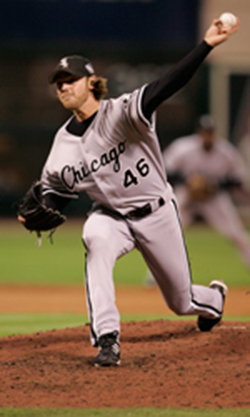
Lee Arthur Smith was the 2nd round selection of the Cubs in the 1975 draft.  He made his major league debut on September 1, 1980, becoming a fixture in the Cubs bullpen wearing #46.  He took over the closer role in 1982 and became a force, leading the league in saves in 1983 while earning his first All Star nod and post-season support for both the Cy Young award and MVP.  Following the 1987 season, he was traded to the Red Sox for Al Nipper and Calvin Schiraldi, ending his Cubs career with a 40-51 record and a 2.92 ERA with 180 saves and 342 games finished.  In 2019, he was elected to the Hall of Fame by the Veteran’s Committee.

On the South side of town, Neal Cotts donned #46 after being acquired by the White Sox, along with Billy Koch and Daylan Holt, from the A’s in exchange for Keith Foulke, Mark Johnson, and Joe Valentine in December of 2002.  He made his major league debut on August 12, 2003, lasting only 2 1/3 innings in a start against the Angels, and made 3 additional starts, finishing the year with an 8.10 ERA in only 13 1/3 innings pitched.  Cotts moved to the bullpen in 2004 and, in 2005, things finally clicked.  He appeared in 69 regular season games and posted a sparkling 1.94 ERA, before facing one batter in the ALDS and becoming the only White Sox reliever to appear in the ALCS, getting the final 2 outs in the Game 1 loss to the Angels.  As the White Sox moved on to their first World Series since 1959, Cotts appeared in all 4 games, winning Game 2 and giving up only 1 hit in an inning and a third.  Cotts reverted back to his previous form in 2006 and, following the season, he was traded across town to the Cubs for fellow relief pitcher David Aardsma.


By The Numbers – 52

In 1929, uniform numbers appeared on the back of baseball jerseys for the first time, thanks to the Indians and the Yankees.  By 1937, numbers finally appeared across all uniforms, both home and away, across both major leagues.  Since that time, 81 distinct numbers have been worn by members of the White Sox, while the Cubs boast 76.

Today, we continue our look at those players, picking our favorite, if not the best, player to wear each uniform number for both Chicago teams with #52.  40 players have donned #52 while playing in Chicago, 20 each for the White Sox and the Cubs.

Acquired at the trade deadline in 2004 from the Yankees, Jose Contreras joined the White Sox rotation for the remainder of the season, pitching inconsistently and finishing with a 5-4 record and a 5.30 ERA in 13 starts.  He got off to a slow start in 2005, entering the All Star break with a 4-3 record, but an improved arm angle allowed Contreras to catch fire in the second half, becoming one of the most dominating pitchers in the league.  He finished the year with a 15-7 record with a 3.61 ERA, as the White Sox won their first AL Central title in 5 years, and earned the nod in Game 1 of the ALDS, the ALCS, and the World Series.

He started 2006 9-0, breaking the team record for consecutive regular season victories previously held by LaMarr Hoyt and Wilson Alvarez.  After the All Star break, Contreras started to come back down to Earth, due in part to the extra workload from the previous post-season.  The rest of his White Sox career was as inconsistent as it began, until his 2009 trade to the Rockies.

On the north side of town, Jim Bullinger wore #52 with pride from 1992-1996.  Drafted as a shortstop in 1986, he was converted to a pitcher full time in 1990.  2 years later, he made his debut with the Cubs in a forgettable appearance against the Giants.  His best season was the strike-shortened 1994, when he went 6-2 with a 3.60 ERA as he split time between the rotation and the bullpen.  He left as a free agent following the 1996 season.

iTunes Top 200 Artists: #41-50

It’s been 4 years since we last counted down the Top 200 artists in my iTunes library.  Since my iTunes stats are still intact, across multiple PCs, iPods, iPads, and iPhones, I figured it was time to take another look at the artists that have entertained me the most based on number of plays from late 2007 through January 1, 2021.

We start the final quarter of the list today with the next batch of 10 artists, with ties at 50th, 48th, and 43rd.

#50: Queen
iTunes stats: 176 plays
Previous ranking: #35

A big 15 spot drop for the band from England, due mostly to their dropping off the White Sox victory playlist now more than 10 years removed from their 2005 World Series title.

#48: Boyz II Men
iTunes stats: 177 plays
Previous ranking: #49

The stars of my first concert added 80 new listens from their 9 tunes in my collection, inching them up one spot in the rankings.

#48: Klaus Badelt
iTunes stats: 177 plays
Previous ranking: #30

The composer dropped 18 spots in the rankings due to the White Sox no longer using his theme from Pirates of the Caribbean as part of their pre-game routine.

#47: Snoop Dogg
iTunes stats: 181 plays
Previous ranking: #45

The ganja-smoking gangsta rapper, a somewhat surprising 14-time Grammy nominee, added 71 additional listens, dropping him two spots in the rankings.

#46: John Morris
iTunes stats: 182 plays
Previous ranking: #88

The composer of the score from the best movie ever made, Clue: The Movie.

#45: Purdue “All-American” Marching Band
Continue reading →

By The Numbers – 56

In 1929, uniform numbers appeared on the back of baseball jerseys for the first time, thanks to the Indians and the Yankees.  By 1937, numbers finally appeared across all uniforms, both home and away, across both major leagues.  Since that time, 81 distinct numbers have been worn by members of the White Sox, while the Cubs boast 76.

Today, we continue our look at those players, picking our favorite, if not the best, player to wear each uniform number for both Chicago teams with #56.  19 different players have donned #56 while playing in Chicago, and, spoiler alert, it has been retired on one side of town.

Mark Buehrle joined the White Sox organization in 1998, drafted in the 38th round.  Despite his lowly draft status, he rose quickly through the system, first coming up during the 2000 season, working out of the bullpen for the eventual division champions.  He moved into the rotation the following season, and stayed there for the next 11 seasons.  During that time, there were numerous memorable appearances, many of which I was privileged to see in person.

  • The 2007 no-hitter against the Rangers
  • The 2009 perfect game against the Rays
  • Winning Game 2 of the 2005 ALCS against the Angels, thanks to AJ’s heads-up baserunning, and starting the streak of 4 straight complete games
  • The 1 hour 36 minute game against the Mariners in 2005
  • The no look, through his legs flip to Paul Konerko on Opening Day 2010 against the Indians
  • And, of course, his performance in the 2005 World Series, starting Game 2, getting a no decision, and coming in to pitch the 14th inning and earning the save in Game 3

In White Sox annals, Buehrle is currently fifth all-time in strikeouts, sixth in games started, and eighth in wins and innings pitched.  Number 56 was retired in his honor in 2017.

Slim pickings for #56 on the north side of town, but centerfielder Brian McRae, who spent parts of 3 seasons with the Cubs, gets the nod.  McRae was acquired from the Royals in April of 1995, following the early season lockout that continued from the strike the year before.  He was sent to the Mets, along with Mel Rojas and Turk Wendell, in August of 1997.

2021 Hall Of Fame Ballot – The Newcomers


baseballhof

The BBWAA recently released their ballot for the Hall of Fame class of 2021, with the results of the vote due to be revealed on January 26th.  Assuming the corona virus is under control by then, induction would take place July 25th.  With Derek Jeter and Larry Walker getting elected in last year’s voting, the new ballot contains 14 holdovers along with 11 newcomers, which may potentially continue the logjam caused by the current BBWAA rules which limit the number of votes on one ballot to 10 and the ongoing refusal by some writers to vote for players tainted by PEDs, leaving too many qualified candidates fighting for limited spots.

Yesterday, we looked at the returning candidates.  Today, it’s time to look at the newcomers and who may be thankful come January.

Mark Buehrle

While he is one of only three pitchers, along with Cy Young and Sandy Koufax, to have a no-hitter, a perfect game, and win a World Series title with the same organization, I don’t see any way he will make it.  Hopefully he will get enough votes to remain on the ballot for another year.

A.J. Burnett

I don’t see him getting much in the way of support.

Michael Cuddyer

I wonder what it feels like to be placed on the ballot knowing that you won’t earn even a single vote.

Dan Haren

I can see him getting a vote or two, but not enough to stick around.

LaTroy Hawkins

I mean, he had a nice career and all, but no.

Tim Hudson

My initial reaction was no, but he was the first one to make me look up his numbers.  His predictive numbers are actually very similar to Buehrle’s, so I’m going to have to say no here as well.  It’ll be interesting to see how their vote totals match up considering how close their predictive scores are.

Torii Hunter

Probably the most interesting case out of the newcomers.  I can see him sticking around for the entire 10 year run, but I don’t see him getting in.

Aramis Ramirez

While a local favorite, I don’t see him getting a lot of support.

Nick Swisher

F this dude and anyone who votes for him.

Shane Victorino

No.

Barry Zito

The start of his career looked promising, but those later Giant years were brutal.