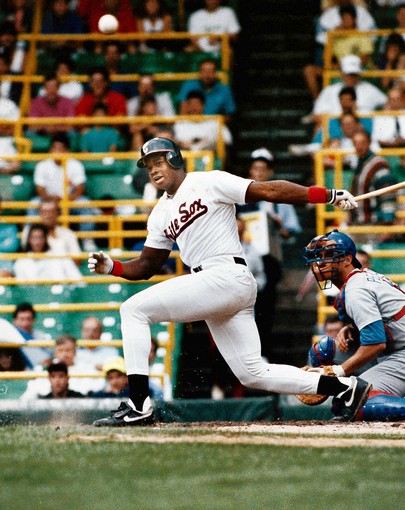
#5 – Frank Thomas

Name: Frank Thomas

Rank: 5

Position: 1B/DH

Years With White Sox: 1990-2005

Frank Thomas was selected by the White Sox with the seventh pick in the first round of the 1989 draft.  A little more than 1 year later, he made his major league debut on August 2, 1990 against the Brewers at County Stadium, going hitless in 4 at bats with an RBI as the White Sox won 4-3.  The next night, he tripled off of Mark Knudson for his first major league hit.  On August 28, he hit the first home run of his career, off Gary Wayne, in a 12-6 loss against the Twins at the Metrodome.  He finished the year with a .330 average, with 7 home runs and 31 RBIs.

In 1991, as the White Sox moved into the new Comiskey Park, Thomas became one of the most feared hitters in the American League.  On April 22, he hit the first White Sox home run in the new stadium, in an 8-7 victory over the Orioles.  When the season ended, Thomas finished with a .318 average, 32 home runs, and 109 RBIs.  He lead the league in walks, OBP, OPS, and OPS+.  He won his first Silver Slugger award and finished 3rd in MVP voting.

Thomas continued his mastery in 1992.  He ended the year hitting .323, with 24 home runs and 115 RBIs. He led the league in doubles, walks, OBP, and OPS.  Those numbers were good enough for him to place 8th in MVP voting.

In 1993, Thomas helped the White Sox win their first division title since 1983.  He made his first All Star game appearance, getting a hit in his only at bat.  On August 31, he clubbed his 100th career home run against the Yankees at Yankee Stadium.  He finished the year batting .317 and set a club-record with 41 homers.  He added 128 RBI, 106 runs scored, and 112 walks, to join Babe Ruth, Lou Gehrig, Jimmie Foxx and Ted Williams as the only players in baseball history to eclipse .300 with more than 20 homers and more than 100 RBI, runs, and walks in three straight seasons.  In the ALCS against the Blue Jays, Thomas hit .353 in the 6 game series.  Thanks to his historic season, Thomas collected his second Silver Slugger award and all 28 first place votes for a unanimous AL MVP award, the first by a White Sox player since Dick Allen in 1972.

1994 was on track to be even better, before the strike ended the season in August.  Thomas was elected to start the All Star game and got 2 hits in his 2 at bats.  In only 113 games, Thomas had 38 home runs, 101 RBIs, 106 runs scored, and 109 walks.  He led the league in runs scored, walks, OBP, slugging percentage, OPS, and OPS+.  For the second year in a row, he took home the Silver Slugger and MVP awards, becoming just the second first baseman to earn consecutive MVP awards.

When baseball returned in 1995, Thomas picked up where he had left off.  He started his second straight All Star Game for the American League, hitting a home run off John Smiley.  At the end of the season, Thomas had hit .308 with 40 home runs and 111 RBIs while leading the league in games played, walks, sacrifice flies, and intentional walks.  He dropped to 8th place in MVP voting as the White Sox found themselves out of contention for the first time in his career.

The White Sox bounced back in 1996 and Thomas continued to be an offensive force.  He mashed his 200th career home run on June 9, going deep at Camden Yards against the Orioles.  He was named to his fourth straight All Star team, though he didn’t make it into the game.  He set a career high with a .349 average, while again hitting 40 home runs with 134 RBIs.  For the second straight year, he led the league in intentional walks and finished 8th in MVP voting.

1997 was another strong year for Thomas.  He was named to his fifth, and final, All Star team.  He led the league with a .347 average, a .456 OBP, a 1.067 OPS, and an OPS+ of 181, while hitting 35 home runs and knocking in 125.  He finished 3rd in MVP voting, his 7th top 10 finish in his 7 full seasons.

Off the field issues started to show an effect on Thomas’ production in 1998, his first as a full time designated hitter.  Marital problems messed with his head, leading him to think the umpires were screwing him, opposing pitchers were taking advantage of him, and the media were ganging up on him. “I was miserable, and I made everyone around me miserable,” Thomas said early in the 1999 season. “It was an extremely humbling season.”  He hit .265, 65 points lower than his career average entering the season, and finished with only 29 home runs, his lowest total in six years.  He started referring to himself as Five O’clock Frank, a batting-practice terror who at game time sank under the weight of self-pity and tired excuses.

Thomas, and the White Sox, hoped that he would bounce back in 1999.  “I think he had a lot on his mind, personal things that were weighing on him,” hitting coach Von Joshua said early in the season. “He didn’t talk about it, but you could just see it in his eyes. He’s a lot more settled this year.”  Unfortunately, things didn’t go well, though he did hit his 300th career home run on August 7 against the A’s.  While his average did rebound, back up to .305, he hit only 15 home runs and drove in just 77 while setting a career low with a .471 slugging percentage.  Bone spurs on his ankle limited him to just 135 games.

2000 got off to an explosive start, and not the good kind.  Thomas and manager Jerry Manuel went toe to toe in spring training over Thomas’ ability to participate in drills, following his surgery the previous September.  Once the regular season began, though, it looked like the old Thomas was back.  As the surprising White Sox ran off and won their first division title since 1993, Thomas, missing only 3 games all year, hit .328 and set career highs with 43 home runs and 143 RBIs.  Unfortunately, Thomas, like the rest of his teammates, struggled in the post-season, going hitless in the ALDS as the Mariners completed a 3 game sweep.  He won his fourth, and final, Silver Slugger award and finished 2nd in MVP voting, behind a juiced Jason Giambi.

2001 was a tough year for Thomas, both personally and professionally.  On April 27, he hurt his triceps diving for a ball while playing first base.  After spending 5 days back in Georgia due to the death of his father, Thomas returned to Chicago for tests, which revealed a muscle tear that would require surgery and end his season.  “This is the worst week of my life”, he said during a press conference. “First I lose my father, then come back and find out I’m lost for the season.”  In only 20 games, Thomas hit .221 with 4 home runs and 10 RBIs.

Thomas returned in 2002, but was obviously no longer the same player he was before the injury.  He struggled in the first half, before picking things up in the final month of the season, hitting .359 with 6 home runs in September.  He finished the season with a .252 average, 25 home runs and 92 RBIs.

2003 was a better year for Thomas, though still below his career norms.  On June 26th, he became the 36th player in history to reach the 400 career home run mark with a 5th inning shot against the Devil Rays at US Cellular Field.  At the end of the year, he had posted a .267 average with 42 home runs and 105 RBIs.

Injuries robbed Thomas of most of 2004.  He was placed on the disabled list on July 7th, with a .271 average, 18 home runs and 49 RBIs.  He underwent surgery in early October to remove debris from the ankle, perform a bone graft, and insert two screws.

Thomas began the 2005 season on the disabled list as he recovered from his ankle surgery.  He was activated on May 30, with the White Sox in first place in the AL Central.  On July 18, he clubbed his 448th and final home run with the White Sox against the Tigers at US Cellular Field.  He hit .219 with 12 home runs and 26 RBIs in 34 games before breaking his foot on July 21, causing him to miss the rest of the season and the post-season.  Thomas threw out the first pitch prior to game one of the ALDS against the Red Sox.

Thomas is the White Sox all time leader in home runs, runs scored, doubles, RBIs, walks, on-base percentage, slugging percentage, and OPS.  He is the only player in major league history to have seven consecutive seasons (1991-1997) with a .300 average and at least 100 walks, 100 runs, 100 runs batted in, and 20 home runs.  His number 35 was retired by the White Sox on August 29, 2010 and he was part of the 2014 Hall of Fame class, elected on the first ballot with 83.7% of the vote.

Thomas’s numbers in a White Sox uniform, both for games I attended and overall, were: Continue reading →

The Waiting Game

Spring training camps are opening up all across Arizona and Florida and the two biggest free agents are still unsigned.  Bryce Harper and Manny Machado, both aged 26, were looking to snare 10 year deals worth in excess of $300 million, but are on the outside looking in as their peers get back to work.  With 2 straight winters of a free agent freeze out, many people are questioning what is going on.  Especially when 2 superstars, each about to enter their prime, are unable to find the deals that they are looking for.

There are many reasons for the lack of movement.  First, many of the teams that you would expect to be outbidding each other are treating the luxury tax thresholds as though it were a salary cap.  This has left the Yankees, Red Sox, Cubs, and Dodgers on the sidelines.  Secondly, the number of teams that aren’t planning on being competitive further limits the list of available suitors.

Of course the remaining reason, depending on your point of view, may be the most troubling.  Either teams are colluding to keep the price of free agents down, as they did in the 80s before to a cost of $280 million in a 1990 settlement, or analytics has gotten to the point where each team values players the same, leaving little variation in offers.  Either way, the last 2 off-seasons are likely to lead to labor unrest, which the sport has largely been able to avoid since the 1994 strike.  And the longer Machado and Harper are out of camp, the worse it will be.

#10 – Ozzie Guillen

Name: Ozzie Guillen

Rank: 10

Position: SS

Years With White Sox: 1985-1997

Acquired by the White Sox, along with Tim Lollar, Bill Long, and Luis Salazar, on December 6, 1984 from the Padres for Kevin Kristan, Todd Simmons, and LaMarr Hoyt, Ozzie Guillen made his major league debut on Opening Day 1985, leading off against the Brewers and going 1-5 in the 4-2 victory at County Stadium.  Settling in as the everyday shortstop, Guillen finished the year with a .273 average, 21 doubles, and 9 triples.  Those totals were good enough to score Guillen the 1985 AL Rookie of the Year trophy.

Guillen saw a slight drop off in his sophomore season.  His average dropped to .250 and he managed 19 doubles and 4 triples.  Defensively, he led the American League in Defensive WAR.

1987 was a nice bounce back for Guillen.  He raised his average back up to .279 with a .656 OPS.  For the second straight year, he led the AL, and all of baseball, in Defensive WAR.

Guillen earned his first All Star nod in 1988, though he didn’t get in to the game.  By the end of the season, he once again led all of baseball in Defensive WAR, while seeing his average drop to .261 with 7 triples, the fifth highest total in the AL.

1989 was a tough year for Guillen.  He posted his worst offensive numbers since 1986 and, on the base paths, he fell victim to the hidden ball trick.  Twice. On June 23, against the Brewers, first baseman Greg Brock held the ball after a pickoff attempt and when Guillen took his hand off the base to stand up, Brock tagged him out.  Less than 2 months later, on August 5 against the Tigers, Dave Bergman made the same play.  He finished the year with .253 average and, despite his adventures on pick off attempts, a career high 36 stolen bases.

As the surprising White Sox challenged for the AL West title while saying goodbye to Comiskey Park, Guillen put in one of the finest seasons of his career.  He was named to his second All Star team, going 0-2, finished in 17th place in MVP voting, and earned his first, and only, Gold Glove.  He raised his average back up to .279 and knocked in a career high 58 RBIs.

Expectations were high for the White Sox as they moved across the street to the new Comiskey Park in 1991.  Guillen earned his third, and final, All Star nod, getting a sacrifice in his only plate appearance.  He ended the year with a .273 average and set a career high with 3 home runs.

Guillen’s 1992 season came to an early end when, on April 21 during a loss against the Yankees, a collision with outfielder Tim Raines ended in a severe knee injury.  Appearing in only 20 games, he hit a career low .200 in only 40 at bats.

Guillen recovered in 1993, though he appeared in only 134 games, his lowest total to date.  However, it was his most productive season offensively, posting a .280 batting average, and career highs with 4 home runs and a .666 OPS, as the White Sox won their first division title in a decade.  He hit .273 and scored 4 runs in a losing effort, as the White Sox were defeated in 6 games by the Blue Jays in the ALCS.

1994 looked to be the year that the White Sox finally broke through.  Guillen was up to the challenge, hitting a career high .288 with a .659 OPS.  Unfortunately, the year ended early when players went on strike on August 12 with the White Sox in first place in the newly created AL Central.

The 1995 season got off to a late start and had an abbreviated schedule due to the long work stoppage.  The success of the White Sox, and for Guillen himself, didn’t survive the long layoff.  Guillen saw his average drop to .248, his lowest over a “full” season in his career to this point.  His OPS dropped to its lowest total, excepting 1992, since 1989.

1996 saw a slight improvement for Guillen.  He appeared in 150 games, his highest total since his knee injury in 1992.  He raised his average back to .263 and tied his career high with 4 home runs.

1997 was easily the worst season of Guillen’s White Sox career.  He had the lowest average of his career, coming in at .245, though he did once again tie his career high with 4 home runs.  Following the season, Guillen became a free agent and his playing career with the White Sox came to an end.

Guillen returned to the White Sox organization for the 2004 season as manager.  In 2005, he led the team to their first American League pennant since 1959 and their first World Series title in 88 years.  Ongoing personal difficulties with General Manager Kenny Williams led to his leaving with 2 games left in the 2011 season as the third winningest manager in franchise history.

Guillen’s numbers in a White Sox uniform, both for games I attended and overall, were:

Continue reading →

#11 – Bo Jackson

Name: Bo Jackson

Rank: 11

Position: RF/DH

Years With White Sox: 1991, 1993

Vincent Edward “Bo” Jackson joined the White Sox as a free agent on April 3, 1991 after being released by the Royals following a hip injury suffered in January during the NFL playoffs as a member of the Raiders.  “In making the business decision,” owner Jerry Reinsdorf said at the time, “I assume he will not play this year. If he does, it will be a big bonus.”  Jackson did spend most of 1991 on the disabled list, rehabbing the injury, but did eventually manage to make his way back to the field.  He appeared in 23 games, hitting only .225 with 3 home runs.

Diagnosed with avascular necrosis of the hip joint and having lost all of the cartilage supporting his hip, Jackson decided to undergo a hip replacement surgery, keeping him on the shelf for the entire 1992 season.  While rehabbing, Jackson promised his mother he would return to the major leagues and hit a home run for her.

Unfortunately, Jackson’s mother died before he could return, but, in his first at bat of the 1994 season, and his first with an artificial hip, he hit a home run to right field against the Yankees at Comiskey Park.  On September 27, Jackson belted a three-run home run off of the Mariners to help the White Sox clinch their first AL West Division title in a decade.  Jackson ended up appearing in 85 games for the White Sox, hitting .232 and hitting 16 home runs while driving in 45.  He appeared in 3 of the 6 ALCS games against the Blue Jays, going hitless in 10 at bats.

Following the season, he became a free agent, ending his White Sox playing career.  In 2014, he returned to the organization as an ambassador, a role he continues to play today.

Jackson’s numbers in a White Sox uniform, both for games I attended and overall, were:

Continue reading →

#12 – Jack McDowell

Name: Jack McDowell

Rank: 12

Position: P

Years With White Sox: 1987-1988, 1990-1994

Jack McDowell was selected as the fifth overall pick in the 1987 draft by the White Sox.  After 6 appearances split between Rookie ball and AA, he made his major league debut September 15, throwing 7 shutout innings and earning the win against the Twins at Comiskey Park.  He made 3 more starts to finish out the season, ending with a 3-0 record, a 1.93 ERA, and a seemingly bright future on the South Side.

In 1988, the success McDowell saw in his first stint in the big leagues was hard to find.  In 158.2 innings pitched, he struck out only 84 batters while walking 68.  While his ERA was a respectable 3.97, he finished with a 5-10 record.

Injuries, and a 6.13 ERA in 16 starts for AAA Vancouver, kept McDowell out of the big leagues in 1989.  He returned to the majors for good in 1990 and helped lead a surprising White Sox team to a 94-68 record and a season long battle with the A’s for the AL West crown.  McDowell finished with a 14-9 record and a 3.82 ERA and nearly doubled his strikeout total from 1988 in only about 50 more innings.

Expectations were high as the White Sox moved into their new stadium in 1991.  McDowell earned his first All Star game selection on his way to a 17-10 record and a 3.41 ERA.  Those numbers were good enough for a 9th place finish in Cy Young Award voting.

1992 was even better for McDowell.  He earned his second straight All Star Game nod, pitching a scoreless second inning and retiring Fred McGriff, Terry Pendleton, and Andy Van Slyke in order.  When all was said and done, he ended up with a 20-10 record and a 3.18 ERA, good enough for a 2nd place finish in Cy Young Award voting, behind Dennis Eckersley, and 19th place in MVP voting.

Everything came together for the White Sox and McDowell in 1993.  As the team ran off to their first division title in a decade, McDowell led the league with 22 victories and 4 shutouts, ending at 22-10 with a 3.37 ERA.  He nabbed his 3rd straight All Star selection, earning the victory while throwing a scoreless 5th inning, and finally claimed his first Cy Young Award.  He also finished 9th in MVP voting, behind teammate Frank Thomas.  McDowell made 2 starts during the ALCS against the Blue Jays, losing both and giving up 10 runs total in 9 innings pitched.

The 1994 season again had high expectations for the White Sox and McDowell.  Unfortunately, those expectations would be squashed, not on the field, where the White Sox held first place in the newly formed AL Central division, but in the boardrooms, where the end of the 1994 season and the post season were cancelled due to a work stoppage.  In just 25 starts, his fewest since 1987, McDowell went 10-9 with a 3.73 ERA.

In December, with the 1995 season in doubt, McDowell was traded to the Yankees, for Keith Heberling and a player to be named later who turned out to be Lyle Mouton.

McDowell’s numbers in a White Sox uniform, both for games I attended and overall, were:

Continue reading →

2018 Predictions Revisited

Six months ago, at the dawn of the 2018 baseball season, I made my annual predictions as to who would win what.  Now that the regular season has come to an end, it is time revisit those predictions and see what, if anything, I got right.

American League

East: Yankees

The Red Sox set a franchise record in wins and have pretty much held a commanding lead for the entire season, so I was a little off here.

Central: Indians

Getting this right shouldn’t really count, as the Indians are the only team in the Central to finish with a winning record.

West: Astros

The Astros have surpassed 100 wins and are ready to defend their title.

Wild Cards: Red Sox, Angels

Well, if you swap out the Red Sox and the Yankees, this doesn’t look too bad.  The Angels, however, did not pan out and instead the A’s took the second Wild Card slot.

AL Champion: Yankees

Well, they are still alive, so I guess it can still be a good pick.

Cy Young: Chris Sale

This seemed like a good pick through much of the season, but a late year injury may hold him back.

MVP: Giancarlo Stanton

Not going to happen.  Either Mookie Betts or Mike Trout will take home this award.

National League

Continue reading →

All Time Team Records

The 2018 baseball season gets underway today, with an early start brought about due to the last collective bargaining agreement, which added additional off days for each team throughout the year.  To celebrate, it is time once again to look at the all-time team records for games that I have identified as having attended dating back to 1984. The Cubs look to avenge last year’s NLCS loss and make it back to the World Series, while the rebuilding White Sox hope to finally start seeing their young talent blossom.  The 2018 season should be an exciting one on both sides of town.

All-Time Team Records
Team Name Won Loss Winning Pctg
California Angels 1 0 1.000
Arizona Diamondbacks 13 2 0.867
Florida Marlins 15 8 0.652
Philadelphia Phillies 10 6 0.625
Toronto Blue Jays 13 9 0.591
New York Yankees 14 10 0.583
Colorado Rockies 8 6 0.571
Los Angeles Angels 16 13 0.552
Boston Red Sox 16 13 0.552
Kansas City Royals 27 24 0.529
Chicago White Sox 284 256 0.526
Chicago Cubs 209 189 0.525
Continue reading →

2018 Predictions

The 2018 baseball season is scheduled to kick off tomorrow, the earliest date in history (not counting special series outside of North America) with a full slate of games featuring all 30 teams.  For the eighth consecutive year, I’ve looked into the crystal ball to make my picks for the upcoming season.

American League

East: Yankees

Central: Indians

West: Astros

Wild Cards: Red Sox, Angels

AL Champion: Yankees

Cy Young: Chris Sale

MVP: Giancarlo Stanton

National League

Continue reading →

2018 Hall Of Fame Ballot – The Newcomers

baseballhof

The BBWAA released their ballot for the Hall of Fame class of 2018 on Monday.  The results of the vote are due to be revealed on January 24th, with induction taking place next July.  After Jeff Bagwell, Tim Raines, and Ivan Rodriguez were elected in last year’s voting, the new ballot contains 14 holdovers along with 19 newcomers, which may continue the logjam caused by the current BBWAA rules which limit the number of votes on one ballot to 10 and the ongoing refusal by some writers to vote for players tainted by PEDs, leaving too many qualified candidates fighting for limited spots.  Once again, the BBWAA and the Hall may find themselves with a mess on their hands.  And that doesn’t even take in to account Joe Morgan’s letter.

Yesterday, we looked at the returning candidates.  Today, it’s time to look at the newcomers and who may be thankful come January.

Chris Carpenter

He put together some monster seasons, but lost nearly 4 1/2 seasons due to injury, leaving his numbers well short of enshrinement.

Johnny Damon

Probably would not get anywhere near enough support, but he spent many years in a Red Sox or Yankees uniform, so who knows.

Livan Hernandez

The Cuban ex-pat may get a vote or two, but it should be one and done for him.

Orlando Hudson

I can’t imagine a world where Orlando Hudson, who finished out his career with the White Sox in 2012, earns a Hall of Fame vote.

Aubrey Huff

Not that he was going to garner any support anyway, but his recent social media posts, falling for the worst of the right wing conspiracies, certainly aren’t helping.

Jason Isringhausen

This has been a weak batch of newly eligible players. no?

Andruw Jones

Now here is an interesting conundrum.  If we stick to his first 11 seasons, it seemed like he was destined for the Hall.  His last 7 seasons, though, were so bad that it makes it hard to consider him.  This would be a tough choice.

Chipper Jones

Ah, there we go.  A sure-fire, first ballot selection for the long time Brave.

Carlos Lee

The former White Sox outfielder may get a little support, but not enough to keep him on the ballot for a second go-around.

Brad Lidge

Lidge was on the mound when the Phillies won the World Series in 2008, but that won’t erase the memories of the huge home runs he gave up in the 2005 post-season, to Albert Pujols and Scott Podsednik.

Hideki Matsui
Continue reading →

2017 Final Standings

For the third consecutive year, the NL pennant was captured at Wrigley Field.  Unfortunately, this year it was the Dodgers that will be moving on, winning the NLCS 4 games to 1 against the Cubs and bringing the game-attending portion of the 2017 season came to an end.  I made it to 49 games this season, my largest total since 2010.  I did manage to add one new stadium this year, along with trips to 3 others that I had been to before.  Here are the final standings for those games and the 20 different teams I saw in person, through both the regular season and the playoffs.

2017 Team Records
Team Name Won Loss Winning Pctg
Milwaukee Brewers 2 0 1.000
Seattle Mariners 2 0 1.000
Oakland Athletics 2 0 1.000
Colorado Rockies 1 0 1.000
Pittsburgh Pirates 1 0 1.000
Boston Red Sox 2 1 0.667
New York Yankees 2 1 0.667
Kansas City Royals 3 2 0.600
Los Angeles Dodgers 3 2 0.600
Continue reading →