| TeamCity | TeamName | Won | Loss | Winning Pctg |
|---|---|---|---|---|
| Los Angeles | Angels | 1 | 0 | 1.000 |
| Texas | Rangers | 1 | 0 | 1.000 |
| Pittsburgh | Pirates | 1 | 0 | 1.000 |
| Houston | Astros | 2 | 0 | 1.000 |
| Florida | Marlins | 2 | 1 | 0.667 |
| Chicago | White Sox | 9 | 7 | 0.563 |
| Cleveland | Indians | 2 | 2 | 0.500 |
| Los Angeles | Dodgers | 1 | 1 | 0.500 |
| Washington | Nationals | 1 | 1 | 0.500 |
| Minnesota | Twins | 1 | 1 | 0.500 |
| Toronto | Blue Jays | 1 | 1 | 0.500 |
| Chicago | Cubs | 5 | 6 | 0.455 |
| Milwaukee | Brewers | 0 | 1 | 0.000 |
| Arizona | Diamondbacks | 0 | 1 | 0.000 |
| Oakland | Athletics | 0 | 1 | 0.000 |
| Seattle | Mariners | 0 | 2 | 0.000 |
| Atlanta | Braves | 0 | 1 | 0.000 |
| Kansas City | Royals | 0 | 1 | 0.000 |
Tag / White Sox
Priceless

Book 4 (of 52) – Game Of My Life

Game of My Life: Chicago White Sox - Lew Freedman
Game of My Life: Chicago White Sox takes stories from 30 current and former Sox players, coaches, front office executives, and organists and asks them to describe the game of their life. The only problem I had with the book was the order. By going (mostly) in chronological order, many of the recollections came from the same game, especially those from either the 1959 pennant winners of th 2005 champions, and they started to get repetitive. Had they been split up, it would have been more entertaining when going back to the well.
The Big Hurt Says Goodbye

Frank Thomas
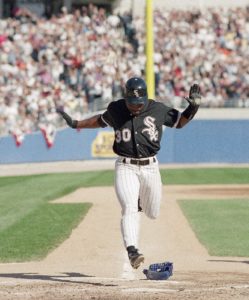
Frank Thomas, the best hitter in White Sox history, called it a careeryesterday, after 18 big league seasons. Thomas was third of former GM Larry Himes four #1 draft picks that all helped lead the White Sox renaissance of the early 90s, culminating with the 1993 AL West title and the lead in newly created AL Central when the strike wiped out the 1994 season. Thomas, of course, brought home the AL MVP trophy both seasons.
The Big Hurt, as he came to be known for the hurt he put on the ball when he hit it, would start to break down in later seasons, and, unfortunately, was mostly a spectator in the magical 2005 season, playing in only 34 mid-season games and missing the entire post-season. Following the excitement of winning the World Series for the first time in 88 years, the White Sox sent their best all-time player packing.
Over the years, I managed to see Thomas play only 66 times, and he was not at his best when I was in the ballpark. A career .301 hitter, he managed only a .256 mark in those 66 games, with 15 of his 521 career home runs. Two of those home runs came in his first game in Chicago as a visitor, after a standing ovation before his first trip to the plate got national attention and produced my first (and, to this point, last) appearance on SportsCenter.
Thomas will make one more official trip to US Cellular Field on August 29th, when the White Sox retire his number 35, just over 20 years after his debut, and I’ll be there cheering him on for the penultimate time. The last time will be in 2014, when he’s elected to the Hall of Fame.
2010 Hall of Fame Inductees
The BBWAA will announce the results of their Hall of Fame voting for 2010 tomorrow afternoon. Yesterday, we looked at the 26 candidates and dismissed over half of them. Today, we’ll take a look at the remaining 8 who have a better chance and the 4 who should be elected.

Try Again Next Year: A case can be made, but will need to be made again next year.
-
Fred McGriff – Probably has the numbers to make it, but will suffer due to never being thought of as a potential Hall of Famer while he was playing. He and Alan Trammell were probably hurt the most by the late-90’s offensive (and steroid) explosion.
-
Bert Blyleven – In his first year of eligibility, he got 26 fewer votes than Tommy John, and nobody is looking to put Tommy John in the Hall of Fame.
-
Harold Baines – He barely got enough votes last year to stay on the ballot, which is a shame. He’s hurt by being a DH for the majority of his career after knee injuries, and played the majority of his career in the shadows of Chicago’s south side and Baltimore. If Jim Rice makes it in, so should Harold. But he won’t.
-
Lee Smith – He was the all-time saves leader when he retired, but benefited from the transition of the closer role from fireman to guy who gets the last three outs and racks up saves. He’s already been passed twice on the career saves list.
-
Jack Morris – One of the best, if not the best, Game 7 World Series performance of all time, but, overall, an very good pitcher who wasn’t quite good enough to make the Hall of Fame.
-
Don Mattingly – No offense to Donnie Baseball, but being the best Yankee in a decade of bad Yankee teams does not a Hall of Famer make. If it weren’t for injuries, he may have had a legitimate shot.
-
Edgar Martinez – Will probably make it some day, but will need to overcome the DH stigma. Many are excusing that he didn’t hit the big numbers due to not making the majors full-time until age 27, but I don’t see why he gets a pass for that.
-
Barry Larkin – Again, will probably make it but not on the first shot. Might be slightly overlooked after spending his entire career in Cincinnati.
The 2010 Hall of Fame Class (according to me)

Seeing as Jim Rice made it last year, Andre Dawson should have no problems punching his ticket this year. While Rice may have been the “most feared” hitter in the AL during the 1970s, an argument could be made that Dawson filled a similar role in the NL. In addition to the power numbers, Dawson was also able to play defense and wasn’t a hindrance on the base paths. He was the 1977 NL Rookie of the Year and the 1987 NL Most Valuable Player.
Some of the things that will hold back his election is the low career OBP and his spending his formative years in the spotlight graveyard known as Montreal, but after getting 67% of the vote last year, he’s due for a bump this year.
 Last year, Raines garnered only 22.6% of the vote, which is mind-blowing. He is quite possibly the best leadoff hitter in the history of the game not named Rickey Henderson, with a similar, if not as potent, blend of speed and power.
The only downsides are, again, his best years were spent in Montreal and his involvement in the Pittsburgh Drug Trials. There’s really no reason why Raines shouldn’t be in Cooperstown.
So, what to say about McGwire. His numbers speak for themselves, but he’s been locked out of Cooperstown so far due to a backlash against the “steroid era” stemming from his testimony, or lack thereof, in front of Congress.
I think this is the year that things start to turn around for McGwire. For one, he is returning to the game as the hitting coach for the Cardinals. Secondly, while McGwire was the first of the suspected users to come up for election, he won’t be the last and they are coming soon. I seriously don’t see how the BBWAA can justify keeping Barry Bonds and Roger Clemens out of the HOF, given the numbers they put up before they “allegedly” started using PEDs. And once you let one in, you’ll have to let the rest in.
So, while it may not be this year, but McGwire will end up in Cooperstown someday.
 Like McGwire, Alomar, numbers wise, is a sure bet for the Hall of Fame, but there is that one incident that casts doubt upon his candidacy. Unlike McGwire, Alomar apologized, took responsibility for what he had done, and has continued to make amends through charity work.
On the field, there was no doubt that Alomar belongs in the Hall of Fame. Certainly one of the best second baseman of all time, he combined offense and defense at a position where few had done so before.
So there you have it. The Class of 2010 (according to me) for the Baseball Hall of Fame.