A Changing Landscape

The national and streaming television landscape for Major League Baseball will be changing for 2026 as the league prepares to overhaul its approach starting in 2029.  This past February, ESPN opted out of the final three years of its deal with the league that would have paid MLB $550 million per year.  Those rights will be split up three ways for the next three seasons, with chunks going to ESPN, Netflix, and NBC/Peacock.  Between the three, MLB is expected to get $750 million per year in total over the next three seasons.

ESPN will receive a national 30-game package throughout the season available exclusively on ESPN’s television networks and streaming app.  They will also continue to carry the Little League Classic and will stream over 150 out-of-market games, one per day, via the ESPN app.  In addition, they will take over control of the out-of-market streaming capabilities available today through MLB.tv.  Details on how that will work were not made available at this time.

Netflix will get exclusive rights to the standalone Opening Day game in prime time, the Home Run Derby and the Field of Dreams game.  No word yet on if they will produce these events in house and, if so, who the broadcasters may be.

NBC and its streaming app Peacock will become the new home of Sunday Night Baseball and the Wild Card round of the postseason.  The network will also take over the Sunday Leadoff game, a package that premiered on Peacock but has aired on Roku for the past two seasons.

The rest of the national agreements, with FOX, TBS, and Apple TV, will continue as is through 2028.  At that point, all of MLB’s television rights will be coming up together at the same time.  Commissioner Rob Manfred would like the league to control the local rights for all teams by that point, hoping a singular package will generate the most revenue.  Teams that have ownership stakes in their own local RSNs, like the Dodgers, Yankees, Mets, and Cubs, may not be aligned with this approach.

Changes Are A’comin’

Yesterday, MLB announced a slew of rule changes to be implemented for the upcoming 2019 season and the 2020 season.  For 2019, the changes include shortening the breaks between innings, reducing mound visits, modifying the trade deadline, and updates around the All Star Game.  2020 changes include changes to the active roster, the minimum number of batters a pitcher must face, and increasing the time pitchers must spend either on the injured list or in the minor leagues when optioned.

The breaks between innings will be reduced from 2:05 to 2:00 for local games, and from 2:25 to 2:00 for national games.  This should remove between one and a half minutes to 7 and a half minutes of dead time from every game, shortening game times across the league.  Of course, the fine print says that these changes are “subject to discussions with broadcast partners”, which means, nationally, FOX, ESPN, and TBS need to be aligned with losing over 7 minutes of their commercial inventory.  Which, frankly, seems unlikely.

The number of mound visits is being reduced from 6, which was first introduced last season, to 5.  Since the limit of 6 affected exactly zero teams in 2018, this doesn’t seem to be much of a change and shouldn’t have much, if any, impact.

The trade deadline is staying put on July 31st, but trade waivers, the archaic system by which trades enacted after the trade deadline, will be eliminated.  Players may continue to be placed and claimed on outright waivers after July 31st, but players may not be traded after that date.  This means buyers and sellers will need to make a final call on their season a month earlier than they do now.  There is also some thought that this will help with the service time manipulation of young phenoms, as injured and ineffective players will no longer be able to be replaced from the outside over the final two months of the season.

Voting for the All Star Game is being changed, with fan voting conducted in two rounds.  Each team will nominate one player per position (three outfielders), who will be voted on by fans during the first, “Primary Round”.  In late June or early July, the top three vote-getters at each position during the Primary Round will be voted on by fans to determine the All Star Game starters, in what is currently being called “Election Day”.  Final details on the new fan voting format will be announced sometime in April.  Bonus payments will be given to the top three vote-getters at each position per league during the Primary Round (top six for outfielders).  Additionally, the prize money awarded to players on the winning All Star team will be increased.  None of this really should have any effect on the game itself, unless the new bonuses and increased prize money is substantial enough to make the players take winning the exhibition more seriously.

The big change is that, in the case of extra innings at the All Star Game, both teams will start the 10th inning, and each subsequent inning, with a runner on second base, with re-entry substitutions allowed for the runners.  This follows changes made in hockey and college football, where, when a game “ends” in a tie, you change the rules of the game to determine a winner.  I’m not a fan of this type of change, as it fundamentally changes how the game is played.  If it stays in the realm of exhibition games, where the goal is more to finish the game without anyone getting hurt, I can live with that.  I would hate to ever see this implemented during regular season, or post-season, play.

The final change for 2019 is an increase in prize money for the Home Run Derby, up to $2.5 million with the winner receiving $1 million.  Maybe this reduces the number of players turning down the derby?  As someone who doesn’t care about the derby, this does nothing to move my needle.

The changes due to take effect for the 2020 season include the following: Continue reading →

Post Mortem – Cougar Town

cougar-town-cast-tbsAfter 6 seasons, split evenly between ABC and TBS, the poorly-named Cougar Town drew to a close this spring.  Originally featuring Courteney Cox as a divorced cougar (hence the name) trying to navigate the dating world, the show quickly pivoted to focus on Cox and her family and friends, far surpassing any juice in the original premise.

After 6 years, the show was starting to show its age.  Brian Van Holt had left the show as a regular during the last season, and the rest of the cast also seemed ready to move on.  At the end of the day, Cougar Town was the most successful post-Friends attempt by any of the Friends and certainly brought an audience to TBS, along with Conan, that might not have gone there otherwise.

Book 1 (of 52) – Behind The Bell

Behind The Bell - Dustin Diamond

Behind The Bell – Dustin Diamond

When I was in college, there was a daily 2 hour block of Saved By The Bell, courtesy of superstations WGN and TBS.  When I first heard of this behind-the-scenes tell-all from the former Screech, I was of course interested.  Just not interested enough to shell out retail prices for the hard cover version of his autobiography.  For 99 cents, though, I was willing to wade into the supposed sordid details in my first foray into Ebooks.

Dustin Diamond is sure of one thing: he was a normal kid growing up in an abnormal world.  Nearly everyone else, including cast mates, other child actors, network executives, were colossal douchebags out to harsh his good time.  Mark-Paul Gosselaar was the golden child who horded his status over everyone and could do no wrong.  Mario Lopez was a man whore.  Tiffani Amber Thiessen was a slut who was passed back and forth between Zack and Slater.  Elizabeth Berkley got TAT’s sloppy seconds.  Lark Voorhies got even sloppier thirds.  Dustin Diamond, meanwhile, was the well meaning kid who just wanted to make friends but ended up the outcast for not buying into Mark-Paul’s golden status.  Somehow, it all reads a little false.

What can easily be explained by age difference (Diamond was 3 years younger than the rest of the cast), Dustin ascribes to malice.  He takes little-to-no responsibility for his own actions and is more than willing to blame others for every real or imagined slight.  He tells tales of his extensive womanizing, using extras and Disneyland as his personal whorehouses.  There is strangely no mention of the sex tape he released.

At the end of the day, I’m sure some of Diamond’s tales, both personal and about his SBTB cast mates, are true.  One would have to be incredibly naive to think a crew of teenagers would not be involved in some sexual hijinks.  But Diamond goes beyond just telling the tales, instead painting everyone except himself in the worst possible light.  It’s little surprise that Diamond has had little success after Saved By The Bell.  I suppose that is someone else’s fault as well.

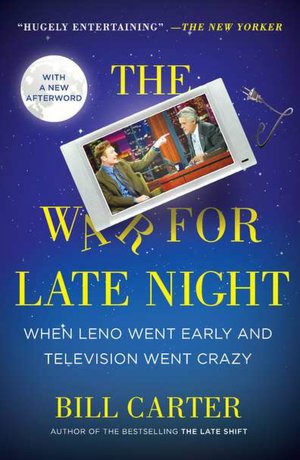
Book 1 (of 52) – The War For Late Night

The War For Late Night - Bill Carter

Jay Leno is a sad individual.  That is the one main takeaway from this, the tale of the late night showdown of 2009-2010, and author Bill Carter’s previous work, The Late Shift, which chronicled the first occurance when Leno’s people ousted Carson from The Tonight Show.  Jay is quoted numerous times as saying his only purpose in life is to “tell jokes at 11:30,” no matter who, or what, gets in the way.

In 2004, NBC had a (good) problem: two successful late night hosts who both wanted to host the same show.  In an effort to keep Conan O’Brien from moving to ABC or FOX and competing directly against Jay Leno, they promised him that Jay would retire and he would get The Tonight Show in 5 years.  This book tells the familiar story of what happened after those 5 years, when a hurt Jay Leno wouldn’t (couldn’t?) just walk away, a naive Conan O’Brien thought that his loyalty counted for something, and a happy David Letterman watching it all unfold from the sidelines.  We all know how the story ended, with Jay back on The Tonight Show and Conan off on TBS, but the destination is not as intriguing in this case as the journey.