MVPito

On Thursday night, White Sox first baseman Jose Abreu took home MVP honors. becoming the fourth White Sox player to receive the award.  He received 21 first-place votes after leading the American League in hits, RBI, total bases, slugging percentage, and extra base hits.  The 2014 Rookie of the Year, he became just the 28th player to nab both awards.

Abreu follows Nellie Fox, Dick Allen, and Frank Thomas in winning the award for the White Sox and Zolio Versalles and Jose Canseco as Cuban-born winners.

Grievence Denied

After nearly 5 years, an arbitrator has ruled in favor of the Cubs in the grievance filed by the MLBPA on behalf of Kris Bryant.  The grievance, filed in May of 2015, alleged that the Cubs manipulated Bryant’s service time in an effort to keep an extra year of team control before Bryant was eligible for free agency.  The hearing took place this past October, once it became obvious that Bryant and the Cubs would not be coming to an agreement on a long term contract that would make the grievance moot.

Bryant split the 2014 season between Double A Tennessee and Triple A Iowa.  Despite hitting .325 with a combined 43 home runs and 110 RBIs between the two levels, he did not get a September call-up by the Cubs.  Determined to break camp with the big league team the next spring, Bryant slashed .425/.477/1.175 with nine home runs in 40 at-bats in the Cactus League.  However, that was not good enough to supplant Mike Olt, and Bryant was returned to Triple A to, allegedly, work on his defense.  When Olt injured his wrist on April 11, the Cubs waited until April 17 to put him on the DL and recall Bryant, the very day they gained an extra year of control.  Bryant went on to win the NL Rookie of the Year award, hitting .275 with 26 home runs and 99 RBIs while Olt, after finishing the year with the White Sox, never played in the major leagues again after the 2015 season.

So, the Cubs retain control over Bryant for an additional two years.  Whether he steps foot on the field again as a member of the team is still up in the air.  With the Cubs too close to the luxury tax threshold for Tom Ricketts’ comfort, Bryant has been rumored to be on the trading block all winter, with the result of his grievance, and the length of time before he becomes a free agent, seen as being the holdup in closing a deal.  While trading Bryant may be the best way to replenish a farm system left bare by 5 years of contention, while also lowering the team’s overall payroll commitments, doing so does not signal an intention to try and win in 2020, while the remainder of the team’s core moves closer to free agency themselves.

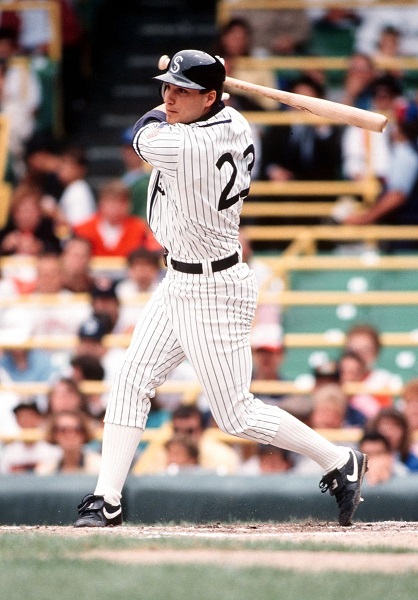
#4 – Robin Ventura

Name: Robin Ventura

Rank: 4

Position: 3B

Years With White Sox: 1989-1998

Robin Ventura joined the White Sox organization as the 10th overall pick in the 1988 draft.  He made his major league debut the following September, going 1-4 with an RBI in a 11-1 victory over the Orioles at Memorial Stadium.  He appeared in 16 games down the stretch, hitting only .178 while driving in 7 runs in 45 at bats.

A good spring in 1990 led to Ventura breaking camp with the White Sox.  He struggled, both on the field and at the plate, suffering through a horrendous 0-for-41 slump while committing 25 errors over the course of the season.  However, he did lead AL rookies with 150 games played and his 123 hits were the most by a White Sox rookie since Ozzie Guillen in 1985.  He finished the year with a .249 average, 5 home runs, and 54 RBIs.  He placed 7th in Rookie of the Year voting and was named to the Topps All Star Rookie team.

Ventura and the White Sox moved in to the new Comiskey Park in 1991, hoping to improve on the previous year’s growth.  He improved his fielding enough to earn his first Gold Glove award and led the league in putouts.  At the plate, he set a White Sox team record for RBIs by a third baseman, finishing with an even 100.  He upped his average to .284 and hit 23 home runs.  His work was enough to garner enough MVP votes to finish in 20th place.

1992 was another good year for Ventura.  He earned his first All Star nod, going 2-2 in the AL’s victory at Jack Murphy Stadium.  He finished the year with a .282 average, 16 home runs, and 93 RBIs.  He also snagged his second consecutive Gold Glove award.

Ventura continued his successful ways in 1993.  He collected his 500th hit in May and, on August 4, he entered the public consciousness with an event that would come to define his entire career.  While batting against the Rangers, Ventura was hit by a pitch thrown by Nolan Ryan and charged the mound.  Ryan, 20 years Ventura’s senior, placed him in a headlock and punched him several times, starting a bench-clearing brawl that was voted the best baseball brawl of all time by SportCenter.  Ventura saw his average drop to .262, but his OPS set a new career high.  His 94 RBIs made him the first AL third baseman with three consecutive 90-RBI seasons since Graig Nettles in the mid 70s.  During the ALCS against the Blue Jays, Ventura hit .200, with just 1 home run and 5 RBIs across the six game series.  After the season, he was awarded his third consecutive Gold Glove award.

The strike in 1994 saw Ventura’s streak of 90 RBI seasons and Gold Gloves come to an end.  When baseball stopped in August, Ventura was hitting .282 with 18 home runs and 78 RBIs, while posting a new career high with an .832 OPS.

When play resumed in late April 1995, Ventura struggled out of the gate, committing ten errors in the first ten games.  As the White Sox started to tear down the team that had finished the previous two seasons on top of their division, trade rumors started to follow Ventura, though nothing came to fruition.  On September 4, he became the eighth player in history to hit two grand slams in one game, and the first since Frank Robinson in 1970.  He finished the year setting career highs with a .295 average, an .882 OPS, and 26 home runs while driving in 93 runs.

Ventura had the best year of his career to date in 1996.  He set White Sox team records in career home runs by a third baseman, with 142, and grand slams, with 9.  He set new career highs with 34 home runs, 105 RBIs, 2 triples, an OPS of .888, and a .974 fielding percentage at the hot corner.  He hit .287, while earning his fourth Gold Glove award.

1997 turned into a dismal year for Ventura and the White Sox.  During a spring training game at Ed Smith Stadium, Ventura caught his foot in the mud while sliding into home plate and suffered a broken and dislocated right ankle.  Expected to miss the entire season, he returned on July 24, collecting the game-winning hit that night, and homered in his first at-bat the next night.  With the White Sox only 3.5 games behind the Indians in the standings, a healthy Ventura might have put them over the top.  A week later, the team threw in the towel in what eventually became to be known as the White Flag Trade, sending Wilson Alvarez, Roberto Hernandez, and Danny Darwin to the Giants for prospects.  “We didn’t realize Aug. 1 was the end of the season,” said an upset Ventura.  He finished the year appearing in 54 games, hitting .262 with 6 home runs and 26 RBIs.

As Ventura entered the last year of his contract in 1998, the White Sox made little attempt to sign him to an extension, with owner Jerry Reinsdorf claiming his skills were “deteriorating” after his injury the year before.  With more trade rumors following him throughout the season, he finished the year with a .263 average, 21 home runs, and 91 RBIs while earning his fifth Gold Glove award.  Following the season, he became a free agent, ending his White Sox playing career.

On October 6, 2011, Ventura returned to the White Sox as their 39th manager.  He resigned following the 2016 season, finishing with a career record of 375-435 for a winning percentage of .463.

For his career, Ventura ranks 6th in White Sox history with 39.4 WAR, 8th with 28.8 OWAR, 8th with 12.9 DWAR, 6th with 171 home runs, 8th with 741 RBIs, and 5th with 668 walks.

Ventura’s numbers in a White Sox uniform, both for games I attended and overall, were:

Continue reading →

#9 – Magglio Ordonez

Name: Magglio Ordonez

Rank: 9

Position: RF

Years With White Sox: 1997-2004

Signed by the White Sox as an amateur free agent in 1991.  Starting in 1992, he worked his way up the ladder, making his major league debut on August 29, 1997, going 2-3 in the interleague victory against the Astros at Comiskey Park.  Appearing in 21 games down the stretch, Ordonez hit .319 with 4 home runs and 11 RBIs.

Ordonez made the White Sox roster out of spring training in 1998.  He appeared in 145 games, and finished the year with a .282 average, 14 home runs, and 65 RBIs.  Those totals were good enough for him to finish in 5th place in AL Rookie of the Year voting, behind winner Ben Grieve and teammate Mike Caruso.

1999 was a breakout year for Ordonez.  Earning his first All Star selection, he went 0-1 in the AL’s victory at Fenway Park.  He finished the year hitting .301 with 30 home runs, 117 RBIs, and an OPS of .858.

Ordonez’s hot streak continued in to 2000.  In his second straight All Star game, he doubled and hit a sacrifice fly in his 2 plate appearances, driving in one run.  When the season ended, he had a .315 average with 32 home runs and 126 RBIs.  With the White Sox winning their first division title since 1993, Ordonez hit .182 in the ALDS against the Mariners, joining his teammates in not hitting at all during the 3 game sweep.  After the season, Ordonez won the Silver Slugger award and finished 12th in MVP voting.

While the White Sox failed to replicate their success in 2001, Ordonez kept up his end of the bargain.  He earned his third straight All Star nod, going 2-3 with an RBI and a run scored at Safeco Field.  Missing only 2 games, Ordonez ended up hitting .305 with 31 home runs, 113 RBIs, and a .914 OPS.

Ordonez saw his streak of All Star appearances snapped in 2002, mostly due to his .320 average, career high 38 home runs, 135 RBIs, and a .978 OPS.  Following the season, he came in 8th place for MVP voting and earned his second Silver Slugger award.

2003 was another excellent year for Ordonez.  He was named to his fourth All Star team, going 0-1 in his home stadium of US Cellular Field.  He hit .317 with 29 home runs and 99 RBIs, his lowest totals since his rookie year.  Even with that, he finished 18th in MVP voting.  During the off-season, Ordonez was nearly traded to the Red Sox, contingent on the Red Sox acquiring Alex Rodriguez from the Rangers for outfielder Manny Ramirez.  The Red Sox would then send Nomar Garciaparra to the White Sox for Ordonez.  When the Rodriguez-for-Ramirez trade fell through, the Ordonez deal was off as well, and he remained with the White Sox.

Ordonez’s 2004 season was on track to match his career norms when, during the May 19 game against the Indians, he collided with second baseman Willie Harris on Omar Vizquel’s popup to right field.  Two trips to the disabled list and two surgeries on his left knee later, his season was over after only 52 games.  Following the season, he became a free agent and his White Sox career came to an end.

Ordonez’s numbers in a White Sox uniform, both for games I attended and overall, were:

Continue reading →

#10 – Ozzie Guillen

Name: Ozzie Guillen

Rank: 10

Position: SS

Years With White Sox: 1985-1997

Acquired by the White Sox, along with Tim Lollar, Bill Long, and Luis Salazar, on December 6, 1984 from the Padres for Kevin Kristan, Todd Simmons, and LaMarr Hoyt, Ozzie Guillen made his major league debut on Opening Day 1985, leading off against the Brewers and going 1-5 in the 4-2 victory at County Stadium.  Settling in as the everyday shortstop, Guillen finished the year with a .273 average, 21 doubles, and 9 triples.  Those totals were good enough to score Guillen the 1985 AL Rookie of the Year trophy.

Guillen saw a slight drop off in his sophomore season.  His average dropped to .250 and he managed 19 doubles and 4 triples.  Defensively, he led the American League in Defensive WAR.

1987 was a nice bounce back for Guillen.  He raised his average back up to .279 with a .656 OPS.  For the second straight year, he led the AL, and all of baseball, in Defensive WAR.

Guillen earned his first All Star nod in 1988, though he didn’t get in to the game.  By the end of the season, he once again led all of baseball in Defensive WAR, while seeing his average drop to .261 with 7 triples, the fifth highest total in the AL.

1989 was a tough year for Guillen.  He posted his worst offensive numbers since 1986 and, on the base paths, he fell victim to the hidden ball trick.  Twice. On June 23, against the Brewers, first baseman Greg Brock held the ball after a pickoff attempt and when Guillen took his hand off the base to stand up, Brock tagged him out.  Less than 2 months later, on August 5 against the Tigers, Dave Bergman made the same play.  He finished the year with .253 average and, despite his adventures on pick off attempts, a career high 36 stolen bases.

As the surprising White Sox challenged for the AL West title while saying goodbye to Comiskey Park, Guillen put in one of the finest seasons of his career.  He was named to his second All Star team, going 0-2, finished in 17th place in MVP voting, and earned his first, and only, Gold Glove.  He raised his average back up to .279 and knocked in a career high 58 RBIs.

Expectations were high for the White Sox as they moved across the street to the new Comiskey Park in 1991.  Guillen earned his third, and final, All Star nod, getting a sacrifice in his only plate appearance.  He ended the year with a .273 average and set a career high with 3 home runs.

Guillen’s 1992 season came to an early end when, on April 21 during a loss against the Yankees, a collision with outfielder Tim Raines ended in a severe knee injury.  Appearing in only 20 games, he hit a career low .200 in only 40 at bats.

Guillen recovered in 1993, though he appeared in only 134 games, his lowest total to date.  However, it was his most productive season offensively, posting a .280 batting average, and career highs with 4 home runs and a .666 OPS, as the White Sox won their first division title in a decade.  He hit .273 and scored 4 runs in a losing effort, as the White Sox were defeated in 6 games by the Blue Jays in the ALCS.

1994 looked to be the year that the White Sox finally broke through.  Guillen was up to the challenge, hitting a career high .288 with a .659 OPS.  Unfortunately, the year ended early when players went on strike on August 12 with the White Sox in first place in the newly created AL Central.

The 1995 season got off to a late start and had an abbreviated schedule due to the long work stoppage.  The success of the White Sox, and for Guillen himself, didn’t survive the long layoff.  Guillen saw his average drop to .248, his lowest over a “full” season in his career to this point.  His OPS dropped to its lowest total, excepting 1992, since 1989.

1996 saw a slight improvement for Guillen.  He appeared in 150 games, his highest total since his knee injury in 1992.  He raised his average back to .263 and tied his career high with 4 home runs.

1997 was easily the worst season of Guillen’s White Sox career.  He had the lowest average of his career, coming in at .245, though he did once again tie his career high with 4 home runs.  Following the season, Guillen became a free agent and his playing career with the White Sox came to an end.

Guillen returned to the White Sox organization for the 2004 season as manager.  In 2005, he led the team to their first American League pennant since 1959 and their first World Series title in 88 years.  Ongoing personal difficulties with General Manager Kenny Williams led to his leaving with 2 games left in the 2011 season as the third winningest manager in franchise history.

Guillen’s numbers in a White Sox uniform, both for games I attended and overall, were:

Continue reading →

#23 – Carlos Lee

Name: Carlos Lee

Rank: 23

Position: LF

Years With White Sox: 1999-2004

Carlos Lee signed with the White Sox as an amateur free agent in 1994.  He worked his way through the minor league system, making his major league debut on May 7, 1999 against the A’s and hitting a home run in his first at bat.  Lee became the everyday left fielder and finished the year with a promising .293 average, 16 home runs, ans 84 RBIs.  He tied for seventh in Rookie of the Year voting with future teammate Billy Koch.

The 2000 season saw Lee improve, upping his average to .301 and his home runs to 24, as the White Sox took home the Central Division title.  Like most of his teammates, Lee struggled in the ALDS against the Mariners, garnering only 1 hit in the 3 game series.

While Lee struggled a bit in 2001, he became a south side folk hero on June 8, when he hit a walkoff grand slam in the 10th inning against the rival Cubs.  He ended the year with a .269 average, 24 home runs, and 84 RBIs.  2002 was more of the same, as his average dropped to .264 with 26 home runs and 80 RBIs.

2003 was a bounce back year for Lee.  His average rebounded to .291 and he set new career highs with 31 home runs and 113 RBIs.  The effort was good enough for an 18th place finish in MVP voting.

Lee put up another strong season in 2004.  He pushed his average up to .305 and again hit 31 home runs.  He set a career high with an OPS of .891.  Following the season, he was traded, along with Nelson Cruz, to the Brewers for Scott Podsednik, Luis Vizcaino, and a minor league throw-in.

Lee’s numbers in a White Sox uniform, both for games I attended and overall, were:

Continue reading →

#26 – Ray Durham

Name: Ray Durham

Rank: 26

Position: 2B

Years With White Sox: 1995-2002

Selected in the fifth round of the 1990 draft, Ray Durham broke camp with the White Sox in 1995 and made his major league debut on Opening Day, leading off and going 1-4 in the 12-3 loss to the Brewers at County Stadium.  Durham stuck in the leadoff spot and finished the year with a .257 average, 7 home runs, and 51 RBI, good enough for a 6th place finish in Rookie of the Year voting.

Durham saw improvement in 1996, raising his average to .275 and his OBP to .350.  His home run and RBI totals also jumped, going to 10 and 65 respectively.  1997 was another good year for Durham, as he hit .271 with 11 home runs.

In 1998, Durham earned his first All Star nod and finished the year setting career highs with a .285 average, 19 home runs, 67 RBIs, and 36 stolen bases.  Durham improved his average again in 1999, raising it to .296, his career best.  It was also his second of seven straight years with an OPS over .800.

Durham nabbed his second All Star selection in 2000.  When the season came to an end, Durham had a .280 average with 17 home runs and 75 RBIs and the White Sox were atop the AL Central for the first time.  Like the rest of his teammates, Durham struggled during the ALDS, hitting .200 in the three game sweep against the Mariners.

2001 saw Durham’s average drop to .267, his lowest total since his rookie year.  He did manage to set a new career high with 20 home runs as the White Sox failed to repeat.  Durham was hitting .299 with 9 home runs at the trade deadline in 2002 when, facing free agency, he was shipped to the A’s for Jon Adkins.  At the time of the trade, Durham was the club’s all-time leader in leadoff home runs, while placing in the top 10 in franchise history in steals (5th), doubles (7th), extra base hits (7th), and runs (8th).

Durham’s numbers in a White Sox uniform, both for games I attended and overall, were:

Continue reading →

#31 – Tadahito Iguchi

Name: Tadahito Iguchi

Rank: 31

Position: 2B

Years With White Sox: 2005-2007

After an impressive career in the Japanese league, Tadahito Iguchi signed with the White Sox prior to the 2005 season.  As a 30 year old rookie, the second baseman locked down the #2 spot in the batting order, hitting .278 with 15 home runs.  The personal highlight of his season came in Game 2 of the ALDS against the Red Sox, hitting a 3 run homer off of David Wells to give the White Sox the lead.  Later that month, when the White Sox won their first title in 88 years, he became the first Japanese-born position player to win a World Series.  His numbers earned him fourth place in the Rookie of the Year voting.

2006 was an even more impressive year for Iguchi.  He made his mark on defense, going horizontal to make a tremendous play against the Blue Jays on April 15.  Offensively, he shined on June 25, hitting a 3 run homer in the bottom of the 8th to cut the Astros lead to 4 and then smacking a grand slam in the 9th to send the game to extra innings.  He finished the year with a .281 average, 18 home runs, and 67 RBIs.

2007 was a rough year for both Iguchi and the White Sox.  After signing a contract extension, he struggled as the White Sox fell to 4th in the AL Central, losing 90 games for the first time since 1989.  Iguchi’s average dropped to .251 with only 6 home runs.  With the White Sox not going anywhere, they traded Iguchi to the Philles on July 27 for a busted prospect.

Iguchi’s numbers in a White Sox uniform, both for games I attended and overall, were:

Continue reading →

#33 – Ron Kittle

Name: Ron Kittle

Rank: 33

Position: LF/DH

Years With White Sox: 1982-1986, 1989-1990, 1991

Ron Kittle joined the White Sox organization in Septmber of 1978.  He worked his way through the minor leagues before making his major league debut on September 2, 1982, pinch hitting for Aurelio Rodriguez and striking out in the White Sox 6-5 victory over the Rangers at Comiskey Park.  Kittle got sporadic playing time over the final month of the season, earning just 29 at bats in 20 games.  He hit .241 with a single home run.

Kittle, and the White Sox, broke out in a big way in 1983.  While the team charged towards their first division title, Kittle earned an All Star nod and finished the year with a team rookie record of 35 home runs while hitting .254 and driving in 100.  Kittle was knocked out of the ALCS against the Orioles after getting hit by a pitch in Game 3, finishing the series with just 2 hits in 7 at bats.  His season earned him Rookie of the Year honors.

1984 was a bit of a letdown for both Kittle and the White Sox.  While the team failed to perform up to the expectations set the previous year, Kittle did the same, falling to a .215 average.  His power numbers remained, as he clubbed 32 home runs, but his OPS was down by 70 points.  There was a slight improvement in 1985, with his average improving to .230, but he hit only 26 home runs and drove in just 58 runs in 116 games.

In 1986, Kittle was hitting .213 with 17 home runs at the trade deadline when he, along with Joel Skinner and Wayne Tolleson, were sent to the Yankees for Ron Hassey, Carlos Martinez, and a player to be named later.  He rejoined the White Sox a year and a half later, signing as a free agent after the 1988 season.

Injuries limited Kittle to just 51 games in 1989.  In 169 at bats, he hit .302 with 11 home runs and 37 RBI.  He returned in 1990, seeing his average drop to .245 with 16 home runs in 83 games when, again at the trade deadline, he was sent to the Orioles in exchange for Phil Bradley.

Kittle returned for one final hurrah with the White Sox in 1991, signing as a free agent on June 19 before being released on August 15.  In between, he appeared in 17 games and hit only .191 with 2 home runs.

Kittle’s numbers in a White Sox uniform, both for games I attended and overall, were:

Continue reading →

25 Million Dollar Man

Fresh off an exciting rookie season and expected to be one of the cornerstones of the rebuild on the south side, Tim Anderson signed a long term deal that will potentially keep him as a member of the White Sox through the 2024 season.  The 6 year, $25 million deal also includes two option years, which could boost the overall value of the deal over $50 million.

Anderson’s deal is the largest for a player with less than one year of major league experience, besting Chris Archer’s 2014 deal with the Rays.  He hit .283 with 9 home runs and 30 RBIs in 99 games last year after getting recalled from Triple A, good enough for seventh place in American League Rookie of the Year voting.  The White Sox are betting that he can improve on that production and help return the team to glory.