Throwback Thursday – Pitching Leaders Of The 1980s

Our Throwback Thursday feature continues, as we once again point the wayback machine back to the 1980s, finally putting our focus on the defensive leaders of that decade.  As a reminder, I’ve identified a mere 14 games that I attended during this time period, when I would have been ages 5 through 14.

Wins

Name Total
14 tied with 1

Losses

Name Total
Tom Seaver 2
12 tied with 1

ERA (> 6 IP)

Name Total
Floyd Bannister 0.00
Mark Langston 0.00
Dwight Gooden 0.00
Scott McGregpr 1.00
Bud Black 1.23

Strikeouts

Name Total
Britt Burns 12
Tom Seaver 10
Tim Lollar 9
Continue reading →

By The Numbers – 37

In 1929, uniform numbers appeared on the back of baseball jerseys for the first time, thanks to the Indians and the Yankees.  By 1937, numbers finally appeared across all uniforms, both home and away, across both major leagues.  Since that time, 81 distinct numbers have been worn by members of the White Sox, while the Cubs boast 76.

Today, we continue our look at those players, picking our favorite, if not the best, player to wear each uniform number for both Chicago teams with #37.  74 different players have donned #37 while playing in Chicago, 27 for the White Sox and 47 for the Cubs.

Selected in the fourth round of the 1985 draft, Bobby Thigpen made his major league debut for the White Sox just over a year later, wearing #58.  He switched to his more familiar #37 the following year, as he moved in to the closer role full time, replacing Bob James, and racked up 16 saves while also putting up a 7-5 record with a 2.73 ERA.  In 1988, he broke the team record for saves, with 34, while leading the league with 59 games finished.  He duplicated the effort in 1989 with another 34 saves, though with a 2-6 record and a 3.76 ERA.

Thigpen’s 1990 season was one for the record books.  He earned his first All Star nod while on his way to setting the major league record with 57 saves, while also leading the league with 77 games and 73 games finished.  On September 30, he earned his 57th save while throwing the final pitch at Comiskey Park.  After the 1990 season, Thigpen joined other major league all stars on a tour of Japan where, unfortunately, he would suffer a back injury that would plague him for the remainder of his career.

In 1991, he still managed to earn 30 saves, but his ERA jumped up to 3.49.  In 1992, he set a career high with a 4.75 ERA while earning only 22 saves, losing his grip on the closer role to both Scott Radinsky and Roberto Hernandez.  His 1993 was even worse, as his ERA jumped to 5.71 and he managed only 1 save in 25 appearances before an August 10 trade to the Phillies for former teammate Jose DeLeon.  He left as the franchise’s all time leader with 201 saves, a position he still holds today.

On the north side of town, pitcher Travis Wood was acquired by the Cubs, along with Dave Sappelt and Ronald Torreyes, in exchange for Sean Marshall.  Wearing #37, Wood was called up to the major league club in early May of 2012, replacing Chris Volstad, who started the season 0–6.  Wood went 6-13 with a 4.27 ERA in his first year as a Cub.  In 2013, Wood became the first Cub since Mordecai Brown to start a season with 9 straight quality starts and, on May 30, he hit his first career grand slam, leading to his first All-Star selection.

Wood struggled in 2014, with a 5.03 ERA in 31 starts, though he did hit his 9th career home run.  After struggling in the rotation to start the 2015 season, Wood was moved to the bullpen, where he fared much better, posting a 2.95 ERA and 4 saves in relief.  Continuing to work out of the bullpen in 2016, Wood posted a 4-0 record with a 2.95 ERA in 77 appearances.  In Game 2 of the NLDS, Wood hit a home run off of Giants’ reliever George Kontos, becoming just the second relief pitcher to homer in a postseason game., after Rosy Ryan in Game 3 of the 1924 World Series.  Wood appeared in 3 games of the 2016 World Series, giving up 2 hits and a run in 1 2/3 innings.  Following the season, he became a free agent.
#22 – Bobby Thigpen

Name: Bobby Thigpen

Rank: 22

Position: P

Years With White Sox: 1986-1993

Selected in the fourth round of the 1985 draft, Bobby Thigpen made his major league debut for the White Sox just over a year later, throwing 3 innings of mop-up relief in a 9-0 loss to the Red Sox on August 6 at Fenway Park.  He made 20 appearances over the final 2 months of the season, going 2-0 with a 1.77 ERA and 7 saves.

In 1987, Thigpen moved in to the closer role full time, replacing Bob James.  In 51 games, Thigpen racked up 16 saves while also putting up a 7-5 record with a 2.73 ERA.

Thigpen broke the White Sox team record for saves in 1988, with 34, while leading the league with 59 games finished.  He ended the year with a 5-8 record and a 3.30 ERA.  In 1989, he duplicated the effort with another 34 saves, though with a 2-6 record and a 3.76 ERA.

Thigpen’s 1990 season was one for the record books.  He earned his first All Star nod while on his way to setting the major league record with 57 saves.  He also led the league with 77 games and 73 games finished.  He ended the year with a 4-6 record and a 1.83 ERA as the surprising White Sox competed for the division title.  On September 30, he earned his 57th save while throwing the final pitch at Comiskey Park.  His year earned him 4th place in Cy Young Award voting and 5th place in Most Valuable Player considerations.

After the 1990 season, Thigpen joined other major league all stars on a tour of Japan.  Unfortunately, he would suffer a back injury that would plague him for the remainder of his career.  In 1991, he still managed to earn 30 saves, but his ERA jumped up to 3.49.

Thigpen struggled in 1992, setting a career high with a 4.75 ERA.  He earned only 22 saves, losing his grip on the closer role to both Scott Radinsky and Roberto Hernandez.  1993 was even worse, as his ERA jumped to 5.71 and he managed only 1 save in 25 appearances.  On August 10, he was traded to the Phillies for former teammate Jose DeLeon.  He left as the franchise’s all time leader with 201 saves, a position he still holds today.

Thigpen rejoined the White Sox organization in 2007, managing and coaching throughout the minor league system.  In 2013, he became the bullpen coach for the big league team, a position he held through the 2016 season.

Thigpen’s numbers in a White Sox uniform, both for games I attended and overall, were:

Continue reading →

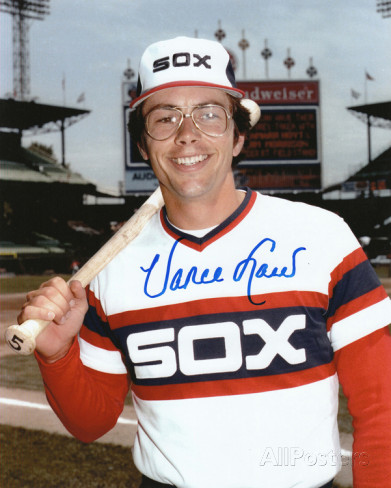
#94 – Vance Law

vance-lawName: Vance Law

Rank: 94

Position: 3B

Years With White Sox: 1982-1984

As spring training was winding down in 1982, the White Sox acquired Vance Law, along with Ernie Camacho, from the Pirates in exchange for Ross Baumgarten and Butch Edge.  Law jumped around the infield for the White Sox, spending time at shortstop, third base, and second base.  In his first major league stint with regular playing time, Law responded by hitting .281 with 5 home runs.

The offseason acquisitions of Jerry Dybzinski and Scott Fletcher meant Law could focus on third base for the 1983 season.  His offense suffered some, with his batting average dropping nearly 40 points, but he helped the White Sox secure their first post-season appearance since 1959.  Unfortunately, Law, like the rest of his teammates, struggled against the Orioles in the ALCS.  Law managed only 2 hits in the 4 game series.

While the White Sox regressed in 1984, Law put up arguably his best season as a pro.  He set a career high in games played and home runs, while his batting average rebounded to .252 and his OPS again surpassed the .700 mark.  Following the season, however, he was traded by the White Sox to the Expos for closer Bob James.

Law’s numbers in a White Sox uniform, both for games I attended and overall, were:

Continue reading →

#157 – Bob James

jamesName: Bob James

Rank: 157

Position: P

Years With White Sox: 1985-1987

Bob James was acquired by the White Sox on Decmber 7, 1984 from the Expos in exchange for Vance Law.  James was installed as the team’s closer for 1985 and helped to return the White Sox to a contending club.  Manager Tony La Russa said, “We’ve had a decent bullpen since I’ve been here, but, with Bob, our bullpen can compare with anybody’s in the league.”  Broadcaster, and Hall of Fame pitcher, Don Drysdale agreed.  “They have a guy down in the bullpen now who they haven’t had for quite a few years. . .a stopper,” Drysdale said.  “Without James, I don’t know where they would be.”

The White Sox finished the season in 3rd place, with an 85-77 record, but James finished with an 8-7 record, a 2.13 ERA, and 32 saves, behind only Royals reliever Dan Quisenberry.  Things appeared to be looking up for the White Sox heading in to the 1986 season.

Sadly, things went a bit crazy in 1986, both for James and the White Sox.  While new GM Hawk Harrelson turned the organization on its head, James lost any semblance of effectiveness that he had showed the previous year.  In early August, James went down with triceps issues and was lost for the season.  His final numbers were nightmarish: a 5-4 record but an ERA of 5.25 and only 14 saves in 49 appearances.

James continued to struggle in 1987, and in May, he lost his position as the team’s closer.  “I told him he`s not throwing as well as he could be,” manager Jim Fregosi said.  “I’m going to use him as a long man so he can get back to where he`s throwing well.”  Shoulder problems put him out of commission in July, and he finished the season with a 4-6 record and a 4.67 ERA.

The White Sox released James in December, but looked to resign him to an incentive-laden deal the following spring.  “We’ve had several talks with him,” general manager Larry Himes said.  “He’s looking at other places. The Sox are interested, but he knows the conditions. We’re willing to pay for performance. Bob James has not performed up to our expectations the last couple years.”  James ended up not signing with the White Sox, or anyone else, and his major league career came to an end.

James’s numbers in a White Sox uniform, both for games I attended and overall, were:

Continue reading →