150 Years Of Cubs Baseball – Outfielders Part 2

Originally founded in 1869, the Chicago Cubs became a charter member of the National League in 1876.  Over the next 150 seasons, the Cubs have played more than 22,000 games, scored over 103,000 runs and recorded more than 200,000 hits, more than any other team in baseball history.  Nearly 2,300 players have worn a Cubs uniform, earning eight division titles, 17 NL pennants, and three World Series championships.

Fans have witnessed generations of unforgettable players, from historical heroes like Joe Tinker, Gabby Hartnett, Ernie Banks, and Billy Williams to more recent stars like Ryne Sandberg, Derrek Lee, Kerry Wood, and Anthony Rizzo.  The team has called Wrigley Field home for 110 of those 150 seasons.

To celebrate this milestone, the Cubs are holding a fan vote to select the franchise’s anniversary team.  Each week, we will go through the provided options for each position and declare who should, and, if different, who will, win the fan vote.  We continue today with the second eight selections for outfielder.
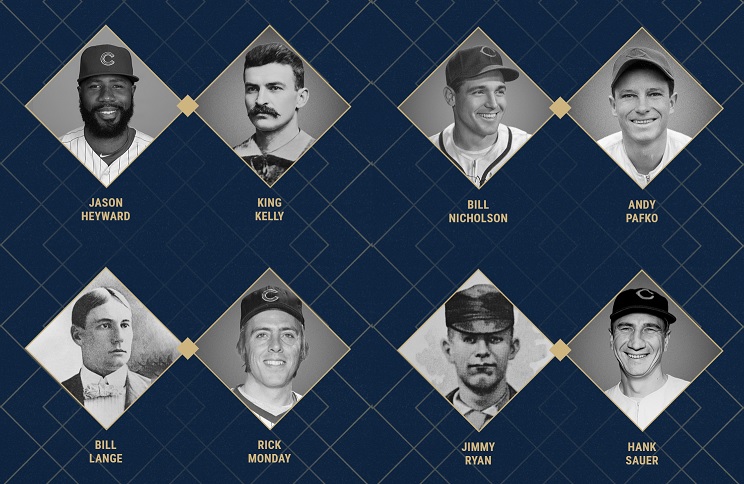
Jason Heyward signed an 8-year, $184 million contract with the Cubs in December of 2015.  His place in Cubs lore was set when he was credited with leading an inspiring, players-only meeting during the 17-minute rain delay towards the end of Game 7 of the 2016 World Series, after which the Cubs stormed out and took the lead in the 10th inning, leading to their first championship in 108 years.  While he never quite produced enough to justify his lofty contract and the team failed to duplicate their 2016 success, he became as much of a scapegoat as anyone else on the roster, eventually seeing his playing time reduced.  In addition to his World Series ring, Heyward won Gold Glove awards in both 2016 and 2017.

King Kelly emerged as one of 19th‑century baseball’s first true superstars as a member of the White Stockings.  He led the NL in runs scored for three consecutive seasons, from 1884 through 1889 and also won the NL batting title in both 1884 and 1886.  During his seven years with the franchise, they won five NL pennants.  In 1945, he was elected to the Hall of Fame.

Bill Lange spent his entire seven-year MLB career with the Colts/Orphans, becoming a full-time center fielder in 1894.  He retired at age 28 to marry a woman whose father had forbid her from marrying a ballplayer, finishing his career with a .330 batting average.  In 1897, he led the NL in stolen bases.  He is a member of the Cubs Hall of Fame.

Continue reading →

Ballpark Tour: Cubs

With spring training wrapping up this week and Opening Day just days away, we wind down our tour of all of the different baseball stadiums I’ve been to over the years. This week, we have our penultimate entry from the north side of Chicago. So, without further ado, let’s take a deeper look at my history with Wrigley Field.

Stadium Name: Wrigley Field

Years in Service: 1914 – Present

Visits: 388 (that I’m aware of)

Weeghman Park, home of the Chicago Chifeds of the Federal League, opened on April 23, 1914.  When the Federal League folded in December of 1915, team owner Charles Weeghman was allowed to buy the rival Chicago Cubs and immediately moved them from the dilapidated West Side Park and into his stadium for the 1916 season.  The Cubs played their first game at Weeghman Park on April 20, 1916, besting the Cincinnati Reds 7–6 in eleven innings.

That year, Weeghman sold a minority interest in the Cubs to chewing gum magnate William Wrigley.  As Weeghman’s financial fortunes started to decline, Wrigley acquired an increasing number of shares in the club and took on a growing role in the team’s affairs until November 1918, when Weeghman gave up his remaining interest to Wrigley, resigned as president, and left baseball for good. Wrigley would acquire complete control of the Cubs by 1921, and, prior to the start of the 1927 season, the park was officially renamed Wrigley Field.

William’s son, Philip K. Wrigley, had intended to install lights at Wrigley Field prior to the 1942 season.  However, when the Japanese attacked Pearl Harbor in December of 1941 and the US entered World War II, Wrigley donated the materials for the lights to the war effort.  The Cubs eventually became the only team without lights, continuing to play day games at home exclusively until 1988, when lights were finally installed.  To this day, the Cubs are still limited in the number of night games they may schedule per season, though that number has increased significantly since the late 80s.

As Wrigley Field continues in its second century, renovations to the stadium to make it economically viable for the 21st century are nearly complete.  Expanded clubhouses and new training facilities have been put in place for the players, both home and away.  New scoreboards, rebuilt bleachers, new clubs, and expanded concourses have been put in place for the fans.

I’ve managed to identify 388 games I’ve attended at Wrigley Field, most of them since 2002, when I became a season ticket holder.  After years of futility with the occasional bit of success tossed in, the Cubs saw sustained success for the first time in decades to close out the 2010s but have struggled to repeat it since.

Ballpark Tour: Cubs

Well, spring training has been cancelled and nobody knows when opening day will occur, but life must go on.  So, it is time to start wrapping up our tour of all of the baseball stadiums I’ve been to over the years with the penultimate stadium: the home of the Chicago Cubs.  Over 100 years old, I’ve been able to identify 359 games that I’ve seen there.  So, without further ado, let’s take a deeper look at my history with Wrigley Field.

Stadium Name: Wrigley Field

Years in Service: 1914 – Present

Visits: 359 (that I’m aware of)

Weeghman Park, home of the Chicago Chifeds of the Federal League, opened on April 23, 1914.  When the Federal League folded in December of 1915, team owner Charles Weeghman was allowed to buy the rival Chicago Cubs and immediately moved them from the dilapidated West Side Park and into his stadium for the 1916 season.  The Cubs played their first game at Weeghman Park on April 20, 1916, besting the Cincinnati Reds 7–6 in eleven innings.

That year, Weeghman sold a minority interest in the Cubs to chewing gum magnate William Wrigley.  As Weeghman’s financial fortunes started to decline, Wrigley acquired an increasing number of shares in the club and took on a growing role in the team’s affairs until November 1918, when Weeghman gave up his remaining interest to Wrigley, resigned as president, and left baseball for good. Wrigley would acquire complete control of the Cubs by 1921, and, prior to the start of the 1927 season, the park was officially renamed Wrigley Field.

William’s son, Philip K. Wrigley, had intended to install lights at Wrigley Field prior to the 1942 season.  However, when the Japanese attacked Pearl Harbor in December of 1941 and the US entered World War II, Wrigley donated the materials for the lights to the war effort.  The Cubs eventually became the only team without lights, continuing to play day games at home exclusively until 1988, when lights were finally installed.  To this day, the Cubs are still limited in the number of night games they may schedule per season, though that number has increased significantly since the late 80s.

As Wrigley Field continues in its second century, renovations to the stadium to make it economically viable for the 21st century are nearly complete.  Expanded clubhouses and new training facilities have been put in place for the players, both home and away.  New scoreboards, rebuilt bleachers, new clubs, and expanded concourses have been put in place for the fans.

I’ve managed to identify 359 games I’ve attended at Wrigley Field, most of them since 2002, when I became a season ticket holder.  After years of futility with the occasional bit of success tossed in, the Cubs have seen sustained success over the past 5 years for the first time in decades, despite their collapse down the stretch last September.

Ballpark Tour: Wrigley Field

WrigleyField

Stadium Name: Wrigley Field

Location: Chicago

Home Team: Cubs

Years in Service: 1914 – Present

Visits: 313

Weeghman Park, home of the Chicago Chifeds (soon to be the Whales) of the Federal League, opened on April 23, 1914.  In December of 1915, when the Federal League folded, team owner Charles Weeghman was allowed to buy the rival Chicago Cubs and immediately moved them from the dilapidated West Side Park and into his Weeghman Park for the 1916 season.  The Cubs played their first game at Weeghman Park on April 20, 1916, besting the Cincinnati Reds 7–6 in eleven innings.

Also in 1916, Weeghman sold a minority interest in the Cubs to chewing gum magnate William Wrigley.  As Weeghman’s financial fortunes started to decline, Wrigley acquired an increasing number of shares in the club and took on a growing role in the team’s affairs until November 1918, when Weeghman gave up his remaining interest to Wrigley, resigned as president, and left baseball for good. Wrigley would acquire complete control of the Cubs by 1921, and, prior to the start of the 1927 season, the park was officially renamed Wrigley Field.

William’s son, Philip K. Wrigley, had intended to install lights at Wrigley Field prior to the 1942 season.  However, when the Japanese attacked Pearl Harbor in December of 1941 and the US entered World War II, Wrigley donated the materials for the lights to the war effort.  The Cubs eventually became the only team without lights, continuing to play day games at home exclusively until 1988, when lights were finally installed.  To this day, the Cubs are still limited in the number of night games they may schedule per season, though that number has increased significantly since the late 80s.

As Wrigley Field prepares to enter its second century, there are plans in motion to renovate the stadium and make it economically viable for the 21st century.  Those renovations were expected to start this offseason, but threats of lawsuits from the rooftop owners, who fear that new signage would block their views, have stalled those plans.

I’ve managed to identify 313 games I’ve attended at Wrigley Field, most of them since 2002, when I became a season ticket holder.  While it is hard to argue with the historical value of Wrigley Field, it is as hard to argue that the stadium needs work to satisfy the needs of fandom in the year 2013.  I hope that the bickering sides come to an agreement soon so that Wrigley Field can continue to be a viable home to the Cubs for the next 100 years.  Besides, they will need that time in order to bring their first World Series championship to the ballpark.