You Can Put Him In The Hall, Yes!

Former White Sox broadcaster Ken “Hawk” Harrelson, who retired following the 2018 season, was awarded the 2020 Ford C. Frick Award yesterday, presented annually for excellence in broadcasting by the National Baseball Hall of Fame and Museum.  Harrelson spent 33 of his 42 seasons as a broadcaster for the White Sox, starting in 1982, with a brief interruption caused by his inadvised turn as the teams General Manager in 1986.  He returned to the broadcast booth in 1989, where he stayed until retiring last fall.

Harrelson’s broadcasting career began in 1975, following the end of his playing career and a short foray into professional golf.  He, along with Don Drysdale, joined the White Sox booth in 1982, replacing Harry Caray, who had clashed with the team’s new ownership group.  He returned to the south side in 1989, alongside former Sox player Tom Paciorek. In 2000, he was joined in the booth by another former White Sox outfielder, Darrin Jackson.  2009 saw his final broadcast partner, Steve Stone, join the team.  A five-time Emmy Award winner, Harrelson’s trademark calls of “You can put it on the board…Yes!” and “Mercy!” became the nightly soundtrack for multiple generations of White Sox fans, including a young Jason Benetti, who would grow up to replace him with the White Sox.

Harrelson, 78, is the fifth announcer with ties to Chicago to earn the honor, following Milo Hamilton, Harry Caray, Jack Brickhouse, and Bob Elson.  Two other finalists for next year’s award also have strong ties to the city: current Cub radio announcer Pat Hughes and former Cub announcer Dewayne Staats.

#30 – Greg Walker

Name: Greg Walker

Rank: 30

Position: 1B

Years With White Sox: 1982-1990

Acquired as a rule 5 selection from the Phillies in 1979, Greg Walker made his major league debut for the White Sox on September 18, 1982, pinch hitting for Marc Hill and getting a hit against Brian Kingman in the White Sox 5-4 loss to the A’s at Comiskey Park.  During his brief cup of coffee with the big league club, Walker took advantage, hitting .412 with 2 home runs in 11 games.

Walker split time with Tom Paciorek in 1983, hitting .270 with 10 home runs and 55 RBIs in 118 games.  He led the American League with 15 pinch hit RBIs.  He appeared in 2 games during the ALCS against the Orioles, going 1-3 with a walk.

In 1984, Walker started to establish himself as the every day first baseman.  In 136 games, he hit 24 home runs while posting a .294 average.  He hit another 24 home runs in 1985 while tying a White Sox record with 163 games played.

1986 saw Walker spend time on the disabled list, limiting him to 78 games and only 13 home runs, with a .277 average.  He bounced back in 1987, appearing in 157 games and setting career highs with 27 home runs and 94 RBIs while hitting a career low .256.

Walker’s 1988 season came to a premature end on July 30, when he suffered a seizure during batting practice while fielding grounders from coach Ed Brinkman.  Four trainers were needed to hold Walker down and pry open his mouth to prevent Walker from swallowing his own tongue.  During the ordeal, Walker bit his tongue and chipped a tooth from biting down on a pair of scissors.  A subsequent seizure the following day kept Walker in the hospital for 11 days.  A third seizure, days after being released from the hospital, left him in a daze for months.

He returned in 1989, unsure if he would be able to continue his career, until a .308 spring average with 7 home runs convinced him, and the White Sox, that he once again could be a productive member of the lineup.  He wasted little time in getting back in the swing of things, participating in an Opening Day brawl against the Angels after Bob McClure hit Ivan Calderon with a pitch in the ninth inning.  The good feelings did not last, though, as he appeared in only 77 games due to a shoulder injury and hit a career low .210 with only 5 home runs.

Walker found himself the odd man out in 1990, appearing in only 2 games before being released on April 30.

Walker rejoined the White Sox organization on May 19, 2003 as hitting coach, a position he would hold until September 28, 2011 in the waning days of Ozzie Guillen’s tenure.

Walker’s numbers in a White Sox uniform, both for games I attended and overall, were:

Continue reading →

#89 – Darrin Jackson

djName: Darrin Jackson

Rank: 89

Position: RF

Years With White Sox: 1994, 1999

Darrin Jackson signed with the White Sox as a free agent prior to the 1994 season.  He set career highs with a .312 batting average and a .817 OPS during the strike-shortened season, thanks in part to two separate 8 game hitting streaks.  With uncertainty about the state of MLB heading in to the 1995 season, Jackson moved on to the Japanese leagues.

He returned to the White Sox in January, 1999, again signing as a free agent.  He appeared in 73 games, getting only 149 at bats and ended the year hitting .275.  He retired following the year and joined the White Sox broadcast booth, replacing Tom Paciorek as the color analyst on television along side Hawk Harrelson.  In 2009, he moved over to the radio side, where he remains to this day.

Jackson’s numbers in a White Sox uniform were:

Continue reading →

#115 – Tom Paciorek

wimpyName: Tom Paciorek

Rank: 115

Position: 1B/LF

Years With White Sox: 1982-1985

Tom Paciorek was traded to the White Sox from the Mariners in December of 1981, for Rod Allen, Todd Cruz, and Jim Essian.  He became the primary first baseman for the White Sox in 1982 and finished the year second on the team with a .312 average.

In 1983, Paciorek split time between first base and the outfield, due to the emergence of young players like Greg Walker and Ron Kittle.  He finished the year with a team-leading .307 average as the White Sox took home their first division title, by a record 20 games.  Paciorek appeared in all 4 games of the ALCS, picking up 4 hits in 16 at bats as the White Sox fell to the Orioles.

Paciorek saw his playing time diminish further in 1984, as the White Sox struggled to repeat their success of the prior year.  His personal highlight came on May 8th (and 9th), when he set an odd major league record, garnering 5 hits in a game he did not start.  Paciorek replaced Ron Kittle in the 4th inning of what would become the longest game in major league history, with the White Sox eventually defeating the Brewers in 25 innings, with Paciorek going 5-9.

By 1985, Paciorek’s playing time was decreased even further.  He had only 122 at bats when, on July 16, he was traded to the Mets for outfielder Dave Cochrane, drawing his White Sox playing career to an end.

Following his playing career, Paciorek rejoined the White Sox as color commentator on their television broadcasts from 1988 through 1999, and appeared as an occasional fill-in in more recent times.

Paciorek’s numbers in a White Sox uniform, both for games I attended and overall, were:

Continue reading →

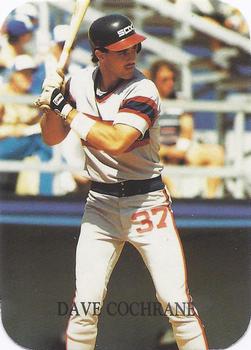
#219 – Dave Cochrane

dcochrane

Name: Dave Cochrane

Rank: 219

Position: 3B

Year With White Sox: 1986

Dave Cochrane joined the White Sox organization on July 16, 1985, when he was acquired from the Mets in exchange for Tom Paciorek.  The following year, he was a September callup for the White Sox, making his major league debut on September 2, 1986 against the Royals.  Cochrane appeared in 19 games for the White Sox down the stretch in a season that saw the team lose 90 games.

Despite hitting .271 with 15 home runs for Triple A Hawaii in 1987, Cochrane did not get a chance to return to the major leagues.  On February 3, 1988, he was packaged along with Floyd Bannister in a trade with the Royals that brought back John Davis, Greg Hibbard, and Melido Perez.

Cochrane’s numbers in a White Sox uniform were:

Continue reading →