#259 – Scott Bradley

scottbradleyName: Scott Bradley

Rank: 259

Position: C

Year With White Sox: 1986

Scott Bradley joined the White Sox on February 13, 1986 along with Neil Allen and a minor leaguer who never sniffed the big leagues from the Yankees in exchange for Ron Hassey, Matt Winters, and two additional minor leaguers who would never again heard from.  Bradley spent the majority of his time with the White Sox in Triple A, earning a promotion to the big league club on May 28th after the release of Marc Hill.  With Carlton Fisk and Joel Skinner also on the roster, Bradley wasn’t going to be limited to catching.  “Wherever they want to play me is fine with me,” Bradley said. “The whole key is being here.”

He wasn’t there for long, though.  On June 26, his short stay in Chicago came to an end when he was traded to the Mariners for a player to be named later, which, 5 days later, became Ivan Calderon.

Bradley’s numbers in a White Sox uniform were:

Continue reading →

#262 – Ben Davis

ben-davisName: Ben Davis

Rank: 262

Position: C

Year With White Sox: 2004

Ben Davis was acquired by the White Sox along side Freddy Garcia in the June 27, 2004 trade that sent Mike Morse, Miguel Olivo, and Jeremy Reed to the Mariners.  Davis appeared in 54 games for the White Sox after the trade, putting up an anemic .231 batting average.

He re-signed with the White Sox for the 2005 campaign, but the arrival of A.J. Pierzynski meant Davis started the year in Triple A Charlotte.  He only appeared in 10 games before a fractured finger and a right elbow injury ended his season.  He underwent Tommy John surgery, was released at the end of the season, and never played in the major leagues again.

Davis’s numbers in a White Sox uniform, both for games I attended and overall, were:

Continue reading →

2014 Hall Of Fame Ballot – The Holdovers

mlb_hofThe BBWAA released their ballot for the Hall of Fame class of 2014.  The results of the vote are due to be revealed on January 8th, with induction taking place next July.  After nobody was elected in last year’s voting, the new ballot contains 17 holdovers along with 19 newcomers, which may start to cause a bit of a problem.  The current BBWAA rules limit the number of votes on one ballot to 10, and there may be more than 10 deserving candidates.  As they start to pile up, and even more deserving candidates become eligible, the BBWAA and the Hall may find themselves with a mess on their hands.

Let’s take a look at the returning candidates today before moving on to the newcomers.

Jeff Bagwell
Years on ballot: 3
2013 Percentage: 59.6

Bagwell is going to be one of those candidates that, I think, gets hurt due to 10 vote limit.  He would have been elected already were it not for seemingly unfounded PED rumors.

Craig Biggio
Years on ballot: 1
2013 Percentage: 68.2

Biggio was the highest vote getter in last year’s election, only 39 votes shy of getting elected.  You would think he could make up that total this year as voters who have some inane theories on when someone deserves to be elected add him to their ballot.  It would be a boost to the Astros if both he and Bagwell were to go in together.

Barry Bonds
Years on ballot: 1
2013 Percentage: 36.2

Barry Bonds, he of the 7 MVP awards and 762 career home runs, found himself on the outside looking in after his initial run through the voting process.  Due to his connection to BALCO and PEDs, he’s unlikely to do much better this year.

Roger Clemens
Years on ballot: 1
2013 Percentage: 37.6

Roger Clemens, he of the 354 career victories and 7 Cy Young awards, also found himself on the outside looking in after his initial run through the voting process.  The interesting thing is that, despite his inclusion in the Mitchell Report and his connection to Andy Pettitte’s PED confession, Clemens picked up 8 more votes than Bonds.

Edgar Martinez
Years on ballot: 4
2013 Percentage: 35.9

The longtime DH for the Mariners has had plenty of support from the Internet but not as much from the BBWAA.  His long career as a DH may be holding him back.

Don Mattingly
Years on ballot: 13
2013 Percentage: 13.2

Back in 2010, I said that “being the best Yankee in a decade of bad Yankee teams does not a Hall of Famer make.”  Nothing that has happened since then would change my, or, seemingly, the voters, mind.

Fred McGriff
Years on ballot: 4
2013 Percentage: 20.7

A very good argument could be made that Fred McGriff has been hurt by the PED users more than anyone else.  Had he stuck around to hit an additional 7 home runs, he would likely have been elected thanks to his 500 home runs.  Without them, he gets penalized for not putting up better numbers than the PED users, who are also being penalized.  Doesn’t seem right.

Mark McGwire
Years on ballot: 7
2013 Percentage: 16.9

McGwire finds himself over 100 votes behind fellow PED users Barry Bonds and Roger Clemens.  Even if the voters do start to reverse track and start to vote for the convicted users, I think McGwire might still have trouble getting elected.

Jack Morris
Years on ballot: 14
2013 Percentage: 67.7

Morris enters his final year on the ballot needing only 42 additional votes to get enshrined, but with the influx of new, and exceptionally deserving, candidates,  I don’t see how he gets them.  Not that I would be too disappointed in that, as Morris, while a very good pitcher, falls short in my estimation.

Continue reading →

Ballpark Tour: Comiskey Park II/US Cellular Field

20109565

Stadium Name: Comiskey Park II/US Cellular Field

Location: Chicago

Home Team: White Sox, Marlins

Years in Service: 1991 – Present

Visits: 361

On the evening of June 30, 1988, with time literally stopped, the Illinois legislature passed a bill that provided the financing for a new stadium for the White Sox, stopping them from moving to St. Petersburg, Florida.  2 and a half years later, on April 18, 1991, Comiskey Park II opened, the first new major facility built in Chicago since the erection of the Chicago Stadium in 1929.  Sadly, the White Sox were destroyed by the Tigers 16-0 in the opening of their new park.

Unfortunately for the White Sox, the new Comiskey Park was also the last stadium to be built prior to the wave of retro ballparks that started with the opening of Camden Yards the following year.  Because of this, there have been numerous renovations to the park, starting in 2001 with the addition of nearly 2000 seats and the relocation of the bullpens.  More extensive renovations began in 2003 in preparation for that season’s All Star Game and using the money generated from selling the naming rights to US Cellular, and conrinued through 2007, when the replacement of the blue seats with green seats was completed.

In 2004, the reigning World Series champion Florida Marlins called the stadium home for a series against the Montreal Expos thanks to Hurricane Ivan, the first time the defending World Series champions had played a home game in Chicago since 1918.  One year later, the stadium hosted its first World Series game, the first to be played in Chicago since 1959, as the White Sox went on to sweep the Houston Astros and win their first World Series since 1918.

I attended my first game at the new Comiskey Park on April 20, 1991, the second game in the stadium’s history.  Since then, I’ve been to 360 other games at the stadium, the majority coming from 2005 on, when I became a season ticket holder.  I went to both games of the 2000 ALDS, which the White Sox lost to the Mariners, both games of the 2005 ALDS, which the White Sox won against the Red Sox, both games of the 2005 ALCS, which the White Sox split against the Angels, and game 2 of the 2005 World Series.  I attended game 163 of the 2008 season to break the tie between the White Sox and the Twins. and then the two ALDS games against the Rays, the first time I saw the White Sox actually end a post-season series, either in victory or defeat.

Notable regular season games I’ve seen at US Cellular Field include the September 13, 2004 game between the Marlins and the Expos, the April 16, 2005 game where Mark Buehrle defeated the Mariners in 1 hour and 39 minutes, the April 2, 2006 season opener against the Indians when the World Series championship banner was raised, the April 4, 2006 game where the players received their World Series rings, and the September 16, 2007 game where Jim Thome hit his 500th career home run against the Angels.

#271 – Jerry Don Gleaton

Jerry-Don-Gleaton-White-SoxName: Jerry Don Gleaton

Rank: 271

Position: P

Years With White Sox: 1984-1985

With the White Sox struggling to repeat as AL West champions, they made a move to shore up the bullpen, sending Salome Barojas to the Mariners in exchange for Jerry Don Gleaton and Gene Nelson.  Gleaton put up good numbers in Triple A for the White Sox and was eventually called up to the big leagues, appearing in 11 games.

Gleaton again split the 1985 season between Triple A and the White Sox, with more success in Triple A.  He made it in to 31 games for the White Sox, but put up a 5.76 ERA.

Gleaton spent all of 1986 in Triple A before leaving the White Sox organization as a free agent.

Gleaton’s numbers in a White Sox uniform, both for games I attended and overall, were: Continue reading →

Ballpark Tour: Comiskey Park

comiskeyout2

Stadium Name: Comiskey Park

Location: Chicago

Home Team: White Sox

Years in Service: 1910 – 1990

Visits: 12 (that I’m aware of)

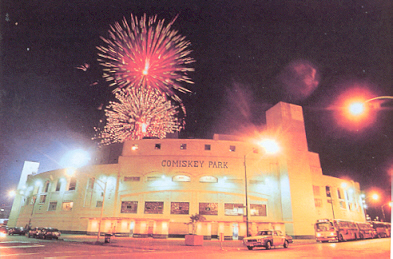
Comiskey Park, the so-called Baseball Palace of the World, was the home of the White Sox from 1910 through the 1990 season.  Built on a former city dump at the corner of 35th Street and Shields Avenue, the stadium opened as White Sox Park on July 1, 1910, as the White Sox lost to the St. Louis Browns 2-0.  In 1913, owner Charles Comiskey renamed the stadium after himself, and Comiskey Park was born.  From 1962 until 1975, the White Sox Park name was officially re-establshed, as new ownership groups tried to separate themselves from the Comiskey name.  However, Bill Veeck, in his second tour of duty as owner of the White Sox, put the Comiskey Park name back on the stadium in 1976, where it remained until 1990.  The final game for the old ballyard occurred on September 30, 1990, a 2-1 victory over the Mariners.

Comiskey Park was the host for 4 World Series contests, including 3 in a row from 1917-1919.  The White Sox won the World Series in 1917 against the New York Giants.  The Cubs, looking for a larger seating capacity, moved their home games in the 1918 series against the Red Sox to Comiskey Park.  The 1919 World Series, of course, was the Black Sox scandal, where the White Sox threw the series against the Reds.  The White Sox returned to the World Series 40 years later in 1959, but fell to the Dodgers.  The final post-season games to be played in Comiskey Park were games 3 and 4 of the 1983 ALCS, which the White Sox lost to the Baltimore Orioles.

Comiskey Park was also the host to 3 All-Star games.  The first All-Star game ever, in 1933, was held in conjunction with Century of Progress Exposition being held on Chicago’s lakefront.  The event returned to Chicago’s south side in 1950.  The final All-Star game at Comiskey Park was in 1983, the 50th anniversary of the first game.  Comiskey Park was also the frequent home of the Negro League East-West All-Star Game from 1933 to 1960.

In addition to White Sox baseball, Comiskey Park was also the home to the Chicago American Giants of the Negro Leagues, the Chicago Cardinals of the NFL, and the Chicago Sting of the NASL.  Comiskey Park also hosted numerous boxing matches, including the 1937 heavyweight title match where Joe Louis defeated then champion James J. Braddock.  The Beatles played two concerts at Comiskey Park in August of 1965.  Other musical acts to perform there include Aerosmith, AC/DC, The Eagles, The Police, Simon & Garfunkel, and The Jacksons, who performed 3 shows during their Victory tour in October of 1984.

Looking back, I’ve been able to piece together evidence of 12 games that I attended at Comiskey Park.  I know there are more, but I have not been able to pinpoint exact games yet.  The most memorable game I can remember would be the final night game, on September 29, 1990, where, after the game, the lights were symbolically turned off for the final time.

#276 – Jon Rauch

jon_rauch_autograph

Name: Jon Rauch

Rank: 276

Position: P

Years With White Sox: 2002. 2004

Jon Rauch was selected in the 3rd round of the 1999 draft by the White Sox.  Rauch worked his way through the minor league system and made his major league debut on April 2, 2002, closing out the White Sox loss against the Mariners.  Rauch, who remains the tallest player in major leage history, struggled against major league hitters and was quickly demoted back to Triple A.

Rauch returned to the major leagues in 2004, but again had difficulty getting batters out.  On July 18, he was sent to the Expos along with Gary Majewski in exchange for Carl Everett.

Rauch’s numbers in a White Sox uniform, both for games I attended and overall, were:

Continue reading →

2013 Final Standings

MLB: Cincinnati Reds at Los Angeles DodgersA miserable baseball season in the city of Chicago came to an end last weekend, with the White Sox and the Cubs combining for the most losses in the history of the teams sharing the city.  I saw less than half of the teams in the league this year, and attended on 29 games, the fewest I’ve seen since I started getting Cub season tickets back in 2002.  On the bright side, the White Sox and Cubs will both draft in the top 5 next June, which will hopefully help them both get back to the top of their respective Central divisions sooner rather than later.

That said, here’s our final look at the records in games I attended this past season.

 
TeamCity TeamName Won Loss Winning Pctg
Cleveland Indians 4 0 1
Tampa Bay Rays 2 0 1
Chicago Cubs 2 0 1
Minnesota Twins 4 1 0.8
Kansas City Royals 3 1 0.75
Los Angeles Angels 1 1 0.5
Chicago White Sox 11 16 0.407407407407407
Continue reading →

Ballpark Tour: Miller Park

Stadium Name: Miller Park

Location: Milwaukee

Home Team: Brewers, Indians, Astros

Years in Service: 2001 – Present

Visits: 4

After spending the first 26 years of their existence in Milwaukee’s County Stadium, the Brewers broke ground on a new stadium on November 9, 1996, in a parking lot behind County Stadium, with plans to open the park for the 2000 season.  Construction was delayed in 1999 after a crane collapsed while lifting a 400-ton roof section, killing three workers.  This caused the opening to be delayed for a year, and the new Miller Park did not open until April 6, 2001.  In 2007, the stadium hosted an Indians series against the Angels after snow storms in Cleveland forced the cancellation of the previous series against the Mariners.  The Astros called Miller Park home for two games in 2008 when Hurricane Ike stormed through Houston.

I made the first of my four visits to Miller Park during the inaugural season of 2001.  That May 7th contest had the Cubs squeaking out a 7-6 victory against the hosting Brewers.  This was my first experience with a retractable roof stadium and I enjoyed it.  Miller Park was a vastly superior replacement over County Stadium, and I’ve enjoyed each of my subsequent trips up to Milwaukee.

All Star Break Standings

With the All Star Game on the agenda for tonight, it’s time to take a look at the team records for the 16 games I’ve been to in the first half.  It’s been a disappointing 3 months for both Chicago teams, although one of them was expecting it.

Team Won Lost Winning Pctg
Tampa Bay Rays 2 0 1
Minnesota Twins 2 0 1
Cleveland Indians 3 0 1
Chicago Cubs 2 0 1
Los Angeles Angels of Anaheim 1 1 0.5
Chicago White Sox 6 8 0.429
Seattle Mariners 0 2 0
Milwaukee Brewers 0 1 0
Miami Marlins 0 2 0
Kansas City Royals 0 1 0
Houston Astros 0 1 0