National Mascot Day

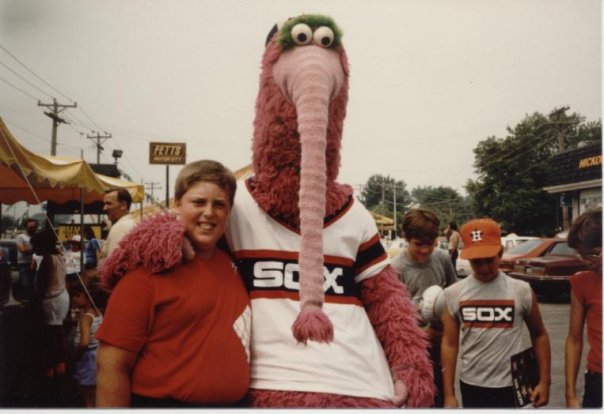
In honor of National Mascot Day, I thought it would be a treat to look back at the history of White Sox mascots.  After purchasing the team in 1981, Jerry Reinsdorf and Eddie Einhorn looked to upgrade the team’s marketing and community relations efforts.  One of those moves was to hire the same firm that designed the Phillie Phanatic to come up with modern mascots for the White Sox.  Ribbie, a purple anteater, and Roobarb, whatever he was supposed to be, debuted in September of 1981 and, as with most things involving Jerry Reinsdorf and company, the introduction of the pair was tainted with controversy: the removal of Andy the Clown.

While never an official mascot or team employee, Andy Rozdilsky had been appearing at Comiskey Park in a clown costume since 1960, usually given free admission by the ushers.  He would wander the stands, yelling “Cooooommeeee Onnnnnnn Youuuuuu Whiiiiiiiite Soxxxxxxxxxxx!” and had a nose that would light up whenever a child shook his hand. On the day Ribbie and Roobarb were introduced, Andy the Clown was told he had to pay his own way into the ballpark.  The controversy tainted the new mascots in many fans’ minds, and they were retired following the 1988 season.

In 2004, the team introduced a new mascot, the fuzzy green dude himself, Southpaw.  He has been a fixture on the South Side ever since, and has resonated with fans, young and old alike, in ways his predecessors didn’t, which has enabled him to endure for over 22 seasons.

Book 39 (of 52) – The Truth Hurts

The Truth Hurts – Jimmy Piersall with Richard Whittingham

In The Truth Hurts, Jimmy Piersall, with help from Richard Whittingham, tells the story of his major league career starting in 1953 with his return from “nervous exhaustion” through his tumultuous broadcast career with the White Sox in the late 70s and early 80s.  Of course, my interest was in the later parts, working with Harry Caray and his battles with Bill Veeck, Eddie Einhorn, Jerry Reinsdorf, and Tony LaRussa.

Piersall’s tenure in the White Sox booth was just before my time, so all I knew were a few highlights here and there and stories.  If even half of what he says about Tony LaRussa is true, then it is surprising that he ever became the “Hall of Famer baseball person” that he turned out to be.  Piersall’s association with the White Sox ended in 1983, but he continued to be a Chicago-area presence until his 2017 death.

100 Years Of Innovation

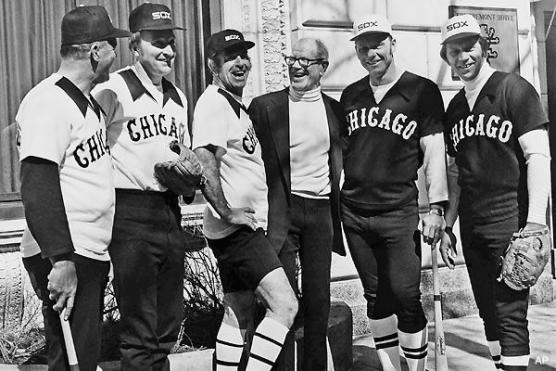
1976 Chicago White Sox100 years ago today, Bill Veeck, the former club treasurer for the Cubs and two-time owner of the White Sox, was born here in Chicago.  Veeck followed his father, the then president of the Cubs, into baseball.  As a 13 year old, Veeck came up with the idea of planting ivy to cover the outfield walls at Wrigley Field.  In 1937, as general manager, he oversaw the construction of the iconic hand operated scoreboard that is still in use today.

Veeck left the Cubs in 1941, striking out on his own and buying the minor league Milwaukee Brewers.  While he owned the team, he also served in the Marines during World War II, where he injured his leg, which required amputation.  After the war, Veeck sold his interests in the Brewers and bought the Cleveland Indians, returning to the major leagues.  In July of 1947, Veeck broke the color barrier in the American League by signing Larry Doby.  In 1948, the Indians won their first World Series title since 1920.  Veeck was forced to sell the Indians in 1949 due to his divorce.

2 years later, Veeck was back in business, purchasing the St. Louis Browns.  While trying to force the Cardinals out of town, Veeck came up with one of his most famous, or perhaps infamous, stunts, signing Eddie Gaedel, standing 3 feet and 7 inches tall, and sending him to the plate in the second game of a double header against the Detroit Tigers on August 19, 1951.  Gaedel walked on four pitches and was lifted for a pinch runner.  American League president Will Harridge voided Gaedel’s contract the next day, claiming that Veeck was making a mockery of the game. In response, Veeck threatened to request an official ruling on whether Yankees shortstop Phil Rizzuto, the reigning MVP, was a short ballplayer or a tall midget.

Continue reading →

30 For 30 – See A Game At A Classic Ballpark

Cubs_L_flag_070602The fine folks at away.com have come up with a list of 30 Things Every Traveler Must Do Before They’re 30.  Of those 30, I’ve managed to accomplish 12 of them, or roughly 40% of them, some of which was even before I turned 30.  Today we look at #20 on their list, see a game at a classic ballpark.  Thankfully, I’ve never had to travel far to do this.

From my birth in 1974 until the end of the 1990 season, I was lucky enough to have two classic ballparks right here in my own backyard.  Comiskey Park was at one time considered to be the “Baseball Palace of the World”, although it had fallen on hard times by the time I was old enough to enjoy it.  Struggling White Sox ownership groups over the years had put off necessary repairs and preventative maintenance so that, by the time the group led by Jerry Reinsdorf and Eddie Einhorn purchased the club from Bill Veeck, the stadium needed a lot of work.  After deciding that it would be prohibitavely expensive to repair the park, the new owners worked at getting funding for a new stadium and, on September 30, 1990, the White Sox defeated the Mariners in the last game ever in what is now known as Old Comiskey Park.

The almost exact opposite was happening on the other side of town.  The Cubs were also under new ownership in the early 80s, but instead of telling everyone who would listen how run down their stadium was, they sold the history of the ballpark and the experience of it to great success.  The lore of the Friendly Confines was born, and, thanks to the superstation status of WGN television, people came from all over the country to be at Wrigley Field.  For some of them, the game itself was unimportant.  Wrigley Field in general, and the bleachers specifically, became Chicago’s biggest (and most expensive) beer garden.  Time, however, doesn’t care how much fun people are having or how much Old Style is flowing, and Wrigley Field has shown its age in recent years.  As we sit here one month into the 99th year of baseball at the corner of Clark and Addison, the Cubs are working hard on a plan to renovate the stadium so that it can be used well into its second century.  Maybe the Cubs will even win a World Series there.

I’ve been able to identify 12 games that I attended at the Old Comiskey Park before they tore her down, including the final night game on September 29, 1990.  My Wrigley Field attendance is currently at 312 games and counting.