By The Numbers – 20

In 1929, uniform numbers appeared on the back of baseball jerseys for the first time, thanks to the Indians and the Yankees.  By 1937, numbers finally appeared across all uniforms, both home and away, across both major leagues.  Since that time, 81 distinct numbers have been worn by members of the White Sox, while the Cubs boast 76.

Today, we continue our look at those players, picking our favorite, if not the best, player to wear each uniform number for both Chicago teams with #20.  85 different players have donned #20 while playing in Chicago, 30 for the White Sox and 55 for the Cubs.

Carlos Quentin was acquired by the White Sox in a December 2007 trade with the Diamondbacks for Chris Carter, earning the nickname “The Carlos Quentin” after general manager Kenny Williams was quoted saying that the team’s goals for the winter meetings were to “acquire Carlos Quentin, and not a guy like him but actually Carlos Quentin.”  Quentin played immediate dividends, breaking through in a big way for the 2008 White Sox.  He was leading the American League in home runs and was third in slugging percentage, OPS, and RBIs when he broke his wrist slamming his bat following a strikeout against Cliff Lee, causing him to miss the last 6 weeks of the season.  The injury likely cost him the MVP award, and certainly impacted the White Sox, as their battle with the Twins for the AL Central title came down to 163rd game and left the starting rotation is disarray before playing, and eventually losing to, the Rays in the ALDS.

Quentin continued to struggle with injuries for the remainder of his White Sox career, never appearing in more than 131 games.  A shoulder injury ended his 2011 season, and his White Sox career, at the end of August.  That December, just over 4 years since he was acquired, Quentin was shipped to the Padres, for Simon Castro and Pedro Hernandez.

On the north side of town, Corey Patterson switched to #20 when he was recalled to the Cubs in 2001, appearing in 51 games and hitting only .221.  He became a full time player in 2002, hitting .253 in 153 games and slugging 14 home runs while driving in 54.  He was breaking out in 2003, becoming the threat the Cubs had hoped he would be, with a .839 OPS, a .298 average, and 13 and 55 for the power numbers when a torn ACL ended his season on July 6.  He returned in 2004, playing 157 games and hitting .266, but was never quite the same player as before the injury.  2005 was not a good season for Patterson, as he saw himself demoted in July following an 8-game losing streak.  Following the season, he was traded to the Orioles.

2020 Hall Of Fame Ballot – The Newcomers


baseballhof

The BBWAA recently released their ballot for the Hall of Fame class of 2020. The results of the vote are due to be revealed on January 21st, with induction taking place July 26th.  After Mariano Rivera, Mike Mussina, Edgar Martinez, and Roy Halladay were elected in last year’s voting, the new ballot contains 14 holdovers along with 18 newcomers, which may potentially continue the logjam caused by the current BBWAA rules which limit the number of votes on one ballot to 10 and the ongoing refusal by some writers to vote for players tainted by PEDs, leaving too many qualified candidates fighting for limited spots.

Yesterday, we looked at the returning candidates.  Today, it’s time to look at the newcomers and who may be thankful come January.

Bobby Abreu

I’ll be honest, I can see him getting some modest support, but I never considered him a Hall of Fame player during his career.

Josh Beckett

I’m sure he’ll get some support, but I don’t see it translating into an eventual election.

Heath Bell

I wonder what it feels like to be placed on the ballot knowing that you won’t earn even a single vote.

Eric Chavez

Again, I’m sure he’ll see a little support, but he’s not going to make it.

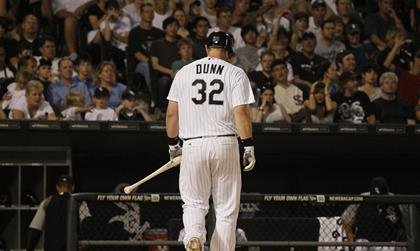
Adam Dunn

There aren’t enough home runs in the world to make up for the rest of his game.

Chone Figgins

Come on, now.  This is getting a little ridiculous.

Rafael Furcal

A career to be proud of, but not one that ends with election to the Hall.

Jason Giambi

The 2000 AL MVP should stick around on the ballot, but the PED stigma will likely keep him on the outside looking in.

Raul Ibanez

The former slugger may get a little support, but not enough to keep him on the ballot for a second go-around.

Derek Jeter

The only question here is whether he will join his former teammate, Mariano Rivera, in getting 100% of the vote.

Paul Konerko

Personal feelings aside, he will likely see enough support to hang on the ballot, but not enough to actually make it.

Cliff Lee

Continue reading →

#18 – Carlos Quentin

Name: Carlos Quentin

Rank: 18

Position: LF/RF

Years With White Sox: 2008-2011

Carlos Quentin was acquired by the White Sox in a December 2007 trade with the Diamondbacks for Chris Carter.  He earned the nickname “The Carlos Quentin” after general manager Kenny Williams was quoted saying that the team’s goals for the winter meetings were to “acquire Carlos Quentin, and not a guy like him but actually Carlos Quentin.”  Quentin played immediate dividends, breaking through in a big way for the 2008 White Sox.  He was leading the American League in home runs and was third in slugging percentage, OPS, and RBIs when he broke his wrist slamming his bat following a strikeout against Cliff Lee, causing him to miss the last 6 weeks of the season.  The injury likely cost him the MVP award, and certainly impacted the White Sox as they battled the Twins for the AL Central title before eventually losing to the Rays in the ALDS.


Quentin continued to struggle with injuries for the remainder of his White Sox career, never appearing in more than 131 games.  A shoulder injury ended his 2011 season, and his White Sox career, at the end of August.  That December, just over 4 years since he was acquired, Quentin was shipped to the Padres, for Simon Castro and Pedro Hernandez.

Quentin’s numbers in a White Sox uniform, both for games I attended and overall, were:

Continue reading →

Goodbye To The Q

Former White Sox outfielder Carlos Quentin, who finished 5th in MVP voting in 2008 despite missing the final six weeks of the season with a broken wrist, announced his retirement after 9 seasons.  After being released in spring training after being acquired by the Braves in a trade, Quentin had been playing with the Mariners’ Triple A club, but was hitting only .176 in 17 at bats.

After spending parts of the 2006 and 2007 seasons with the Diamondbacks, Quentin was acquired by the White Sox in a December 2007 trade.  He earned the nickname “The Carlos Quentin” after general manager Kenny Williams was quoted saying that the team’s goals for the winter meetings were to “acquire Carlos Quentin, and not a guy like him but actually Carlos Quentin.”

Quentin played immediate dividends, breaking through in a big way for the 2008 White Sox.  He was leading the American League in home runs and was third in slugging percentage, OPS, and RBIs when he broke his wrist following a strikeout against Cliff Lee.  The injury likely cost him the MVP award, and certainly impacted the White Sox as they battled the Twins for the AL Central title before eventually losing to the Rays in the ALDS.

Quentin continued to struggle with injuries for the remainder of his White Sox career, never appearing in more than 131 games.  A shoulder injury ended his 2011 season, and his White Sox career, at the end of August.  That December, just over 4 years since he was acquired, Quentin was shipped to the Padres.

In 3 years with the Padres, injuries continued to plague Quentin, as he failed to appear in 90 games in any season.  His most famous (or infamous) moment with the Padres was the April 11, 2013 brawl against the Dodgers, where he broke Zach Greinke’s collarbone after being hit by a pitch.

This spring, Quentin was traded to the Braves, who promptly released him.  He had signed on with the Mariners in the hopes of working his way back to the major leagues, but his history of injuries had finally caught up to him and caused him to call it a day.

Quentin’s numbers in a White Sox uniform, both for games I attended and overall, were:

Continue reading →