Playoff Pitching Leaders

The Cubs dispatched the Padres yesterday to win their Wild Card series and will be heading to the NLDS against the Brewers this weekend.  While we wait, it’s time to take our updated look at the pitching leaders from the now 33 post-season games I’ve attended since the White Sox won the AL Central in 2000.

Wins

Name Total
Mark Buehrle 2
Jon Lester 2
Jake Arrieta 2
27 tied with 1

Losses

Name Total
Matt Clement 2
31 tied with 1

ERA (> 6 IP)

Name Total
Aroldis Chapman 0.00
Stephen Strasburg 0.00
Kyle Freeland 0.00
Johnny Cueto 1.13
Chad Billingsley 1.35

Strikeouts

Name Total
Jon Lester 25
Jake Arrieta 22
Mark Buehrle 13
Continue reading →

Playoff Batting Leaders

With their Wild Card Series tied at a game apiece, the Cubs will battle against the Padres this afternoon for the rights to move on and face the Brewers in the NLDS.  With that in mind, it’s time to take an updated look at the offensive leaders from the now 33 post-season games I have attended since 2000.  So, without further ado, we start off with:

Home Runs

Name Total
Kris Bryant 4
Javier Baez 3
Paul Konerko 3
B.J. Upton 3
Dexter Fowler 3
Enrique Hernandez 3

Hits

Name Total
Kris Bryant 11
Javier Baez 11
Dexter Fowler 10
Anthony Rizzo 10
Moises Alou 9
Jason Heyward 9

Runs

Name Total
Dexter Fowler 7
Paul Konerko 6
Daniel Murphy 6
A.J. Pierzynski 5
Kris Bryant 5
Javier Baez 5
Continue reading →

All Time Playoff Team Records

We’ve made it through 162 games and, for the first time since 2020, the Cubs are in the post-season as the top-seeded Wild Card in the National League.  In a rematch of the 1984 NLCS, they start a best of three series against the Padres at Wrigley Field today.  The winner of that series will advance to the NLDS and face the Brewers starting Saturday.

It’s time to take an updated look at the team records for the now 33 playoff contests I have attended. These contests come from the 2018 Wild Card game, the ALDS in 2000, 2005, 2008, and 2021, the NLDS in 2003, 2007, 2008, 2015, 2016, and 2017, the NLCS in 2003, 2015, 2016, and 2017, the ALCS in 2005, and, of course, the 2005 and 2016 World Series.

Post-Season Team Records

Team Name Won Loss Winning Pctg
Florida Marlins 3 0 1.000
Seattle Mariners 2 0 1.000
New York Mets 2 0 1.000
Colorado Rockies 1 0 1.000
Arizona Diamondbacks 1 0 1.000
Chicago White Sox 6 5 0.545
Los Angeles Dodgers 3 3 0.500
Atlanta Braves 1 1 0.500
Cleveland Indians 1 1 0.500
Los Angeles Angels 1 1 0.500
Washington Nationals 1 1 0.500
Tampa Bay Rays 1 1 0.500
Chicago Cubs 9 13 0.409
Houston Astros 1 2 0.333
San Francisco Giants 0 2 0.000
St. Louis Cardinals 0 1 0.000
Boston Red Sox 0 2 0.000

Switching Sides Revisited

Five years ago today, the White Sox continued their selloff and pulled off the trade that many said couldn’t be done, sending Jose Quintana to the Cubs in exchange for Eloy Jimenez, Dylan Cease, Matt Rose, and Bryant Flete.  At the time, the Cubs were looking for a boost to their starting rotation as one of the strengths of their championship season the year before had turned into a question mark during the first half of 2017.  For the rebuilding White Sox, Jimenez, who was the 8th ranked prospect in baseball, and Cease, who was the 63rd, gave them nine out of the top 100 prospects.

So how did it work out, five years later?  You can say the White Sox were the runaway winners of the trade, but not for the reasons you would have thought five years ago.  After a slow start in his rookie campaign in 2019, Jimenez seemed to figure things out down the stretch and followed that up with an pandemic-abbreviated 2020 campaign that earned him the Silver Slugger.  Unfortunately, he’s played less than 75 games since, with major injuries keeping him on the shelf for large portions of the 2021 and 2022 seasons.  When he has played, he hasn’t yet been able to put together the type of production he showed in previous years.

Dylan Cease, on the other hand, has turned into the ace of the White Sox staff.  After a slow start in 2019 after making his debut in early July, Cease has improved each season.  He currently leads the American League in strikeouts and is widely considered one of, if not the biggest, snub for this year’s All Star team.

Quintana, meanwhile, spent parts of four seasons with the Cubs, going 33-23 with a 4.24 ERA.  He was decent, but not great, and the Cubs never were able to replicate their 2016 success.  In the postseason, he appeared in four games in 2017, two each in the NLDS and NLCS,

By The Numbers – 6

In 1929, uniform numbers appeared on the back of baseball jerseys for the first time, thanks to the Indians and the Yankees.  By 1937, numbers finally appeared across all uniforms, both home and away, across both major leagues.  Since that time, 81 distinct numbers have been worn by members of the White Sox, while the Cubs boast 76.

Today, we continue our look at those players, picking our favorite, if not the best, player to wear each uniform number for both Chicago teams with #6.  67 different players have donned #6 while playing in Chicago, 27 for the White Sox, who haven’t retired it but have not issued it since 1995, and 42 for the Cubs.

In his second go-around with the Cubs after being selected off waivers from the Mariners on July 6, 1998, Glenallen Hill, wearing #6. hit .351 with 8 homers and 23 RBIs in 48 games.  He appeared in one game during the NLDS against the Braves, where he was one for three with a run batted in and a stolen base.  Returning in 1999, Hill hit .300 with 20 home runs and 55 runs batted in.  On May 11, 2000, Hill became the first, and thus far only player to hit a home run on the three-story residential building across Waveland Ave. from Wrigley Field in the second inning of the Cubs’ 14–8 loss to the Brewers.  With the Cubs far out of contention, he was traded to the Yankees on July 23.

On the south side of town, Jorge Orta signed with the White Sox out of the Mexican Baseball League in 1972 and made the team out of spring training.  Playing shortstop, Orta batted just .211 through the middle of May before losing his job.  He returned to Chicago when rosters expanded that September.  Orta was shifted to second base for the 1973 season after batting over .500 in spring training.  Playing through injuries for much of the year, he batted .266 and tied for second in the league with eighteen errors among second basemen.

Orta began the 1974 season batting at the bottom of the White Sox line-up but was moved up to the two spot Chuck Tanner’s batting order, hitting .411 with 23 runs scored in the month of June.  For the season, his .316 batting average was second only to Rod Carew.  In 1975, Orta batted .296 with four home runs and 46 RBIs in the first half, good enough to be named to the All-Star team.  He topped that by hitting .314 with seven home runs and 37 RBIs in the second half.

New manager Paul Richards opted to move Orta to third base for the 1976 season, which proved to be a poor decision.  Orta was eventually moved into the outfield and the Sox narrowly avoided a hundred losses while Orta hit .274 with hitting a career-high fourteen home runs and scoring a career high 74 runs.  Orta returned to second base when Bob Lemon took the reins as manager in 1977.  The surprising White Sox, dubbed the South Side Hitmen, won 90 games and Orta, now batting third, finished second on the team with a career high 84 RBIs.  He remained at second in 1978, but new player-manager Don Kessinger deployed Orta as the designated hitter in 1979, a role Orta struggled with, putting up a .212 batting average, three home runs and 21 RBIs through June 27.  Orta returned to second base in the middle of July, and batted .313 with seven home runs and 22 RBIs the rest of the way on his way to free agency.

By The Numbers – 16

In 1929, uniform numbers appeared on the back of baseball jerseys for the first time, thanks to the Indians and the Yankees.  By 1937, numbers finally appeared across all uniforms, both home and away, across both major leagues.  Since that time, 81 distinct numbers have been worn by members of the White Sox, while the Cubs boast 76.

Today, we continue our look at those players, picking our favorite, if not the best, player to wear each uniform number for both Chicago teams with #16.  65 different players have donned #16 while playing in Chicago, 24 for the White Sox, who retired the number in 1987, and 41 for the Cubs.

Aramis Ramirez switched to his familiar #16 shortly after being acquired by the Cubs from the Pirates.  Ramírez finished the 2003 season strong, appearing in 63 games down the stretch and hitting 15 home runs while helping the Cubs capture their first division title since 1989.  He managed 11 hits during the post-season, including 4 home runs and 10 RBIs and hitting the first playoff grand slam in Cubs’ history during Game 4 of the NLCS.  The following year, Ramirez became the 14th player in baseball history to hit 3 home runs in 2 different games in the same season.  While his offense remained strong, posting a .951 OPS, his defense was a bit of a liability, as he posted the lowest range factor among all third basemen.

Ramirez was elected to his first All-Star Game in 2005.  He finished the season with 31 home runs and 92 RBIs despite missing the last month of the year with a strained quadriceps femoral muscle.  While his defense continued to suffer in 2006, with his third straight season with the lowest range factor, his offense continued to carry the load.  He collected his 1000th hit in July against the Mets and ended up with 38 home runs, 119 RBIs, and an OPS of .912.  A free agent at the end of the season, he re-signed with the Cubs, scoring a 5-year, $73 million contract.

In April of ’07, Ramirez launched his 200th career home run.  His continued offensive presence helped lead the Cubs back to the post-season in 2007 and 2008, winning division titles both seasons.  Unfortunately, Ramirez, like his teammates, went cold in both series as the Cubs were swept in the NLDS each season.  In 2009, Ramirez christened the season with his 250th career home run on Opening Day against Roy Oswalt.  He followed that with #300 in July of 2011 against the White Sox.  Following that season, he declined his portion of a mutual option and became a free agent.

Julio Cruz wore #16 on the southside following his June 1983 acquisition from the Mariners, when he gave the White Sox the spark they were looking for, helping the team go on a 72-31 run to finish the season and go from 6 1/2 games back to 20 games ahead.  Cruz scored the winning run on a Harold Baines sacrifice fly against, of all teams, the Mariners on September 17, clinching the first division title in White Sox history.  Cruz hit .333 during the ALCS against the Orioles, swiping 2 bases in the 4-game series.  Heading in to the 1984 season, Cruz re-signed with the White Sox with a 6-year deal, thought to be worth between $3.6 to $4.8 million.  Unfortunately, time, and injuries, were starting to take their toll.  1984 was the best year of the deal, and Cruz saw his average drop to .222 and he stole only 14 bases, a career low to date.  Following that season, Cruz changed his number from #16 to #12.

Against The Cardinals All Time Leaders – Through 2021

cardinalsIn the past, we’ve looked at the all time leaders in both offensive and defensive categories for all 30 teams. This offseason, we will take our first ever look at those leaders against all 30 clubs.  We continue today with the St. Louis Cardinals.

The Cardinals began life in 1891, joining the National League the following year after the dissolution of the old American Association.  They took on the Cardinal name starting in 1900.  I’ve seen them play 33 times at 3 different stadiums, including the 2015 NLDS and, most recently, last May at Guaranteed Rate Field.

Home Runs

Name Total
Moises Alou 6
Michael Barrett 4
Sammy Sosa 3
Aramis Ramirez 3

Hits

Name Total
Moises Alou 16
Derrek Lee 15
Michael Barrett 14
Aramis Ramirez 14
Corey Patterson 14

Runs

Name Total
Moises Alou 12
Sammy Sosa 12
Aramis Ramirez 10

RBI

Name Total
Moises Alou 14
Michael Barrett 10
Aramis Ramirez 9
Alex Gonzalez 9

Doubles

Name Total
Derrek Lee 6
Alex Gonzalez 4
Ryan Theriot 4

Triples Continue reading →

Against The Braves All Time Leaders – Through 2021

bravesIn the past, we’ve looked at the all time leaders in both offensive and defensive categories for all 30 teams.  This offseason, we will take our first ever look at those leaders against all 30 clubs.  We continue today with the Atlanta Braves.

The Braves began life in Boston, moving to Milwaukee in 1953 and finally landing in Atlanta in 1966.  I’ve seen them play 20 times, 12 against the Cubs, 7 against the White Sox, and once against the Yankees, including games 3 and 4 of the 2003 NLDS against the Cubs.

Home Runs

Name Total
Derrek Lee 2
Eric Karros 2
Frank Thomas 2

Hits

Name Total
Moises Alou 9
Alex Rios 8
Alexei Ramirez 7
Aramis Ramirez 7

Runs

Name Total
Aramis Ramirez 5
Alexei Ramirez 5
Alex Rios 4
Alejandro de Aza 4
Derrek Lee 4

RBI

Name Total
Alex Rios 9
Jeromy Burnitz 5
Derrek Lee 4
Rene Rivera 4

Doubles

Name Total
Derrek Lee 2
Alex Gonzalez 2
Mark Grudzielanek 2
Josh Phegley 2

Triples Continue reading →

By The Numbers – 24

In 1929, uniform numbers appeared on the back of baseball jerseys for the first time, thanks to the Indians and the Yankees.  By 1937, numbers finally appeared across all uniforms, both home and away, across both major leagues.  Since that time, 81 distinct numbers have been worn by members of the White Sox, while the Cubs boast 76.

Today, we continue our look at those players, picking our favorite, if not the best, player to wear each uniform number for both Chicago teams with #24.  104 different players have donned #24 while playing in Chicago, 49 for the White Sox and 55 for the Cubs.
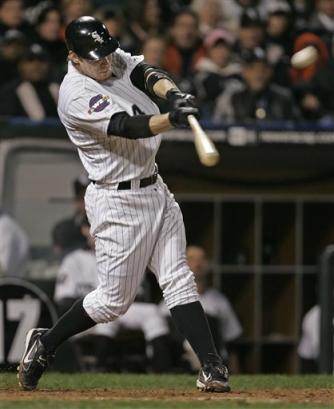
Joe Crede earned a September call-up from Double A in 2000, and, wearing #24, made his major league debut on September 12, replacing Herbert Perry and going 0-1 in the Tigers 10-3 victory at Comiskey Park.  Crede appeared in 7 games, making the most of his 14 at bats, and finished with a .357 average.  Crede got another cup of coffee with the big league club in September of 2001, earning a little more playing time, but he was less successful, finishing with a .220 average in 50 at bats over 17 games.  Crede returned to the White Sox for good in July of 2002.  On August 12, he hit his first major league home run off of former teammate James Baldwin and he finished with 12 home runs, 35 RBIs, and a .285 average.  Crede established himself as the starting third baseman in 2003.  He appeared in a career high 151 games and launched 19 home runs with 75 RBIs while posting a .261 average.  He struggled in 2004, seeing his average drop to .239 while hitting 21 home runs with 69 RBIs.

In 2005, Crede started to come in to his own.  While he improved his average to .252 and hit 22 home runs with 62 RBIs, he came alive in the second half, culminating with a game winning, and possible season saving, home run in the 10th inning against the Indians on September 20, which pushed the White Sox to a 3.5 game lead and propelled them into the playoffs.  Crede had a rough series in the ALDS against the Red Sox, getting only 1 hit in 9 at bats, but rebounded in the ALCS and World Series, hitting .368 and .294 respectively, with 2 home runs in each series.  2006 was Joe Crede’s breakout season.  He hit .283 with career highs in home runs, with 30, and RBIs, with 94, winning his first, and only, Silver Slugger award.  A back injury in 2007 limited him to 47 games and only 4 home runs.  He returned with a bang in 2008, hitting a grand slam on opening day against the Twins and parlayed a good first half into his first All Star selection, but the back injury recurred and kept him out for most of the second half of the season, including the playoffs, thus ending his White Sox career.

On the north side of town, Dexter Fowler joined Cubs via trade prior to the 2015 season.  Donning #24, he ended the year with a .250 average, 102 runs scored, 46 RBIs, 17 home runs, and 20 stolen bases as the Cubs made a surprise run for the NL Wild Card.  Fowler helped propel the Cubs to the NLDS, putting up three hits, three runs scored, a home run, and a stolen base in defeating the Pirates.  In nine postseason games, Fowler batted .396 with two home runs and three RBIs, as the Cubs made it to the NLCS against the Mets.

Fowler became a free agent after the season and was unsigned into the start of spring training.  Despite reportedly agreeing to a three-year contract with the Orioles, Fowler arrived in Cubs camp and signed a one year deal.  And what a year it was.  Fowler finished the year with a .276 average, 13 home runs, 48 RBIs, and 84 runs scored as the Cubs won the NL Central.  Fowler’s .333 average with 4 RBI helped the Cubs win the NLCS against the Dodgers, advancing to the World Series for the first time since 1945.  On October 25, 2016, Dexter Fowler became the first African-American to appear and to bat for the Cubs in a World Series game.  Fowler led off Game 7 of the World Series with a home run, becoming the first player in history to do so, and helping the Cubs win 8–7 in 10 innings, giving the team their first championship in 108 years.

Against The Dodgers All Time Leaders – Through 2021

dodgersIn the past, we’ve looked at the all time leaders in both offensive and defensive categories for all 30 teams. This offseason, we will take our first ever look at those leaders against all 30 clubs. We continue today with the Los Angeles Dodgers.

The Dodgers began life in Brooklyn in 1883, moving to their current home on the west coast, along with their rival Giants, in 1957.  I’ve seen them play 27 times, including the first two games of their 2008 NLDS sweep against the Cubs and their pennant-clinching victory in the 2017 NLCS.

Home Runs

Name Total
Aramis Ramirez 3
Javy Baez 3
Paul Konerko 2
Alexei Ramirez 2
A.J. Pierzynski 2
Josh Fields 2
Willson Contreras 2

Hits

Name Total
Derrek Lee 15
Alfonso Soriano 13
Ryan Theriot 12

Runs

Name Total
Alexei Ramirez 7
A.J. Pierzynski 6
Alfonso Soriano 5
Ryan Theriot 5
Aramis Ramirez 5

RBI

Name Total
Alexei Ramirez 8
Aramis Ramirez 7
Mark DeRosa 7
Paul Konerko 7

Doubles

Name Total
Alexei Ramirez 4
Kris Bryant 4
Derrek Lee 4

Triples Continue reading →